A SMALL group of protesters who meet each week to give out free food parcels and benefit advice to the unemployed and homeless, outside Ashton-under-Lyne Jobcentre, were told to move on yesterday by the local police and Tameside Council security personnel, after they arrived outside the new Tameside One building, in Market Place, Ashton. The building now accommodates Ashton library, Tameside Council's Customer Services, Citizens Advice, Cash Box Credit Union and Jobcentre Plus. Among those who were told to move on by burly Tameside security staff, were two Tameside Councillors and Cabinet members - Oliver Ryan, Executive Member (Children Services) and Leanne Feeley, Executive Member (Lifelong Learning). A former Tameside Mayor, Michael Ballagher, was also among the group as was Nigel Morgan, Chief Executive Officer, Tameside Citizens Advice Bureau.
Charlotte Hughes, a single parent from Ashton-under-Lyne, who leads the group 'Tameside Against The Cuts', later wrote on her blog:
'We arrived as normal at 10am outside the new Jobcentre. It was pouring down with rain which didn’t help things either.
'The minute that we arrived the police arrived, they must have been waiting for us. At first they were quite happy for us to stand outside the Jobcentre in the plaza area because it had been deemed a public place, however a member of the local authority decided differently. We were told that we had to stand in the area near the steps downstairs... Of course that the Jobcentre don’t want us there so they’ve probably had words with someone, you know how these things go. Despite this’ll we will be back outside the Jobcentre next week.
'We help people, hand food parcels out and support people… All things that the DWP should do. Whilst we were there local councillors who were standing with us weren’t impressed with us being moved. Believe me we will be back.'
Ms Hughes also believes that some disabled people may have difficulty accessing the Jobcentre because of the stairs both in and outside the building and the small lift that some people might be unable to use because of its restricted space. She was also critical of the lack of signs in the building indicating where to locate services and the lack of privacy in the library. Apparently, one member of the public complained to her that DWP staff were seen "milling round the library and looking at what people were doing."
Although Labour have been in power in Tameside for the last forty years, the borough has one of the worst records for food poverty in the North West. It looks like Tameside Council might live to regret having invited Jobcentre Plus into their new administrative centre.
UNITE, Britain and Ireland’s largest union, has called off the
Birmingham bin strike that was set for Friday 8 March after a
new deal was tabled.
A ‘heads of settlement agreement’ has been drawn up between Unite and
Birmingham city council. This is the first time that an agreement that
meets the union’s expectations has been put on the table.
Strike suspended
As a consequence and to allow Birmingham’s cabinet to discuss the
proposed offer the strike action scheduled for tomorrow has been
suspended. If the cabinet approves the deal than the bins strike
concerning ‘secret payments' and the ‘blacklisting’ of Unite members will
have concluded.
Unite assistant general secretary Howard Beckett said: 'The heads of settlement is a real breakthrough in negotiations. 'For the first time there is a deal on the table which meets Unite’s
members expectations, it is now imperative that Birmingham council’s
cabinet signs up to the deal. 'I am sure that Birmingham residents will be keeping their fingers
crossed that the cabinet does the right thing and this long running
dispute is finally brought to a close.'
Three days of action
Since the dispute started there have been three days of strike
action. An overtime ban and a work to rule have been in place since the
end of December 2018.
Bavaria celebrates most successful referendum ever – to save its bees
Nearly 18.5 percent of eligible voters in
Bavaria participated in a referendum to strengthen organic farming
practices - setting a record and potentially changing the course of the
country's environmental protection.
For language learners: we've highlighted some useful vocabulary in
this news story. You'll find the German translations at the bottom of
the article.
According to the preliminary official result, 18.4 percent of the
eligible voters (or 1,745,383 people) took part in a petition for the
protection of species diversity in Bavaria - setting a new record for referendum participation in the southern state.
The referendum could also carry far-reaching consequences for the German farming industry and environmental protection.
The number of people who descended on city halls across the state to
sign the petition far surpassed the one million required to obtain a
referendum
within six months, under the state's direct democracy system.
The proposal for a vote to protect species diversity sets a target to
have 20 percent of farmland meeting organic standards by 2025, before
reaching 30 percent by 2030.
It also states that 10 percent of green spaces in Bavaria should also
be turned into flowering meadows, while rivers and streams must be
better protected from pesticides and organic fertilizers.
Already on the first day of the two-week initiative, which ran under the slogan "Save the Bees", Bavarians braved the frosty weather to cast their vote. SEE ALSO: Bavarians brave cold to campaign to 'save to bees' A historically high turnout
The highest turnout to date on a referendum in Bavaria - or 17.2 percent - was recorded in 1967.
According to Bavaria's Environment Minister Thorsten Glauber, of the Free Voters party, the success of the petition increases pressure for more species protection in cities and communities.
The initiative is aimed at changes to the Bavarian Nature Conservation
Act: in addition to expanding organic farming, it states that biotopes
(or ecological zones) should be better connected to each other, and that
riparian strips (the area between land and a stream or river) are strongly protected.
The success of the petition also came despite opposition from the powerful regional farmers' association, which has urged the population to "stop bashing farmers" and warned of the potential financial costs to the industry.
The petition also puts the Bavarian government led by the CSU --
sister party of Chancellor Angela Merkel's CDU -- under intense
pressure, as it counts farming communities among its staunchest
supporters.
Having ruled the wealthy state known for its Oktoberfest and lederhosen
traditional dress almost uninterrupted for decades, the CSU in October
lost its absolute majority as voters angry with its hardline stance
against migrants turned to the Greens party.
Many also turned to the Greens in a bid to improve air quality and protect natural resources. SEE ALSO: Why is the Green Party suddenly flying so high in Germany?
Daily Süddeutsche Zeitung noted that with Bavaria now poised to decide
on the future of bees with a popular vote, the region "could become a
forerunner in Europe on environmental protection".
Many voters and political parties, such as the Greens, hailed the
success of the referendum. "18.4% of eligible voters are for a better nature protectionlaw," tweeted the Greens.
Next steps
The representative of the people's petition, Agnes Becker (of the
Ecological Democratic Party, or ÖDP) said that she would hold a round
table with Prime Minister Markus Söder (CSU) to discuss the demands from
the bill of the people's petition.
"We are going into the discussion with all our good will," Becker told
the Süddeutsche Zeitung. The newspaper hailed the initiative as a
"revolution" and "too progressive" for the CSU.
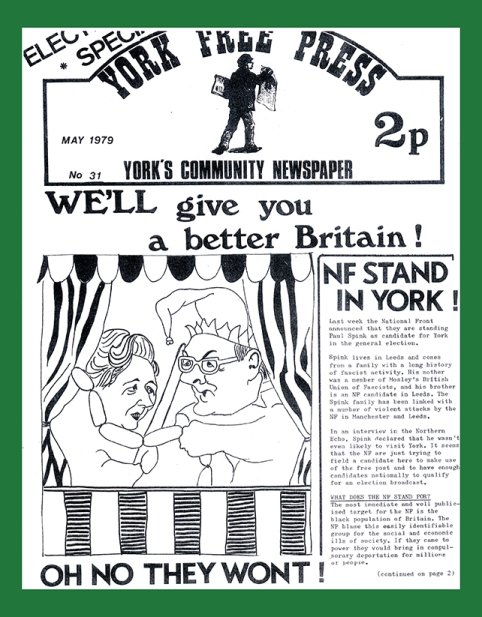
THATwas my introduction to “York Free Press”, one
of the best and most enduring of the “alternative newspapers” that for a
decade or two enlivened Britain’s culture and politics.
It was 1976 and I was an idealistic young teacher living and working
in York and aggrieved at an article I’d read in a recent issue. York’s
selective school system was about to be “comprehensively” reorganised
but the YFP article argued for incorporating six-form colleges which I
considered a device for keeping an A-Level elite away from less academic
plebs. YFP claimed to be open to everyone and advertised weekly
meetings upstairs in the Lowther on King’s Staith so I turned
up one evening expecting a row and instead was welcomed in and invited
to write a rejoinder. I was utterly disarmed, it wouldn’t happen at Socialist Worker! I was already a libertarian socialist but this bunch of scruffy student hippies turned me 100% anarchist and so I’ve remained.
Actually they weren’t all scruffy hippies, Vaughn Harvey was but Tony
Zurbrugg (who now runs Merlin Press) was already a serious-minded
libertarian-communist permanently clad in an RAF greatcoat, Danae and
Howard Clarke (later of “War Resisters International”) were smart-casual
and always smiling, Danny Golding “The Ayatollah” (nowadays Labour
loyalist) was too humourless to qualify as a real hippy but there was
always a supporting cast of “occasionals” who couldn’t be asked to turn
up every week. That was an attractive feature of YFP, you helped at
whatever level you felt comfortable with. Most political groups demand
so much that they retain only fanatics. YFP enjoyed regular “bring food
and drink to share” socials so less active supporters kept in touch and
made friends with regular “collectivists”.
Around 1978 we organised a national 'PAPERS EVERYWHERE!'conference-jamboree
weekend at York University. We invited every community paper we could
think of and people from about eighty titles turned up. It was wonderful
exchanging papers, experiences, ideas and what little technical
expertise we’d acquired. I was especially impressed by a rather posh
Sheffield guy who single-handed ran The Totley Independent, which
he gave away free and financed by taking ads from small shops and
tradesmen. He stuck out like a sore thumb amongst an array of vaguely
alternative-socialists but was content to paddle his own canoe. It
showed the potential of the format. Some titles such as Islington Gutter Pressand Rochdale Alternative Paper (RAP), which I believe sold 8,000 copies per issue, were real big hitters whilst others, like the Totley,were
happy to nurture community spirit and less intent on exposing scandal
and corruption. RAP revealed Cyril Smith’s dirty deeds forty years
before the commercial press dared touch the story.
I think two things sparked the birth of the alternative press, the
“swinging sixties” do-it-yourself politics and certain technical
developments in printing. Lead-typesetting was no longer involved and
the new process required less skill and cost. Like other papers, at YFP
we used ordinary typewriters to produce the text and trimmed, then glued
the result to a large sheet of cartridge paper. Other articles were
stuck alongside the first to build up a newspaper page with spaces left
for photographs which had to be “screened” and treated separately.
Headlines were the real pain – LETRASET!
Headlines were produced by a
sort of transfer process. You bought these rather expensive “Letraset”
transparent plastic sheets with individual black letters affixed to the
undersides. By scribbling on top of the required letter it detached from
the sheet and adhered to the paper placed underneath You had to build
the headline a letter at a time, any misspelling meant you must discard
your first effort and start all over again and keeping it all level and
evenly spaced was a tedious task. Sometimes we had lots of tables and
space to lay out the paper but often we managed in someone’s cramped
bedroom with people coming and going and ideas, jokes and arguments
flying back and forth.
YFP was a monthly with a price of 2p and 1,000 print run, sold door
to door with a network of local shops selling on the basis of sale or
return. It was a struggle to keep it going but the paper survived long
after I left York. I was always a bit of a populist, keen to present the
politics in an attractive wrapping and my favourite all-time article
was, “The Great York Fish and Chip Survey!” Every Thursday for
three months we’d sample 3 or 4 different local chip shops, weigh the
portion of chips and the fish and then assess the price, quality etc.
Finally we tabulated the results and published a league table to great
reader acclaim! Is that petit bourgeois politics or anarchy in action?
Every article was subject to the deepest of political analysis – “Is it
ideologically sound?” – was the inevitable dilemma.
The balance of collective responsibility and initial initiative at
YFP remained problematic. When a character calling himself “Euston Arch”
joined us he immediately began arranging music events in the name of
YFP and only afterwards seeking collective approval. When he signed us
up to a potentially disastrous gig featuring “Wayne County and the
Electric Chairs” at the Mecca Ballroom we accepted responsibility and
survived but immediately expelled him from the collective. After we
printed a story by a guy who told us he was literally kicked out of his
York bedsit by the landlord as a uniformed policeman stood idly by
(illustrated by a cartoon of a cop shielding his eyes) I received a
threat to sue from The Police Federation (my address, 1 Newton Terrace,
was the published editorial address). We agonised whether to apologise
and “correct” the story or stand firm and take the consequences.
Fortunately, within days the local straight press published an account
of the same landlord doing the same thing to someone else so we lived to
fight another day.
Anarchism rather than socialism characterised the alternative papers
movement. Although lots of Marxists were individually supportive they
tended to regard papers like YFP as trivial compared to their party
newspapers whilst Tories and Labour Party types regarded us as
scurrilous troublemakers. Although I wanted the paper to become a sort
of local Private Eye, both funny and muck-raking, whilst at YFP
I established an abiding interest in researching radical history. I
interviewed a founder member of York Communist Party who claimed workers
were more interested in politics in the old days and all he had to do
in the twenties was ride his bike along a road, ring a hand-bell and
people would come out of their houses and he’d start an impromptu
discussion on socialism. He described how difficult it was to keep up
with the ever-changing political line emanating from Moscow and how he’d
finally been expelled from the CP when “I zigged when I should have zagged”!
In 1979 I researched and YFP published a series of articles on
“Fascism in York in the 1930’s” which revealed a continuity of not only
Blackshirtideas with current National Front candidates but the same
local families were still organising attacks on socialist opponents.
There were so many good stories and so many great times and in 1980 I
was sorry to leave but keen to start another scurrilous rag elsewhere,
but that’s a story for another day…
A
personal experience of using the “Freedom of Information Act”
to
research anarchist history
byChristopher Draper
IN
1892
four Walsall
anarchists were imprisoned for a bomb plot orchestrated by
Auguste
Coulon, a police agent-provocateur. Although the police and
trial judge conspired to conceal Coulon’s role he subsequently
boasted of his involvement to reporters. For over a century the
Metropolitan Police refused to disclose details of its part in
securing conviction until in 2001 there was a breakthrough. Despite
claims that all relevant documents had either been lost or destroyed
a serving police officer seeking early retirement and academic
respectability was granted access to hitherto hidden Special Branch
files to complete his PhD: "Three
“Special Account” books, each measuring 160mm by 200mm, and
printed into five columns per page. They detail, among other
items, what appears to be the cash amounts paid out to individual
informants. In all, approximately six thousand individual
entries span a total of the twenty four years from 1888 to 1912”.
These
files revealed Coulon was paid almost £1,000 by the Metropolitan
Police (and incidentally also revealed the previously unsuspected
involvement of a second police agent in a separate high-profile
“anarchist-terrorist conspiracy"). This initiative
prompted me to wonder whether the Walsall anarchists’ local police
force might similarly be sitting on undisclosed evidence, so in
September 2017 I made a formal FOI request to West Midlands Police
(WMP) for copies of documents relating to this 1892 case. It has
taken almost 1½ years for that simple enquiry to be concluded and in
the hope that it might amuse, enlighten and encourage fellow
researchers I’ve recorded details of my quest.
RISKSNumber 887: RISKS is the TUC's weekly online bulletin for safety reps and others sponsored by Thompsons Solicitors.
Sign up to receive this bulletin every week.
Past issues are available. Disclaimer and Privacy Editor: Rory O'Neill of Hazards magazine. Comments to the TUC at
healthandsafety@tuc.org.uk. SENT TO NV by Joe Bailey: A CONSTRUCTION boss who played a pivotal role in orchestrating a
blacklisting scandal that targeted union safety activists will face the
courts, the union Unite has pledged. The union said it “is closing in”
on Cullum McAlpine who it wants to account for
his actions in court. Unite is taking fresh legal action on behalf of
workers who were blacklisted by the Consulting Association. Most of the
major construction companies in the UK used the illegal service. Unlike
the previous court case which concluded in
2016, Unite says it will be seeking to ensure Cullum McAlpine, the
original chair of the Consulting Association and a director of UK
construction giant Sir Robert McAlpine, is required to give evidence in
court under oath. The trial is set to begin on 4 June
and could last for six weeks.
Unite assistant general secretary Howard
Beckett said: “Unite is totally committed to ensuring that the key
individuals behind blacklisting workers and ruining their lives as a
result are required to account for their crimes in
the public arena of a court.” He added: “This is the minimum that the
affected workers deserve. They need to see those responsible in the dock
and finally forced to account for their actions. The forthcoming court
case will finally ensure this will happen.”
Unite assistant general secretary Gail Cartmail said: “There remain
employers in construction and other industries who continue to believe
it is somehow acceptable to engage in the disgusting and deceitful
practice of blacklisting, to ruin people’s lives.
We are seeing blacklisting ‘outsourced’ to labour suppliers at the beck
and call of large firms and acting as unaccountable instigators of
union busting. That’s why Unite is still fighting for justice for those
who were previously affected but is also fighting
to stamp out contemporary blacklisting.”
One week to go until our 10th anniversary meeting in parliament... we've got new revelations that are gonna make the news:
5pm Wed 6th March 2019
Committee Room 10
Houses of Parliament, Westminster
Confirmed speakers (so far):
John McDonnell MP - founder member of the Blacklist Support Group (and Shadow Chancellor of the Exchequer)
Imran Khan QC - BSG lawyer at undercover policing public inquiry
Gail Carmail - UNITE the union, Assistant General Secretary
Chris Stephens MP - SNP employment spokesperson
YOU TUBE has suspended adverts on the account of former English Defence League leader Tommy Robinson.
Mr
Robinson had broken the site's advertising rules, said YouTube, adding
that his channel covered 'controversial issues and sensitive events'.
The decision means the channel, which has 270,000 subscribers, will not earn revenue when people watch the videos.
Mr Robinson denied they contained any 'hateful'content and said he was the victim of 'continued censorship'.
Corporate Censorship
YouTube said
it believed in freedom of expression but also had a duty to protect
viewers from "derogatory and disparaging" content.
The decision
comes a day after YouTube removed adverts for anti-Islamic group Britain
First from its site, saying they breached its advertising rules
prohibiting "hatred, intolerance or discrimination".
A Britain
First representative said: "Britain First is at present suing Facebook
in Belfast for political discrimination. Once that case is resolved, in
February, we will launch proceedings against YouTube for their
politically motivated censorship."
Campaign group Hope Not Hate said social media companies had been "too slow" when responding to reports of hate speech. "Lennon
and others in the far right are utterly reliant on social media and
crowdfunding platforms to keep their coffers plump," it said.
In November, PayPal announced it would no longer process payments for Mr Robinson, saying he had broken its policy on acceptable use.
In
May, Mr Robinson, 35, was jailed for contempt of court. The 13-month
sentence sparked a series of #freetommy protests. The conviction was
later quashed after procedural concerns.
The case has now been referred to the attorney general.
In March 2018, Mr Robinson was banned from Twitter. It is understood that his account was suspended for breaking its "hateful conduct policy".
Editorial note: At last Saturday's Tommy Robinson event reported below. an editor from Northern Voices and an editor from 'The Word' went into the Tommy Robinson enclosure to cover the story as presented by the Robinson contingent. Our view was that based on the material released prior to this event by Robinson in his You Tube excerpts neither the BBC or the Panorama presenter, John Sweeney, had covered themselves with glory in their approach in producing a proposed Panorama program entitled 'Tommy Takedown'. As such the screening of the Robinson film purporting to document the BBC's research methods used was a newsworthy story.
*******
YESTERDAY up to 5,000 people supported the former English Defence League leader
Tommy Robinson in a protest against the BBC's allegedly unethical methods of producing a forthcoming program entitled 'Tommy Takedown'.
The theme of the event was to criticise the Panorama journalist John Sweeney's conduct and alleged use of fake news to discredit Mr. Robinson. The demonstration took place in Media City in front of the BBC's Salford
offices. Only some 500 people attended a counter-protest by
anti-fascists.
The BBC has insisted that the proposed episode will follow its 'strict editorial
guidelines'.
Mr Robinson said the aim of the protest was to make a stand 'against the corrupt media' and effectively called for people to withhold the BBC licence
fee.
During the protest, undercover filming of BBC Panorama journalist
John Sweeney, carried out by 'a mole' and a supporter of Mr Robinson, was
broadcast on a large screen. This all presented Mr. Sweeney in an unflattering light.
At one point Sweeney is heard saying 'one of my political heroes is the
former head of the IRA Martin McGuinness', which the BBC says
was taken out of context as Mr Sweeney was referencing Mr
McGuinness's role in the peace process.
Mr McGuinness, who, as a prominent Sinn Fein politician, became
Northern Ireland's deputy first minister, had acknowledged he was a
member of the IRA. He died in 2017.
Mr Sweeney was also recorded making remarks which Tommy Robinson
has described as racist, homophobic and anti-working class.
In response, a BBC spokeswoman said: 'The BBC strongly
rejects any suggestion that our journalism is "faked" or biased.
'Any programme we broadcast will adhere to the BBC's strict
editorial guidelines.
'Some of the footage which has been released was recorded
without our knowledge during this investigation and John Sweeney made
some offensive and inappropriate remarks, for which he apologises.
BBC Panorama's investigation will continue.'
At yesterday's event the UKIP leader Gerard Batten told demonstrators that Mr Robinson 'speaks up for things that are right, he tells the truth and he
can mobilise lots of people like you, and that's what they fear'
.
The National Union of Journalists (NUJ) has said they 'roundly
condemn Tommy Robinson... and his fellow, far-right thugs who intend
to intimidate staff at the corporation, particularly those working on
Panorama.'
The case of Tommy Robinson has been a long running affair, and in October 2018, the judge retrying Robinson for contempt of court referred the case
to the government's top legal adviser. Mr Robinson faced an allegation that he had committed contempt by filming people before a criminal trial. But now Judge Nicholas Hilliard QC has ruled that the case needed to be referred up to the attorney general to decide and that is the current position. Robinson is still awaiting his decision.
BILLY Holiday sang 'Strange Fruit on the Poplar Trees' about the hangings by the Ku Klux Klan of negros in the Deep South in the USA. Similarly, Panorama journalist John Sweeney in an moment of gay abandon described how he encountered a proletarian in the Green Room while he was working on 'some film on Newnight'. And it was so rare, he says, 'to meet a white working class male in the newsnight green room' that he and one of his mates 'went down there to have a drink with him'.
Pity Mr. Sweeney didn't realise that curiousity killed the cat. For the tedious Tommy Robinson, who fancies himself as an investigative journalist, was then able to entrap poor John by the short and curlies. Somehow Tommy Robinson caught him out as saying 'it was so unusual...in the way that you would do with somebody, from the, you know a CANNIBAL from the Amazonian, erm Amazonia or maybe a CREATURE from OUTER SPACE'.
The footage
was posted to Robinson’s social media accounts on both Facebook and
Instagram over the weekend and shows the former English Defence
League leader confronting Sweeney over his comments.
As a consequence of this the The Unity News Network now reports that 'over the last few weeks the internet has been ablaze with chatter
as to how Tommy Robinson managed to snare the senior Panorama reporter
John Sweeney. In a further teaser trailer Tommy posted tonight it
reveals that his ex-employee Lucy Brown was playing a double bluff
with Panorama.'
Mr. Sweeney on these social media videos, cuts a Rumpole of the Bailey figure, treating a young woman to a largely liquid lunch of champange rather than red burgundy and flaming Sambuca as a digestive with the desert course. All for £220 with or withour service charge, pressumeably all on BBC expenses.
Robinson has also said that the full footage will be compiled into
a documentary that will be shown in Manchester on February 23rd
outside of the BBC’s offices in the city. He has also revealed that
he will post further footage from the documentary every 72 hours,
starting on Tuesday evening.
So far, neither Sweeney, the BBC, nor HOPE Not Hate have
addressed Robinson’s released footage or claims of further
revelations, although HOPE not HATE senior researcher Joe Mulhall
briefly locked his Twitter account following the release of the
footage.
Historic Ashton Central Library - Closed February 2019
NORTHERN VOICES has learned that the findings of a survey, 'Open Libraries Plus, Evolution And Review', which closed on 5th February 2018, was not made public by Tameside Council despite the council having a policy of 'Engagement' - "the continuous conversation with and involvement of stakeholders and residents" and its 'Big Conversation'. The survey which was undertaken over a four week period from 9 January 2018 to 5 February 2018, by Tameside Libraries into 'Open +' - their unstaffed, do-it-yourself library system - was intended to assess how the system was working and public attitudes towards it. The new library system was rolled out across eight libraries in 2018. Although Tameside Libraries have stated: "The purpose of collecting the information was to assist officers in understanding people's views of using Open+, it was not necessary to put this in the public realm", it is clear from reading the survey, and the comments made by those who participated in it, that the vast majority of people have expressed dissatisfaction with unstaffed libraries in Tameside, and are highly critical of it. Despite what the library service say, they seem to have just buried bad news. Some 145 people responded to the survey, but when asked how many questionnaires had been distributed, Tameside Libraries were unable to answer the question. When asked which library people used most often, Stalybridge was the most used library in Tameside, followed by Hyde, Dukinfield, Droylsden, Denton and central library in Ashton-under-Lyne. When asked during which hours do you normally use the library, only 19 people (13.38%), out of 142 responses, said they used the library during Open+ hours. 57 said they used it during staffed hours and 66 during both staffed and Open+ hours. Tameside Libraries were keen to stress that the responses to the survey did not represent the total users of Open+ only the ones that completed the survey, adding: "66 survey responders also indicated that they used the library in both staffed and Open+ mode." A question about how helpful the induction by library staff to Open+ was, elicited 79 responses with 66 skipping the question. 42 (53.16%) thought it very helpful and 10 (12.66%), unhelpful. When asked why they found the induction helpful and how it could be made better, only 9 answered and 136 skipped the question. Some of the comments left by respondents, were as follows: "As always staff at Stalybridge brilliant." "I feel that older generation was not informed. They were told it was 'online and Facebook', but not many people that age access Facebook. The older people have followed us into the library, they have been very confused. I have spent more time explaining Open+ than doing my job teaching." "Don't want unstaffed libraries." "Libraries without people are merely shells." When asked which library service people mainly used during Open+ hours, 71 answered and 74 skipped the question. 60 (84.51%), said they borrowed, returned or renewed items, paid charges and used self-service machines during Open + hours. 31 (43.66%), said they picked up or borrowed or reserved items and 14 (19.72%), said they used Open+ hours to use public computers and the scanner. Only 8 (11.27%), said they used Open+ hours to access Wifi. One respondent left the following comment: "I cannot access Wifi. The computers have gone down on numerous occasions which has had a huge impact on my student who has (SE MS) needs."
The question "How easy have you found it to access the library during Open+ hours?" was answered by 73 and skipped by 72. 33 (45.21%) said very easy and 11 (15.07%) said it was difficult with ten (13.70%), saying very difficult. 29 (40.28%) said they had found the extended Open+ hours very useful and 13 (18.06%), not useful at all. When asked to say why they had found using Open+ useful, 47 answered the question and 98 skipped answering it. 21 (44.68%) said the library was quieter in Open+ hours. 34 (72.34%), thought there was more opportunity to use the library due to longer opening hours, and 20 (42.55%) thought the new times worked better around their lives. One respondent said: "We have had numerous problems being locked out, being tailgated, being followed, being verbally abused. No internet. The only good thing about it are the staff, They are lovely and helpful." Another respondent said: "I do not like Open+, I much prefer to deal with human beings. When library users were asked (Question 9), "Are there any other comments you would like to make about Open+ or any suggestions for improvement, 53 answered and 92 skipped answering. Of the 53 responses the vast majority of responses (50), were negative. There are comments about personal safety: "We do not feel safe!", "There has been no thought for personal safety, it's a crazy idea." "I don't use the library much at all now. Don't feel safe. Thanks for excluding us from libraries now. Not happy!" "Stalybridge library is only open till 7.00 because of gates, not good for me. The library is ghostly when it is empty of customers. You should have at least one person here. I feel vulnerable..." "I don't want to go into an empty building with no life. Not to mention the safety aspect too." "I was tailgated despite challenging person." "Takes some getting used to, to be alone in a public space in the evening. I do not linger like I would during staffed hours..." "I am very concerned about personal safety when using the library when it is unstaffed." "As a female I feel uncomfortable attending the library during unmanned hours." Although Tameside libraries have said that they don't consider female library users to be at risk during Open+ hours they have also said that they consider children under 16 to be at risk, even with live CCTV monitoring. Therefore, they have to be accompanied by an adult during Open+ hours. Tameside libraries also say: "Men are more likely to use an unsupervised library building than females" (Report to Executive Cabinet 14/12/2016) but they don't say why they feel this is the case. However, there is recognition that some people may feel unsafe during Open+ hours. Tameside's active library users are predominately female (59.8%), and it is likely that many of the above comments about fears for safety, reflect the views of female library users. Though several respondents expressed positive views about Open+ "The new hours work brilliant for me. I visited last week during Open+ hours and found the library empty and quiet..." others wanted to see more staff in libraries and felt that libraries should be an opportunity for human contact and interaction, "It is far better to deal with humans (librarians) rather than machines", said one respondent. Some respondents expressed dissatisfaction with the technology that was sometimes faulty. The survey findings which are consistent with other previous surveys, show that library users are predominately from a white background with (90.9%) identifying as such. They are also largely female - 16,193 active library users. Overall, there are 27,079 active library users. Tameside's population is predominately white. The largest BME group in Tameside are Asian/Asian British (8.94%). As of 30/11/2018, 3,074 female library users had registered for Open+ and 1,784 male library users. Tameside Libraries also pointed out that 79 library users had declined to indicate whether they were male or female. The former leader of Tameside Council, Kieran Quinn, when launching the 'Big Conversation', said: "It's not about withdrawing services, its about redesigning services." The council closed fived libraries in 2012, following a comprehensive review. Staff were cut and hours were reduced at the remaining eight libraries. There were originally 22 libraries in Tameside ( a reduction of 64%) and most of these were closed well before the CONDEM government in 2010, introduced austerity measures. Not only have hours and staff been cut, but also publications. In 1983, Ashton reference library had 130 magazine publications and this was down to about 30 in 2016. I recently visited Ashton reference library and asked to see a copy of the reference book 'Who's Who'. I was told it was in the cellar and that the library hadn't updated it since 2015. This is what Tameside Council call libraries fit for the 21st century. What we're witnessing with Open+ is the dissolution of the Libraries in Tameside by a Labour council that doesn't read books and is as thick as a book end.
NV Editor: Below is a description coming from Labour sources of how the Spotland & Falinge ward Labour Party in Rochdale went about setting out to select their candidate for the forthcoming local elections next May. Clearly some people in the Labour Party think it is slightly skewed, and see it unfair to allow Rachel Massey's husband to have insider knowledge, which should he may be tempted to divulge to his 'nearest and dearest' would give her an unfair advantage in the selection interview.
**********
To
show you how bad the Spotland & Falinge selection was. Here is the
post they have put on Twitter after the vote. As you can
see they had already had posters printed out with Rachel’s name on it as
the candidate before a vote had been cast.
'HONESTY', 'INTEGRITY', & 'VISION'
At
the Spotland & Falinge short listing meeting the week before,
Rachel Massey’s husband, Phillip Massey – who is also on the panel of
Labour candidates - was allowed
to remain in the meeting when the questions to the candidates were being
formulated.
Despite
objections from the meeting Cllr. Liam O’Rourke who was chairing the
meeting on behalf of Rochdale LCF ruled that he could stay. Commenting:
“I’m sure that
Mr. Massey will not divulge the questions to his wife”.
The response came back that this would not happen.
A
week later at the selection meeting, it was commented upon that Rachel
Massey’s presentation was very smooth, and seamless. Reading and barely
lifting her eyes
from an iPad containing prepared statements for each of the eight
questions asked. Could it be that she had knowledge beforehand of the
questions put to her?
Rochdale Labour Party must have moved with the speed of Zeus to get the posters printed for the selection of Rachel Massey on Monday 11th, February. The selection meeting with the candidates took place at 7.30pm, yet by 11.53pm the same evening Rachel the victorious one was posing with her supporters on Twitter. At least her husband had the grace to wait until the next day:





 Posts
Posts


