Showing posts with label statistics. Show all posts

Sunday, 14 March 2021

The Acceptable Face Of Prejudice by Les May

WHEN Davina McCall tweeted: 'Female abduction / murder is extremely rare. Yes we should all be vigilant when out alone. But this level of fear-mongering isn’t healthy. And men’s mental health is an issue as well. Calling all men out as dangerous is bad for our sons, brothers, partners.' she found herself being attacked by people eager to prove the equivalent of ‘black is white’.
As I pointed out a few days ago in the past eleven years an average 28% of killings of women were by someone not known to them compared with 51% of killings of men. In the same period on average more than twice as many men were murdered each year than women, 408 men and 189 women.
When I read that some of the responses referred to ‘an epidemic of violence against women’ I thought that either the definition of violence had been subtly changed whilst I wasn’t looking or the people who were making them were talking about something other than the seemingly random killing of a young woman which had prompted McCall’s original tweet.
What is not in question is that over the same 11 year period where the killer was known to a male victim in 6% of cases the killer was a partner or ex-partner, but where the victim was a woman the killer was a partner or ex-partner in 60% of cases. In spite of their marked asymmetry what these figures demonstrate is that violence leading to death is not exclusively the preserve of men. Some women are violent too and no amount of excuses designed to exonerate them will change that.
A common assumption is that domestic abuse is also something which is exclusively carried out be men. But the term itself embraces all forms of abuse within a domestic situation irrespective of the relationship between perpetrator and victim. A more useful approach is to examine ‘partner abuse’ which occurs within/between married or cohabiting couples.
Data from the Office for National Statistics shows that for the 12 months ending March this year 4% of people aged 16 to 74 were victims of partner abuse, e.g. non-physical, threats, force, sexual and stalking, on one or more occasions. A frequent complaint by women eager to over egg the pudding is that there is under reporting to the police of such incidents.
Not subject to this complaint as they were collected from a random sample of adults by means of a questionnaire, are data taken from the Home Office Statistical Bulletin published in 2012. This does not report sexual abuse and stalking by partners separately from the domestic context, however it does report non-physical abuse, threats and force by partners and it shows that 5% of women and 3% of men reported one or more such incidents in the previous year. It also reported that 24% of women and 12% of men claimed to have experienced at least one incident of non-physical abuse, threats and force by partners at some time in their lives between the ages of 16 and 59. What is clear is that women as well as men abuse their partners; only the extent of abuse differs. Vague talk about ‘changing the culture’ or demanding that misogyny be made a hate crime whilst always insisting that men are the problem and women are the victims, will not change things. It is no more than the socially acceptable face of prejudice. Similar levels of prejudice on the basis of skin colour would result in howls of protest. If we are shocked that 1 in 20 women experience abuse by a partner in any one year, we ought to be equally shocked that 1 in 33 men experience the same. If we are shocked that an average of 52 women a year die in random attacks we should be equally shocked to discover that for men the figure is four time higher at 209.
****************************************************

Saturday, 13 March 2021

Making The Streets Safe For Men by Les May

DONALD Trump introduced us to the world of ‘alternative facts’ or to give them their proper name ‘deliberate lies’. It worked and now a significant proportion of US voters continue to believe he is the legitimate president. But as we are seeing at the moment with the insistence of some Tory apologists that the ‘Test, Track, Trace’ scheme was wondrously good value for money, some people are willing to repeat the same thing over and over again on the assumption that people will start to believe that it is true.
Sometimes it’s not the result of politicians trying to persuade us that results in a public perception that something is true when it isn’t. What we read in the print media or see on TV is the result of selection by journalists of what they think is important enough to make a good story. A murder which figures prominently on our front pages or news headline, especially the murder of an attractive young woman, can by constant repetition, be made to give a distorted picture of reality unless one is careful to look at the data.
According to the Office of National Statistics:
In the 1960s, the proportion of homicide victims was fairly evenly split between males and females. Since then trends in homicide have generally been driven by changes in the number of male rather than female victims. Over the longer term, the number of female victims has tended to fluctuate between 200 and
250 a year from the 1960s. In contrast, the number of male victims increased…
In recent years the number of male victims has fluctuated from an average of 550 between 2001 and 2005, to 323 in 2015, the lowest number for a quarter of a century. Even in that year male victims still made up about two thirds of the total number.
Since 2000 some 40% of all murder victims have been in the age range 16 to 34. Young men made up 80% of victims between the ages of 16 and 24, and 72% between 25 and 34.
In the year ending March 2019, 14% of victims were Black and almost half of these were in the age range 16 to 24. White murder victims made up 71% of the total, 6% were Asian (Indian subcontinent), 4% ‘other’.
The claim sometimes made that our streets are particularly unsafe for women is not supported by the available data. Over the most recent eleven year period 51% of killings of men were by someone not previously known to them compared with 28% of women victims.
Contemplating figures like this is not a pleasant occupation, but it should warn us about the futility of a‘ knee jerk’ reaction to a single well publicised death. A more mature response might be to recognise that directing our efforts towards young men, perhaps especially young Black men, between the ages of 16 and 34 might pay the greatest dividend.
*************************************************************

Wednesday, 30 December 2020

LOCKDOWN SCEPTICS & a new strain of virus!

TODAY TIM JONES on the Lockdown Sceptics website asks: 'If the new strain has a biological advantage that makes it more transmissible why isn’t it taking over in every region?'
He continues: 'However it is a real question that needs answering, and one that’s also being asked by Professor Francois Balloux on Twitter:
'The new 'UK #SARSCoV2 variant' (lineage B 1.1.7) which has recently gone up in frequency in the UK has been identified in numerous countries including in Denmark, where its frequency remained at ~1% in mid-December.
1/ https://t.co/ElOC2zqTAW
Prof Francois Balloux (@BallouxFrancois) December 29, 2020 'A number of media outlets have reported on the new technical briefing from Public Health England that shows considerably more being infected by carriers of the new variant than carriers of other variants. Here’s the report in the Times. 'Contacts of people with the new coronavirus variant are 54% more likely to develop the disease, according to new analysis from Public Health England. 'They found, however, that it did not appear likely to cause more severe disease or higher death rates.
'Researchers found the “secondary attack rate”, or proportion of contacts of confirmed cases that develop the disease themselves, was 15.1% for people with a confirmed case of the new variant and 9.8% for people confirmed to have another variant.'
The figures were published yesterday in a technical report on the variant, now named VOC (variant of concern) 202012/01.
Ministers pointed to the variant’s increased infectiousness when announcing higher Tier 4 restrictions for much of England earlier this month.
However, according to Tim Jones, 'the PHE briefing does not draw any conclusions about transmissibility from the data it presents (it doesn’t mention transmissibility at all). Is this because the authors are aware that this may be just coincidence? In other words, that it appears to be more transmissible just because most of the infections with it happen to be in the areas that are currently surging? This by itself would explain why the secondary attack rate (the proportion of contacts who become infected) for the new variant in England is higher in recent weeks – because it happens to be the variant most prevalent in the areas of the country where more people are currently being infected. To know whether it is the new variant itself that is responsible for the higher secondary attack rate, or something else, we would need to see it higher in other regions, not just the one currently surging. And as Loftus and Prof Balloux observe, there is not currently evidence of that.'
***********************************************************

Friday, 13 November 2020

Lies, Damn Lies and Lies About Statistics

by Les May
AFZAL KHAN, MP for Gorton recently wrote, amongst other things, ‘Islamophobia is rooted in racism and is a type of racism that targets expressions of Muslimness or perceived Muslimness’ and ‘We have seen during this Covid 19 pandemic that people of Muslim heritage have been disproportionately affected.’
The latter statement is complete bunkum because there is no evidence to support it. Kahn’s use of the term ‘Muslim heritage’ is an attempt to give credence to his claim that the followers of Islam form a distinct racial group and should be treated as such. This claim will no doubt come as something of a surprise to all the people who would identify as being Muslims in Africa and China and the Middle East.
The latest research, published only today, indicates that Black people are about twice as likely to become infected as White people and Asian people about one a half times more likely. It provides no statistics and makes no comment about ‘Muslim Heritage’, and no doubt Black and Asian people whose heritage is that of Buddhism, Christianity or Judaism, share an increased susceptibility to infection.
It has been speculated, and it is only speculation not an established fact, that this increased susceptibility results from multi-generational family structures, the nature of their employment and higher prevalence of co-morbidities in these two groups. Equally plausible are that it results from genetic differences or differences in behaviour.
What Kahn is trying to do is claim exceptionalism for Muslims, something which no other religious group in this country has. Roman Catholicism is frequently subject to criticism due to its views on homosexuality, divorce, contraception and abortion. What would your reaction be if Roman Catholics insisted that such criticism is a form of ‘racism’?
**********************************************

Wednesday, 9 September 2020

Walking the Covid tightrope: a Bluffer's Guide

Taking a chance on exposure to Covid-19
TIM HARFORD at the end of August in his Financial Times column measured the risks of going outside and the perils of the pandemic on the street. A friend of his asked: 'What I want is a survival guide for life in the age of Covid,' The man is in his sixties and has barely left home since March mostly because of the risks of travelling on the underground seem too great. Yet the man knows that his instincts may be wrong.
Tim Harford writes: 'The typical English resident, then, has a 44 in a million chance each day of being infected. In the US, the midpoint of epidemiological models suggests around 150,000 new infections a day, or 450 per million people per day, about 10 times the risk in England. In South Korea, despite the recent spike in confirmed case, the risk of infections is probably closer to 1 or 2 per million people per day.'
These averages include folk who take precautions, people who work in exposed professions and everyone inbetween. So Mr Harford says he can only guess how much his friend's risk increases if he should decide to venture outside. Yet he estimates that for his friend Covid-19 currently presents a background risk of a one in a million chance of death or lasting harm, every day. And he claims that the 'risk of death alone is one in 2m.'.
Finally Tim Harford FT article concludes: 'But simply existing in a country where the virus is uppressed but circulating is not so risky. It depends on age, gender, geography, behaviour and much else. But on average it is half a micro-mort a day-similar to taking a bath, a going skiing, or a short motorbike ride, and consideringly less risky than a scruba dive or a skydive.'
Later Tim Harford following much publicity about the risk of taking a bath, has had to admit that he was wrong and that in truth one would have take a bath for a year to run an equivalent risk, but the risk of sky diving, and scuba diving is considerably more dangerous. What really worries Mr. Harford, the host on the Radio Four program 'MORE OR LESS' dedicated to understaning statistics, is the danger of the virous surging back; and he writes: 'We cannot afford to relax just yet, because we will be walking a tightrope this autumn.'
************************************

Wednesday, 20 May 2020

Infection Control? What’s That?


by Les May

THE Care Quality Commission identified 3,200 deaths of elderly people who were receiving care in their own home in the twenty eight day period 10 April to 8 May.  This figure is about 2000 more than the average number of deaths for the same period in the past three years.   I am sorry to have to say that this jump in the numbers does not surprise me.

My wife and I are both in this age group. For our own protection we closed our door to the rest of the world on 21 March.  Two kind friends drop off food about once a week and we get occasional deliveries from a supermarket.  Milk is delivered to us three times a week.  Post arrives most days.

Before anything is allowed into the house it is either sterilised or quarantined for three days.  Cans and bottles are sprayed with diluted bleach, left for ten minutes, then washed bleach free.  Anything which is double wrapped, and most foods from supermarkets are, has the outer packing cut away with scissors, the food tipped out and the packaging goes straight into the outside bin.  Other food is quarantined.  Post which has come from a mailing list and will have been machine handled has the end of the envelope cut away, the contents tipped on to the floor and the envelope goes straight to the paper bin.  After the weekly waste collection the handles on the bins get the bleach treatment.  Hands which have touched anything which might be contaminated get the Lady Macbeth treatment.

Pedantic, careful, we don’t mind what you call us, we just intend to remain safe.

One of my neighbours who is much the same age as I, has been receiving ‘in home’ care since being discharged from hospital. There has been a regular stream of people involved in that care going in and house. I watch them. Some put on face masks, aprons and gloves, and some do not. Some come in clean white uniforms; most do not; they come in ‘clobber’ wearing backpacks. I have struck up conversations. If they come with some kind of PPE I mention how seldom this happens. I can usually guess, but ask politely, ‘are you Care Service or NHS’?

Yesterday I tried this with someone I could tell was from the NHS. When I mentioned how seldom people from the Care Service come with proper PPE the response was ‘We keep trying to get into their heads the importance of infection control’. Trying, but failing, it would seem.

Thankfully it is not my wife who is receiving ‘in home’ care. If it were I would not let the buggers in the house until they matched the standards of infection control I impose on myself.

*************************

Tuesday, 12 May 2020

Blue-Collar Workers & Covid Secure Workplaces

Return to work 'fumbled presentation' by Boris
by Brian Bamford

TODAY the editorial in the Financial Times took a dim view of last Sunday's Prime Minister Boris Johnson's TV address and his plans for a phased economic reopening and scheme for rebuilding public confidence.  The FT editor writes:  'The fumbled presentation, and impression that not all elements had been fully thought through, undermined the impact. they also risk widening the social and economic divide between those who can work from home and those compelled to return to their workplace.'

The restart in the government's 'Plan to Rebuild' does have some credible grounds for easing-up on the lock-down so long as the physical distancing rules are intact.  

But the Sunday statement lacked clarity and provoked confusion as today's FT editorial showed:  'Making the statement without explaining sufficient, safe transport would be available - or whether workplaces could be guaranteed "Covid-secure" - suggested a more cavalier attitude towards the welfare of blue-collar workers than stay-at-home "knowledge" workers.'

For example men in some blue-collar jobs are already more than twice as likely as the general workforce to have died from Covid-19 according to official figures. The Office of National Statistics found that the highest mortality rate amoung men working as security guards, with bus and taxi drivers, chefs and retail staff also among those more affected. 

Francis O'Grady, the Trade Union Congress's general secretary, warned of 'chaos' if people were forced back into work tomorrow as promised especially if their workplaces had not been prepared for proper social distancing.  At the same time, it seems, there has been haggling between business leaders and employers about a return to work. 

The FT which had previously excused the government's earlier errors before it later introduced the lock-down is now arguing:  'Mr Johnson's breezy assertion that workers should explore cycling or walking, and avoid public transport, betrays a metropolitan middle-class failure to appreciate how much more difficult that may may be for those in rural or small-town areas.'

Now the FT is saying:  'After earlier mis-steps, the government had a chance to prove it was getting on top of coronavirus policymaking, but has flunked it.' 

Today I rung my eldest lad who works on the shopfloor at a fibre glass company in Burnley, he hasn't yet gone back to work and is expecting to be furloughed for the next few weeks.  It's not going to be easy to return to anything like normal.

******************************


Monday, 27 April 2020

Keep Watching China


by Les May

THIS morning just after 7o’clock, I watched a Sky News presenter, who for reasons which completely baffle me was standing outside 10 Downing Street, ask a hapless government minister ‘when are schools going to reopen?’, a question he could not possibly answer.

At the moment we do not even know whether the numbers of new infections, as measured by the figures published at the end of each day, are fluctuating randomly around some stable figure, indicating a plateau, or are actually falling as appears to be the caseUsing the published data for the period after 8 April it is possible to calculate* that there is approximately a 1 in 9 chance (11%) that we would get figures like this if the number of new infections was in fact stable and not really falling.  This is hardly evidence that there should be an easing of the so called ‘lockdown’.

It seems to me utterly irresponsible for the media to constantly use personal stories’ of the difficulties that people face being cooped up, e.g. with children in small spaces and no garden, to subtly intimate that the government should be able to tell us when various restrictions are going to be eased. You can only have an ‘adult conversation’ when both sides are willing to behave like adults.

I suggest that the sensible thing to do is to keep watching what is happening in China.  You don’t have to believe the quantitative data, i.e. the figures which are published regarding infections and deaths; look at the qualitative data, i.e. how and when China is easing controls on movement and allowing facilities to reopen. Parts of China which have been living under strict controls for three months are only now beginning to reopen.  This may be a clue there about how long some of our own restrictions need to be in place.

* Any test is complicated by the so called ‘Monday Effect’.  The test I used is the non-parametric Cox-Stuart test for trend modified to take this into account.  The figure I give is approximate, but indicates the need for continuing caution.


(Look about half way down the page.)

^ The figures for China may indeed be suspect, but does anyone take the US figures for testing seriously?


************************************

Thursday, 9 April 2020

WUHAN WHISTLE BLOWER: Dr. Li Wenliang


Focus on Eyes: Chinese ophthalmologist warned about COVID-19 outbreak

Dr Li Wenliang
WHILE we are all sheltering in our homes amid the COVID-19 outbreak, we're being bombarded with statistics, news conferences and social media arguments that make it hard to know what is fact and what is fiction.

What we do know is one doctor tried to warn the world in December, and he, too, is now a statistic after dying from the virus in January.

The virus is presumed to have an animal origin with animal-to-human transfer at the Huanan Seafood Wholesale Market in Wuhan, China.
 
The infection became human-to-human and is now a global pandemic.
It continues to spread throughout the United States with infection and fatalities in many states, including Florida.

A sad and disturbing part of this epidemic is the story of Dr. Li Wenliang, an ophthalmologist at Wuhan Central Hospital, which is the epicenter of COVID-19.
Dr. Li found seven confirmed cases of respiratory disease and coronavirus infection in his hospital in late December 2019.

He messaged his medical school classmates in WeChat, the Chinese social network, on Dec. 30, 2019. His WeChat post was shared in multiple internet platforms and gained wide attention.

The local authorities reprimanded Dr. Li for making false comments on the internet. He was forced to sign a letter of admonition and promised not to repeat the transgression.

After the admonition, Dr. Li went back to work in Wuhan Central Hospital where he examined a patient, who was a storekeeper at Huanan Seafood Market with glaucoma and fever. Sadly, he became infected with coronavirus, which eventually took his life.

The death of Dr. Li generated an outpour of grief and anger.

Many Chinese considered him a hero for being a whistleblower of the COVID-19 outbreak and a victim of authoritative government.

It is difficult to determine whether the ultimate outcome of this epidemic would be different if earlier public health measures were taken.

Just last week, on March 20, Chinese officials offered an apology to Dr. Li's family.

Beijing investigators say Wuhan authorities acted "inadequately" when they reprimanded the late doctor and failed to follow "proper law enforcement procedure."

This story of Dr. Li reminded us all physicians and health care providers have the responsibilities to be alert of new diseases that can affect large segment of the population.

The COVID-19 infection is believed to spread from one person to another through respiratory aerosols from coughing and sneezing.

It could also be transmitted from touching mouth, noses and eyes after contacting objects or surfaces with virus from an infected person.

The virus can cause a severe respiratory disease.

Conjunctivitis, or pink eye, is observed in rare patients with COVID-19.
Proper hand washing and not touching one’s face with unwashed hands are measures recommended to prevent infection.

Dr. Frederick Ho, the medical director of Atlantic Eye MD and Atlantic Surgery and Laser Center, is a board certified ophthalmologist. Atlantic Eye MD is located at 8040 N. Wickham Road in Melbourne. To make an appointment please call (321) 757-7272. To learn more visit AtlanticEyeMD.com.

**************************************************************

Tuesday, 7 April 2020

Understanding The Data

by Les May


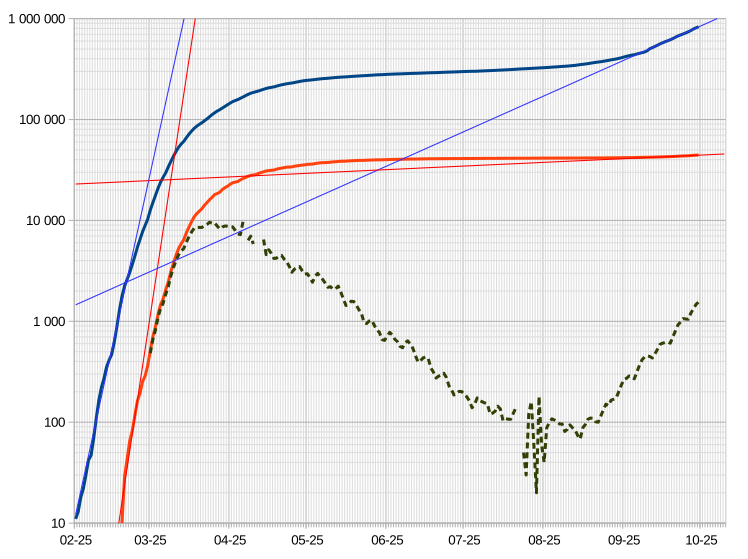
If the image does not load automatically click this link to see it.*


DURING the daily updates of the new cases and deaths due to Covid19 infection the speaker usually makes reference to one or more charts. To the best of my knowledge the only person from the media who has drawn attention to the fact that the charts are drawn with a ‘log scale’. Here the word ‘log’ is shorthand for the word ‘logarithmic’. What this means is that each division on the vertical (left hand side) shows equal ratios. So 100 is ten times more than 10, 1,000 is ten times more than 100, 10,000 is ten times more than 1,000, so these show as the same size division on the scale.

This has two advantages. The first is that small numbers of cases at the start of the UK pandemic and large numbers as we have now and in the foreseeable future can be shown on the same scale. More importantly when cases (or deaths) are plotted on a log scale the slope of the line can be used to calculate the rate of increase, or to put it another way, the number of days it takes for the number of cases (or deaths) to double. The steeper the line the shorter the time for the number to double.

In the chart the figures for cases and deaths are plotted with a thicker line; blue for cases, orange for deaths. The same colours have been shown to plot the thin lines which show the slope early in the pandemic and more recently.
**********************************************
* What is clear is that up to 17 March the daily rate of increase in the number of cases was greater than it has been in the period 27 March to 6 April and the rate of increase in the number of deaths was lower in the period 20 March to 6 April than it was before 20 March.
This is good news but the thick blue line will have to become more or less horizontal before we will know if the ‘lockdown’ and ‘social distancing’ measures have been effective.


The image which appears at the head of this article is the situation as it was on 5 April. Clicking on the image loads a larger version of that image. To get the most up to date image of the data click on the link below the image. Today 8 April this has been updated to show the number of confirmed cases and deaths up to Tuesday 7 April.

As you will see from the new image the slope of the curves in recent days has begun to decrease which is further good news. It is a hint, but only a hint, that the so called ‘lockdown’ and the social distancing are starting to have the desired effect of reducing the infection rate.
***************************

Tuesday, 24 March 2020

Rise in page-views from the UKRAINE

Editor:  Since NV have been covering
stories about the Ukrainian Famine of
1933-4, there has been an increase in
interest from readers in that part of 
the world.  The table below shows that
in the last 24-hours it leads the page-views.
We would welcome more comments on the
consequences of the dreadful Holodomor.


EntryPage-views
Ukraine
194
United States
116
United Kingdom
68
Germany
50
Yemen
34
Brazil
27
Italy
26
Dominican Republic
23
Argentina
22
South Africa
14

***********************************************

Sunday, 22 March 2020

Epidemiologist Neil Ferguson caught coronavirus!

by Brian Bamford
YESTERDAY's editorial in the Financial Times declared 'Johnson is coming to grips with the virus'.  Yet only a week ago the same FT editor had argued that 'The [then] UK approach is ... potentially more costly in human lives than strict containment measures, if the latter do succeed in stopping the virus in its tracks.'  The FT editor was concerned, a week ago, that if Chris Whitty, England's chief medical officer, was right in estimating a 'reasonable worst-case scenario' was that 80% of Britain's 66m people would be infected then the death toll could be 500,000 - almost doubling the UK's normal annual death rate.

Last week it also turned out that the epidemiologist Neil Ferguson had reported having a 'dry cough' and a high fever; the classic symptoms of the coronavirus.  Last Wednesday he tweeted that he felt 'a bit grotty'.

A test soon showed he had been infected by the virus he was modeling.  At this time it's a sobering thought!


Ferguson is a mathematician and an epidemiologist whose work on the spread of Covid-19 is informing policy in not only the UK but also France, the US and other countries as well.  The centre he founded with colleagues at Imperial College, the MRC Centre for Global Infectious Disease Analysis, collaborates with the World Health Organization.

This week the massive swift shift in the UK response from essentially letting the virus spread through the population to the wholescale stay-at-home policy now in place has resulted from Ferguson’s work, supported by other modellers especially at the London School of Hygiene and Tropical Medicine.

Ferguson has taken a lead, advising ministers and explaining his predictions in newspapers and on TV and radio, because he is that valuable thing, a good scientist who is also a good communicator.

Naturally mathematical modelling is only as good as the data fed into the computers. It was new information on the high rate of patients needing critical care in Italy and on the limited ability of the NHS to respond to the pandemic that caused Ferguson and colleagues to recommend a switch from what they called scenario 1 – mitigation – to scenario 2 – suppression of the virus, including the drastic measures that have emptied the pubs, closed theatres and is now to shut all schools.

The latest analysis comes from a team modelling the spread and impact COVID-19 and whose data are informing current UK government policy on the pandemic.

The findings are published in the 9th report from the WHO Collaborating Centre for Infectious Disease Modelling within the MRC Centre for Global Infectious Disease Analysis, J-IDEA, Imperial College London.

Professor Neil Ferguson, head of the MRC GIDA team and director of the Abdul Latif Jameel Institute for Disease and Emergency Analytics (J-IDEA), said:
“The world is facing the most serious public health crisis in generations. Here we provide concrete estimates of the scale of the threat countries now face.
“We use the latest estimates of severity to show that policy strategies which aim to mitigate the epidemic might halve deaths and reduce peak healthcare demand by two-thirds, but that this will not be enough to prevent health systems being overwhelmed. More intensive, and socially disruptive interventions will therefore be required to suppress transmission to low levels. It is likely such measures – most notably, large scale social distancing – will need to be in place for many months, perhaps until a vaccine becomes available.”

He is a workaholic, according to his colleague Christ Donnelly, a professor of statistical epidemiology based at Oxford University most of the time, as well as at Imperial.  “He works harder than anyone I have ever met,” she said.  “He is simultaneously attending very large numbers of meetings while running the group from an organisational point of view and doing programming himself.  Any one of those things could take somebody their full time.

“One of his friends said he should slow down – this is a marathon not a sprint. He said he is going to do the marathon at sprint speed. It is not just work ethic – it is also energy.  He seems to be able to keep going. He must sleep a bit, but I think not much.”

Donnelly met Ferguson when they were both working for Prof Roy Anderson’s epidemiology group at Oxford University.  Their first project together was modelling the BSE epidemic in cattle in 1996 and then the variant CJD (Creutzfeldt-Jakob disease) outbreak in humans.

They came up with an estimate that was incredibly broad for the likely number of human deaths – between 50 and 50,000 – but that was at a time when some were predicting 2 million people would be infected. There were calls for the sort of NHS resources now going into Covid-19 to be directed towards vCJD. Ferguson and Donnelly’s modelling helped defuse that. In the end the UK had about 170 cases.

Next came foot and mouth, then Sars, then pandemic influenza. With every disease outbreak, governments have turned to the modellers. While Donnelly, with her statistical training, could have had a quiet life as a researcher in the pharmaceutical industry discovering new drugs, she is instead watching the predictions she and Ferguson have made hit the headlines on the TV news. She says both of them were attracted to “high-impact” projects.
Ferguson may have the symptoms of Covid-19 but he is still working. At 9am he joined an online meeting with his colleagues as usual. The stakes are too high for somebody with his dedication and central role in the crisis to stay in bed.

Slowing and suppressing the outbreak

The report details that for the first scenario (slowing the spread), the optimal policy would combine home isolation of cases, home quarantine and social distancing of those over 70 years.  This could reduce the peak healthcare demand by two-thirds and reduce deaths by half.  However, the resulting epidemic would still likely result in an estimated 250,000 deaths and therefore overwhelm the health system (most notably intensive care units).
The world is facing the most serious public health crisis in generations. Prof. Neil Ferguson Director, J-IDEA
In the second scenario (suppressing the outbreak), the researchers show this is likely to require a combination of social distancing of the entire population, home isolation of cases and household quarantine of their family members (and possible school and university closure).  The researchers explain that by closely monitoring disease trends it may be possible for these measures to be relaxed temporarily as things progress, but they will need to be rapidly re-introduced if/when case numbers rise.  They add that the situation in China and South Korea in the coming weeks will help to inform this strategy further.

**************************