OUR ABSURD SOCIETY is awash with champagne socialists courting popularity by railing against privilege and inequality whilst brown-nosing their way onto the Honours List…
1) Bea Campbell – Officer of the Order of the British Empire – Ms Campbell claimed that, 'The survival of an honours system clothed in royalism and imperialism is a reproach to New Labour' and insisted that 'every morsel, every cameo, scandal and chapter in the story of the Spencers, the Windsors, their servants, their scribes and us, confirms the case for a Republic'. Marking Queen Elizabeth II’s Golden Jubilee, in 2002 she wrote, 'My republican hope is that when she dies, she takes the monarchy with her.' As the daughter of communist parents Bea joined the CP as a teenager, married a party member and joined him as a journalist on The Morning Star. Subsequently divorced, in 2009 she described herself in the Guardian as 'republican with politics rooted in Marxism and feminism' and accepted an OBE from the Queen!
2) Clement Attlee – Companion of Honour 1945, Order of Merit 1951, Earl 1955, Knight of the Order of the Garter 1956, – When the iconic Labour Prime Minister Clement Attlee offered an Earldom to R H Tawney, the historian declined, expressing surprise “that Labour still valued such baubles” yet, pathetically, Attlee considered his bauble collection his career validation, boasting in a 1956 letter to his son;
'Few thought he was ever a starter –
There were many who thought themselves smarter –
But he ended PM
CH and OM
An Earl and a Knight of the Garter.'
3) Janet Street-Porter – Commander of the Order of the British Empire – Extravagantly vulgar and rebellious, JSP was born to unmarried working-class parents, had an illegal abortion as a schoolgirl and famously carved out a media career as the unbridled 'Voice of Yoof'. She famously described TV management as, 'male, middle-class, middle-aged and mediocre' and in 2015 called the BBC, 'a cosy middle-class' club prone to 'creeping fucking paralysis' yet having achieved fame upsetting establishment apple carts, in 2016 Janet Street Porter graciously accepted a CBE.
4) Paul Kenny – Knighthood – after spending most of his life employed as a full-time GMB union official in 2005 he was appointed acting General Secretary and elected unopposed the following year and again in 2010. At the 2012 GMB Conference he accused the Labour Party of elitism, 'Even good trade unionists don’t engage with the Labour Party. Everyone agrees it looks too much like a political elite'. In 2015 Paul Kenny knelt before the Queen and was Knighted.
5) Vanessa Redgrave – Commander of the Order of the British Empire – Acclaimed actor, from 1971 key member of the Troskyist Workers Revolutionary Party until expelled in the late 1980’s, has been a constant critic of British State policy from treatment of asylum seekers to 'the war on terror'. Curiously, this erstwhile revolutionary having accepted a CBE, declined being ennobled as a 'Dame' in 1999 although, 'I’m not agains't the royal family, they do many good things' but because she objected to being nominated by Tony Blair.
6) David Olusoga – Officer of the Order of the British Empire – brought up on a Gateshead council estate his family were forced to move after repeated racist attacks on their home. After studying the history of slavery at Liverpool University, Olusoga worked in television, first as a researcher and then a presenter. His authoritative, sustained criticism of British Imperialism has brought him fame and fortune; in 2019 he accepted appointment as an, 'Officer of the Order of the British Empire.'
7) Claire Fox – Peerage – Broadcaster and political panellist Fox joined the Revolutionary Communist Party in 1980 and for more than two decades was a key RCP activist, organiser and co-publisher of “Living Marxism”. She continued to work with former RCP associates after the Party, in the 2000’s, morphed into 'The Institute for Ideas'. Having called for abolition of the Lords and in 2015 tweeted congratulations to the Liberal Democrats for not taking up Peerages, in 2020 Claire Fox accepted the title 'Baroness' and membership of the House of Lords
.
8) John Prescott – Peerage – Trade union official and Labour Minister who played the role of pantomime 'working class hero'. In 2009 he boasted to the BBC, 'I’ve always felt very proud of Wales and being Welsh…I was born in Wales, went to school in Wales and my mother was Welsh. I’m Welsh. It’s my place of birth, my country' despite leaving Wales in 1942, aged four! Having previously described members of the House of Lords as 'The vermin in ermine' in 2010 he was delighted to join them as 'Baron Prescott of Kingston-Upon-Hull” insisting, “I need a peerage to save the planet!'
9) Shami Chakrabarti – Commander of the Order of the British Empire, Peerage – The daughter of Bengali parents, a human-rights lawyer with a long and honourable record of opposing the State’s excessive use of anti-terror legislation, its control orders and attempted imposition of identity cards. Committed to social equality, against privilege and the expansion of grammar schools she sent her own son to Dulwich College (annual fees £18,000) and in 2007 accepted a CBE followed in 2016 by a peerage when Baroness Chakrabarti joined the House of Lords.
10) Neil Kinnock – Peerage – after working for just three years as a WEA tutor in 1970 Kinnock began his long career as a professional, nominally left-wing, politician. On 19th November 1977 he wrote in Tribune, 'The House of Lords must go. Not to be replaced, not to be reformed in some life-after-death patronage paradise, just closed down, abolished, finished' In 2005 Kinnock accepted a peerage, becoming a 'Baron' and entered the House of Lords, where in 2009 he was joined by his equally 'left-wing' wife, who similarly accepted a Peerage and the title, Baroness!
Fortunately, amidst all the flotsam and jetsom of washed up politicians and media luvvies there are still people with integrity who refuse to bend the knee. Next time on NV I’ll unveil the REAL HONOURS LIST and identify honourable individuals who spurned these tawdry titles…
POLISH DIRECTOR Agnieszka Holland’s important new film tells the
story of Gareth Jones’ courageous reporting of Stalin’s murderous
1932-33 “Holomodor”. This Soviet “holocaust” was alternately
ignored and denied by the world’s press and remains so today.
Jones’ reports and reputation were traduced by his press
colleagues, orchestrated by Walter Duranty, the celebrated, Pullitzer
Prize-winning, resident Moscow correspondent of the New York
Times who shockingly trivialised the deaths of four million
Ukrainians with the observation, 'You can’t make an omelette
without breaking eggs.'
Mr Jones goes Free-range
Whilst the salaried correspondents of the international press were
content to remain in Moscow, wined, dined and accommodated in
relative luxury as favoured mouthpieces of Soviet propaganda, Gareth
Jones investigated independently as an irregular 'stringer'.
After interviewing, on his own initiative, numerous Russian
representatives in Moscow, in March 1933 Jones obtained official
permission to travel by rail to visit and report on a 'model'
Soviet tractor factory in Kharkiv. Gareth duly boarded the train in
Moscow but got off well before reaching Kharkiv so that he could
conduct his own 'unofficial' investigations into conditions on
the ground in rural Ukraine.
Already aware of widespread rumours of
Stalin’s ruthless treatment of rural Ukraine, Jones, a fluent
Russian speaker, trudged forty miles on foot, passing through
fourteen villages and everywhere encountering starving people.
Peasants expressed their fierce resentment against Bolshevik
battalions corralling them into collectivized farms and then stealing
away their pitiful produce with no regard for their former ways of
farming, culture, co-operation and exchange. Despite this mechanistic
regimentation of rural labour resulting in a catastrophic diminution
of production Stalin demanded and appropriated ever increasing
amounts of grain, meat and vegetables.
Inconvenient Truths
Jones left Russia at the end of March and immediately filed newspaper
reports and delivered public lectures on the starvation conditions
he’d witnessed and just as promptly he came under attack from
Stalin’s apologists, led by Walter Duranty. The first of more than
twenty of Jones’ published reports appeared in the Manchester
Guardian on 30 March 1933 headlined 'FAMINE IN RUSSIA'. The very
next day the New York Times printed Duranty’s dismissive, 'RUSSIANS
HUNGRY, BUT NOT STARVING'. Referring to Jones by name, Duranty
described Gareth’s account as 'a big scare story'.
Holland’s film does an excellent job of raising the profile of the
myriad key issues around the Holodomor and its reporting. The
production values are high and visually the picture looks well
alongside other 'art-house' productions but characterisation has
been sacrificed to inaccurately accentuate a desired narrative. Like
the original reporting of the Holodomor, the film shows signs of
clumsy political manipulation. Absolute integrity and telling
inconvenient truths were the essence of Gareth Jones’ reporting yet
Agnieszka Holland has taken several absurd liberties with the truth
to sex up her picture. To be specific:
a) There is no evidence that Jones, inadvertently, or otherwise,
indulged in or even witnessed any incidents of cannibalism in the
Ukraine.
b) Jones explicitly states that he saw no dead bodies lying around
unburied.
c) Whilst living in Paris it’s quite possible that Duranty
previously indulged in the sort of sex parties depicted, there’s no
evidence, and it’s most unlikely, that he did so in Moscow in the
1930’s and placing Jones at such an event is absurd.
d) Jones never met George Orwell, nor is there any evidence that his
reporting inspired Animal Farm.
e) The key character 'Paul Klebb' who, in the film, posthumously
inspires and informs Jones’ Ukraine journey never existed but was
doubtless inserted as a spurious, politically motivated reference to
a similarly named individual who was likely murdered on Putin’s
orders.
Good Effort but no Cigar
Despite the film’s shortcomings it should be seen and reflected
upon. It’s not unvarnished truth, if that were ever possible, but
it’s accessible, reasonably entertaining and essential viewing for
anyone with a serious interest in history or politics though it’s
far from the last word.
Many lies and inaccuracies about the
Holomodor remain to be challenged and as this film exemplifies, new
untruths are still being manufactured so in “HOLOMODOR - Part
Two” (to be published shortly on this website) I’ll identify
false claims made by (amongst others) authors, Anne Applebaum, Sally
J Taylor, James William Cowl and the Communist Party of Great Britain
and examine Stalin’s role in the 1935 murder of Gareth Jones.
International Brigade deplores EU Remembrance Resolution
YOU'VE certainly
got to hand it to those few people on the British left who still stick
with the idea that Russia offers some form of hope for human
civilisation. It is an idea that somehow a remnant of a golden age
ideal rooted in historical Marxist-Leninism, will emerge through the person of
Vladimir Vladimirovich Putin; (a former student of law at Leningrad University and later a KGB foreign intelligence officer going on to be Director of the Federal Security Service (FSB), the KGB's successor agency).
In this country the International Brigade Memorial Trust (IBMT) is seemingly one of those bodies dedicated to upholding the myth of this new Russian Saint Vladimir Vladimirovich Putin. As evidence of this on the 5th, October 2019, at the LONDON AGM of the Chair Jim Jump moved a motion expressing dismay at the decision of the European Parliament to approve a remembrance resolution.
The actual text of the EU resolution, of which the IBMT so violently disapproves, reads as follows:
'This strand supports activities inviting
reflection on European cultural diversity and on common values. It aims
to finance projects reflecting on causes of totalitarian regimes in
Europe's modern history (especially, but not exclusively, Nazism that
led to the Holocaust, Fascism, Stalinism and totalitarian communist
regimes) and to commemorate the victims of their crimes.
'This strand also concerns other defining
moments and reference points in recent European history. Preference will
be given to projects encouraging tolerance, mutual understanding,
intercultural dialogue and reconciliation.'
Now the International Brigade resolution, which was agreed unanimously, begins sa follows:
'The European Parliament’s recent decision
to equate communism with Nazism and to ignore British appeasement of
fascism as one of the key factors leading to the Second World War has
been roundly condemned by the IBMT.'
This is the opening wording with which the International Brigade AGM
motion begins condemns European Parliament’s remembrance resolution as an ‘insult’ to anti-fascists! What this IBMT motion blatantly ignores is the Molotov–Ribbentrop Pact,[a] officially known as the Treaty of Non-Aggression between Germany and the Union of Soviet Socialist Republics,[b] was a non-aggression pact between Nazi Germany and the Soviet Union signed in Moscow on August 23, 1939, by Foreign MinistersJoachim von Ribbentrop and Vyacheslav Molotov, respectively.[8]
In the end it was the Germans that broke with this pact not the Soviets. The British International Brigade. However, it would good if we could conclude the crimes of the Soviet Union with a dodgy pact taken out with a neighbouring regime in the difficult circumstances of the1930s. Any disinterested observer of 20th century history must know this cannot be the case. As I write this I am reviewing a book 'THE RESPONSIBILITY OF INTELLECTUALS: Reflections by Noam Chomsky & others after 50 years' which which deals with what honest journalists and academics ought to be doing to tell truth to the powerful. In this book Craig Murray* writes about 'The abdication of responsibility': 'It is worth noting the clear-eyed recognition in Chamsky's work that the Soviet Union was also a rival empire. Even while deporing Russophobia and continual threat posture of encirclement - which Chomsky also note in his essay - I always find it is worth reminding people that Russia itself still is an empire. Much of its current land - and I mean Russia itself, not the former Soviet Republics - was acquired in the nineteenth century by imperial conquest precisely contempororary with British acquisitions in India or indeed the westward expansion of the USA. These territories are majority Muslim. Russian imperialism is quite real.'
This is indeed an inconvenient truth which the IBMT and those who sell the Morning Star may wish to forget. It's harder to forget the mountains of corpses in the Ukrainian Famine of 1933-4 or Stalin's Show Trials and purges in the later 1930s, but George Orwell described in December 1945 in a penetrating essay entitled'Through a Glass, Rosily', an attack on a Tribune's Vienna correspondent for revealing 100,000 rape cases owing to the inappropriate misbehavior of the Russian occupying troops with the local citizenship. At that time Orwell argued that some readers of Tribune seemed to imply that (even if true) the'100,000 rape cases in Vienna are not a good advertisement for the Soviet regime: therefore, even if they happened, don't mention them. Anglo-Russian relations are more likely to prosper if inconvenient facts are kept dark.'
What the wrong-headed motion, which originates from the International Brigade Memorial Trust, and is now being promoted by the Morning Star salesmen, is doing is to throw historical facts down the Orwellian 'Memory Hole'. What these people are saying is 'don't reveal inconvenient facts' like the Ukrainian Famine in 1933-4 or mass rapes by Russian troops of citizens in occupied wartime Vienna or the purges, simply it because it will play into the hands of the enemy.
But the trouble with this kind of cover-up is that when it gets out that it is false then people tend not to believe you even when you are telling the truth. The Morning Star itself has few readers and it little credibility in intellectual circles. By contrast the International Brigade has retained some degree of integrity over the years, but now by associating itself with the motion it risks bring its own organisation into disrepute: any body who is willing to weigh the management of the Russia's Soviet gulags more favourably than the gas-chambers of Nazi Germany has surely an unenviable task?
Orwell introduced the term 'Inverted Nationalism', to explain how some people came to embrace either Germany or Russia in contrast to their own countries in the 1930s. With some people on the left somehow the needle got stuck, and despite Russian regime now being committed to the Orthodox Church and passionate Slav nationalism these same people still cling emotionally to this Oriental despotism. It's as if there is some deep physological need for these attachments.
*****************
* Craig Murray is author of Murder in Samarkand (Mainstream Publishing, 2006). Became well known when he resigned as British ambassador to Uzbekistan in protest against British collusion with the Uzbek dictatorship during the 'war on terror'. He received the Sam Adams Award for Integrity in Intelligence in 2006.
A
17-year-old Muslim girl's TikTok — which started as a makeup tutorial
and bait-and-switched to a quick lesson on China's Muslim concentration
camps — went viral over the weekend.
People were outraged when
TikTok banned Feroza Aziz, who is from New Jersey, days later. They said
the app's Chinese developer, ByteDance, was censoring views that went
against the Chinese Communist Party, indicative of the delicate balance
the company finds itself in. But TikTok told BuzzFeed News that Aziz was
actually suspended for another video — one with a meme about Osama bin
Laden.
ADVERTISEMENT
"So, the first thing you need to do is grab your lash curler,
curl your lashes, obviously," Aziz begins in the TikTok about China.
"Then, you're gonna put them down and use the phone you're using right
now to search what's happening in China, how they're getting
concentration camps, throwing innocent Muslims in there. ... This is
another Holocaust, yet no one is talking about it."
An estimated 1 million Uighur Muslims are currently imprisoned in
internment camps in northwest China's Xinjiang region. The camps have
been widely condemned by the United States and other nations.
ADVERTISEMENT
In the camps, Uighur Muslim families are separated from each
other, and those imprisoned have reportedly been beaten, tortured, and
forced to study communist propaganda and sing songs of praise to the
government.
On Monday, Aziz was banned from using TikTok on
her phone, prompting widespread outrage and accusations that the Chinese
company was censoring criticism about the country.
TikTok denied
that Aziz’s ban had anything to do with her videos on the internment
camps, but she doesn’t quite believe it. “I still find it suspicious
that TikTok took down my video right when my posts on China’s
concentration camps were made. Doesn’t sound right to me,” she said.
The incident comes just a month after Congress raised questions about whether the Chinese app poses "national security risks."
“With
over 110 million downloads in the U.S. alone, TikTok is a potential
counterintelligence threat we cannot ignore,” wrote Sens. Chuck Schumer
and Tom Cotton. “Given these concerns, we ask that the Intelligence
Community conduct an assessment of the national security risks posed by
TikTok and other China-based content platforms operating in the U.S. and
brief Congress on these findings.”
Responding in a blog post last month, the company said it does not “remove content based on sensitivities related to China.”
“We
have never been asked by the Chinese government to remove any content
and we would not do so if asked. Period,” the company said.
But a spokesperson for TikTok told BuzzFeed News that Aziz wasn't
suspended for that video, but another: one that sexualized Osama bin
Laden, they said.
The spokesperson's representation of the
video was not entirely accurate. Aziz has posted about the dead al-Qaeda
leader and mastermind of the 9/11 attacks, but in an interview with
BuzzFeed News she said the offending video was a dark spin on a TikTok
meme — not a sexualization of him.
"There’s a trend on TikTok
where you post like, ‘The type of boys or girls I liked when I was
little,'" Aziz said. "Mine was like, ‘I liked a lot of white guys, but
now I like brown people’ and at the end was [bin Laden] as a joke."
She
added, "It was a dark humor joke that he was at the end, because
obviously no one in their right mind would think or say that."
In
the TikTok, Aziz shows images of the white male celebrities — such as
Justin Bieber — she had crushes on in middle school. "Whatcha Say" by
Jason Derulo plays over the short video as she reveals she now has
crushes on nonwhite and Muslim celebrities like Zayn Malik. The last
photo in the video is of bin Laden.
Aziz did not know why she was banned before her interview with BuzzFeed News, despite having reached out to TikTok about it.
"I
emailed them about this, and they never got back to me," she said. "I
woke up on Monday and saw [I was banned], and was like, wow, okay."
This
isn't the first time Aziz's account has been taken down or had videos
removed, she said. She believes many of them got reported by other
users; her previous account was banned too. (The video about China was
posted on Saturday from a new account.)
"For my last account, I
had multiple videos taken down, and all the videos taken down were my
Muslim videos — me making jokes Muslims could laugh about, relatable
Muslim content," she said. "That’s just how TikTok is. There’s always
people that report things."
ADVERTISEMENT
Aziz's new account and videos are still up, but she said she
cannot access her account from her phone. A TikTok spokesperson said it
was because her device was banned the last time she had her account
removed, but that her current account remains active — though not usable
from the same phone.
All in all, it equates to an exceptionally
2019 story. Aziz said she's frustrated and confused that she could get
banned for what she believes was clearly a joke.
"Everybody has
dark humor, and there are people on TikTok who post explicit things
about murder and very intense stuff, and that’s not taken down," she
said. "My thing that’s a joke that my group can laugh at, that Muslims
and brown people can laugh at, that’s taken down."
Still, she's also glad so many people now know about the human rights crisis in China.
"As
a Muslim girl, I’ve always been oppressed and seen my people be
oppressed, and always I’ve been into human rights," she said.
She
added: "I’ve known about this [crisis] since 2018, and I’ve always
talked about it, but whenever I talked about it, no one would care to
listen. Everyone just cares what people are wearing, what’s the new
style, who’s the new YouTuber, who’s doing this. So I wanted to make a
TikTok about it.
"I just wish I could do more to help. I hope something can be done from this."
Julia Reinstein is a reporter for BuzzFeed News and is based in New York.
Blackballed MP, Chris Williamson, addresses Rochdale folk
by Brian Bamford
IN 1951, I had a newspaper round and I use to deliver the odd copy of the Daily Worker to one customer up Long Hill in Rochdale. The Daily Worker attracted my curiosity as it, the Renolds News and Sunday Citizen.[5]and a Polish paper a refugee family took were unusual compared to theNews Chroniclewhich my Dad read
mainly for its coverage of horse racing and sport. One day on my paper round I would read of a conference in which the slogan was 'FOR the MILLIONS & AGAINST the MILLIONAIRES', and the next I would see some story about a communist program about 'The British Road to Socialism'.
Last night, I listened to Chris Williamson, the Labour MP, who has fallen foul of some senior people in the Labour Party for making light of the claims of anti-semitism within the party, and for daring to suggest that there had been too much apologising for this 'sin'. One can sympathise with him for the treatment he has received over this and for the vicious attempts to 'no-platform' him at events like the recent Manchester Peterloo commemoration: see (North
West TUC Snubs Peterloo Rally over Chris Williamson MP!)
Yet there was something very quaint about Mr. Williamson's approach last night: In 1951, Harry Pollitt, who had been elected as General Secretary of the Communist Party of Great Britain (CPGB) in 1929 wrote a Forword to the Programme titled 'The British Road to Socilism', which was adopted by the then Executive Committee of the Communist Party of Great Britain (CPGB). In the Foreword Pollitt wrote:
'This is the message of this programme. It is a call above all to the
whole Labour Movement to recall its glorious traditions of struggle for
the immediate interests of the working people, and to safeguard their
future interests in a Socialist Britain. But it is no less a call to the
great majority of the British people to join with the Communist Party
and the whole Labour Movement in the struggle to win a new future for
Britain in the socialist world which history is now shaping.'
Those were the utterances of Harry Pollitt in 1951, when the country was then, as now we suspect, facing a General Election and I was about to start delivering the Daily Worker. Allowing for the time lapse, the utterances of Chris Williamson last night were only slightly different in tone from those of Harry Pollitt almost almost 60 years ago. His rhetoric was all too easy, suggesting we can do it; a sovereign Labour Government after Brexit could print the money and build a better Britain afresh, no trouble there he claimed.
Working people could take over failing companies to save them from the asset strippers, and establish cooperatives to manage business. Denis Healey, when he was Chancellor, was wrong in the past to go to the IMF for money and fall into the hands of the Wall Street bankers. 'He should have listened to Tony Benn', who knew what was what!*
This is all post-facto 'What if?' stuff, if you like: But, what if the James Callaghan government had accepted Tony Benn's 'Alternative plan B' in the 1970s would it have resulted in avoiding Thatcher, Hayek's 'The Road to Serfdom revisted', Milton Freedman economics, and the consequent problems of what came to be called neo-liberalism as Chris Williamson claimed in his theatrical performance last night? **
Tony Benn admitted his own plan would result in a 'siege economy', but he claimed the
difference is that in the monetarist course 'you will have the bankers
with you and the British people, the trade unions, outside the citadel
storming you; with mine it will be the other way round'.[3] ***
All this was referred to in the speech of Chris Williamson last night at Woolworth's Social Club in Castleton, Rochdale, but it was not easy to discern among the gabbling annunciations from the megaphone beneath his mouth. Les May has criticised this presentation in the post below entitled 'Our Answer to "No Platforming".'
Despite our concerns about his performance and some the things he has to say, we are anxious to continue to hear him speak. Unlike some senior people in the Labour Party!
*****************
* Healey became Chancellor of the Exchequer in March 1974 after Labour returned to power as a minority government. His tenure is sometimes divided into Healey Mark I and Healey Mark II.[21] The divide is marked by his decision, taken with Prime Minister James Callaghan, to seek an International Monetary Fund
(IMF) loan and submit the British economy to IMF supervision. The loan
was negotiated and agreed in November and December 1976, and announced
in Parliament on 15 December 1976.[22][23] Within some parts of the Labour Party the transition from Healey Mark I (which had seen a proposal for a wealth tax)
to Healey Mark II (associated with government-specified wage control)
was regarded as a betrayal. Healey's policy of increasing benefits for
the poor meant those earning over £4,000 per year would be taxed more
heavily. His first budget saw increases in food subsidies, pensions and
other benefits.[24]
** The Alternative Economic Strategy (AES) is the name of an economic programme proposed by Tony Benn, a dissident member of the BritishLabour Party, during the 1970s and 1980s.
The Secretary of State for Industry in the Labour government, Tony Benn,
wrote a paper for his Department in January 1975, which he described in
his diary: "It described Strategy A which is the Government of national
unity, the Tory strategy of a pay policy, higher taxes all round and
deflation, with Britain staying in the Common Market.
Then Strategy B which is the real Labour policy of saving jobs, a
vigorous micro-investment programme, import control, control of the
banks and insurance companies, control of export, of capital, higher
taxation of the rich, and Britain leaving the Common Market".[1]
*** With Britain in economic crisis in October 1976, Benn put forward the AES in Cabinet with the partial support of Peter Shore.[2] He claimed the two courses open to the government were the monetarist, deflationary course recommended by the Treasury and "the protectionist
course which is the one I have consistently recommended for two and a
half years...protectionism is a perfectly respectable course of action.
It is compatible with our strategy. You withdraw behind walls and
reconstruct and re-emerge".[3]
Benn further said that both courses were a "siege economy" but the
difference is that in the monetarist course "you will have the bankers
with you and the British people, the trade unions, outside the citadel
storming you; with mine it will be the other way round".[3]
However the Cabinet rejected the AES (along with two other proposals)
on 1/2 December and accepted the terms for a loan from the International Monetary Fund on 12 December.[4]
MANCHESTER
and Hong Kong are
6000 miles and 200 years apart. The
Peterloo Massacre
took place at St Peter’s
Field, Manchester on
Monday 16 August 1819 when cavalry charged into a crowd of
60,000–80,000 who had gathered to demand the reform of
parliamentary representation. It
took four Reform Acts, 1832, 1867, 1884 and 1918 before every man
over the age of 21 had the right to vote to select who should enact
the laws which governed him. The
1918 Act added about 5
million men to the 8 million previously entitled to vote. Many,
perhaps a majority, of the men who fought and died in the First World
war did not have the right to vote.
Some
women gained this right in 1918 but
it took another ten years before all women over 21 could vote in
Parliamentary elections.
In
Hong Kong on
Sunday, March 26, 2017, a
committee dominated by a
pro-Beijing elite chose
Hong Kong's next leader Carrie
Lam as the new Chief
Executive of Hong Kong Special Administrative Region, People's
Republic of China. She
was ‘elected’ after she gained 777 of the
votes of 1,194 Hong Kong notables and
was regarded
as Beijing’s favoured candidate.
China
is a totalitarian state ruled by the Communist party which is run by
a small elite. Beijing’s fear is that if a more democratic
system of government is instituted in Hong Kong the people of
mainland China will demand the same and the Communist party will lose
control.
Being
able to vote to select who will enact the laws under which you will
live is an essential, but not sufficient attribute, of a democracy.
The right to hold and express a different view to your fellow
citizens is another essential requirement of democracy. This is the
way we bring about change. Change is the one thing the Chinese
Communist party leaders fear. In
their eyes the status quo equals stability; change equals
instability.
Not
only is the right to hold and express a different view an essential
component of democracy it is also necessary if we are to feel equal
to our fellow citizens and to have any sense of personal autonomy.
Totalitarianism is the total antithesis of this.
The
men and women at St Peter’s field were there because they saw
extension of the suffrage as a way of improving their material lot in
life at a time when trade had slumped following the ending of the
Napoleonic wars. The demonstrators in Hong Kong are not on the bread
line, a fact which the apologists for the Chinese government who
appear on news programmes make much of, they want to be able to
choose lawmakers with views different from those of the Chinese
communist party leadership, or not, as the case may be.
In
Hong Kong as in the rest of China totalitarian conformity and the
suppression of dissenting views is imposed by the state. That’s
not the British way of doing things. Our totalitarianism has been
privatised. In some circles and on some matters we are no longer
allowed to hold and express a dissenting view.
Here
are three examples. In July of this year I wrote a review of a
booklet under the heading ‘Transsexuals vs Cocks in Frocks’*.
Someone saw this and in a post on Facebook described it as ‘funny’
and went on to express broadly similar views. He happened to be a
member of a self styled London based ‘anarchist’ group. This
group, behaving more like good Marxists, had a produced a statement
about so called ‘trans’ issues and everyone was expected to
follow it. He resigned.
Tim
Farron, leader of the
Liberal Democrats
from 2015 to 2017 is the sort of Christian who believes that
homosexual sex is ‘sinful’.
When asked about his attitude to it he denied this. Later it
emerged that he had done this only because he felt under pressure
from his party to do so.
Farron’s continued
association with evangelical anti-gay-lobby
groups was
seen as a ‘lack of
care’ to the LGBT
community.I
think this probably means that he declined to shield them from
hearing views they did not like.
Farron
eventually resigned saying ‘The
consequences of the focus on my faith is that I have found myself
torn between living as a faithful Christian and serving as a
political leader’,
but
not before he had been subjected to false
allegations by the former head of the LGBT+ Liberal Democrats, Chris
Cooke,
who
made unsubstantiated complaints to the party about Farron's personal
conduct when ‘drunk’,
and later admitted that he ‘made
up a story to cause trouble’.
What
I find sad about both these cases is that neither of the people
affected was prepared to take a stand on the right of individuals to
hold and express a different point of view to that of their fellow
citizens. Someone needs to remind
the
people who
complained that
freedom of expression applies to people you disagree with as well as
those whose views coincide with yours. The alternative is the echo
chamber of social media where you need only listen to views that
coincide with your own.
The
third example concerns the nature
of the complaints of ‘anti-semitism’
made against the Labour party. There is a tendency amongst Labour
supporters to view these as an attempt by some Jewish people to
prevent criticism of the policies pursued by the state of Israel and
an attempt to get rid of Jeremy Corbyn.
But
to those of us who believe that the
right to hold and express a different view to our fellow citizens is
essential requirement of democracy, it
seems more sinister.
Many
of the complaints seem to be about what people say or have said. An
otherwise
excellent 85
page reportfrom
the Institute
for Jewish Policy Research
with the title ‘Antisemitism
in contemporary Great Britain: A study of attitudes towards Jews and
Israel’by
L.
Daniel Staetsky
says on pages
63 and 64 ‘However,
what Jews are exposed to far more frequently are people who hold, and
from time to time may express, views that make Jews feel
uncomfortable
or offended.
A person expressing such a view (e.g. ‘Jews think that they are
better than other people’) may hold this view in isolation and may
indeed hold a weak version of it, but when it is casually voiced in
front of a Jewish individual, it can cause considerable upset and
concern.’ (my
emphasis)
Taken at its face value this
means that one section of the population is demanding the right never
to be offended and the right to tell us what we should think about
them. This is a demand for exceptionalism.
In Hong Kong thousands of people
are running the risk of provoking the Chinese communist party into
ordering the Peoples Liberation Army (all despots like to claim they
are acting in the name of ‘the People’ and setting them free) to
clear the streets, in order to express their wish to select their own
lawmakers. Let’s not betray them by handing control of what we
think and what we say to any bunch of people who are afraid to hear
views that differ from their own. Freedom is having the right to
tell people what they do not want to hear.
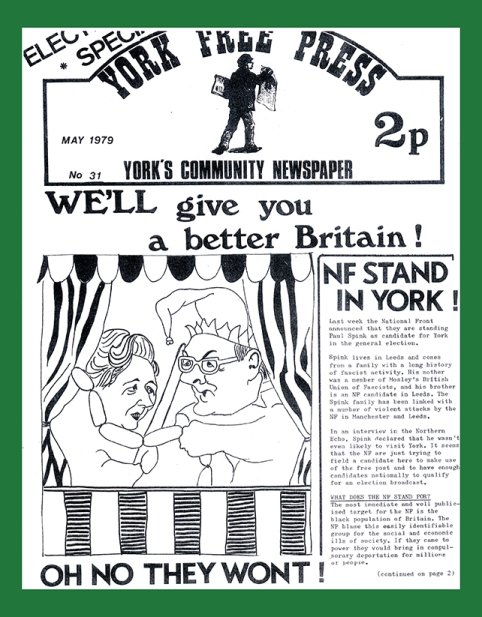
THATwas my introduction to “York Free Press”, one
of the best and most enduring of the “alternative newspapers” that for a
decade or two enlivened Britain’s culture and politics.
It was 1976 and I was an idealistic young teacher living and working
in York and aggrieved at an article I’d read in a recent issue. York’s
selective school system was about to be “comprehensively” reorganised
but the YFP article argued for incorporating six-form colleges which I
considered a device for keeping an A-Level elite away from less academic
plebs. YFP claimed to be open to everyone and advertised weekly
meetings upstairs in the Lowther on King’s Staith so I turned
up one evening expecting a row and instead was welcomed in and invited
to write a rejoinder. I was utterly disarmed, it wouldn’t happen at Socialist Worker! I was already a libertarian socialist but this bunch of scruffy student hippies turned me 100% anarchist and so I’ve remained.
Actually they weren’t all scruffy hippies, Vaughn Harvey was but Tony
Zurbrugg (who now runs Merlin Press) was already a serious-minded
libertarian-communist permanently clad in an RAF greatcoat, Danae and
Howard Clarke (later of “War Resisters International”) were smart-casual
and always smiling, Danny Golding “The Ayatollah” (nowadays Labour
loyalist) was too humourless to qualify as a real hippy but there was
always a supporting cast of “occasionals” who couldn’t be asked to turn
up every week. That was an attractive feature of YFP, you helped at
whatever level you felt comfortable with. Most political groups demand
so much that they retain only fanatics. YFP enjoyed regular “bring food
and drink to share” socials so less active supporters kept in touch and
made friends with regular “collectivists”.
Around 1978 we organised a national 'PAPERS EVERYWHERE!'conference-jamboree
weekend at York University. We invited every community paper we could
think of and people from about eighty titles turned up. It was wonderful
exchanging papers, experiences, ideas and what little technical
expertise we’d acquired. I was especially impressed by a rather posh
Sheffield guy who single-handed ran The Totley Independent, which
he gave away free and financed by taking ads from small shops and
tradesmen. He stuck out like a sore thumb amongst an array of vaguely
alternative-socialists but was content to paddle his own canoe. It
showed the potential of the format. Some titles such as Islington Gutter Pressand Rochdale Alternative Paper (RAP), which I believe sold 8,000 copies per issue, were real big hitters whilst others, like the Totley,were
happy to nurture community spirit and less intent on exposing scandal
and corruption. RAP revealed Cyril Smith’s dirty deeds forty years
before the commercial press dared touch the story.
I think two things sparked the birth of the alternative press, the
“swinging sixties” do-it-yourself politics and certain technical
developments in printing. Lead-typesetting was no longer involved and
the new process required less skill and cost. Like other papers, at YFP
we used ordinary typewriters to produce the text and trimmed, then glued
the result to a large sheet of cartridge paper. Other articles were
stuck alongside the first to build up a newspaper page with spaces left
for photographs which had to be “screened” and treated separately.
Headlines were the real pain – LETRASET!
Headlines were produced by a
sort of transfer process. You bought these rather expensive “Letraset”
transparent plastic sheets with individual black letters affixed to the
undersides. By scribbling on top of the required letter it detached from
the sheet and adhered to the paper placed underneath You had to build
the headline a letter at a time, any misspelling meant you must discard
your first effort and start all over again and keeping it all level and
evenly spaced was a tedious task. Sometimes we had lots of tables and
space to lay out the paper but often we managed in someone’s cramped
bedroom with people coming and going and ideas, jokes and arguments
flying back and forth.
YFP was a monthly with a price of 2p and 1,000 print run, sold door
to door with a network of local shops selling on the basis of sale or
return. It was a struggle to keep it going but the paper survived long
after I left York. I was always a bit of a populist, keen to present the
politics in an attractive wrapping and my favourite all-time article
was, “The Great York Fish and Chip Survey!” Every Thursday for
three months we’d sample 3 or 4 different local chip shops, weigh the
portion of chips and the fish and then assess the price, quality etc.
Finally we tabulated the results and published a league table to great
reader acclaim! Is that petit bourgeois politics or anarchy in action?
Every article was subject to the deepest of political analysis – “Is it
ideologically sound?” – was the inevitable dilemma.
The balance of collective responsibility and initial initiative at
YFP remained problematic. When a character calling himself “Euston Arch”
joined us he immediately began arranging music events in the name of
YFP and only afterwards seeking collective approval. When he signed us
up to a potentially disastrous gig featuring “Wayne County and the
Electric Chairs” at the Mecca Ballroom we accepted responsibility and
survived but immediately expelled him from the collective. After we
printed a story by a guy who told us he was literally kicked out of his
York bedsit by the landlord as a uniformed policeman stood idly by
(illustrated by a cartoon of a cop shielding his eyes) I received a
threat to sue from The Police Federation (my address, 1 Newton Terrace,
was the published editorial address). We agonised whether to apologise
and “correct” the story or stand firm and take the consequences.
Fortunately, within days the local straight press published an account
of the same landlord doing the same thing to someone else so we lived to
fight another day.
Anarchism rather than socialism characterised the alternative papers
movement. Although lots of Marxists were individually supportive they
tended to regard papers like YFP as trivial compared to their party
newspapers whilst Tories and Labour Party types regarded us as
scurrilous troublemakers. Although I wanted the paper to become a sort
of local Private Eye, both funny and muck-raking, whilst at YFP
I established an abiding interest in researching radical history. I
interviewed a founder member of York Communist Party who claimed workers
were more interested in politics in the old days and all he had to do
in the twenties was ride his bike along a road, ring a hand-bell and
people would come out of their houses and he’d start an impromptu
discussion on socialism. He described how difficult it was to keep up
with the ever-changing political line emanating from Moscow and how he’d
finally been expelled from the CP when “I zigged when I should have zagged”!
In 1979 I researched and YFP published a series of articles on
“Fascism in York in the 1930’s” which revealed a continuity of not only
Blackshirtideas with current National Front candidates but the same
local families were still organising attacks on socialist opponents.
There were so many good stories and so many great times and in 1980 I
was sorry to leave but keen to start another scurrilous rag elsewhere,
but that’s a story for another day…
Just
after the 2016 Referendum
I met a someone who is a member of the Heywood and Middleton
Constituency Labour party. He was not impressed that our MP, Liz
McInnes, had resigned
from her shadow post as communities
and local government minister as
a gesture of no confidence in Jeremy Corbyn.
Now
Liz is one of the few MPs who have ‘had a proper job’ before
becoming an MP so I am happy to vote for her. (I also have it from an
impeccable source that a political opponent once said admiringly of
her that she was known as ‘The Rottweiler’ for her
determination to defend workers’ rights.)
A
little lamely I muttered something that she would have come under a
lot of pressure to join the herd who were calling for Corbyn to go.
An
enthusiastic Corbyn supporter he was having none of it! He argued
that Labour MPs should listen to the views of members of the local
party and could not expect members to do the leg work for them at
election time if they didn’t. And he was quite right of course.
I
remembered this conversation last night when I read the
response of Joan
Ryan, the chair of Labour Friends of Israel, tolosing
a vote of no confidence at her local constituency party where
she was accused
of smearing Jeremy Corbyn.
So
what was Ms Ryan’s response? She called the people who had voted
against her ‘Trots,
Stalinists, Communists and assorted hard left’.
Given
that just over half of the people who attended the meeting voted
against her, 94 out of 186, this may not have been the cleverest
idea.
Why would any of these people who she has attacked in this
unpleasant way want to go round the streets at the next election
trying to persuade people to vote for her?
Joan
Ryan is not a woman who is meticulous in checking her facts as you
will see in this video.
The
video is about 26 minutes long. The incident involving Joan Ryan
starts at about 7 minutes and 40 seconds.
Chuka
Ummuna’s recent comments are thought to have been prompted by the
votes of no confidence in Joan Ryan and Chris Leslie. It may just be
a coincidence that both these MPs are members of the ‘Friends of
Israel’ group. It may also be just a coincidence that Chuka Ummuna
(and Angela Eagle) are seen in the video at the Friends of Israel
stall asking to be updated.



![.@x_feroza says #TikTok capitulated to China & blocked her account after she posted this fab clip [sound on]](https://pbs.twimg.com/profile_images/1153709600895619072/vosYTFk-_normal.png)


 Posts
Posts


