Showing posts with label bolton. Show all posts

Friday, 27 November 2020

Greetings on Lancashire Day!

An occasional update from Lancashire Loominary
No. 2 November 27th 2020
Greetings on Lancashire Day!
This is an update about ideas, publications and events at Lancashire Loominary. It’s about publishing fiction and non-fiction on the history and culture of Lancashire (by which I mean all of it) and its people. It’s not about ‘the great and the good’ but so-called ‘ordinary’ working class people who did extraordinary things. I do this roughly every 4-6 weeks. Let me know if you don’t want to receive it.
The original ‘Lankishire Loominary’ was published by James T. Staton in Bolton in the 1850s and 1860s. The name changed on a fairly regular basis; at one point it was ‘The Bowtun Loominary, Tum Fowt Telegraph Un Lankishire Lookin’ Glass. But I like the alliteration of Lancashire Loominary and its textile connections. The reason you’re getting this is because you’ve either bought, helped or promoted previous examples of my work and I thought you might be interested in future titles.
Lancashire Re-united: A Lancashire Day thought-piece
Lancashire and Yorkshire both have strong identities and despite historic rivalries, we have more in common, as Jo Cox would have said, than what divides us. Yet while our Yorkshire neighbours are building up momentum for a ‘One Yorkshire’ region, Lancashire is lagging behind. On Lancashire Day 2020, this paper argues for a re-united Lancashire, with its own democratically-elected assembly, based broadly on its historic boundaries but looking to the future for a dynamic and inclusive county-region that could be at the forefront of a green industrial revolution. It isn’t about creating top-down structures but having an enabling body that can help things happen: in business, arts, education and other fields. As well as a new county-region body to replace the mish-mash of unelected regional bodies and mayors with little accountability, a re-united Lancashire also needs strong local government (that is genuinely local) working co-operatively with the communities it serves and a vibrant economy that is locally based where profits go back into the community.
Back in 1895, Bolton writer and visionary Allen Clarke said:
“I would like to see Lancashire a cluster of towns and villages, each fixed solid on its own agricultural and industrial base, doing its own spinning and weaving; with its theatre, gymnasium, schools, libraries, baths and all things necessary for body and soul. Supposing the energy, time and talent that have been given to manufacture and manufacturing inventions had been given to agriculture and agricultural inventions, would not there have been as wonderful results in food production as there have been in cotton goods production?” (Effects of the Factory System, 1895)
Utopian? Perhaps – we need our utopian visions!. But there’s an element of realism there too. He recognised that capitalism had unleashed enormously powerful productive forces, but not necessarily with the best results. What Clarke was saying over a century ago is being said by many green activists and thinkers today and was what Gandhi preached in his own time and what ‘small is beautiful’ thinkers like Leopold Kohr, Franz Schumacher and John Papworth argued.
Humanity has the resources and skills to create a better world, for everyone; the consequences of not trying are worsening climate change and all that follows from it. The old cliché remains true: think globally, act locally – and regionally.
Clarke looked forward to a Lancashire that was a greener, more self-sufficient place – within a co-operative rather than a capitalist system. Now, as we struggle to emerge from the coronavirus pandemic, is the time to think differently about the world we live in. This paper is about what Lancashire could look like in the next twenty years – by which I mean the ‘historic’ Lancashire, including Greater Manchester and much of Merseyside. But this is not about looking backward – it’s about creating a progressive and inclusive vision for a re-united Lancashire ‘county-region’ within a prosperous North and a Federal Britain. A Lancashire Co-operative Commonwealth.
The state of the county
The Lancashire of Allen Clarke’s day has changed in so many ways. In the towns, gone are the mills and mill chimneys with their attendant pollution and poor working conditions inside the factory walls. But we have also lost some of the civic pride and buoyancy of the great Lancashire boroughs including Clarke’s beloved Bolton.
‘Lancashire’ itself has been split and divided in what was a travesty of democracy. No wonder there is a very worrying degree of despondency and cynicism within these towns that ‘nothing can be done’ and we are powerless. It becomes easy to blame scapegoats, be they immigrants, asylum seekers, politicians or whoever.
Lancashire has yet to find a new role that can build on its past achievements, without just being a dull collection of retail parks, charity shops and sprawling suburbia, nor indeed a heritage theme park. We have many successful businesses and a thriving academic sector with great universities, some world-class, in many towns and cities; there is the potential for that to spin-off into new industries and services that are world-leaders.
Manchester has emerged as a dynamic regional centre, though many of the once-thriving towns surrounding it are in a parlous state. This has got to change and consigning towns like Bolton, Oldham, Rochdale and Bury to the role of commuter suburbs is not acceptable. Instead of the centralised ‘city-region’ we need a more decentralised and collaborative ‘county-region’ with several centres and smaller hubs connected by good rail links.
There is a disconnect between urban and rural, with tourist ‘honeypots’ around Lancashire and areas like the Ribble Valley and Trough of Bowland besieged by traffic from towns and cities and homes for local people made unaffordable by urban dwellers buying up second homes – a process accelerated by Covid-19.
The county that was stolen
Allen Clarke’s Lancashire has been shrunk by an undemocratic diktat in the 1970s. Nobody asked the people of Bolton, Rochdale, Oldham, Wigan and other towns if they wanted to be part of ‘Greater Manchester’. We have an elected mayor but without the democratic oversight of an elected council – which at least the original Greater Manchester Council had, before it was abolished by Mrs Thatcher in 1986. Something else we weren’t asked about. Now, in 2020, some politicians are contemplating further municipal vandalism with the destruction of the remaining ‘Lancashire’ county council and three ‘super’ councils replacing it and the existing districts. Talk about making a bad job even worse. In Cumbria, there is talk of creating one single unitary authority; this would mean the death of ‘local’ government.
Allen Clarke was a strong believer in municipal reform and backed The Municipal Reform League, formed in Lancashire in the early 1900s. There’s a need for something like that but on a bigger scale, addressing the huge democratic deficit in the English regions, particularly the North, as well as the loss of power by local government. We need a ‘Campaign for Northern Democracy’ that can involve Lancashire, Yorkshire, Cheshire, Cumbria and the North-East as friendly allies and partners.
Samuel Compston of Rossendale, a radical Liberal of the old school, spoke of the virtue of ‘county clanship, in no narrow sense’. He was on to something and his words were carefully chosen. Regional or county pride does not pre-suppose antipathy to other regions and nations, and it needs to include everyone within the region. But it requires a democratic voice, not just one person elected every few years as ‘mayor’, nor a committee of local authority leaders whose prime loyalty is to their own council ward.
Yorkshire has been quicker off the mark and the Campaign for a Yorkshire Parliament has won wide cross-party support; the Yorkshire Party has made several local gains. The Yorkshire-based ‘Same Skies Collective’ has developed some fresh new ways of thinking about regionalism. The Yorkshire Society is succeeded in reinvigorating a strong, inclusive Yorkshire identity - a very good model for us to follow in Lancashire.
Here, there’s a ‘Friends of Real Lancashire’ and we have a Lancashire Society which currently has a low profile. Lancashire needs to play its part in the regionalist revival with a much higher profile and cross-party support. A reformed Lancashire that includes Greater Manchester and Merseyside makes sense as an economic unit but also chimes with people’s identities – in a way that artificial ‘city regions’ never will.
‘Greater Manchester’ typifies the problem of ‘city-regions’. It has reduced the once proudly-independent county boroughs to the status of satellites - commuter suburbs of Manchester (or ‘Manctopia’ as it was described in an excellent TV programme recently). Nearly 50 years on from the creation of ‘Greater Manchester’ our ‘city region’ still has precious little legitimacy and if there was a referendum tomorrow on being part of Lancashire or ‘Greater Manchester’ I have little doubt about the result.
A democratic new Lancashire
Regional democracy must be the next big jump for our political system with county assemblies, elected proportionately, taking real powers out of Westminster and Whitehall, backed up by strong well-resourced local government which has the right scale (not too big!). In England, we haven’t grasped the distinction between the national, regional and local, with cack-handed attempts to combine the regional and local (witness current attempts to create a unitary authority for all of Cumbria and three huge ‘local’ authorities covering all Lancashire). The latter are neither sufficiently ‘strategic’ to be effective regional bodies, and anything but ‘local’. Cumbria itself is big enough to be a county-region but still needs effective local government beneath it.
We need to get power out of the centre – Westminster/Whitehall – and give county-regions such as Lancashire real powers (see below) complemented by local government which really is ‘local’ and relates to historic, ‘felt’ identities which make economic and political sense.
Parameters and powers
A re-constituted Lancashire county-region should include much of what once constituted Lancashire with the additions of parts of historic Cheshire to the south (Stockport, Tameside and Trafford in Greater Manchester). In some places, e.g. Warrington, Widnes and Runcorn, local referenda on joining the appropriate county-region could be held. The historic ‘Lancashire north of the Sands’ really makes more sense within a Cumbria county-region that works closely with its Lancashire sister. This provides a county-region of significant size able to wield economic clout without being too large (which a region of ‘The North’ would be, both in population and geographical scale). Crucially, it would reflect people’s identities.
A major failure of the attempts to create regional assemblies during the Blair Government was their obvious lack of powers, prompting the successful attempts by the advocates of the centralised status quo to label them as expensive ‘white elephants’. While on one hand it makes sense for a new county-region to evolve gradually in terms of the powers and responsibilities it has, it must be able to demonstrate a clear reason to exist from the start. That means taking over responsibility for many of the areas which Wales and Scotland already have. It should include tax-raising powers.
The county-region should be empowered to support economic development across its area, investing in emerging industries, research and marketing. The ‘Lancashire Enterprises’ of the 1980s, stimulated and overseen by Lancashire County Council, would be a good model to start with. Part of its role should be to encourage new social enterprises and encourage greater employee and community involvement in large enterprises.
For transport, a ‘Transport for Lancashire’ should be created to take over the powers of existing transport authorities, as well as the ineffective Transport for the North. There should be close collaboration between sister bodies in Yorkshire, Cumbria, the North-east, and the Midlands, with formation of joint bodies to develop inter-regional links.
Another regular canard against regional government is that it creates ‘more politicians - ’jobs for the boys’, another effective line of attack against the idea of a North-East Assembly in 2004. It depends how you look at that. Regional devolution must include reducing the number of MPs at Westminster, as their functions transfer to the county-region. The same goes for the civil servants. Some powers that are currently devolved, but with little democratic scrutiny (transport, health, etc.) could simply come under the democratically-elected county-region, with members elected by a proportional voting system.
Localising local government
One of the most disastrous decisions of local government reform in the 70s was the destruction of small, usually highly efficient, local councils. Medium-sized towns, such as Darwen, Heywood, Farnworth, Radcliffe and others often ran their own services, built good quality housing and underpinned a very strong sense of civic pride. They were ruthlessly destroyed in the spurious cause that ‘big is better’ and the knee-jerk approach of far too many bureaucrats to centralise as much as possible. Can anyone honestly say that these medium-sized towns have benefitted from the changes imposed on them in the 70s?
Within a Lancashire ‘county-region’ local government should ultimately be based on smaller but empowered and well-resourced units that reflect people’s identities – the Darwens, Athertons, Radcliffes as well as larger towns such as Oldham, Burnley, Blackburn and Blackpool. However, in the short term use should be made of existing powers to create local councils (‘town’ or parish councils) for small and medium-sized towns that don’t have their own voice, based on the ‘Flatpack Democracy’ model developed by independent town councillors in Frome, Somerset.
These smaller but more powerful local councils should co-operate with their parent borough council and neighbouring communities on issues of mutual concern within a Lancashire county-region – a ‘co-operative commonwealth’ as argued below.
Having vibrant town as well as city centres must be a major element of the county-region. This means having a vision for town centres which offer something that the mega-stores don’t offer: a sense of conviviality and sociability. The arts have a key role to play – small galleries, larger public facilities including theatres and annual festivals (Bolton’s Film Festival is a good example) can help revive town centres and give them a new role.
Some Lancashire towns have been successful in developing niche manufacturing which offer highly skilled, well-paid jobs – but there’s a need for much more, working in partnership with the higher education sector. The ‘Preston Model’ should be rolled out to other similar-sized towns and cities to encourage much more local procurement and business support. It all needs sensitive encouragement which should come from re-structured and empowered local councils working within a collaborative framework provided by the county-region’s Lancashire Enterprises, as part of ‘The Lancashire Co-operative Commonwealth’.
A new green industrial revolution for Lancashire
Allen Clarke’s prophecy in Effects of the Factory System in (1895) that the cotton industry was doomed has finally come to be. Most of the mills that once dotted the south Lancashire landscape have been demolished. A few have survived but many are in poor condition, with only the prospect of demolition ahead of them unless something is done. The University of Bolton has had the sense to re-use some old mill buildings as part of its campus.
Yet most of the surviving Lancashire mills, perhaps with the exception of Manchester’s Ancoats, don’t have the wonderful mix of creative industries, office space and living accommodation that has been achieved with some of the mills in Yorkshire. At Saltaire, Salt’s Mill is perhaps the finest example, though rivalled by the Dean Clough Mills in Halifax. More should be done to protect our Lancashire mills and find good uses for them. Why should Yorkshire have all the fun?
Allen Clarke would have loved the idea of putting the mill buildings to better use - as places to live, but also as office and art space, recreational centres and performance areas. How about mill roof gardens? There’d be no shortage of space, with room to grow fruit and veg. Time for the ‘Incredible Edible Mill’!
We also need to build new, inspirational buildings that can take their place alongside the fine architecture bequeathed us by past generations. We need a vision, at least as radical as that of the Bolton landscape architect T.H. Mawson, of what our towns and cities should look like in the next 20 years, not what developers think is ‘good enough’ for us and makes the quickest return for them. We need some new Lord Leverhulmes (for all his faults!), women and men of vision, able to work collaboratively and creatively. Lancashire could be at the forefront, once again, of an industrial revolution – but this time a green revolution which benefits everyone, not just a handful of entrepreneurs.
Sharing the same skies: the countryside for everyone
Alongside a vibrant urban society, economy and culture, we need to make the best of our countryside, the ‘green lungs’ that make Lancashire so special. At its best, it can compete with the Lakes and the Peak District in terms of scenic beauty and is relatively well served with vibrant shops and smaller towns. It’s a huge asset in attracting talent into the region as a place to live and work.
Yet public transport access to the countryside is nothing like as good as it ought to be. Some of the most attractive areas have little or no bus services, or they don’t operate on Sundays – just when people need them. Places like Rivington, Pendle and Holcombe – let alone the Ribble Valley and Pendle - can be clogged with cars and motor bikes at weekends. At the same time, many stations that gave walkers access to the countryside, have closed.
Never mind HS2, let’s rebuild a world-class local transport network. For a fraction of the cost of that high-speed white elephant, we could have a network of modern, zero-emission trams and buses serving town and country, feeding in to a core rail network. If we look at the examples of Germany, Switzerland and Austria their popular rural areas typically have either frequent train services or rural trams connecting from the larger urban centres.
One of the few bright spots during the coronavirus outbreak has been the remarkable growth in cycling. Clarke and his friends Johnston and Wild would be delighted. Quiet roads, good weather and time on your hands was the ideal combination. Cycle shops have enjoyed a boon. I hope this renewed interest in cycling will survive, particularly if the Government puts its money where its mouth is and provides funding to expand cycle facilities in both town and country. That will need a strong regional body to implement cycle infrastructure working with local authorities and communities – a clear role for Transport for Lancashire.
People will still use their car to get out into the countryside and that needs to be managed and provided for. Car parks can be ugly, but so can cars parked alongside verges. The more alternatives there are available, the less likely we are to assume that the only way to enjoy the countryside is by that form of transport which does most to disfigure it.
Why not copy the example of some of the national parks in the United States, which prohibit car access to the most sensitive areas? If you get there by car, leave it in a ‘parking lot’ and either walk, get on a local bus or hire a bike. It could work in some of our national parks including the Lakes and popular visitor locations such as Rivington and the Pendle Forest. The exciting plans for a ‘South Pennines’ regional park could include sensitive measures to restrict visitors’ car access and promote use of public transport, cycling and walking.
Allen Clarke wanted to see a new ‘agricultural revolution’ in Lancashire, and that’s still relevant. Much of Lancashire, particularly in the north of the county, has a highly productive agricultural sector and we need to guard against precious agricultural land being lost to development. We need to do much more to feed our own people and not be dependent on imported foods. The ‘incredible edible’ model, of small-scale food production within towns was invented here in Lancashire and needs to be rolled out in every town and village.
Beyond a boundary: a Red Rose Co-operative Commonwealth?
The future of England should be about county-regions co-operating with empowered, but geographically smaller, local councils. There should be strong encouragement to co-operate on issues when it makes sense, and to share resources and specialist staff. That co-operation should extend further, across the North. Why not a ‘Northern Federation’ of county-regions – Lancashire, Yorkshire, Cheshire, the North-East and Cumbria, collaborating on issues of joint concern, such as strategic transport links and academic co-operation?
Good, democratic governance must be about addressing inequality, jobs, the environment, health, education and having a thriving and diverse cultural sector. Allen Clarke’s vision in 1895, of locally-based and socially-owned units of production make sense in a modern digital age, co-operating as equals with partners across the globe.
His idea of a ‘co-operative commonwealth’ could certainly work at a Lancashire level; after all, it’s where co-operation began. Allen Clarke, with and his radical friends Solomon Partington, the co-operator and feminist Sarah Reddish and Samuel Compston looking over his shoulder, would have said “what are you waiting for?”
And we can’t wait. The coronavirus pandemic has focused people’s minds on the dysfunctional way we have lived our lives. An even bigger threat is climate change which requires re-thinking every aspect of how we live, travel, work and play. A democratic revolution is needed to create appropriate governance that can address those issues.
That revolution needs to go beyond Lancashire and the North. We need to build a Federal Britain which is no longer dominated by London: a federation of equals. Now is the time to create that Allen Clarke’s vision of a ‘Lancashire Co-operative Commonwealth’ that can, in the words of Clarke’s heroine, Rose Hilton – get agate with the job of “washing the smoky dust off the petals of the red rose” and create a county-region that is fit for the 21st century. A Lancashire re-united.
Lancashire United: What we stand for
· The promotion of a strong, inclusive Lancashire identity that is welcoming to everyone regardless of race, ethnicity, gender or age
· The creation of a new Lancashire county-region which includes Greater Manchester and Merseyside
· The formation of a democratically-elected Lancashire Assembly, using a fair voting system
· The devolution of powers over transport, health, education, economic development, culture and tourism to the county-region, with democratic oversight
· The encouragement of informal Lancashire-wide networks in the areas of higher education and research, culture and the arts, sport and other areas
· The encouragement of democratic forms of social ownership - ‘a co-operative commonwealth’
· The empowerment of local government and town/parish councils
· Close and collaborative working with our neighbours in Cumbria, Yorkshire, Cheshire and Derbyshire and the formation of a Northern Confederation
Lancashire Day, November 27th 2020
See facebook group #Lancashire United twitter @lancsunited and www.lancashireloominary.co.uk

Wednesday, 18 November 2020

LANCASHIRE RE-UNITED?

For a New Lancashire County-Region
WHILE our Yorkshire neighbours are building up momentum for a ‘One Yorkshire’ region, Lancashire is lagging behind. This paper argues for a re-united Lancashire, with its own democratically-elected assembly, based in part on its historic boundaries but looking to the future for a dynamic and inclusive county-region that could be at the forefront of a green industrial revolution. As well as a new county-region body to replace the mish-mash of unelected regional bodies and mayors with little accountability, a re-united Lancashire also needs strong local government working co-operatively with the communities it serves and a vibrant economy that is locally based.
Back in 1895, Bolton writer Allen Clarke said: “I would like to see Lancashire a cluster of towns and villages, each fixed solid on its own agricultural and industrial base, doing its own spinning and weaving; with its theatre, gymnasium, schools, libraries, baths and all things necessary for body and soul. Supposing the energy, time and talent that have been given to manufacture and manufacturing inventions had been given to agriculture and agricultural inventions, would not there have been as wonderful results in food production as there have been in cotton goods production?”
(Allen Clarke, 1895, slightly adapted)
THAT was Allen Clarke, the Lancashire journalist, philosopher and novelist writing in 1895. Utopian? Perhaps (we need our utopian visions!) but there’s an element of realism there too. He recognised that capitalism had unleashed enormously powerful productive forces, but not necessarily with the best results. What Clarke was saying over a century ago is being said by many green activists and thinkers today and was what Gandhi preached in his own time. Humanity has the resources and skills to create a better world, for everyone; the consequences of not trying are worsening climate change and all that follows from it.
Clarke looked forward to a Lancashire that was a greener, more self-sufficient place – within a co-operative rather than a capitalist system. Now, as we struggle to emerge from the coronavirus pandemic, is the time to think differently about the world we live in. This paper is about what Lancashire could look like in the next twenty years – by which I mean the ‘historic’ Lancashire, including Greater Manchester and much of Merseyside. But this is not about looking backward – it’s about creating a progressive and inclusive vision for a re-united Lancashire ‘county-region’ within a prosperous North and a Federal Britain. A Lancashire Co-operative Commonwealth.
The STATE of the COUNTY
THE Lancashire of Allen Clarke’s day has changed in so many ways. In the towns, gone are the mills and mill chimneys with their attendant pollution and poor working conditions inside the factory walls. But we have also lost some of the civic pride and buoyancy of the great Lancashire boroughs including Clarke’s beloved Bolton. ‘Lancashire’ itself has been split and divided in what was a travesty of democracy. No wonder there is a very worrying degree of despondency and cynicism within these towns that ‘nothing can be done’ and we are powerless. It becomes easy to blame scapegoats, be they immigrants, asylum seekers, politicians or whoever.
Lancashire has yet to find a new role that can build on its past achievements, without just being a dull collection of retail parks, charity shops and sprawling suburbia, nor indeed a heritage theme park. We have many successful businesses and a thriving academic sector with great universities, some world-class, in many towns and cities; there is the potential for that to spin-off into new industries and services that are world-leaders.
Manchester has emerged as a dynamic regional centre, though many of the once-thriving towns surrounding it are in a parlous state. This has got to change and consigning towns like Bolton, Oldham, Rochdale and Bury to the role of commuter suburbs is not acceptable. Instead of the centralised ‘city-region’ we need a more decentralised and collaborative ‘county-region’.
There is a disconnect between urban and rural, with tourist ‘honeypots’ around Lancashire and areas like the Ribble Valley and Trough of Bowland besieged by traffic from towns and cities and homes for local people made unaffordable by urban dwellers buying up second homes – a process accelerated by Covid-19.
The County that was Stolen
ALLEN CLARKE’s Lancashire has been shrunk by an undemocratic diktat in the 1970s. Nobody asked the people of Bolton, Rochdale, Oldham, Wigan and other towns if they wanted to be part of ‘Greater Manchester’. We have an elected mayor but without the democratic oversight of an elected council – which at least the original Greater Manchester Council had, before it was abolished by Mrs Thatcher in 1986. Something else we weren’t asked about. Now, in 2020, some politicians are talking about further municipal vandalism with the destruction of the remaining ‘Lancashire’ county council and three ‘super’ councils replacing it and the existing districts. Talk about making a bad job even worse. In Cumbria, there is talk of creating one single unitary authority; this would mean the death of ‘local’ government.
Allen Clarke was a strong believer in municipal reform and backed The Municipal Reform League, formed in Lancashire in the early 1900s. There’s a need for something like that but on a bigger scale, addressing the huge democratic deficit in the English regions, particularly the North, as well as the loss of power by local government. We need a ‘Campaign for Northern Democracy’ that can involve Lancashire, Yorkshire, Cumbria and the North-East as friendly allies and partners.
Samuel Compston of Rossendale, a radical Liberal of the old school, spoke of the virtue of ‘county clanship, in no narrow sense’. He was on to something and his words were carefully chosen. Regional or county pride does not pre-suppose antipathy to other regions and nations, and it needs to include everyone within the region. But it requires a democratic voice, not just one person elected every few years as ‘mayor’, nor a collection of local authority leaders whose prime loyalty is to their own council ward.
Yorkshire has been quicker off the mark and the Campaign for a Yorkshire Parliament has won wide cross-party support; the Yorkshire Party has made several local gains. The Yorkshire-based ‘Same Skies Collective’ has developed some fresh new ways of thinking about regionalism.
Here, there’s a ‘Friends of Real Lancashire’ but the issue needs a higher profile and cross-party support. A reformed Lancashire that includes Greater Manchester and Merseyside makes sense as an economic unit but also chimes with people’s identities – in a way that artificial ‘city regions’ never will.
‘Greater Manchester’ has reduced the once proudly-independent county boroughs to the status of satellites - commuter suburbs of Manchester (or ‘Manctopia’ as it was described in an excellent TV programme recently). Nearly 50 years on from the creation of ‘Greater Manchester’ our ‘city region’ still has precious little legitimacy and if there was a referendum tomorrow on being part of Lancashire or ‘Greater Manchester’ I have little doubt about the result.
A Democratic New Lancashire
REGIONAL democracy must be the next big jump for our political system with regional assemblies, elected proportionately, taking real powers out of Westminster and Whitehall, backed up by strong well-resourced local government which has the right scale (not too big!).
In England, we haven’t grasped the distinction between the national, regional and local, with cack-handed attempts to combine the regional and local (witness current attempts to create a unitary authority for all of Cumbria and three huge ‘local’ authorities covering all Lancashire). The latter are neither sufficiently ‘strategic’ to be effective regional bodies, and anything but ‘local’. Cumbria itself is big enough to be a county-region but still needs effective local government beneath it.
We need to get power out of the centre – Westminster/Whitehall – and give country-regions such as Lancashire real powers (see below) complemented by local government which really is ‘local’ and relates to historic, ‘felt’ identities which make economic and political sense.
Parameters and Powers
A RE-CONSTITUTED Lancashire county-region should include much of what once constituted Lancashire with the additions of parts of historic Cheshire to the south (Stockport, Tameside and Trafford in Greater Manchester). The historic ‘Lancashire north of the Sands’ really makes more sense within a Cumbria county-region that works closely with its Lancashire sister. This provides a county-region of significant size able to wield economic clout without being too large (which a region of ‘The North’ would be, both in population and geographical scale). Crucially, it would reflect people’s identities.
A major failure of the attempts to create regional assemblies during the Blair Government was their obvious lack of powers, prompting the successful attempts by the advocates of the centralised status quo to label them as expensive ‘white elephants’. While on one hand it makes sense for a new county-region to evolve gradually in terms of the powers and responsibilities it has, it must be able to demonstrate a clear reason to exist from the start. That means taking over responsibility for many of the areas which Wales and Scotland already have. It should include tax-raising powers.
The county-region should be empowered to support economic development across its area, investing in emerging industries, research and marketing. The ‘Lancashire Enterprises’ of the 1980s, stimulated and overseen by Lancashire County Council, would be a good model to start with. Part of its role should be to encourage new social enterprises and encourage greater employee and community involvement in large enterprises.
For transport, a ‘Transport for Lancashire’ should be created to take over the powers of existing transport authorities, as well as the ineffective Transport for the North. There should be close collaboration between sister bodies in Yorkshire, Cumbria, the North-east, and the Midlands, with formation of joint bodies to develop inter-regional links.
Another regular canard against regional government is that it creates ‘more politicians’ - ’Jobs for the boys’, another effective line of attack against the idea of a North-East Assembly in 2004.
It depends how you look at that. Regional devolution must include reducing the number of MPs at Westminster, as their functions transfer to the county-region. The same goes for the civil servants. Some powers that are currently devolved, but with little democratic scrutiny (transport health, etc.) would simply come under the democratically-elected county-region, with members elected by a proportional voting system.
Localising Local Government
ONE of the most disastrous decisions of local government reform in the 70s was the destruction of small, usually highly efficient, local councils. Medium-sized towns, such as Darwen, Heywood, Farnworth, Radcliffe and others often ran their own services, built good quality housing and underpinned a very strong sense of civic pride. They were ruthlessly destroyed in the spurious cause that ‘big is better’ and the knee-jerk approach of far too many bureaucrats to centralise as much as possible. Can anyone honestly say that these medium-sized towns have benefitted from the changes imposed on them in the 70s?
Within a Lancashire ‘county-region’ local government should be based on smaller but empowered and well-resourced units that reflect people’s identities – the Darwens, Athertons, Radcliffes as well as larger towns such as Oldham, Burnley, Blackburn and Blackpool.
These smaller but more powerful local councils should co-operate with their neighbouring communities on issues of mutual concern within a Lancashire county-region – a ‘co-operative commonwealth’ as argued below.
Having vibrant town as well as city centres must be a major element of the county-region. This means having a vision for town centres which offer something that the mega-stores don’t offer: a sense of conviviality and sociability. The arts have a key role to play – small galleries, larger public facilities including theatres and annual festivals (Bolton’s Film Festival is a good example) can help revive town centres and give them a new role.
Some Lancashire towns have been successful in developing niche manufacturing which offer highly skilled, well-paid jobs – but there’s a need for much more, working in partnership with the higher education sector. The ‘Preston Model’ should be rolled out to other similar-sized towns and cities to encourage much more local procurement and business support. It all needs sensitive encouragement which should come from re-structured and empowered local councils working within a collaborative framework provided by the county-region’s Lancashire Enterprises, as part of ‘The Lancashire Co-operative Commonwealth’.
A new Lancashire industrial revolution
ALLEN Clarke’s prophecy in Effects of the Factory System in (1895) that the cotton industry was doomed has finally come to be. Most of the Bolton mills that you could once see from the moors above Bolton, described so vividly in his Moorlands and Memories (1920), have been demolished. A few have survived but many are in poor condition, with only the prospect of demolition ahead of them unless something is done. The University of Bolton has had the sense to re-use some old mill buildings as part of its campus.
Yet most of the surviving Lancashire mills, perhaps with the exception of Manchester’s Ancoats, don’t have the wonderful mix of creative industries, office space and living accommodation that has been achieved with some of the mills in Yorkshire. At Saltaire, Salt’s Mill is perhaps the finest example, though rivalled by the Dean Clough Mills in Halifax. More should be done to protect our Lancashire mills and find good uses for them. Why should Yorkshire have all the fun?
Allen Clarke would have loved the idea of putting the mill buildings to better use - as places to live, but also as office and art space, recreational centres and performance areas. How about mill roof gardens? There’d be no shortage of space, with room to grow fruit and veg. Time for the ‘Incredible Edible Mill’!
We also need to build new, inspirational buildings that can take their place alongside the fine architecture bequeathed us by past generations. We need a vision, at least as radical as that of the Bolton landscape architect T.H. Mawson, of what our towns and cities should look like in the next 20 years, not what developers think is ‘good enough’ for us and makes the quickest return for them. We need some new Lord Leverhulmes, women and men of vision, able to work collaboratively and creatively.
Lancashire needs to be at the forefront, once again, of an industrial revolution – but this time a green revolution which benefits the many and not the few...
Sharing the same Skies: the countryside for everyone
ALONGSIDE a vibrant urban society, economy and culture, we need to make the best of our countryside, the ‘green lungs’ that make Lancashire so special. At its best, it can compete with the Lakes and the Peak District in terms of scenic beauty and is relatively well served with vibrant shops and smaller towns. It’s a huge asset in attracting talent into the region as a place to live and work.
Yet public transport access to the countryside is nothing like as good as it ought to be. Some of the most attractive areas have little or no bus services, or they don’t operate on Sundays – just when people need them. Places like Rivington, Pendle and Holcombe – let alone the Ribble Valley and Pendle - can be heaving with cars and motor bikes at weekends. At the same time, many stations that gave walkers access to the countryside, have closed.
Never mind HS2, let’s rebuild a world-class local transport network. For a fraction of the cost of that high-speed white elephant, we could have a network of modern, zero-emission trams and buses serving town and country, feeding in to a core rail network. If we look at the examples of Germany, Switzerland and Austria their popular rural areas typically have either frequent train services or rural trams connecting from the larger urban centres.
One of the few bright spots during the coronavirus outbreak has been the remarkable growth in cycling. Clarke and his friends Johnston and Wild would be delighted. Quiet roads, good weather and time on your hands was the ideal combination. Cycle shops have enjoyed a boon. I hope this renewed interest in cycling will survive, particularly if the Government puts its money where its mouth is and provides funding to expand cycle facilities in both town and country.
People will still use their car to get out into the countryside and that needs to be managed and provided for. Car parks can be ugly, but so can cars parked alongside verges. The more alternatives there are available, the less likely we are to assume that the only way to enjoy the countryside is by that form of transport which does most to disfigure it.
Why not copy the example of some of the national parks in the United States, which prohibit car access to the most sensitive areas? If you get there by car, leave it in a ‘parking lot’ and either walk, get on a local bus or hire a bike. It could work in some of our national parks including the Lakes and popular visitor locations such as Rivington and the Pendle Forest. The exciting plans for a ‘South Pennines’ regional park could include sensitive measures to restrict visitors’ car access and promote use of public transport, cycling and walking.
Allen Clarke want to see a new ‘agricultural revolution’ in Lancashire, and that’s still relevant. Much of Lancashire has a highly productive agricultural sector and we need to guard against precious agricultural land being lost to development. We need to do much more to feed our own people and not be dependent on imported foods. The ‘incredible edible’ model, of small-scale food production within towns was invented here in Lancashire and needs to be rolled out in every town and village.
Beyond a boundary: a Red Rose Co-operative Commonwealth?
THE future of England should be about county-regions co-operating with empowered, but geographically smaller, local councils. There should be strong encouragement to co-operate on issues when it makes sense, and to share resources and specialist staff. That co-operation should extend further, across the North. Why not a ‘Northern Federation’ of regions – Lancashire, Yorkshire, the North-East and Cumbria, collaborating on issues of joint concern, such as strategic transport links and academic co-operation? As the late Jo Cox (a committed regionalist) said, “we have far more in common than what divides us.”
Good, democratic governance must be about addressing inequality, jobs, the environment, health, education and having a thriving and diverse cultural sector. Allen Clarke’s vision in 1895, of locally-based and socially-owned units of production make sense in a modern digital age, co-operating as equals with partners across the globe.
His idea of a ‘co-operative commonwealth’ could certainly work at a Lancashire level; after all, it’s where co-operation began. Allen Clarke, with and his radical friends Solomon Partington, the co-operator and feminist Sarah Reddish and Samuel Compston looking over his shoulder, would have said “what are you waiting for?”
And we can’t wait. The coronavirus pandemic has focused people’s minds on the dysfunctional way we have lived our lives. An even bigger threat is climate change which requires re-thinking every aspect of how we live, travel, work and play.
Now is the time to create Allen Clarke’s vision of a ‘Lancashire Co-operative Commonwealth’ that can, in the words of Clarke’s heroine, Rose Hilton – get agate with the job of “washing the smoky dust off the petals of the red rose” and create a county-region that is fit for the 21st century. A Lancashire re-united.
Lancashire Day, November 27th 2020
See facebook group #LancashireUnited and www.lancashireloominary.co.uk
**************************************************

Friday, 6 November 2020

A Gradely Book for Gradely Folk!

BOOK REVIEW by Christopher Draper
FOR anyone who imagines Sir Keir Starmer, a sharp-suited, Cambridge-educated lawyer and Knight of the Realm, is the embodiment of Socialism, Paul Salveson’s newly published evocation of the writings and cultural milieu of a pioneering Bolton socialist will prove a revelation.
“Moorlands, Memories and Reflections” celebrates, revisits and re-enacts a classic text (“Moorland & Memories”) published a century ago by Allen Clarke (1863-1935), an astonishingly prolific and wide-ranging radical journalist familiar to his contemporaries as the proprietor, editor and chief writer of such popular Northern newspapers as, “Teddy Ashton’s Journal – a Gradely Paper for Gradely Folk”. Clarke wrote poetry, short stories, social and political commentaries and philosophical essays. Although he was an exceptional talent, the popularity of Clarke’s writings with working folk is indicative of the vivacity and cultural diversity of the North’s pioneering socialist and labour movement before it fell beneath the wheels of electioneering and concentrated on getting careerists and snake oil salesmen into Parliament.
Salveson describes Clarke’s politics as, “Libertarian Socialist” but notes that “quite a big part of him leant towards anarchism of the non-violent Tolstoyan sort”. That’s how I first came across Clarke, whilst researching the street-level origins of British anarchism and John Tamlyn, a Burnley-based libertarian whose stories were published in “Teddy Ashton’s Journal”. Much of this very warp and weft of the everyday lives, political networks and cultural milieu of pioneering Northern socialists is still missed by London-centric historians and ivory-towered academics. In contrast Salveson digs down into his home turf and maintains living links with the people, places and politics he writes about. Through a hundred and eighty pages and twenty-eight profusely illustrated chapters, “Moorlands, Memories and Reflections” meanders around Clarke’s Lancashire homeland on foot, by bike and rail, teasing out the many and varied threads running through Clarke’s original 1920 volume. (If only Salveson had included an index readers would be spared page-turning meanderings in attempting to locate particular topics!).
Firstly we get an introduction to the man himself. Clarke was the son of cotton workers and he joined them as a “little piecer” employed in the mill when he was only eleven but the family were far from passive, ignorant victims of poverty. His father was a union activist, blacklisted for his beliefs and the family were avid readers interested in a range of intellectual topics. Appalled by the working conditions he experienced in the factories Allen turned to writing. Employed as a journalist by a series of Northern newspapers he also experimented as a newspaper proprietor and with publication of “Teddy Ashton’s Journal” hit upon a winning formula, which at its peak in the 1890’s attracted a readership of 50,000 every week.
The paper’s letters column, bulging with missives from weavers, minders and railwaymen, shows his readership was overwhelmingly working class. Clarke considered himself part of that great Northern industrial working class and his stories, both serious and comic, featured ordinary people’s lives in the mills, weaving sheds and mines. His political vision, though, extended way beyond the factories he thought so damaged the beloved landscape as well as workers lives. He delighted in nature and the wild places of the North. Salveson clearly shares Clarke’s wider vision of how socialism should and can offer so much more than higher wages and in tracing the threads of Clarke’s writings Salveson re-enacts some of Clarke’s original geographical and philosophical rambles.
Tolstoy, Gandhi, Whitman, Edward Carpenter and Michael Davitt all appear in “Moorlands, Memories and Reflections” as well as trams, windmills and steam engines. Besides the richness of detailed local history perhaps the ultimate value of this book is as a model and inspiration to readers to dig into their own home turf and rediscover the rich radical networks of mutual aid that thrived before our political vision grew dim. As Clarke recalled in “Teddy Ashton’s Lancashire Annual (1908)”:
“I remember Pendle,
Where in days gone by
Crowds of comrades gathered
‘Neath the moor top sky;
Oh the friendly greetings,
When our hearts were jolly bowls
With fellowship o’er flowing,
And the vision in our souls!”
(“Moorlands, Memories and Reflections” – priced £21 – is available at all good bookshops and WH Smith, or direct from the author at paul.salveson@myphone.coop)

Monday, 12 October 2020

Winter Hill 125

by Paul Salveson
DID you know that in 1896 the people of Halliwell, (Bolton), and surrounding areas were involved in a historic battle with wealthy landowner Colonel Richard Ainsworth? Many thousands of local people were involved in what was the biggest rights of way dispute in British history when Ainsworth closed public means of access to the moors so he could hold private grouse shooting parties for his friends. Will Yo’ Come o’ Sunday Mornin’?
One Sunday morning thousands marched up Halliwell, Smithills Dean and then along Coal Pit Road. They were determined to defy Col. Ainsworth and his restrictions. A folk song ‘Will Yo’Come o’ Sunday Mornin’? was written to encourage people to take part. Local historian Paul Salveson wrote a pamphlet of the same name which led to commemorative walks in 1982 and 1996.
Sunday 5th September 2021
A commemorative walk is planned to mark the 125th anniversary of the original “mass trespass”. We hope you’d like to be involved!
Please look out for details. Facebook: Winter Hill 125.
***********************************************

Friday, 27 March 2020

Recycling centres & tips in Manchester to close

The centres will remain closed ‘until further notice’ - 
Recycle for Greater Manchester announced
It means that places like recycling centres will not remain open.
An announcement was made on the Recycle for Greater Manchester website.
It read: “Following on from the Prime Minister’s announcement on March 23, all Recycling Centres are closed until further notice. Please stay at home.”
Residents are urged to check their local council’s website for up to date information about how the announcement would impact collections from homes.

Manchester

According to the Manchester City Council website, food and garden recycling bins will be collected every two weeks instead of every week. All other collections remain unaffected.

Bolton

A post on the Bolton Council website says: “At this stage priority will be given to the collection of grey bins, food waste containers and green bins. Recycling bins will be emptied where possible so please continue to present all bins on the appropriate collection day. If your bins are not emptied please take them back onto your property until your next scheduled collection day, as we will not be able to return for any that have not been emptied.”

Bury

The Bury Council website says they are ‘unable to carry out as many collections as usual’.
It says: “Brown bin collections are cancelled this week (23-27 March) and next (30 March to 3 April) while we prioritise emptying grey, green and blue bins instead.”

Oldham

The Oldham Council website asks residents not to place any garden waste out for collection. They are urged to use green bins and caddies for food waste only.
The website adds: “Place all bins out for collection as normal. Should we not collect your bin on its scheduled collection day please take it back onto your property and put it out again on your next collection day.”

Rochdale

People in Rochdale are being urged to put out their bins as normal. “If we’re not able to collect your bin on its scheduled collection day please take it back onto your property and put it out again on your next collection day”, the website says.

Stockport

People in Stockport should put their bins out as normal.

Tameside

For information, visit https://public.tameside.gov.uk/forms/bin-dates.asp

*************************************************************************

Monday, 25 November 2019

Comments on the Bolton Fire

— Grenfell United (@GrenfellUnited) November 16, 2019
The Pressure Group Grenfell United said the fire in Bolton 'brings back memories' of the Grenfell Tower fire, which claimed 72 lives in 2017, and called for Government action.
“Devastating to see images of such quick fire spread last night in #Bolton,” tweeted the group, which represents bereaved and survivors from the fire.

Matt Wrack, general secretary of the Fire Brigades Union (FBU) said it was “deeply troubling” to see fire spread rapidly up a building’s exterior again and called for a “complete overhaul” of fire safety in the UK.
***********

Sunday, 24 November 2019

STATEMENT on Bolton student residence fire

STATEMENT  by GREATER MANCHESTER
TRADE UNION COUNCIL EXECUTIVE  
– Saturday 23rd November, 2019

THE meeting of the Greater Manchester Association of TUCs [GMATUC] Executive (Saturday 23rd November, 2019), was the first opportunity after the Bolton student residence fire to support the FBU statement (16th November) and the Bolton TUC statement condemning the ‘complete failure’ of the UK fire safety system and relieved that no one was killed.

The fire at The Cube student residence was a disaster that should never have happened.

Along with Bolton TUC there are two points we want to make:

First, there is the question of flammable cladding and the unacceptable delay in enforcing the removal of all flammable cladding in all buildings, following the Grenfell tragedy.

The second point we want to make [the public aware of our] concerns of cuts to the Greater Manchester fire services. The fantastic response of fire fighters to the conflagration at The Cube would have been less effective if the proposed cuts across Greater Manchester had taken place. All cuts to fire services must be shelved.

Stefan Cholewka the GMATUC secretary said: “GM Mayor Andy Burnham on TV said that the building was red flagged previously as it did not conform fully to fire safety regulations even though it was not classified as a high rise. However, he still proposes to go ahead with additional Greater Manchester fire service cuts… Thankfully, Greater Manchester fire service had learned lessons from Grenfell and swiftly evaluated the building with the help of a students residents committee. It seems that everyone is learning lessons from the Grenfell tragedy EXEPT Andy Burnham!”.
…We fully support Les Skarratts, FBU North West executive council member, when he said: "Greater Manchester has lost more than 600 fire fighters since 2010 alone and, alarmingly, Andy Burnham is trying to cut another six fire engines, including one in Bolton. 
"We need to stop the senseless cuts to our fire and rescue service before we see another awful incident like this.”

**************************

Friday, 1 November 2019

Review: The Northern Light Falls on Us

 'NORTHERNESS is an elusive thing to define' so says the playwrite Simon Stephens in the programme to his play 'Light Falls' at the Manchester Royal Exchange.  He says this as the current
Artistic Director at the Royal Exchange is about to step down to go down the London and become Director of the prestigious drama school LAMDA (London Academy of Music & Dramatic Art).  

Ms. Sarah Frankcom caused a bit of a stir in

She was reacting to research conducted by The Guardian in collaboration with Elizabeth Freestone, Artistic Director of Pentabus Theatre, Ludlow.  It seems that in contrast to the situation on stage, figures from Ipsos Mori revealed that on average 68% of theatre audiences are women.  But that when it comes to producing the works of Shakespeare there is an inherent gender imbalance due to the original male only casts, with 155 female characters compared to 826 male characters across the Bard’s plays.

Her experiment using Maxine as Hamlet worked a treat but her more recent production of a female dominated version of Macbeth bewilderingly confusion as did other who came with me and I saw it twice.


'That is ridiculous man!  How arrogant of Sarah Frankcom to feel qualified to re-write the work of a genius. Perhaps she should re-pen Beethoven's 9th while she's at it.  It is such a rare treat and luxury to see a Shakespeare play, and I'm sick and tired of the likes of Frankcom trying to give herself a name at the expense of what is a truly genius piece of literature.  Perhaps she'd like to paint the Mona Lisa as a man too.  What a load of self indulgent pseudo-feminist crap. Just give us the art as it was intended.  It really is that simple.  If you don't like it, write your own bloody play!'

But I think the play's writer Simon Stephens is a man.   When he asked people in his research for this play if they considered themselves northern, he said they all did.  When asked how they defined 'northerness', they seemed to hestitate and then suggest it was their capacity to deal with the rain or cold and deal with it with humour:  'We don't like umbrellas, up here.  We just put our hoods up.'

Mr. Stephens, who now lives in London, He claims:  'I think something has happened with kindness in this country.  It seems that suspicion and mockery are the default position in this county.  Kindness has, in a way that has taken me completely by suprise, become a politically default position.' 

 The current play shifts around the North from the high streets of Doncaster and Blackpool, and the farms of Ulverston and the shut-down shops and pubs of Warrington and Durham to Cheshire Plains and the foothills of the Lake Districts and the Yorkshire Dales.  Warrington and Durham he writes:  'shops and bars heaving under the weight of half a decade of austerity.'


Bill Bryson commenting in 'The Road to Little Dribbling' wrote about a Council's lack of funds to afford it to maintain a shrub planter and made a curious comparison with Durham Cathedral:  'Now I'm no expert on the matter, but I am pretty sure that we are a lot richer today than we were in the eleventh century, and yet back then they could find the resources to build something as splendid and eternal as Durham Cathedral an today we can't afford to keep six shrubs in a planter.'

Today we are better at tearing things down than in maintaining things. As when during the time of the last Labour government he had a mad scheme to set up the Pathfinder Initiative to tear down 400,000 homes, mostly Victorian and Edwardian terraced houses, in the north of England - see Bryson.

Bill Bryson can see this decline acutely because he can view it in relief and observe the changes after coming in from the States after being abroad.  Stephen Simon can come back to the North from London and spot 'the seen but unnoticed' features of what's going on in the North. 

The play struggles with the hyper-aspects of everyday life: a middle aged woman has a stroke and dies reaching for a bottle of vodka in a supermarket; a married man attempts to accomplish a three-some; a insecure student tries to please hie older boyfriend; a single mum tussles with the father of her baby.  The roundhouse stage struggles to fit-in these competing elements, and it just about manages to encompass the performances.

******************

  
HYMN to the NORTH
by Jarvis Cocker

Our Father who art down in the pub
Our Mother doing the washing up
Well that was then, an this is now
So you better listen up

Factories lia empty
Manuafacting emptiness
Life still needs to be filled none the less
So go and find something to love
But just promise me this one thing, yes
Please stay in sight of the mainland
I always know you've got to go
I don't want you to go
So before you go, there's just one thing you ought to know, yeah
there's just one thing you ought to know
there's just one thing
just one thing

You can fill your life with love
You can fill your life with hope
You can fill you life with food and drink or whatever floats your boat
I'll be be singing you this song 
There's a million things in store for you just beyond the horizon

But please stay in sight of the mainland
So stay in sight of the mainland
You're wiser than I'll ever be
You're beautiful smart, so funny
You fill my heart, you fill my dreams 
And my only hope is you succeed
my only hope is you succeed
 my only hope is you succeed
you're my only hope
you're my only hope 
 you're my only hope
So please 
Please
Please
Please
Please

Trust and believe
In you and me
Northern lights will guide you home
Northern lives just like you're own
Northern rain turning into a flood 
But Don't forget your northern blood
Do never forget your northern blood

And please stay in sight of the mainland
Yeah please stay in sight of the mainland
Pease stay in touch with me
In this contactless society
Anywhere that you may be
The northern star leads back to me
Yeah the northern star leads back to me
 Yeah the northern star leads back to me
 Yeah the northern star leads back to me
You're my northern star
*******************************

Sunday, 6 October 2019

Forger Shaun Greenhalgh gives interview at Bolton Museum

 By Saiqa Chaudhari Education Reporter
HE fooled the world's art experts with his incredible talent and gained international notoriety after it was revealed an "Egyptian Relic" he sold to Bolton Museum was a fake ­— created in a garden shed.
Now master forger Sean Greenhalgh is returning to Bolton Museum for a rare public interview to coincide with the airing of a new BBC series.

Mr Greenhalgh said: "Bolton Museum is the place that inspired my love and interest in art.
“I am sorry for what I did and so grateful for this opportunity to give something back.
“I hope the pieces I have made will bring in even more people to my hometown museum, which is a fantastic place that everyone should come and visit." 

He will be talking exclusively to Museum Collections Manager Sam Elliott about his past ­— which led to him being locked up ­— and forthcoming BBC Four series "Handmade in Bolton".

He created four historical objects for the programme using traditional methods and materials.
All four items ­— a jewelled eagle brooch, an alabaster carving, a ceramic plate, and a rock crystal bottle ­— will be on display in Bolton Museum’s foyer from October 7.

It is only the third time Mr Greenhalgh has set foot inside the museum, following his release from prison in 2010.

He created several hundred forgeries, which were sold to many museums as well as royalty and even an American president.

Among his forgeries was the infamous ‘Amarna Princess’, which was acquired by Bolton Council for £440,000. A British Museum report authenticated the figure as 3,300 years old.

In July this year, Mr Greenhalgh visited the museum with a film crew and director Waldemar Janusczak to get inspiration for the ceramic plate he was making for the BBC show.

The BBC Four series will air October 7, 9, 10, and 13 at 7.30pm.

Mr Greenhalgh’s question and answer session will take place on Friday, October 11 from 7pm to 8.30pm, in Bolton Library.

Tickets for the interview are £5 and all proceeds will go to the Mayor’s charities.

To reserve a seat visit https://shaungreenhalgh.eventbrite.co.uk or book in at Bolton Central Library. Places are limited.

Mr Greenhalgh will also be signing copies of his book, A Forger’s Tale: Confessions of the Bolton Forger, which will be available to purchase after the interview.

******************

Thursday, 20 July 2017

Crummy Jobs: Park Cake Bakeries have their cake and eat it!

Park Cake Bakeries

Anyone who has had the misfortune to be pressed ganged by the Jobcentre onto a so-called government training scheme in Greater Manchester, will have heard of John Hill Biscuits in Ashton-under-Lyne and Park Cake Bakeries in Oldham. For donkey's years, both firms have relied on seasonal casual workers and temps to meet their production needs particularly in the run up to Christmas and other festive periods.

In 2011, employees at Park Cakes in Bolton and Oldham threatened industrial action following the introduction of new employment contracts, which were described as tantamount to 'slave labour' Park Cake were accused by the 'Bakers, Food and Allied Workers Union' (BFAWU), of seeking to circumvent the EU 'Temporary Agency Workers Directive' which came into effect in October 2011. This directive (which Conservative leader David Cameron tried to block), entitles agency staff who work for twelve consecutive weeks, with the same employer, to equal rates of pay and basic working conditions with permanent  employees. The cake and dessert maker was accused by the union of creating a "two-tier workforce" by introducing about 30 new permanent staff on minimum wage contracts to drive down terms and conditions, in order to bring in cheap agency labour and zero-hour contracts. 

This afternoon I spoke to a young woman outside Ashton Jobcentre who told us about her experience of working at Park Cake Bakeries in Oldham on a wonderful zero-hour contracts. She explained that there are two agencies now based in Park Cake Bakeries who recruit staff on zero-hour contracts. Having been recruited initially via the Jobcentre, she receives text messages from the agency calling on her to attend the bakery for possible work. She then explained that she was told to sit and wait for two-hours, in the expectation that there might be work, but she would be paid for the second hour. If nothing was available, she is sent home. According to this young woman, around 90% of the staff at the bakery are agency staff. When I asked how she could know this, she said because she could tell agency staff by the colour of the hairnets - red and purple for agencies workers and white for those directly employed by Park Cake.

When  I asked this young woman how she managed to live when she was not getting temporary work, she said she relied on the goodwill and generosity of friends and neighbours. This is the world of work that many now face daily in Tory England. Data provided by the Office for National Statistics (ONS), in March of this year, shows that the number of UK workers in zero-hour employment has rocketed to reach a staggering 905,000 people, an increase of 101,000 over the past year alone. Recent research undertaken by Middlesex University found that one-in-20 workers do not get statutory holiday pay and on-in-12 does not get a payslip. Around £1.2bn in wages are unpaid annually. 

As Britain prepares to leave the EU, expect more of this race to the bottom and precarious employment. This country will sold on the basis of low-taxes for the bosses and little or no rights or regulation for the workers. This, we will  be told, is all in the national interest. 

Saturday, 6 May 2017

Waste Disposal in Manchester

THIS week, it was reported that waste handling in Greater Manchester is to be taken back into public ownership.    The Greater Manchester Waste Disposal Authority (GMWDA) has told Viridor, and its joint venture partner John Laing, that it is terminating the region’s long-term waste contract.
On the 4th, May, Robin Latchem, the editor of 'Material Recycling World' [MRW], wrote:
'It was one of the worst-kept secrets in the sector that the GMWDA and Viridor-Laing partnership was on the rocks.'
Back in February, the Greater Manchester Authority raised concerns with Viridor Laing over the progress being made on these works, including 'significant rusting issues' in the mechanical and biological treatment plant tanks and the in-vessel composting facilities.
The authority’s relations with Viridor Laing over the 25-year, £3.8bn private finance initiative deal became even more frayed in recent months, as Costain continued with repairs to some of the 42 facilities.
At that time, in February, it was reported that a trading update from parent company Pennon showed that the construction contractor Costain was making modifications at some facilities servicing the 25-year, £3.8bn private finance initiative (PFI) contract with Greater Manchester Waste Disposal Authority (GMWDA).
The Greater Manchester Authority approved the termination of the contract at a meeting last week. This comes several months after the waste authority revealed that it was ‘not satisfied’ with the status of the contract, and had been seeking ‘significant savings’ through the deal (see letsrecycle.com story).

The Pennon Group – the parent company of Viridor – has noted that there are provisions in the PFI contract for compensation to be paid to Viridor and John Laing on termination.  And, in a statement issued on the 2nd, May, Pennon claimed that the Authority’s exit from the contract is due to ‘financial challenges’ caused by prolonged austerity.

These concerns prompted the authority to decided to exit the PFI deal.
The company has stated:  'Discussions and negotiations are now expected to progress over the coming weeks as we work with GMWDA to ascertain the implications. There are provisions in the PFI Contract for compensation to be paid to Viridor and John Laing on termination.'

Monday, 20 February 2017

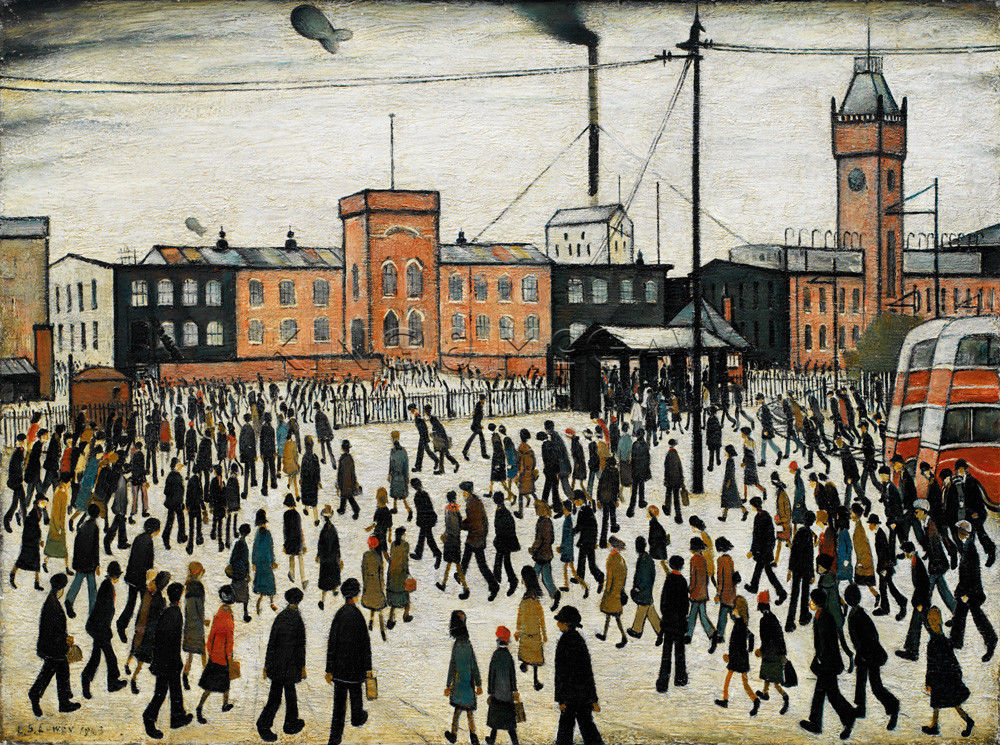
Bids for Shaun Greenhalgh art hit record on day

'Going to work' (1925) by L.S.Lowry
THREE paintings in the style of Lawrence Stephen Lowry by the Bolton artist Shaun Greehalgh, beat their reserve prices when they went on sale at the Bolton Auction Rooms today.  People at the auction rooms reported that the pictures were bought after a bitter series of telephone bids came in.
The reserve prices in the auction house catalogue was given as £1,000-£2,000 in the case of each painting.
On the day, a spkesman for the auction house told Northern Voices that one of the paintings went for £5,700, and the other two went for £5,100.
Shaun Greenhalgh was born in 1961, and became famous after the British Museum examined some of his work before two of his reliefs were submitted to Bonhams auction auction house in 2005, its antiquities consultant Richard Falkiner spotted 'an obvious fake'.  Then Bonhams consulted with the British Museum about various suspicious aspects, and the Museum then spotted several unlikely anomalies.
The Greenhalgh's family became known as the 'the garden shed gang'.  They built up an elaborate cottage industry at Shaun's parents' house in The Crescent, Bromley Cross, South Turton, which is  north of Bolton town centre.[
Shaun Greenhalgh had left school at 16 with no qualifications.   A self-taught artist, he had been influenced by his job as an antiques dealer, he worked up his forgeries from sketches, photographs, art books and catalogues.  He attempted a wide range of crafts, from painting in pastels and watercolours, to sketches, and sculpture, both modern and ancient, busts and statues, to bas-relief and metalwork.  He invested in a vast range of different materials - silver, stone, marble, rare stone, replica metal, and glass.  He also did meticulous research to authenticate his items with histories and provenance (for instance, faking letters from the supposed artists) in order to demonstrate his ownership.  Completed items were then stored about the house and garden shed. The latter probably served as a workshop as well.
Shaun's father, George Greenhalgh, who fronted as the sales operation of the fakes – produced by Shaun, died in October 2014 at the age of 91.
Since his Dad died, Shaun Greenhalgh has produced several paintings in the style of Lowry which went on sale in Bolton today, and bringing more than double their reserve price.
The three successful pictures at the auction included 'Going to work'; 'Coming from the mill'; and 'Before kick off', all framed oil on canvas after L.S.Lowry, and painted by Shaun Greenhalgh in 2015.


Thursday, 19 January 2017

Andy Burnham Says 'I'll be a people's Mayor!'

by Brian Bamford
TODAY at The Albert Halls in Bolton's Victoria Square the Labour candidate for the Greater Manchester Mayor's job told those who gathered to hear his manifesto for 'A safe, inclusive and diverse Greater Manchester' that he would be a 'People's Mayor' and a 'Grass-roots Mayor'
Mr. Burnham declared himself in favour of 'Safer Streets' and promised to work with the Chief Constable to start recruiting new police officers that reflect the diversity of Greater Manchester.  He promised to create 'a different relationship between the State and the Voluntary sector'
We were told that 'Crime is on the rise' and that 'Deep inequalities remain', and that 'we have seen an increasing amount of young people sleeping on the streets'.
The Labour candidate for Mayor worried about the cost of transport and bus fares, though he never said how often he used a bus, he spoke of housing problems and it was claimed that many young people will never be able to own their own house.  It was said that pensioners were made to feel guilty for claiming state pensions.  That scapegoating was prevalent in what was called the 'blame culture' of British society were everyone knows his or her place and fears the disruption that foreigners may bring:  it was said that one Polish nurse had been abused by people who she was treating in the Bolton community, telling her to 'Get back to Poland!'
Andy asked us 'Why has Mental Health shot up the social agenda?', and suggested that the 'voluntary sector' was 'person sensitive' while the 'Statutory sector' was much less inclined to address a 'personalised approach'
He claimed that he had in mind a new apprenticeship system which would draw upon the good things in the traditional apprenticeship and blend it with new concepts:  saying that he had had contact with the union UCATT. 
Regarding care in the community he said that he wanted to recruit the help of the Communication Worker's Union (CWU) to get the post-men to keep an eye on old and frail people in society.  This, he claimed, would reduce the isolation and insecurity people felt.
What was wanted was 'a young-people's cabinet to advise the Mayor on all areas of policy and ensure young peoples' voices are heard'.
Then in keeping with the latest fashion, Mr Burnham stated:  'I am proud that Greater Manchester has such a thriving LGTB community, rivalling London as the LGBT capital.'
Nothing was said about the Labour councillors in Rochdale who last month voted themselves a 34% increase, though one of the Rochdale Labour councillors at the Burnham manifesto meeting quietly told me that he was not going to take the rise, and when asked what the Rochdale Council leader, Richard Farnell, was thinking of by forcing the rise through on a whipped vote he said:  'He's Big Headed and doesn't care about UKIP!'
Nothing was said about the Labour Council leader of Manchester City Council, Richard Lees, who had addressed a meeting of Voluntary Organisations on Devo-Manc at which he said he wanted to see ward and hospital closures across Manchester, including Tameside because he believed that many people are in hospital who ought not to be, and could have their needs better met elsewhere.
Fear of the threat of UKIP was ever present in the workshops.

Monday, 28 November 2016

TUC Crown's Representative to TUC-JCC

AFTER it was decided that Alec McFadden was not eligible to stand for election as the new interim North West representative on the TUC-Joint Consultative Committee, Stephen Hall from Bolton Trade Union Council was appointed to serve in Mr McFadden's place.  This replacement follows a dispute over an internal complaint against McFadden by a member of the Unite union.*  Details of this story have already been published on this Blog.  Tameside TUC in Greater Manchester also submitted a nomination for the post but it was claimed that this arrived too late for consideration.
No-one it seems, least of all Stephen Hall, wanted a coronation, but it could be that the TUC preferred a coronation rather than an election because it is cheaper.


Rule 27 Investigations:
The Regional Secretary advised that with regard to the disciplinary of Mr. Alec McFadden, the Rule 27 Panel had decided that there was a case to answer.  Following Mr. McFadden's appeal in London, the appeal committee found that he had been found guilty of inappropriate behavior and that he be removed from office, with a bar on holding office both for the remainder of the present electoral period and for the next electoral period and that he be required to attend an Equalities Training Course.

Friday, 5 June 2015

Prisoner Pedro Cuadrado & the Spanish War

ADLINGTON Library has an exhibition running until June 12 entitled  ‘Heath Charnock's Green Men’ telling the story of the Spanish anti-fascist prisoners of war at the Hall o' th' Hill Camp.


On Friday June 5, at 7pm, there will be a talk by Dr Richard Cleminson who is a reader in Hispanic Studies at the University of Leeds.
One of the contributors to the exhibition is Lisa Croft who lives in Westhoughton. Her grandmother was a local journalist and wrote articles about the men and had a local artist do sketches to illustrate the stories.
Pedro Cuadrado died in 2010 aged 88.
His life story was recorded and stored at the Imperial War Museum for future generations to learn more about what happened to him and other Spanish men.
As a teenager, living in Barcelona, he was conscripted into the Republican Army fighting General Franco in the Spanish Civil War.
The father-of-three, grandfather and great-grandfather was among the survivors when a truck carrying soldiers was bombed at the battle of Ebro.
His story was the kind read about in books or seen in films.
As Franco's grip tightened he fled across the Pyrenees to France with thousands of others and in France was placed in a refugee camp. But as the Germans invaded at the start of World War Two he fled towards Switzerland, was caught and made a prisoner of war. During his time in the camps this amazingly talented man learned to speak five languages.
He was put to work helping the Nazis build an underground factory near Paris. An attempt to escape failed and he was recaptured.
As the Allies gained ground in the war he found his future in the hands of the Americans and they passed him and his fellow Spaniards over to the British who shipped their prisoners to England.
Pedro found himself interred in the camp near Adlington and two years later became a spokesman for his comrades arguing for their release. The men were freed and Pedro settled in Bolton.
He worked for a textile company in Manchester and married Pauline.  They had children Elena, Carlos and Adrienne.   Pedro became known for his singing in the Casablanca Tavern in the town each evening. He loved introducing people to the Spanish culture and this soon led to him setting up his own bar, Pedro's Taverna.
This bar became a meeting place for everyone from soap stars and footballers to ordinary local folk.
He was famous for his chilli con carne and sangria.  Although he gave up running the taverna in the 1990s he still lived above the premises and his home remained a meeting place for his many friends until his death.
In one of our photographs you can see the Spanish anti-fascist prisoners standing at the entrance of the Hall o' th' Hill camp.
The authorities allowed them to erect a board so that they would not be confused by the local population with German POWs.
To find out more about this fascinating piece of history pop along to see the exhibition or book a seat for the talk by ringing 0300 123 6703 or email adlington.library@lancashire.gov.uk