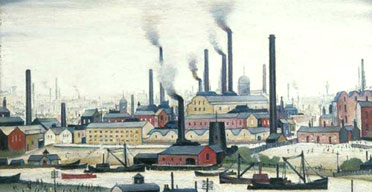
Showing posts with label LS Lowry. Show all posts

Monday, 20 February 2017

Bids for Shaun Greenhalgh art hit record on day

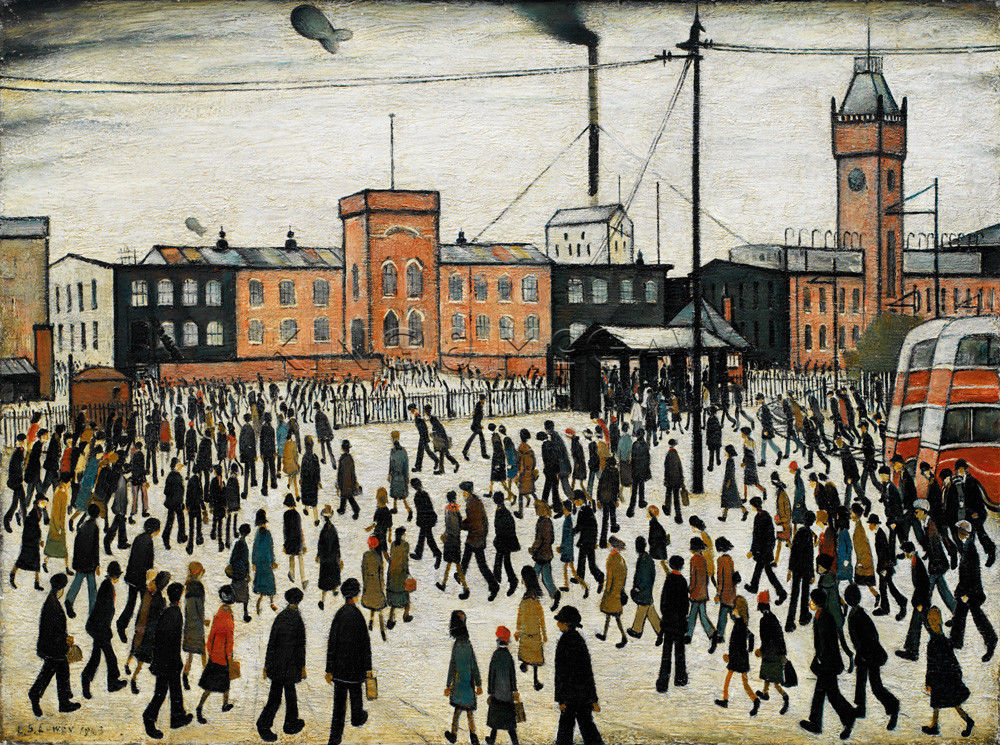
'Going to work' (1925) by L.S.Lowry
THREE paintings in the style of Lawrence Stephen Lowry by the Bolton artist Shaun Greehalgh, beat their reserve prices when they went on sale at the Bolton Auction Rooms today.  People at the auction rooms reported that the pictures were bought after a bitter series of telephone bids came in.
The reserve prices in the auction house catalogue was given as £1,000-£2,000 in the case of each painting.
On the day, a spkesman for the auction house told Northern Voices that one of the paintings went for £5,700, and the other two went for £5,100.
Shaun Greenhalgh was born in 1961, and became famous after the British Museum examined some of his work before two of his reliefs were submitted to Bonhams auction auction house in 2005, its antiquities consultant Richard Falkiner spotted 'an obvious fake'.  Then Bonhams consulted with the British Museum about various suspicious aspects, and the Museum then spotted several unlikely anomalies.
The Greenhalgh's family became known as the 'the garden shed gang'.  They built up an elaborate cottage industry at Shaun's parents' house in The Crescent, Bromley Cross, South Turton, which is  north of Bolton town centre.[
Shaun Greenhalgh had left school at 16 with no qualifications.   A self-taught artist, he had been influenced by his job as an antiques dealer, he worked up his forgeries from sketches, photographs, art books and catalogues.  He attempted a wide range of crafts, from painting in pastels and watercolours, to sketches, and sculpture, both modern and ancient, busts and statues, to bas-relief and metalwork.  He invested in a vast range of different materials - silver, stone, marble, rare stone, replica metal, and glass.  He also did meticulous research to authenticate his items with histories and provenance (for instance, faking letters from the supposed artists) in order to demonstrate his ownership.  Completed items were then stored about the house and garden shed. The latter probably served as a workshop as well.
Shaun's father, George Greenhalgh, who fronted as the sales operation of the fakes – produced by Shaun, died in October 2014 at the age of 91.
Since his Dad died, Shaun Greenhalgh has produced several paintings in the style of Lowry which went on sale in Bolton today, and bringing more than double their reserve price.
The three successful pictures at the auction included 'Going to work'; 'Coming from the mill'; and 'Before kick off', all framed oil on canvas after L.S.Lowry, and painted by Shaun Greenhalgh in 2015.


Friday, 5 August 2016

Sleazy Simon Danczuk!

TOMORROW's Rochdale Observer carries an unsigned letter that claims that Simon Danczuk used 'Fameflynet, a celebrity photo agency' to have photos of himself and a blond woman leaving the Lowry Hotel after a romp.  The photo shows Mr. Danczuk in a suit that looks he has spent the night in bed wearing. 
The letter writer writes:
'The last time he flogged photos of himself to this particular agency it was when he was questioned by Lancashire Police about allegations of historic rape.'
He seems to be making a good living out of behaving badly.  And, the people of Rochdale voted for this get rich quick guy!  God Bless them!
The un-named writer comments:
'Labour must act now on an out of control narcissist.  Danczuk thinks it's OK to peddle this sleaze to the highest bidder.'
Yet, there is no sign of the Rochdale Labour Council Leader, Richard Farnell, doing anything to stop Mr. Danczuk.  The last time Councillor Farnell was asked about Danczuk by the Lib Dem opposition leader, Andy Kelly, he said that he is 'a hard working MP' who 'has a lot on his plate!'
He didn't mention at that time that most of his hard work seems to be done between the blankets. No doubt we haven't seen the last of the sexy side of Mr. Danczuk and maybe we've got until 2020 before there is any let-up in this kind of athletics.

Wednesday, 4 September 2013

The Unseen Lowry Exhibition at the The Lowry Gallery, Salford Quays

The Guardian has described the unseen works as a "testament to Lowrys skill and sense of humour".   These drawings were never shown when Lowry was alive  and only came to light after his death when they were revealed to Carol Ann Lowry (no relation).    Shelley Rohde has written about them in her biography of Lowry- " A private view of L S Lowry".    "They were drawings of a young slender girl....She is dressed as a ballet dancer, a doll, a puppet, her costume cut low to reveal the sensuous curves  of her breasts or the dark shadow of her nipples. .....in one her head is severed from her body with a mighty sweep of an axe....In one she is prostrate beneath a guillotine her head half separated  from her body.    In some the collar of her grotesque costume is monstrously huge, like an instrument of medieval torture, so that it strangles her, twisting her head into attitudes of agony".

It beggars belief that anyone can see a sense of humour in these very disturbing images with elements of bondage and sado-masochism.     However, there are a large number of other paintings and drawings of Lowry on display since Salford has the largest collection of Lowrys works  in the country (about 400) .     The exhibition is well worth a visit especially since there is a superb guided tour by gallery staff and the one I attended on Tuesday afternoon really excited my interest in discovering more about this remarkable northern painter who spent nearly 40 years at 117 Station Road, Pendlebury where he painted most of his industrial scapes ( the famous matchstick men and women). The current issue of Northern Voices has an article by Chris Draper on Northern Artists in which Lowry comes out top in "Six of the best Northern Artists".

The Unseen Lowry runs until September 29th at the Lowry Gallery Salford Quays.    There is free admission and its well worth a visit.   

Monday, 1 July 2013

Modern Life Captured by L.S. Lowry at Tate


The 'Northern Aesthetic':  Revealing the 'Unseen' & 'Unnoticed' features of the everyday

Lancashire Fair, Good Friday, Daisy Nook by Laurence Stephen Lowry
HOW important is the new Tate Britain's exhibition 'Lowry & the Painting of Modern Life,' curated by the Marxist art historian T.J. Clark and his American wife Anne Wagner?  Was Christopher Draper right to use L.S. Lowry in his aim in his essay 'Six O' the Best Northern Artists', in the current issue of Northern Voices (NV14), to try to establish the existence of a 'Northern Aesthetic' in the North of England?  How representative is Lawrence Stephen Lowry of our culture and civilisation?
The reviewers on Radio Four's 'Saturday Review', last weekend, were scornful about Lowry accusing him of being repetitive; of misanthropy; of not being 'politically correct' with his uncomfortable picture 'The Cripples'; of him not having progressed as an artist during his long life; and of creating caricature figures. Was L.S. Lowry a great artist?  A provincial or folk artist?  Or just a rent man who became a weekend painter? 

In last Saturday's Financial Times (FT), Jackie Wullschlager wrote that the exhibition 'is the most radical and exciting re-evaluation of a British artist I have ever encountered, and a thrilling display of how paint conveys ideas, time, place – building a self-contained world at once absorbing and convincing in its relation to lived experience.'

At Brantwood, on the shores of lake Coniston in our northern Lake District, we have the last residence of perhaps our most famous art critic John Ruskin, and the other week when I was there I read a quote from one of his essays in which he says something like (I can't remember the exact quote): 
'For every 100 people there are perhaps 10 who can think, and for every 10 who can think there is perhaps one who can see. For seeing is the most difficult thing'

Lowry has said that he was converted to representing the world of work and industry up North after he was returning from work one day to his home in Pendlebury in Salford, when he got off the train and caught sight of something he'd passed many times before without note: 
'One day … as I left the station I saw the Acme Spinning Company's mill. The huge black framework of rows of yellow-lit windows stabding up against the sad, damp, charged afternoon sky. The mill was turning out. I watched this scene – which I'd looked at many times without seeing – with rapture.' 

When in the 19th century, he was invited to address the great and the good at Bradford Town Hall, John Ruskin bitterly told the local burgers and business men that they wanted him to praise their off-the-peg Gothic building but that what they really wanted to create was shore-to-shore chimneys across England.  The FT art critic Jackie Wullschlager, commenting on Lowry's 'Industrial Landscape Wigan' (1925), writes: 
'It is dusky black, an impressionist tonal oil of puffing chimneys looming over a grim scene of the sort described a decade later by George Orwell in 'The Road to Wigan Pier': “A world from which vegetation had been banished, nothing existed except smoke, shale, ice, mud, ashes and foul water”.' 

The critics on Radio Four last Saturday claimed Lowry does not paint people very well, but Chris Draper quotes an explanation from Lowry in Northern Voices No.14 (NV14) on this topic:
'I wanted to paint myself into what absorbed me... Natural figures would have broken the spell of it, so I made my figures half unreal.  Some critics have said that I turned my figures into puppets, as if my aim were to hint at the hard economic necessities that drove them. To say the truth, I was not thinking very much about the people. I did not care for them in the way a social reformer does. They are part of the private beauty that haunted me. I loved them and the houses in the same way.'

He refers to the people littering his pictures such as those peopling the town centre of 'The Three Cats Alston' (1969) that illustrates the front page of NV14 as being 'half real'. There are other pictures filled with folk at the Tate exhibition such as 'The Pond' (1950), yet 'River Scene' (1935) is a bleak people-less landscape which both predates and reminds me of Max Ernst's post-war surrealist picture 'Europe After the Rain'.

The art establishment has long neglected Lowry and some have suggested that this is because of the nature of southern snobbery, but last night I spoke to one of our northern contacts at Freedom Press, and she may well do a review for Northern Voices of the Tate Britain exhibition.  We know that Lowry collected Rossetti, but who can we compare him with?  We also know that he was taught by the French impressionist Adolphe Valette, and the Tate is exhibiting a foggy view of Manchester in the current exhibition.  Some have claimed that the geographical status or so-called terroire doesn't matter to the true artist as it does for wine or cheese.  As Nietzsche says 'an artist, a man has no home' and Alfred de Musset assertion 'Great artists have no country'.  And yet, Mr. Draper writes:  'for Lawrence Stephen Lowry there was no place like home'.  Some artists need to situate themselves geographically in order to create and produce their work: Van Goth needed the sun and the South of France, while Henri de Toulouse-Lautrec had to work in Paris and situate himself among the Parisian demimonde painting provocative images of the modern and sometimes decadent life of those times and living in the heart of Montmartre, an area he rarely left over the next 20 years.  Thus Lowry lived out most of his life in what is now Greater Manchester and just as Henri de Toulouse-Lautrec worked in Montmartre:  Lowry painting the ordinary scenes and everyday life of industrial Lancashire, and Toulouse-Lautrec painting the extraordinary and exotic in Montmartre.  Both capture the spirit of the two distinct and different civilisations.
_________________________________________________________

The current printed issue of NORTHERN VOICES No.14, is now available for sale with an essay by Chris Draper on 'Northern Artists and the Northern Aesthetic'.  Northern Voices No.14 can be obtained as follows:
Postal subscription: £5 for the next two issues (post included). Cheques made payable to 'Northern Voices' should be sent c/o 52, Todmorden Road, Burnley, Lancashire BB10 4AH.
Tel.: 0161 793 5122.
email: northernvoices@hotmail.com

Wednesday, 26 June 2013

Cyril Smith Our Answer to Silvio Berlusconi!

Former RAP Editor, John Walker, joins NORTHERN VOICES

IN the current edition of Northern Voices (No.14) a former Editor of the Rochdale Alternative Paper (RAP), John Walker, leads with a report on 'Sir Cyril Smith: Our Role in His Downfall!' This account documents those parts of the minority media and independent press that have struggled over the years to put facts of what was really going on into the public domain. Even now it is believed that not everything has been revealed and the nature of a cover-up and those involved in it to protect Cyril Smith has yet to come out. In the end Sir Cyril Smith in his political and sexual appetites begins look like Rochdale's answer to Italy's Silvio Berlusconi.

John Walker founded RAP in the early 1970s together with his friend and colleague David Bartlet. RAP was published on Spotland Road in Rochdale for over 10 years and in the end had a print order of 7,500 copies. John later worked for the Labour Research Department in London and has occasionally written for Private Eye. He is now an author on the Northern Voices' Blog and researched the nine-pages that composes 'Cyril Smith's Spanking Memoirs' in NV14.  Interestingly, unlike some on the NV Editorial Panel, he has history of being associated with political anarchism and has rather been more main stream politically while being journalistically close to the Private Eye school.  Though there have over the years Northern Voices has had many writers who would not identify with anarchism, and a few such as Paul Arnold and Jason Addy have been on the editorial panel, they have mainly been political campaigners while John's journalistic roots in alternative reporting go back decades.

Also in NV14 there is an interview with blacklist protester George Tapp, conducted in May by Barry Woodling at the Salford Royal Infirmary, after he was injured in a road rage incident on a picket at the Manchester City ground on the 15th, May. Tameside Eye breaks with a story about the blacklist and Harold Walker, the ex-President of Ashton Trades Council and a former member of the Trotskyist Socialist Labour, who rose to become Baron Walker of Doncaster and Deputy Speaker of the House of Commons. More news from Salford, Burnley, Manchester and Tameside.

Today, as the Tate Gallery in London has an exhibition that finally gives recognition to Salford artist Laurence Stephen Lowry, Northern Voices cultural correspondent Chris Draper selects his 'Six O' the Best Northern Artists', quoting John Ruskin famous retort to Whistler:
'I have seen and heard much of Cockney impudence before now; but never expected to hear a coxcomb ask two hundred guineas for flinging a pot of paint in the public's face!'

Debbie Firth quotes from Rochdale author Trevor Hoyle's book 'Rule of Night' (1975) to begin her comment on the local Council's attempts to restore Rochdale town centre. The now disgraced Rochdale politician, Cyril Smith wrote in his autobiography 'Big Cyril' (1977)'They call Rochdale the town with the clean face and the dirty neck. The clean face is W.H. Crossland's magnificent Victorian Gothic town hall ...' and 'the dirty neck is the surrounding ring of slums now thankfully being cleared'; in last Sunday's London Observer at the culmination of her review of the book 'Modernity Britain: Opening the Box, 1957-59' Catherine Bennett wrote:
' “Though the centre of Rochdale is rather fine,” this champion of the working man (Richard Crossman) wrote on a byelection visit, “the rest of it is the usual ghastly Lancashire town, with its slummy streets running up and down the hills.” They would soon be wiped out.'

Here too in NV14 is the long awaited review of the northern historian David Goodway's book 'Anarchist Seeds Beneath the Snow: Left-Libertarian thinking and writing from William Morris to Colin Ward' by Derek Pattison considers the degraded nature of the term 'anarchist' in the English political lexicon which according to Mr. Goodway always 'attracted scorn...' in England, and yet mysteriously it still exists in society, like the seed in Ignazio Silone's original novel 'The Seed Beneath the Snow' still survives perhaps secreted (by the peasants) in the intestines of a mule were the police can't find it.  In England it is hard to be grown-up and an anarchist at the same time but Mr. Goodway points to some decent and sensible figures, like Colin Ward and William Morris, who managed to achieve this.
_________________________________________________________
The current printed issue of NORTHERN VOICES No.14, is now available for sale with a review by Derek Pattison of Dave Goodway's book 'The Anarchist Seeds Beneath the Snow: from William Morris to Colin Ward', Northern Voices can be obtained as follows:

Postal subscription: £5 for the next two issues (post included). Cheques made payable to 'Northern Voices' should be sent c/o 52, Todmorden Road, Burnley, Lancashire BB10 4AH.
Tel.: 0161 793 5122.
email: northernvoices@hotmail.com
Thursday, 22 November 2012

Tower Hamlets to Sell-off off Henry Moore!


Making Savings on the Arts down South
 Draped Seated Woman, a three-metre tall bronze by Henry Moore, is currently on display at the Yorkshire Sculpture Park. Photograph: Bethany Clarke/Getty Images


TOWER HAMLETS in London has taken the decision to sell-off the borough's Henry Moore sculpture 'Draped Seated Woman' (pictured above) and known locally as 'Old Flo', to help cover the council's budget problems;  it is faced with cuts of £100.  In doing so it follows in the footsteps of councils in the northern towns of Bolton and Bury.  In 2011, Bolton Council put up for sale 35 works of art, including Millais, Picasso and Hutchinson, and in 2006 Bury Council faced much criticism when it sold off L.S. Lowry's 'A Riverbank' for £1.4m.

At the time of the Bury Council sale of the L.S. Lowry in 2006, Simon wrote:  'The town of Bury was once a cut above adjacent Bolton and Oldham.  Though in the heart of mill country, it had the aura of a small market town, ruined only in the 1970s by a crazy burst of road building.  It's art collection was given by a local paper-making tycoon, Thomas Wright, in the 1880s on condition that the town built an appropriate gallery, which it nobly did.'

A Riverbank by LS Lowry
'A riverbank' by L.S. Lowry

At that time, Mr. Jenkins argued that 'The Museums Association is not protecting galleries by punishing those whose relationship with their council has collapsed under government force majeure'.  Since then Bolton, only last year sold off its Millais painting, getting £74,00 for 'A Somnambulist', well below the auctioneer's estimate, and does not do much to solve the Bolton Council's financial problems. 

Thus, Tower Hamlets, one of London's poorest boroughs, follows on in a sad tradition of the northern councils.  Today it is selling in a climate of high prices for works of art as the market is on a roll.  The temptation is seemingly too great for council bumpkins across the land to resist:  'Let's sell the arty-fary stuff and build a road or summat!'.  So it will be that, as the poet Phillip Larkin said:  'England will become a land of concrete and tyres'.

Monday, 4 July 2011

Death of Salford Class War Veteran - Ken Keating!


THE following obituary for Salford Class War Veteran, Ken Keating, appeared on Ian Bone's blog earlier this week:

Just received sad news from Sean Keating from Salford:

R.I.P KEN KEATING. 24/01/38 - 28/06/11, Legend, Friend, Father, Grandad. My dad Loved by many, hated by authority but respected by all. Safe journey to mum old timer x

Ken was the prime mover in Ordsall Class War in the 1990s and i think it would be safe to say none of us had ever seen the likes of Ordsall Class War! There are others who knew Ken far better than me and I hope to be publishing their thoughts when they are ready. In the meantime best wishes to Sean and family.

See picture of Ken and his ‘Grasswatch’ van here.

What did Ken think about the Lowry Arts Centre:

Oh yeah in an interview with Ken Keating I asked him about Lowry: He gave me a contemptuous look and said “Lowry he was just a f******g rent collector.”

Here’s an account from Practical History of Ordsall Class War in July 1992:

On the Ordsall Estate in Salford (near Manchester), in the space of several days in the first week of July, fires were started at a council neighbourhood office, a housing office, a careers office, a Department of Health office, a MacDonald’s restaurant, and several other buildings. Shots were fired at police vehicles and a petrol bomb thrown at a police station.  Also in Salford, eight people in balaclavas attacked a police car that they had lured into an ambush by setting off an alarm. Local youths complained of police violence, with one saying: “There’s people who can’t pay for electricity. And they’re at home in bed, in the dark, and the door’s kicked in and all they can see is big torches coming up the stairs and the Bill [the police] is saying ‘Stay where you are or you’ll get your heads blown off’”. Another said: “It’s just like Belfast. The police don’t relate to the kids. Why are they dragging them in, beating them up?”

********************