
A second showing of The Brixton Tapes has been arranged, due to the
popularity of the first night:
So, another chance to see the long lost and excellent documentary on the
1981 Brixton Riots with an introduction from our very own Alex (121/ Past
Tense).
Tuesday 28th July
at Whirled Cinema,
259 Hardess St,
Loughborough Junction
London
SE24 0HN
Tickets:https://www.whirledcinema.com
Doors open 7pm. Film showing 8.30pm. There is a bar there so come early...
£5 non members £3 members.
About the film:
The Brixton Tapes, (1981)
Director: Greg Lanning. Television History Workshop
Filmed by a local collective based in Brixton, and consisting of footage
from the April 1981 Brixton Riot, together with interviews with
participants, and other local residents, The Brixton Tapes was filmed in
the immediate aftermath of the uprising. It features local people’s
accounts of the widespread racist and violent policing preceding the riot,
and of the events of the days of disturbances; accounts which contrast
with mainstream media coverage.
The April 1981 riot was a seminal event – followed less than 3 months
later by rioting in inner cities across the whole country. It led to
massive changes in perceptions of policing and race relations. But the
2011 riots, together with widespread concerns about renewed Stop and
Search powers, and current uprisings against police violence in the US,
show that what happened in Brixton, in April 1981 remains relevant today.
Brixton today is also in the grip of another life and death struggle:
between what remains of its vibrant community and development and
gentrification…
Facebook event: https://www.facebook.com/events/1587774461497768/
The film will be introduced by Alex Wild from Past Tense, a long time
Brixton resident and activist, who has taken part in, and written about,
some of Brixton’s turbulent recent past.
Past Tense is a radical history project, formed around a number of South
London rebels and writers, which produces publications, runs walks and
talks, on subversive, working class and hidden history, and relates it to
our own stories and present attempts to change the world for the better.
Check out past tense at:
www.past-tense.org.uk
Showing posts with label riots. Show all posts
Showing posts with label riots. Show all posts
Wednesday, 24 June 2015


Thursday, 9 January 2014
Mark Duggan Inquest: Police 'Not Guilty'
'NO JUSTICE, NO PEACE!'
FEAR of more riots and trouble in Tottenham, north London, is stalking the aftermath of the verdict that Mark Duggan was 'lawfully killed', following a majority jury decision at yesterday's Inquest into the death of Mark Duggan at the London High Court. After the verdict family and friends of Mr. Duggan reacted with anger.
Mark Duggan's aunt, Carol, said:
'The majority of people in this country know Mark was executed. He was executed and we still believe that.'
The jurors accepted that he was unarmed when the fatal shot was fired, but still ruled by a majority of eight to two that he was lawfully killed. Outside the High Court supporters shouted 'Murderers!' and 'No justice no peace.'
Mark Duggan, 29, was shot dead in Tottenham in August 2011, triggering riots in London which soon spread across Britain.
Today, Mr. Duggan's aunt, Carol said on Radio Four news that the family will push for a judicial review. The family solicitor, Marcia Willis Stewart said:
'No gun in his hand and yet he was shot-murdered.'
Last night, extra police were on stand-by in London just in case of signs of unrest.
Riots have a long history in England: in the 19th century on the afternoon of Monday the 8th, February, 1886, London, according to Sarah Wise in her book 'The Blackest Streets', witnessed 'the first of a series of mass demonstrations of the London unemployed, terrifying and astonishing the West End'.
Ms. Wise writes:
'It was one thing to read accounts of privation and appalling conditions in the London slums; it was quite another to see British labouring men (widely thought to be docile, inarticulate and apolitical) going so far as to organise themselves and march behind banners that appeared to question the social and economic foundation of British civilisation.'
The family have urged supporters of Mark Duggan to be peaceful, and a vigil for Mark will be held outside Tottenham police station at 2p.m. on Saturday.
Saturday, 29 June 2013
People's Assembly: We've Been Here Before!
ACCORDING to the organisers well over 4,000 people attended the People's Assembly last Saturday throughout the day. The organisers also claimed they brought together every organisation fighting and resisting austerity for the first time since the financial crash over five years ago. They maintain that they have captured the energy, potential and hope of millions of people affected by austerity, it called for concrete action to be undertaken across the country.
This, they say, includes:
A mass national protest at the Tory Party conference on 29 September in Manchester;
A day of civil disobedience on 5 November in every town and city across the country;
Local People's Assemblies to be established in every area possible;
A national demonstration in London in the new year.
In short yet more marching together, and inconclusive demos. More opportunities for left-wing organisations to sell their newspapers.
The organisers insist we now need to create an infrastructure that can support the local organisations and take forward the national initiatives that were launched at the assembly. To do this, we need your support. The People's Assembly are launching an urgent financial appeal to raise the funds to do this.
Please consider making a monthly donation, or a one off donation if you prefer. You can do this on the website here: http://thepeoplesassembly.org.uk/donate/
Many of the big names on the British left were there such as comedian Mark Steel, Caroline Lucas MP., Owen Jones, writer, and Ken Loach film maker. It was also a 'dear Do'! with tickets at £8 and £4 unwaged. Some asked how a movement of the grassroots could be built by the trade union bosses, and celebrities in the media and politics. Other worries was the influence of the Labour Party in all this.
One lad called Ray, a veteran campaigner, got it right when he said: 'It's all talk and hot air'. He continued:
'What for? To agree to go on another march? It's what's been going on for 40 years. I'm 71 in September... Only radical action on the streets will change anything.'
But even there he's probably optimistic, for the riots of 2011 change nothing. The thing is that inconclusive marches and demos like those already put on by the TUC disillusion people. While street riots can often provoke a public reaction and that calls for more authoritarian measures. Previous people's forums and assembles a decade ago eventually faded away.
This, they say, includes:
A mass national protest at the Tory Party conference on 29 September in Manchester;
A day of civil disobedience on 5 November in every town and city across the country;
Local People's Assemblies to be established in every area possible;
A national demonstration in London in the new year.
In short yet more marching together, and inconclusive demos. More opportunities for left-wing organisations to sell their newspapers.
The organisers insist we now need to create an infrastructure that can support the local organisations and take forward the national initiatives that were launched at the assembly. To do this, we need your support. The People's Assembly are launching an urgent financial appeal to raise the funds to do this.
Please consider making a monthly donation, or a one off donation if you prefer. You can do this on the website here: http://thepeoplesassembly.org.uk/donate/
Many of the big names on the British left were there such as comedian Mark Steel, Caroline Lucas MP., Owen Jones, writer, and Ken Loach film maker. It was also a 'dear Do'! with tickets at £8 and £4 unwaged. Some asked how a movement of the grassroots could be built by the trade union bosses, and celebrities in the media and politics. Other worries was the influence of the Labour Party in all this.
One lad called Ray, a veteran campaigner, got it right when he said: 'It's all talk and hot air'. He continued:
'What for? To agree to go on another march? It's what's been going on for 40 years. I'm 71 in September... Only radical action on the streets will change anything.'
But even there he's probably optimistic, for the riots of 2011 change nothing. The thing is that inconclusive marches and demos like those already put on by the TUC disillusion people. While street riots can often provoke a public reaction and that calls for more authoritarian measures. Previous people's forums and assembles a decade ago eventually faded away.
Friday, 21 June 2013
Hot Money & Turkey's Brave New World
AS the glass towers and shopping malls begin to dominate the historical centre of Istanbul, it is now becoming questionable as to whether the projects that gave rise to the uprising in Taksim Square are financially sustainable. Two weeks ago (6th, June 2013), Landon Thomas Jr., in the International Herald Tribune wrote: 'It is not often that the rock-throwing street protester and the seasoned bond investor reach a powerful economic insight at more or less the same instant.'
The worry is that the so-called 'hot money' that has been flowing into Turkey from investors after high-yielding assets, and financing all these malls and skyscrapers, are almost all short-term loans and that they could just as easily ditch the country. In 2013, Turkey will need $221 billion of financing from outside investors, and most of this will be in short-term loans.
Preparations are now underway for commemorating the 100th anniversary of the founding of the Turkish republic in 1923. In response to this Mr. Erdogan's government has announced a $400 billion public works program that equals over half the size of the $770 billion Turkish economy. Most of these are big projects that will have a highly visible impact on Istanbul, which is precisely what is pissing-off the protesters: planners are after a third bridge spanning the Bosporus at a price of $3 billion; a third airport, designed to be the world's largest, at a cost of $10 billion; and an Istanbul financial centre to compete with Dubai and London.
Some commentators are now comparing Turkey to the situations that prevailed in Ireland and Spain as the euro crisis hit the European Union. Richard Segal, a credit analyst at Jefferies investment bank in London, has said: 'This looks like a huge debt bubble'. He also said that Turkey was more vulnerable than other emerging markets pumped up by hot money in so far as domestic factors, like the possibility of riots might lead to political unrest, which would encourage investors to look for an exit, and the possibility of an increase in interest rates in the United States could reduce the flow of funds to emerging markets like Turkey.
Today, Tim Arango, in the International Herald Tribune reports that some of the liberals who have supported Prime Minister Recep Tayyip Erdogan in the past are now deserting him and his Justice & Development Party, owing to the violent government crack-downs on the demonstrations in the streets.
The worry is that the so-called 'hot money' that has been flowing into Turkey from investors after high-yielding assets, and financing all these malls and skyscrapers, are almost all short-term loans and that they could just as easily ditch the country. In 2013, Turkey will need $221 billion of financing from outside investors, and most of this will be in short-term loans.
Preparations are now underway for commemorating the 100th anniversary of the founding of the Turkish republic in 1923. In response to this Mr. Erdogan's government has announced a $400 billion public works program that equals over half the size of the $770 billion Turkish economy. Most of these are big projects that will have a highly visible impact on Istanbul, which is precisely what is pissing-off the protesters: planners are after a third bridge spanning the Bosporus at a price of $3 billion; a third airport, designed to be the world's largest, at a cost of $10 billion; and an Istanbul financial centre to compete with Dubai and London.
Some commentators are now comparing Turkey to the situations that prevailed in Ireland and Spain as the euro crisis hit the European Union. Richard Segal, a credit analyst at Jefferies investment bank in London, has said: 'This looks like a huge debt bubble'. He also said that Turkey was more vulnerable than other emerging markets pumped up by hot money in so far as domestic factors, like the possibility of riots might lead to political unrest, which would encourage investors to look for an exit, and the possibility of an increase in interest rates in the United States could reduce the flow of funds to emerging markets like Turkey.
Today, Tim Arango, in the International Herald Tribune reports that some of the liberals who have supported Prime Minister Recep Tayyip Erdogan in the past are now deserting him and his Justice & Development Party, owing to the violent government crack-downs on the demonstrations in the streets.
Tuesday, 4 June 2013
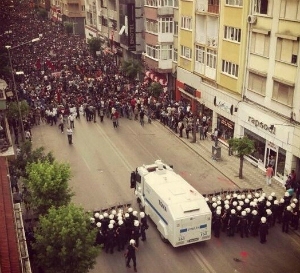
Turkey & Town Centre Politics
BELOW, Eric Lee of the website Labour Start calls for support for the campaign now taking place on the streets of Turkey against what some are calling the 'autocratic ambitions' of the Prime Minister Recep Tayyip Erdogan and his government. In today's International Herald Tribune, the journalist Tim Arango writes from Istanbul:
'Across this vast city, a capital for three former empires, cranes dangle over construction sites, tin wall barricade old slums, and skyscrapers climb higher than the mosque minarets that had dominated the skyline for centuries - all a vanguard for more audacious projects already in the works.'
Already two people are reported to have died since the start of the protests against the bulldozers and construction trailers that are rapidly changing the physical landscape of Istanbul. Edhem Eldem, a historian at Bogazici University in Istanbul, challenged the government for taking on massive development projects without seeking public support:
'In a sense, they are drunk with power (and) they lost their democratic reflexes and are returning to what is the essence of Turkish politics: authoritarianism.'
When the government announced a plan to convert Taksim Square, a historic place of public gathering, into a replica Ottoman-era army barracks and shopping mall; something Mr. Eldem, the historian, called 'a Las Vegas of Ottoman splendor', that was what incited the demonstrators. But Tim Arango writes: 'there are many other contentious projects that have drawn public outrage.' For example the city's oldest film theatre was demolished to make way for another mall, raising howls of protest; a 19th-century Russian Orthodox Church may be destroyed as part of a renovation of the port, and in ghettos across across the city, the urban poor are being uprooted and paid to leave their homes so the contractors can move in to build gated communities, according to Mr. Arango, many of these have ties to government officials. When this kind of thing happened in other European cities like Barcelona in the 1990s, it led to civic unrest when ethic communities moved out of the centre of the city to the periphery.
Please click here to send your message of protest -- and spread the word today.
Thank you!

Eric Lee
---
Which campaigns have I missed? Click here to find out.
'Across this vast city, a capital for three former empires, cranes dangle over construction sites, tin wall barricade old slums, and skyscrapers climb higher than the mosque minarets that had dominated the skyline for centuries - all a vanguard for more audacious projects already in the works.'
Already two people are reported to have died since the start of the protests against the bulldozers and construction trailers that are rapidly changing the physical landscape of Istanbul. Edhem Eldem, a historian at Bogazici University in Istanbul, challenged the government for taking on massive development projects without seeking public support:
'In a sense, they are drunk with power (and) they lost their democratic reflexes and are returning to what is the essence of Turkish politics: authoritarianism.'
When the government announced a plan to convert Taksim Square, a historic place of public gathering, into a replica Ottoman-era army barracks and shopping mall; something Mr. Eldem, the historian, called 'a Las Vegas of Ottoman splendor', that was what incited the demonstrators. But Tim Arango writes: 'there are many other contentious projects that have drawn public outrage.' For example the city's oldest film theatre was demolished to make way for another mall, raising howls of protest; a 19th-century Russian Orthodox Church may be destroyed as part of a renovation of the port, and in ghettos across across the city, the urban poor are being uprooted and paid to leave their homes so the contractors can move in to build gated communities, according to Mr. Arango, many of these have ties to government officials. When this kind of thing happened in other European cities like Barcelona in the 1990s, it led to civic unrest when ethic communities moved out of the centre of the city to the periphery.
The brutal crackdown on protests at the end of May in Istanbul's Taksim Square has shocked the entire world -- and triggered a massive wave of protests across Turkey. A coalition of organizations including trade unions has issued demands which trade unionists everywhere will support. These include: free all those arrested; drop all charges against them; hold accountable those responsible for the police violence; and lift all bans on meetings and demonstrations. Please send your message of protest and spread the word today.
A coalition of organizations including trade unions has issued demands which trade unionists everywhere will support.
These include:
A coalition of organizations including trade unions has issued demands which trade unionists everywhere will support.
These include:
- free all those arrested;
- drop all charges against them;
- hold accountable those responsible for the police violence;
- and lift all bans on meetings and demonstrations.
Please click here to send your message of protest -- and spread the word today.
Thank you!
Eric Lee
---
Which campaigns have I missed? Click here to find out.
Friday, 25 May 2012
'No Fault Dismissal' & Labour Law Reform
YESTERDAY, The Daily Telgraph ran a leader declaring that 'There is no excuse for economic timidity' and in the same issue on the facing page Peter Oborne wrote a column entitled: 'Leave Cable alone - he's the moral centre of this Coalition'. Adrian Beecroft, a Tory donor and private equity boss, had issued a report proposing 'no fault dismissal' for workers; so that they couldn't apply for justice in their cases at Employment Tribunals when they were sacked, even if they had been 'unfairly dismissed'.
What ought to be our position on labour law in these cases?
In Manchester since 2003, and now elsewhere, campaigns have been fought by electricians against blacklisting by taking their former employers the multi-national construction companies to the Employment Tribunals. It was the only way the electricians in the building trade could get justice. A few years ago some British libertarians, like 'Spiky Mike' a fomer housing manager, at a Northern Anarchist meeting even sneered at these efforts. Ought not the electricians to be fighting the blacklist using direct action and not in the courts of law, they would argue? After all the Spanish anarchists in the 1930s would never have turned to the Courts.
The context we now find ourselves is different from Spain in the 1930s, and the electricians had only one option in 2003 to make their point and that was to force cases through the Employment Tribunals and even to be prepared to go to the European Courts. This business of workers and trade unionists becoming barrack-room lawyers has not been an ideal process but it was the only way forward.
What will happen if that possibility of seeking justice at the Tribunals is taken away? Peter Oborne writes: 'Mr Beecroft, along with his Conservative admirers, has taken a very dangerous wrong turning ... The kind of untrammelled free market capitalism which Mr Beecroft is advocating is inhumane, unedifying and unBritish ...' Mr Oborne tells us of Mr Beecroft that 'he is very rich' and 'Apax, the company he helped to run, was one of a number of similar concerns which made vast fortunes for a tiny financial elite on the back of Gordon Brown's tax reforms at the turn of the century.'
Vince Cable, the Business Secretary, has dismissed this proposal saying that the Government doesn't want to 'frighten workers to death' with schemes like that of Adrian Beecroft's 'no fault dismissal'. He is right if we want English politics on the shopfloor and building sites to continue as they have been doing for the last generation or so with disputes often being argued out in the Employment Tribunals. But what Mr Oborne, and perhaps Vince Cable may worry about more, not to mention Mr Cameron and Mr Clegg, is that if the option of workers resorting to the Courts is withdrawn they may take to the streets more readily - as happened with certain other discontented elements in the August 2011 riots.
What ought to be our position on labour law in these cases?
In Manchester since 2003, and now elsewhere, campaigns have been fought by electricians against blacklisting by taking their former employers the multi-national construction companies to the Employment Tribunals. It was the only way the electricians in the building trade could get justice. A few years ago some British libertarians, like 'Spiky Mike' a fomer housing manager, at a Northern Anarchist meeting even sneered at these efforts. Ought not the electricians to be fighting the blacklist using direct action and not in the courts of law, they would argue? After all the Spanish anarchists in the 1930s would never have turned to the Courts.
The context we now find ourselves is different from Spain in the 1930s, and the electricians had only one option in 2003 to make their point and that was to force cases through the Employment Tribunals and even to be prepared to go to the European Courts. This business of workers and trade unionists becoming barrack-room lawyers has not been an ideal process but it was the only way forward.
What will happen if that possibility of seeking justice at the Tribunals is taken away? Peter Oborne writes: 'Mr Beecroft, along with his Conservative admirers, has taken a very dangerous wrong turning ... The kind of untrammelled free market capitalism which Mr Beecroft is advocating is inhumane, unedifying and unBritish ...' Mr Oborne tells us of Mr Beecroft that 'he is very rich' and 'Apax, the company he helped to run, was one of a number of similar concerns which made vast fortunes for a tiny financial elite on the back of Gordon Brown's tax reforms at the turn of the century.'
Vince Cable, the Business Secretary, has dismissed this proposal saying that the Government doesn't want to 'frighten workers to death' with schemes like that of Adrian Beecroft's 'no fault dismissal'. He is right if we want English politics on the shopfloor and building sites to continue as they have been doing for the last generation or so with disputes often being argued out in the Employment Tribunals. But what Mr Oborne, and perhaps Vince Cable may worry about more, not to mention Mr Cameron and Mr Clegg, is that if the option of workers resorting to the Courts is withdrawn they may take to the streets more readily - as happened with certain other discontented elements in the August 2011 riots.
Friday, 28 October 2011
How knee-jerk politicians got riots wrong!
OFFICIAL statistics now suggest that leading politicians were wrong in their initial attempt to blame gangland culture for the August riots. Of those arrested only one in eight were gang members and even where police identified that gang members were present, most forces now believe that they did not play a 'pivotal role'. Further, it has been argued on Radio Four's program 'More or Less' that the arrest statistics could themselves be biased and not give an accurate indication of the typical participants in the riots, because police methods of arrest by their nature tend to target people with previous convictions and prioritise gang members.
Outside London, the majority of police forces identified fewer than 10% of all those arrested as being gang members. Even in London the vast majority of those arrested at 81% were not identified as being members of gangs. This week's latest report by the Home Office and Ministry of Justice stresses the poor educational and socio-economic background of those arrested in the riots and states: 'It is clear that compared to the population averages, those brought before the courts were more likely to be in receipt of free school meals or benefits, were more likely to have had special educational needs and be absent from school, and are more likely to have some form of criminal history.'
Outside London, the majority of police forces identified fewer than 10% of all those arrested as being gang members. Even in London the vast majority of those arrested at 81% were not identified as being members of gangs. This week's latest report by the Home Office and Ministry of Justice stresses the poor educational and socio-economic background of those arrested in the riots and states: 'It is clear that compared to the population averages, those brought before the courts were more likely to be in receipt of free school meals or benefits, were more likely to have had special educational needs and be absent from school, and are more likely to have some form of criminal history.'
Thursday, 6 October 2011
Manchester Chief Constable denies trying to 'airbrush' riots
REPORTS today that the crime statistics are ignoring the riots were denied by Peter Fahy, Chief Constable of Greater Manchester, who said: 'It is plain silly to try to assess the impact of the riots in terms of the number of individual crimes committed'. In Manchester's St. Anns Square for example, where some of the worst violence took place, the site shows the lowest level of crime for four months, with just 21 incidents. In Manchester city centre as a wholem a rise was recorded in August, but the figure of 1,828 street-level offences was just 10 above April and 12 more than February, the shortest month. Mr Fahy said his force recorded 242 crimes in the city centre and 139 in Salford linked to the riots. Today's The Independent has a cartoon with a copper saying: 'Someone stole the crime figures.'
_________________________________________________
THE NEXT ISSUE OF NORTHERN VOICES - N.V.13 - IS OUT IN NOVEMBER. IT WILL HAVE COMMENT ON THE RIOTS IN THE NORTH, AND COVER THE PROBLEMS OF TAMESIDE COUNCIL, BLACKLISTING, COUNCILLOR QUINN & HIS ANXIETIES.
Northern Voices 13 is priced £2.20 [post & package included] or £4.20 for the next two issues cheque payable to 'Northern Voices' from:
c/o 52, Todmorden Road,Burnley,Lancashire. BB10 4AH.
Tel.: 0161 793 5122.
Email: northernvoices@hotmail.com
_________________________________________________
THE NEXT ISSUE OF NORTHERN VOICES - N.V.13 - IS OUT IN NOVEMBER. IT WILL HAVE COMMENT ON THE RIOTS IN THE NORTH, AND COVER THE PROBLEMS OF TAMESIDE COUNCIL, BLACKLISTING, COUNCILLOR QUINN & HIS ANXIETIES.
Northern Voices 13 is priced £2.20 [post & package included] or £4.20 for the next two issues cheque payable to 'Northern Voices' from:
c/o 52, Todmorden Road,Burnley,Lancashire. BB10 4AH.
Tel.: 0161 793 5122.
Email: northernvoices@hotmail.com
Sunday, 11 September 2011
Organised Vengence Called Justice?
On Wednesday the Guardian reported that 'Magistrates and crown court judges could be asked to dock benefits from convicted criminals under preliminary proposals being drawn up by the government in response to the riots ...'
Under these proposals anyone convicted of a crime could be punished by a magistrates court and then by the benefit office. In a hectic attempt to meet an October deadline, Whitehall is rushing through plans to publish its post-riot response: such as withdrawal of child maintenance or child benefit from parents who let their children truant, or repeatably let them stay out on the streets late at night. Some councils already have plans to evict families of convicted rioters from social housing and other court action and ideas such as parenting orders and care proceedings are now in the pipeline.
Meanwhile, a Northern Voices' contact in Bristol reports:
Bristol was caught up in the riots last month but certain areas have had a history of local riots for some time, particularly last May with the campaign against a branch of TESCOs in one district. In that case the riot was provoked after police intervention in a squat. Our reporter says:
There are unique localised aspects to the recent riots that don't fit any single-factor explanation. The riots received some scrutiny this week in the Guardian: 'Different kinds of disorder erupted in different towns towns and cities - Birmingham, Manchester, Wolverhampton, even Gloucester ... [i]n each, we will doubtlessly find, the dynamic was different.' Yet, in Tottenham, where the riots started on Saturday the 6th, August, there was a clear pattern to the events beginning with what seemed like a sloppy response by the local police
Likewise, Northern Voices' correspondent in Bristol also suggests some over-reaction and provocation by the police now:
In Tottenham, local 'socialist historian' and convenor of Tottenham Trades' Council, Keith Flett, who witnessed the start of the riots there, told the Guardian: 'we struggle to know why these things turn into riots ... to can put the same elements together and 99 times out of 100 it won't happen' but 'then something happens ... and that proves to be a spark.' Now, the Guardian and the London School of Economics is preparing to do a study of this, the most serious bout of civil unrest in a generation entitled 'Reading the Riots'.
Under these proposals anyone convicted of a crime could be punished by a magistrates court and then by the benefit office. In a hectic attempt to meet an October deadline, Whitehall is rushing through plans to publish its post-riot response: such as withdrawal of child maintenance or child benefit from parents who let their children truant, or repeatably let them stay out on the streets late at night. Some councils already have plans to evict families of convicted rioters from social housing and other court action and ideas such as parenting orders and care proceedings are now in the pipeline.
Meanwhile, a Northern Voices' contact in Bristol reports:
'I have just started voluntary work at The Methodist Centre which is a Drop-In Centre for homelessness people' and last Sunday 'I witnessed a blatant incident of Police Harassment ... I went to a small community festival in a Park. About a dozen stalls including Palestine Solidarity, Energy Awareness, Craft stalls etc. A band was playing Irish music on a small stage. A homeless guy of about 35 & his dog sat on the grass near the centre of the stage.He was doing nothing wrong but he had a can of drink in his hand. Four Police Officers (three hefty males & one female) took him behind a Food Stall - nearly out of sight. They stop-searched him. He kept his cool. I watched to see the Police behaved themselves. The Police seemed to have finished with him and I spoke to him. He was not drunk just fed up with being picked on. The three police then came over and served him a 12 hour exclusion notice to keep him out of the park. Very heavy handed tactics. I tried to keep him calm as they were on the edge of arresting him. One also provoked him with a few comments. He had to leave the park in the end.'
'What I think is happening is the police are singling out people they think may have been involved in the recent rioting' and he concludes, 'at these small festivals you only usually get the soft cops - the PCSO's ... the three large police officers at this event were bullyboys looking for trouble.'
Likewise, Northern Voices' correspondent in Bristol also suggests some over-reaction and provocation by the police now:
'I think individuals are at risk at present following the riots if they show any signs of dissent. What I saw on Sunday was intimidation tactics. The event was Mina Road Park Community Festival, St Werburghs, Bristol and was meant to bring the community together!!! Drinkers use that same park every day of the week without causing problems because its very near a privately owned hostel and its their back garden in effect. Apart from which St Werburghs is a very tolerant area and I am sure the community copes very well with those members unfortunate enough to suffer from homelessness & alcoholism.'
Saturday, 3 September 2011
D'Ya Wanna Be In My Gang? Erm, No Thanks!
 It’s been suggested elsewhere on the blog that the ‘organisers of discontent’ are no longer charismatic militants - maybe so. Perhaps there’s also a grain of truth in the comment that the ‘deeply conservative and reactionary’ responses to the recent riots are ‘rooted in the culture, history and politics of this country’.
 However, in putting forward the case for militancy, Bammy seems to have forgotten a point he himself made a while ago when commenting on the NUM, i.e. that militancy is not necessarily radical in its intent, often seeking to protect very narrow interests. Indeed, history can offer us many examples of militancy that is itself conservative in its aims or, at least, seeks to establish a state of affairs where conservatism will inevitably prevail.
A good example would be the case of the Suffragettes led by Emmeline Pankhurst and her daughter, Christabel, who are widely offered up as the militant faction of the female emancipation movement and thus too readily associated with universal female liberation. Scratch even a little beneath the surface, however, and you find that their militancy in smashing windows, etc was largely undertaken to achieve a property-based vote for their comfortably middle-class sorority. In fact, after a remarkably brief time spent with working class women in Manchester, Christabel Pankhurst branded them ‘too handicapped by poverty and lacking in prestige to be of any practical use’.
But let’s not pretend that this ‘conservative militancy’ was a middle-class affliction. In the period of jingoistic hysteria around the time of WWI (when, incidentally, Mrs Pankhurst abandoned the ‘votes for women’ campaign to support the war effort), the syndicalist Wilf McCartney said of his fellow workers:
‘Realising that this war had given workers better conditions for a short while (and saved capitalism) the workers would not tolerate anybody opposing the war or asking for peace. Harmless German shopkeepers had their shops wrecked, their goods thrown into the street, their homes ruined, and endured personal injury, all in the cause of smashing Prussian militarism. For the first time in my life I was ashamed of my class.’Of course, it could be argued here that in the wider class struggle it was not the nationality of the ‘harmless Germans’ that was relevant, rather the fact that they were shopkeepers, but that was not the reason they were targeted, nor was that the case in Britain’s cities a few weeks ago. Later, during WWII, a dachshund was stoned to death by a mob because it was German, even though there was no evidence that it held petit-bourgeois aspirations of any kind!
Today, it’s more than depressing that so many young people are so desperate to ‘belong’ that the vacuous culture of celebrity and consumerism holds so much sway over them, more so that they will fight and/or kill one another to forge an identity - whether as part of street gangs or in the better equipped military gangs that, for some reason, are deemed more socially acceptable, even admirable. When we then have to listen to Cameron et al telling us about ‘broken Britain’ whilst unleashing what is by far the country’s biggest (and most corrupt) organised gang to restore order, the situation is even more grim.
But what have working class youths supposed ‘homeboys’ in the trade union gang done to make young people, or anyone for that matter, think that there’s something more to life than being trodden under foot? Yes, they’ve sometimes been militant but rarely radical and their aims are usually specific to their own narrow world view. Ultimately, they’ve achieved the right to work all their lives but feel good about doing it because they might have secured a few extra crumbs from the master’s table. The Daily Mail reader is certainly ripe for contempt with their whining about the ‘nanny state’ whilst expecting the government to defend everything that their spurious middle class morality holds dear but perhaps they are also too easy a target here. Personally, I’m equally worried by those who see cradle-to-grave wage slaving as a badge of honour and look on those who reject this with contempt. These people might have the ability to be militant when their own situation is threatened but most don’t actually want to change things in any truly radical way.
Mainstream historians certainly have a penchant for airbrushing out genuine radicals but let’s not be too quick to convince ourselves that the left’s pantheon is therefore populated by those excluded elsewhere. Charismatic militants may make the headlines and, in the wake of the rise of ‘social history’, university textbooks, but they don’t necessarily represent a radical world view, in fact, they generally seek to uphold authoritarian and hierarchical social structures but with themselves in charge. If you want a strategy and agenda that offers real alternatives, it has to be one that acknowledges this, as well as also offering something more contemporary and familiar by way of example than the Lord of Misrule, or, dare I say it, the Spanish Civil War.
Given the current circumstances, this will undoubtedly be a ‘hard sell’ but it’s not like the ‘charismatic militant’ line is being eagerly consumed (or even looted) either.
Tuesday, 30 August 2011
Articulating Riots: 'MUG THE RICH - BASH THE RICH ...'
LAST WEEK, on the door of a public toilet in Cockermouth in Cumbria just across the road from the birthplace of one of our Northern poets William Wordsworth, I spotted the following piece of graffiti: 'MUG THE RICH ... If the State stops your money become happy shop lifter ... MUG THE RICH'. The same day in a cafe in Church Stile, near Elterwater, I overheard two middle-aged, middle-class men talking about sociologists and then one said: 'These riots over here are just me-too vandalism!'.
There has been a determined attempt in some quarters to shrug off this month's riots and to dismiss them as opportunistic crime - even some on the lower middle-class left have made superficial judgements about them based on outdated ideological positions. Others want to relate the riots to economic causes and the Government cut backs, and some define them in terms of 'Stop and Search' and police behaviour based on the original shooting of Mark Duggan. It was following this shooting that the BBC began by describing the riot outbreaks as 'protests' but later withdrew this categorisation when it seemed that what was taking place was random acts of vandalism and looting. There was an attempt to interview some heavily masked Afro-Caribbean lads on TV in which they gave sociological grounds for their actions, but afterwards Eric Pickles, Secretary of State for Local Government, said they 'seemed to be making post-riot self-justifications after talking to their social workers'.
Harry Eyres, in his column 'The Slow Lane' in the Financial Times wrote a piece entitled 'When words fail us all' on August 20th: 'So these were not protests in any articulate sense - in the sense, that is, of having a defined target or grievance at their core.' Public disorder on a major scale rarely happened in Britain in the 20th Century in contrast to mostly disciplined and mostly peaceful protests. Harry Eyres writes that what happened this time was 'different from the only other riots in London that I can remember, the Brixton riots of 1981 and 1985 and the poll tax riot of 1990; the former arising out of long-standing tensions between the black community and the police, as the subsequent Scarman Report confirmed, and the latter arising out of a demonstration against a levy very widely seen as unfair.' Mr. Eyres doesn't mention them, perhaps because they were in the North rather than London, but the recent riots also differ from the ethnic riots that occurred in Burnley, Oldham, Leeds and Bradford early in the last decade but he does say that they bear little resemblance to what he calls the 'essentially non-violent protests of the Spanish Indignados, people with defined grievances, especially concerning unemployment, able at least to articulate their own mood' and '... they were certainly different from the protests in Tahrir Square, marked by bravery and eloquence.'
The inarticulate responses of these riots were profoundly English just as the organised vengeance called 'justice' perpetuated by the Courts, egged on by the politicians, lacks a coherent grasp of what is actually going on, shelving sociological analysis for later consideration and placing us all in what Harry Eyres calls 'a peculiarly English tragedy of inarticulateness'. This English inarticulacy clearly extends beyond the realm of the young rioters and what's called the under-class, into the political classes in all their self-righteousness as anyone who has listened to their bumbling bombast will have recognised in the last few weeks: even a regular writer for Northern Voices - an anarchist and one of our own - has urged us to take a moral stand against the riots. In this country, as Harry Eyres maintains: '... The ruling classes seem as inarticulate as the so-called rioting under-class.' Sociologists, such as the ethnomethodologists, have drawn our attention to the 'seen but unnoticed features of everyday life' and Mr. Eyres writes: '... in England (not in Scotland, Ireland or Wales) there is an inarticulateness of the upper classes, the mumbling, stumbling inability to perceive what is staring you in the face.'
Northern Voices 13 - OUT IN NOVEMBER 2011: will be covering the riots; hacking; the Luddites; John Ruskin & the Arts & Crafts movement in the North; as well as the usual features such as 'Six O' the Best Northern Theatres'.
Northern Voices, a bi-annual regional journal available from 52, Todmorden Road, Burnley BB10 4AH.
Send cheque for £4.60 (post & packing included) for the two forthcoming issues.
Thursday, 18 August 2011
England's Riots! Are Britain's marginalised youth, 'Mustering for War'?
English radicals have always looked upon the common people with distrust and suspicion. Writing in the 1790s, William Godwin, who some regard as the first modern anarchist, believed that there was: "nothing more barbarous, cruel and blood thirsty, than the triumph of the mob."
Godwin, believed that the task of social change should be left to a "few favoured minds." His wife, the feminist writer Mary Wollstonecraft, also eyed the 'poor' with a certain contempt:
In his 'Radical History of Britain', Edward Vallance, points out that during the Peasants' Revolt of 1381, the mob while in London, engaged in "a carnivalesque orgy of violence and destruction targeted at foreigners and immigrants." In one street alone, it is claimed that the mob beheaded thirty-five Flemish weavers. They also beheaded many members of the nobility who were associated with introducing the dreaded Poll-Tax.
While riots and protests against government austerity measures have been taking place throughout Europe in countries such as Spain, France and Greece, the CONDOM coalition Prime Minister, David Cameron, along with other other British politicians, have been quick to deny any connection between events in England and other countries:
In a series of headline grabbing initiatives, Cameron, has announced that the government are considering withdrawing benefits from offenders, barring people who are suspected of causing unrest from Twitter and Facebook and apart from tougher sentences, making offenders homeless and destitute, which will no doubt lead to further crime.
'Troubled families' (120,000), are also going to be put on the 'Family Intervention Programme' which is run by the government`s 'Family Champion', the multi-millionaire, Emma Harrison, the founder of A4E. Families who do not participate are threatened with losing their homes and kids.
This is all a far cry from the 'compassionate conservatism' that Cameron once preached and his 'hug a hoodie' speech five years ago, when he was ridiculed by the New Labour government for pleading: "Let`s try and understand what has gone wrong in these children`s lives."
While some people no doubt saw the riots as an opportunity to steal (or to expropriate goods), to deny that the riots had anything to do with government policies, spending cuts, race, or poverty, is ludicrous, as many politicians know only too well. Only weeks ago, middle-class students were trashing stores in the West End of London in opposition to government policies. As Ed (Milibore) Miliband, grudgingly conceded, there is always a 'connection between circumstances and behaviour.'
As one might expect, both politicians and many in the media have been eager to dismiss any suggestion that there may be underlying reasons behind the riots. What they cannot accept is that successive governments for the last thirty years, have pursued policies which have incubated poverty in this country and which has led, to a giant leap in poverty and inequality in Britain. What they have created is a nation of ghettos, an economic apartheid, and a 'pandemic disease of working-class poverty'.
Though the Tory Daily Mail has been trawling through the English courts to find middle-class looters in order to demonstrate Britain`s so-called 'moral collapse', many of those arrested are youths from the inner cities who are often unemployed and have little or no prospects of improving their situation. Of the 2.5 million unemployed in this country, nearly one million 18-24 years old, are now unemployed. In Tottenham, (one of London`s poorest boroughs) where the riots started, there are 10,000 people claiming JSA and 54 applicants chasing every registered job vacancy.
A week ago, The Daily Telegraph columnist Mary Riddell, wrote in her column that though mob violence must always be condemned and that poverty does not ordain lawlessness, "those terrorising and trashing London are also a symptom of a wider malaise." According to Riddell, the economic situation in Britain today, is similar to what occurred prior to the 'Wall Street Crash' of 1929. She points out that in his explanation of the great crash, the economist J.K. Galbraith, set out four major factors which are all in evidence in Britain today: (a) bad income distribution, (b) corporate larceny, (c) a weak banking structure, (d) an import/export imbalance. Riddell argues that it is no coincidence that the riots in London took place at a time when the global economy is poised for freefall. Referring to the 'bubble of the 1920s', she adds:
The social unrest which has been taking place on Britain's streets, shows that there is an enormous amount of discontent among young people in this country. Like those disaffected young people in the Arab world, many feel that they have no prospects, no education, and nothing to lose but are paying the price for a financial crisis brought about by incompetent and crooked bankers. Politically, all parties now pander to the whims of the Daily Mail reading uneducated middle-classes, and are socially and politically indistinguishable.
Mary Riddell, the well-paid Daily Telegraph columnist, may indeed believe that 'poverty does not ordain lawlessness' but as that famous 19th century English novelist Charlotte Bronte once said in her novel 'Shirley', "Misery generates hate", a quote which can also be found on the front cover of Beveridges' pioneering 1942 report 'Full Employment in a Free Society', which laid the foundations of the modern welfare state.
Godwin, believed that the task of social change should be left to a "few favoured minds." His wife, the feminist writer Mary Wollstonecraft, also eyed the 'poor' with a certain contempt:
"I have turned impatiently to the poor...but alas! What did I see! a being scarcely above the brutes."There is of course nothing new about riots in this country. Many of us can remember the poll-tax riots and the riots in the early 1980s. But 18th century middle-class radicals like William Godwin, were wise to be wary of the mob. In Godwin's time, England, was said to be one of the most riot-torn countries in Europe and the mob was often used by the authorities, to intimidate and harass radicals and political malcontents.
In his 'Radical History of Britain', Edward Vallance, points out that during the Peasants' Revolt of 1381, the mob while in London, engaged in "a carnivalesque orgy of violence and destruction targeted at foreigners and immigrants." In one street alone, it is claimed that the mob beheaded thirty-five Flemish weavers. They also beheaded many members of the nobility who were associated with introducing the dreaded Poll-Tax.
While riots and protests against government austerity measures have been taking place throughout Europe in countries such as Spain, France and Greece, the CONDOM coalition Prime Minister, David Cameron, along with other other British politicians, have been quick to deny any connection between events in England and other countries:
"We're different in Britain from our Mediterranean friends", said former Labour culture minister, Tessa Jowell, "Walthamstow in north east London, is not Athens or any other Greek city."Cameron is also emphatic that the riots have nothing to do with race, poverty, social deprivation, or his government's policies. According to Cameron, the riots are down to pure and simple criminality, symptoms of a 'broken Britain', a 'sick Britain' where there has been 'moral collapse' and where people don't take responsibility but engage in lawlessness and opportunistic crime. He feels that it is necessary to take tough measures against the thugs and hooligans who have engaged in looting and the destruction of property.
In a series of headline grabbing initiatives, Cameron, has announced that the government are considering withdrawing benefits from offenders, barring people who are suspected of causing unrest from Twitter and Facebook and apart from tougher sentences, making offenders homeless and destitute, which will no doubt lead to further crime.
'Troubled families' (120,000), are also going to be put on the 'Family Intervention Programme' which is run by the government`s 'Family Champion', the multi-millionaire, Emma Harrison, the founder of A4E. Families who do not participate are threatened with losing their homes and kids.
This is all a far cry from the 'compassionate conservatism' that Cameron once preached and his 'hug a hoodie' speech five years ago, when he was ridiculed by the New Labour government for pleading: "Let`s try and understand what has gone wrong in these children`s lives."
While some people no doubt saw the riots as an opportunity to steal (or to expropriate goods), to deny that the riots had anything to do with government policies, spending cuts, race, or poverty, is ludicrous, as many politicians know only too well. Only weeks ago, middle-class students were trashing stores in the West End of London in opposition to government policies. As Ed (Milibore) Miliband, grudgingly conceded, there is always a 'connection between circumstances and behaviour.'
As one might expect, both politicians and many in the media have been eager to dismiss any suggestion that there may be underlying reasons behind the riots. What they cannot accept is that successive governments for the last thirty years, have pursued policies which have incubated poverty in this country and which has led, to a giant leap in poverty and inequality in Britain. What they have created is a nation of ghettos, an economic apartheid, and a 'pandemic disease of working-class poverty'.
Though the Tory Daily Mail has been trawling through the English courts to find middle-class looters in order to demonstrate Britain`s so-called 'moral collapse', many of those arrested are youths from the inner cities who are often unemployed and have little or no prospects of improving their situation. Of the 2.5 million unemployed in this country, nearly one million 18-24 years old, are now unemployed. In Tottenham, (one of London`s poorest boroughs) where the riots started, there are 10,000 people claiming JSA and 54 applicants chasing every registered job vacancy.
A week ago, The Daily Telegraph columnist Mary Riddell, wrote in her column that though mob violence must always be condemned and that poverty does not ordain lawlessness, "those terrorising and trashing London are also a symptom of a wider malaise." According to Riddell, the economic situation in Britain today, is similar to what occurred prior to the 'Wall Street Crash' of 1929. She points out that in his explanation of the great crash, the economist J.K. Galbraith, set out four major factors which are all in evidence in Britain today: (a) bad income distribution, (b) corporate larceny, (c) a weak banking structure, (d) an import/export imbalance. Riddell argues that it is no coincidence that the riots in London took place at a time when the global economy is poised for freefall. Referring to the 'bubble of the 1920s', she adds:
"Today, Britain is less equal in wages, wealth and life chances, than at any time since then. Last year alone, the richest combined fortunes of the richest people in Britain rose by 30% to £333.5 billion. As London burned, Europe`s leaders, our own Prime Minister and Chancellor included, were parked on sun-loungers. Successive British governments have colluded in incubating the poverty, the inequality and the inhumanity, now exacerbated by financial turmoil. Watch the juvenile wrecking crews on the city streets and weep for all our futures, the 'lost generation' is mustering for war!"
The social unrest which has been taking place on Britain's streets, shows that there is an enormous amount of discontent among young people in this country. Like those disaffected young people in the Arab world, many feel that they have no prospects, no education, and nothing to lose but are paying the price for a financial crisis brought about by incompetent and crooked bankers. Politically, all parties now pander to the whims of the Daily Mail reading uneducated middle-classes, and are socially and politically indistinguishable.
Mary Riddell, the well-paid Daily Telegraph columnist, may indeed believe that 'poverty does not ordain lawlessness' but as that famous 19th century English novelist Charlotte Bronte once said in her novel 'Shirley', "Misery generates hate", a quote which can also be found on the front cover of Beveridges' pioneering 1942 report 'Full Employment in a Free Society', which laid the foundations of the modern welfare state.
Friday, 12 August 2011
WHO ARE THE ORGANISERS OF DISCONTENT NOW?

During the disruption of the last few days neither the trade union bosses nor the leadership of what passes for the political left have had anything perceptive to say about the situation on the streets beyond mouthing the typical moral platitudes and proposing the usual half-baked law and order solutions. On Tuesday night, a Northern Voices reporter noted the absence of the extreme left parties on the streets of Manchester. Ken Livingstone, almost alone among politicians, raised the possibility of more sociological causes for the riots.
The left of centre National Shop Stewards Network (NSSN) in a statement has said: 'TUC general secretary Brendan Barber predicted that the government's cuts would lead to riots.' As, of course, did the Liberal Democrat Deputy Prime Minister, Nick Clegg, during the election campaign last year. The NSSN then rightly points out: 'Whilst Brendan Barber had predicted these riots, he and the TUC have not offered an alternative by demonstrating they are capable of leading a movement to defend living conditions.' But the the NSSN go off into their own little wonderland proposing yet more inconclusive demonstrations be held and arguing for a token 'general strike', claiming that a one-day public sector strike 'was a big step forward in the battle against the cuts'.
There is a need for an alternative strategy, an alternative agenda, but there is no sign of it from the TUC or any part of the British left: 'Fight the cuts' or 'Resist the Coalition' but nothing of serious substance. That is because the British left, from the NSSN to Miliband and Brendan Barber, is deeply conservative and reactionary. Forever merely reacting to the agenda set by the Government of the day. This is rooted in the culture, politics and history of this country and is played out like some kind of ritual as events play themselves out. What is different today is that because there is no real 'organiser of discontent' to channel disquiet among the young, like Scargill, or the militant trade unions as there was in the 1970s and early 80s, there is no way to divert or, as the NSSN has said, 'counter frustration and social breakdown'. Hence, we have no mass strikes controlled by the unions ending with some negotiated settlement, but riots controlled by no one in particular. Thus, the powers that be can chorus to a man and woman about structural controls: water cannons, plastic bullets, exemplary sentences in the Magistrates' Courts, and ultimately, the call to bring in the army.
Perhaps we should consider the traditional way of channeling all these misspent energies and reintroduce the Carnival to England and the old Lord of Misrule from Medieval times? It might be cheaper than bringing in the army.
Wednesday, 10 August 2011
Everyday life of the excluded ones on riot

The IHT notes: 'Politicians, police officials and many residents of the areas affected have been quick to describe the riots as criminal and anarchic, lacking even a hint of the anti-government, anti-austerity message that has driven many of the protests in other European countries that have sometimes descended into violence.' The IHT reporter, Landon Thomas, writes that 'to a large extent that is a fair assessment.' But, Mr Thomas claims: '... the riots shine a light on a deeper vein of alienation and hopelessness that is afflicting many young people in Britain, where on million people aged 16 to 24 are officially unemployed, the most since the deep recession of the mid-1980s'
The IHT reporter, Mr Thomas, claims: 'In many ways, Mr James is typical. He lives in a government-subsidized flat in North London and receives jobless benefits of £76, or $123, every two weeks even though he says that he has largely given up looking for work. His mother can barely support herself, his step-brothers and step-sisters. His father who was a heroin addict, is dead.' And 'he says he has been in and out of too many schools to count and left the education system when he was 15.' Mr. James says: 'No one has ever given me a chance; I am just angry at how the whole system works.' It seems that he would like to get a job in a retail store but admits that he now spends most days watching television and just trying to get by then he asserts: 'That is the way they want it', without specifying who 'they' are and he concludes that 'they just give us enough money so that I can eat and watch TV all day' and 'I don't even pay my bills anymore'.
The Landon Thomas writes that 'Jonathan Portes, director of the National Institute of Economic & Social Research in London, says that Mr. James's plight reflects a broader trend here ... proper, more difficult students', and he says these 'have not been receiving the attention they should, because teachers, who are under pressure to meet educational targets, focus on children from more stable homes and those with greater abilities and social skills.' And, with more bosses demanding higher skills most of these kids have never had a proper job and have been excluded from the labour market.
The number of young jobless has nearly doubled since 2008, pushing youth unemployment up to 20% and with an economy that's stagnant and further budget cuts coming this isn't going to get better in the near future.
Cameron Saves London & Sacrifices Manchester!
Did London Met. Go Easy on rioters in Bid to Resist Police Cuts?
'Thanks be to God for corruption
For men are Human & Judges are bribe-able,
And with corruption even the Innocent may get off.'
Bertold Brecht.
POLICE from Greater Manchester were last night sent to support the 16,000 police on the streets of London and save the Capital city. But while the cat's away the mice will play, and much more damage was inflicted on Manchester city centre as a consequence. One police spokesman told Radio 4 listeners this morning, that in Manchester we have a lot of cunning 'opportunist' criminals who naturally took advantage of the absentee policemen.
Meanwhile, this morning on Radio 4, London Mayor, Boris Johnson, called on the Government to withdraw its threat of cuts in the police budget. He said the justification for the cuts to the police was always 'frail' but he said that with the riots the case had been 'seriously weakened'. This must raise worries as to why the London police held back and were slow to react in their dealings with the riots last Sunday and Monday: did they deliberately drag their feet in order to gain public support for their case against Government cuts in the police budget?
This morning, John Humphries on Radio 4 asked a spokesman for the London Met as to 'who gave the order', during the Sunday and Monday night riots in the Capital city, for the police to go easy on the rioters? Moreover, is Boris Johnson colluding with the police in a bid to stop the planned Government cuts in the police budget? Given his comments today, is he and the London Metropolitan Police promoting their own vested interests against the stated polices of the lawfully elected coalition Government? I've always suspected that Boris is a thinly disguised anarchist, but it seems that London Met also has its share of anarcho-syndicalists willing to put the nation at risk in order to get their own way.
Frank Zappa`s ' Trouble Every Day' !
As I watched this weeks riots on TV, I couldn`t help but recall the words of Frank Zappa`s song 'Trouble Every Day':
"Well I`m about to get sick from watching my TV, I`ve been checking out the news until my eyeballs fail to see, I mean to say that every day, is just another mess, and when it`s gona change my friends, is anybodies guess - So I`m watching and I`m waiting hoping for the best, even think I go to praying, everytime I here them say -
There`s no way to delay that trouble coming every day, there`s no way to delay that trouble coming every day -
Wednesday I watched the riots, I seen the cops out on the streets, I watched them throwing rocks and stuff and choking in the heat, I listen to the reports of the whisky passing round, I seen the smoking fire and the market burning down, watched while everybody on the street would take a turn to stomp, and smash, and bash, and crash, and slash, and bust and burn..."
Have a listen to this, the words of this songs seem particularly apt at this moment.
Manchester and Salford "Summer
What follows is an eyewitness account of the tumultuous events in Manchester last night Tuesday August 9th, 2011. It is in the best traditions of citizen journalism following in the footsteps of George Orwell.
As I was travelling into Manchester for a CND-organised event for Nagasaki Day I had my first inkling of trouble when I noticed from the 36 bus a massive police presence in Salford Precinct. Clearly something major had kicked off there in terms of social conflict. The bus continued as far as the Salford Crescent Pub and then stopped. Passengers were given the choice of returning from whence they came or making alternative arrangements to get into Manchester. We were told by the driver that there was "rioting" in the City Centre. I attended the 7 p.m. meeting at the Friends Meeting House, Mount Street which was ended prematurely on police advice.
I then headed down Cross Street towards Victoria train station. There were groups of young people throughout the area and clear evidence of shop fronts having been smashed in.
Surprisingly, there was little evidence of a massive police presence except on Market Street. Every so often, one witnessed large groups of young people racing around the City Centre, witnessed by many spectators taking pictures on their mobiles. Occasionally, one heard the sound of police or fire-engine sirens, although no ambulances.
I stayed in the City Centre for about an hour and felt no threat to my person at all. The atmosphere was electric and one can fully understand why many youngsters felt a sense of excitement and even exhilaration as the "liberation" of goods from the shops proceeded. One commentator subsequently used the phrase "acquisitive entitlement" to explain this phenomenon.
It was impossible to get a bus back to Swinton so I waited at the train station for the 9.10 p.m. but this was cancelled due to the driver refusing to take it out apparently worried about his car parked nearby. I eventually got home and watched the news coverage on TV. The knee jerk reaction of leading Councillors and the Police completely failed to comprehend what the motivation and causes of this unprecedented social unrest were.
Law and order solutions involving robust policing (including water cannon and plastic bullets) will only escalate the problem. The social and economic deprivation occasioned by draconian attacks on social fabric and public provision by the Tory-Lib Dem Government aided and abetted by a supine opposition offer very little hope that "normality" can be restored to the streets quickly.
One last subversive thought entered my head last night the aphorism of the French anarchist Pierre Joseph Proudhon "All Property is Theft".
As I was travelling into Manchester for a CND-organised event for Nagasaki Day I had my first inkling of trouble when I noticed from the 36 bus a massive police presence in Salford Precinct. Clearly something major had kicked off there in terms of social conflict. The bus continued as far as the Salford Crescent Pub and then stopped. Passengers were given the choice of returning from whence they came or making alternative arrangements to get into Manchester. We were told by the driver that there was "rioting" in the City Centre. I attended the 7 p.m. meeting at the Friends Meeting House, Mount Street which was ended prematurely on police advice.
I then headed down Cross Street towards Victoria train station. There were groups of young people throughout the area and clear evidence of shop fronts having been smashed in.
Surprisingly, there was little evidence of a massive police presence except on Market Street. Every so often, one witnessed large groups of young people racing around the City Centre, witnessed by many spectators taking pictures on their mobiles. Occasionally, one heard the sound of police or fire-engine sirens, although no ambulances.
I stayed in the City Centre for about an hour and felt no threat to my person at all. The atmosphere was electric and one can fully understand why many youngsters felt a sense of excitement and even exhilaration as the "liberation" of goods from the shops proceeded. One commentator subsequently used the phrase "acquisitive entitlement" to explain this phenomenon.
It was impossible to get a bus back to Swinton so I waited at the train station for the 9.10 p.m. but this was cancelled due to the driver refusing to take it out apparently worried about his car parked nearby. I eventually got home and watched the news coverage on TV. The knee jerk reaction of leading Councillors and the Police completely failed to comprehend what the motivation and causes of this unprecedented social unrest were.
Law and order solutions involving robust policing (including water cannon and plastic bullets) will only escalate the problem. The social and economic deprivation occasioned by draconian attacks on social fabric and public provision by the Tory-Lib Dem Government aided and abetted by a supine opposition offer very little hope that "normality" can be restored to the streets quickly.
One last subversive thought entered my head last night the aphorism of the French anarchist Pierre Joseph Proudhon "All Property is Theft".
Tuesday, 9 August 2011
LONDON'S SEMANA TRAGICA (Tragic Week)
Man Shot; Riots Ensue; Parliament Recalled!
IN some ways what people believe is more important than what actually happened: this morning on BBC News, the Afro-Caribbean writer, Darcus Howe, claimed that last week the police in Tottenham 'Blew Mark Duggan's head off'. This was later refuted by someone from Scotland Yard on Sky News, who said that Mr. Duggan was killed by 'a single shot to the chest'. Mr Howe also insisted that what we are witnessing in London is not 'riots' but 'insurrection'. Meanwhile, the British political class went into a chorus of condemnation, piling painful platitudes onto the long suffering British public. Little attempt has yet been made to seriously analyse these events which are now spreading across the country. I hope that my local MP, Jim Dobbin, will not add to this mountain of half-baked muck when Parliament reconvenes this Thursday.
The nearest comparison to the London events, to my mind, was the Semana Tràgica that took place in Barcelona in 1909, after the Spanish War Office in Madrid, in a provocative move, called up the army reserves from Catalonia to fight in North Africa - then after tearful scenes at the railway station as the troops left - Gerald Brenan wrote in his book 'The Spanish Labyrith' that '... the next day the whole city rose'. Mr Brenan described the Semana Tràgica thus: '... the Jovenes Barabaros or "Young Barbarians" as they called themselves, let themselves go ... the result was five days of mob rule, in which the union leaders lost control of their men and twenty-two churches and thirty-four convents were burned. Monks were killed, tombs were desecrated and strange macabre scenes took place, as workmen danced in the street with the disinterred mummies of nuns.'
With the Semana Tràgica in Barcelona of 1909, as with the London Riots of today, it was difficult for the authorities to understand why it happened when it did. Of course, the people in Barcelona were reacting against the war in North Africa that was being promoted by the Government in Madrid and Gerald Brenan writes: 'Since the disastrous war in Cuba and the return of thousands of starving and malaria-ridden troops, the whole country had been strongly pacifist.' But there was something else; Brenan describes an important class distinction: 'The reserves consisted of married men of the working classes, for in Spain no one who could afford the small sum required to buy himself out was ever conscripted.' At the same time, because many poor Spaniards and Catalans saw the Catholic Church as part of the boss class, in times of disquiet people would attack the clergy.
The situation in London is different, in so far as while Barcelona in 1909 was a relatively modern developing industrial city that was reacting against the traditional authorities in the Government in Madrid as well as the Church hierarchy, the youth in London are like everyone else - hooked on consumerism and shopping. And yet, they are both similar in so far as just as in Barcelona 'the unions lost control of their men', in London, none of the political parties or Social Workers seem to have any influence over the people in the streets today. In 1909, the veteran anarchist Anselmo Lorenzo commenting on what he described as 'A social revolution ... in Barcelona' in a letter to a friend, confirms that it was the same: 'No one has instigated it. No one has led it. Neither Liberals, nor Catalan Nationalists, nor Republicans, nor Socialists, nor Anarchists.' In London today the Home Secretary, Theresa May, dark roots showing beneath her bleach blond locks, lipstick and make-up applied in abundance yet insufficient to hid the bags hanging beneath her hawk-like eyes and crimson beak, denounced what she called 'sheer criminality'.
In the end what is happening in London is a perverse embrace by young people of our modern places of worship as our youth prostrate themselves before today's new secular cathedrals: the shops; the Malls; the Department Stores etc. No one on the streets of London is doing what the Catalan workers did in 1909 - dancing with the 'mummies of nuns' - instead they are prancing with the electric gear of what passes for our new religion: consumerism.
Monday, 8 August 2011
Torn from Thatcher's Womb
RIOTS on the ENGLISH STREETS DOWN SOUTH
AMID a weekend of riots in Tottenham, North London, I ponder that within my lifetime a substantial social transformation has taken place as English urban riots led by young people on the streets replace trade union industrial action in factories and workshops as a safety valve in British society. The triumph of Thatcherism in the 1980s, that succeeded in smashing the old order with Arthur Scargill, the NUM and the miners, and later the political effectiveness of the British trade unions throwing the TUC into retreat, did also inadvertently set into motion a more subversive community-based and potentially insurrectionary force in the form of the street riot. Yesterday, a barber in riot strewn Tottenham told Ravi Somaiya of the International Herald Tribune: 'This country has changed ... we've lost something' and he was referring to the recent scandals in which the media, the politicians and the police are implicated. Another man, a bus driver who didn't want to give his name, blamed it on endemic youth unemployment and said: 'This will happen again'.
In a talk I gave on the 20th, June on the Spanish Civil War at Haringey Labour Club to the Radical History Network of North East London (RaHN), I said: 'I couldn't help but notice that the big trade union strikes have more or less disappeared from the post-modern scene and that they have been replaced by the street riot from the time of Thatcher.' I explained this radical social change according to a comment in Ignazio Silone's book 'School for Dictators', published in 1939, where he has one of his characters pose this question:
Even without Margaret Thatcher's supreme efforts in the 1980s these social changes disrupting the culture of working life and taking us back mentally to an earlier age would probably have come about anyway; because the decline of the big factories and manufacturing industry would have thrown Silone's concept into reverse: shifting work patterns from modern mass man in the factories with his trade unions, strikes and industrial action back (or forward) to riots, insurrections and individually initiated act of violence to what some would call a post-modern world.
GOD SAVE MARGARET THATCHER!
AMID a weekend of riots in Tottenham, North London, I ponder that within my lifetime a substantial social transformation has taken place as English urban riots led by young people on the streets replace trade union industrial action in factories and workshops as a safety valve in British society. The triumph of Thatcherism in the 1980s, that succeeded in smashing the old order with Arthur Scargill, the NUM and the miners, and later the political effectiveness of the British trade unions throwing the TUC into retreat, did also inadvertently set into motion a more subversive community-based and potentially insurrectionary force in the form of the street riot. Yesterday, a barber in riot strewn Tottenham told Ravi Somaiya of the International Herald Tribune: 'This country has changed ... we've lost something' and he was referring to the recent scandals in which the media, the politicians and the police are implicated. Another man, a bus driver who didn't want to give his name, blamed it on endemic youth unemployment and said: 'This will happen again'.
In a talk I gave on the 20th, June on the Spanish Civil War at Haringey Labour Club to the Radical History Network of North East London (RaHN), I said: 'I couldn't help but notice that the big trade union strikes have more or less disappeared from the post-modern scene and that they have been replaced by the street riot from the time of Thatcher.' I explained this radical social change according to a comment in Ignazio Silone's book 'School for Dictators', published in 1939, where he has one of his characters pose this question:
'40 or 50 years ago if you read the history of the working class movement the masses could produce men bold enough to fight violently to assassinate monarchs, and groups if men bold enough to fight violently during strikes ... how do you explain that loss of dynamism, that spirit?'The character representing Silone's own view answer in this way:
'Perhaps it is one of the consequences of the growth of big industry ... in moving from the artisan's workshop and small plant to the great factory the worker undergoes a considerable transformation. His mental horizon is broadened and his class consciousness increased, but at the same time, he looses taste for freedom and his readiness for individual action - the factory worker is mass man par excellence and the growth of big industry forced workers German workers especially towards "Zusammenmarschieren".'"Zusammenmarschieren" means "marching together". For Silone this characteristic in the Germans, born of their different life style to say the Spaniards, explains how it was that the Spaniards put up stronger resistance to Fascism than did the Germans with their mass Socialist, Communist Parties and trade unions. Silone concludes: 'Inter-party struggles of the Germans are essentially struggles between different party machines, individual initiative has been reduced to zero.'
Even without Margaret Thatcher's supreme efforts in the 1980s these social changes disrupting the culture of working life and taking us back mentally to an earlier age would probably have come about anyway; because the decline of the big factories and manufacturing industry would have thrown Silone's concept into reverse: shifting work patterns from modern mass man in the factories with his trade unions, strikes and industrial action back (or forward) to riots, insurrections and individually initiated act of violence to what some would call a post-modern world.
GOD SAVE MARGARET THATCHER!
Subscribe to:
Posts (Atom)

 Posts
Posts


