Showing posts with label Official Statistics. Show all posts

Saturday, 10 April 2021

Trade with EU slumps after Brexit

TRADE groups have challenged government claims that post-Brexit freight had returned to 'normal' last month following a record fall in January, saying there were 'fundemental problems' with new trade barriers that were 'real and costly'.
In Januarry after the Brexit transition period ended, according to the Office of National Statistics, UK goods exports to the EU fell 40.7% while imports deopped 28.8%. These were the biggest declines since comparable records began in 1997.
There have been no similar declines in Britain's trade with non-EU countries. This suggests what's happening is likely to be related to Brexit controls and are not down to the consequences of the coronavirus surge and the January lockdown.
David Frost, Boris Johnson's leading advisor on Europe, had claimed that factors like stockpiling before Brexit came into effect on January 1st, meant their was 'less need to move goods in January', and Covid lockdowns had also 'reduced demand' for goods.
'These effects are strting to unwind' he said, adding that freight levels had returned to 'normal levels' since the start of February.
This is now being disputed by the haulage industry, which pinpointed the rise in the number of lorries returning empty yo the continent from the UK. According to a report in the Financial Times this weekend: 'Before Brexit, about 30% of lorries returning to the EU were typically empty. French port data has suggested the figure has risen to 50% in the first two months of this year,...'
Fresh food exports were hit particularly hard. For example new border controls have resulted in the seafood industry experiencing an 83% fall of in sales to Europe, according to Scotland Food and Drink, a trade association. Shane Brennan, chief executive of the Cold Chain Federation, which represents the perishable products industry, said that while trading conditions had impoved since January, but he added: 'I wish the government spent as much time listening to business concerns as they do searching for ways to spin the trade figures.'
***************************************************

Sunday, 14 March 2021

The Acceptable Face Of Prejudice by Les May

WHEN Davina McCall tweeted: 'Female abduction / murder is extremely rare. Yes we should all be vigilant when out alone. But this level of fear-mongering isn’t healthy. And men’s mental health is an issue as well. Calling all men out as dangerous is bad for our sons, brothers, partners.' she found herself being attacked by people eager to prove the equivalent of ‘black is white’.
As I pointed out a few days ago in the past eleven years an average 28% of killings of women were by someone not known to them compared with 51% of killings of men. In the same period on average more than twice as many men were murdered each year than women, 408 men and 189 women.
When I read that some of the responses referred to ‘an epidemic of violence against women’ I thought that either the definition of violence had been subtly changed whilst I wasn’t looking or the people who were making them were talking about something other than the seemingly random killing of a young woman which had prompted McCall’s original tweet.
What is not in question is that over the same 11 year period where the killer was known to a male victim in 6% of cases the killer was a partner or ex-partner, but where the victim was a woman the killer was a partner or ex-partner in 60% of cases. In spite of their marked asymmetry what these figures demonstrate is that violence leading to death is not exclusively the preserve of men. Some women are violent too and no amount of excuses designed to exonerate them will change that.
A common assumption is that domestic abuse is also something which is exclusively carried out be men. But the term itself embraces all forms of abuse within a domestic situation irrespective of the relationship between perpetrator and victim. A more useful approach is to examine ‘partner abuse’ which occurs within/between married or cohabiting couples.
Data from the Office for National Statistics shows that for the 12 months ending March this year 4% of people aged 16 to 74 were victims of partner abuse, e.g. non-physical, threats, force, sexual and stalking, on one or more occasions. A frequent complaint by women eager to over egg the pudding is that there is under reporting to the police of such incidents.
Not subject to this complaint as they were collected from a random sample of adults by means of a questionnaire, are data taken from the Home Office Statistical Bulletin published in 2012. This does not report sexual abuse and stalking by partners separately from the domestic context, however it does report non-physical abuse, threats and force by partners and it shows that 5% of women and 3% of men reported one or more such incidents in the previous year. It also reported that 24% of women and 12% of men claimed to have experienced at least one incident of non-physical abuse, threats and force by partners at some time in their lives between the ages of 16 and 59. What is clear is that women as well as men abuse their partners; only the extent of abuse differs. Vague talk about ‘changing the culture’ or demanding that misogyny be made a hate crime whilst always insisting that men are the problem and women are the victims, will not change things. It is no more than the socially acceptable face of prejudice. Similar levels of prejudice on the basis of skin colour would result in howls of protest. If we are shocked that 1 in 20 women experience abuse by a partner in any one year, we ought to be equally shocked that 1 in 33 men experience the same. If we are shocked that an average of 52 women a year die in random attacks we should be equally shocked to discover that for men the figure is four time higher at 209.
****************************************************

Saturday, 13 March 2021

Making The Streets Safe For Men by Les May

DONALD Trump introduced us to the world of ‘alternative facts’ or to give them their proper name ‘deliberate lies’. It worked and now a significant proportion of US voters continue to believe he is the legitimate president. But as we are seeing at the moment with the insistence of some Tory apologists that the ‘Test, Track, Trace’ scheme was wondrously good value for money, some people are willing to repeat the same thing over and over again on the assumption that people will start to believe that it is true.
Sometimes it’s not the result of politicians trying to persuade us that results in a public perception that something is true when it isn’t. What we read in the print media or see on TV is the result of selection by journalists of what they think is important enough to make a good story. A murder which figures prominently on our front pages or news headline, especially the murder of an attractive young woman, can by constant repetition, be made to give a distorted picture of reality unless one is careful to look at the data.
According to the Office of National Statistics:
In the 1960s, the proportion of homicide victims was fairly evenly split between males and females. Since then trends in homicide have generally been driven by changes in the number of male rather than female victims. Over the longer term, the number of female victims has tended to fluctuate between 200 and
250 a year from the 1960s. In contrast, the number of male victims increased…
In recent years the number of male victims has fluctuated from an average of 550 between 2001 and 2005, to 323 in 2015, the lowest number for a quarter of a century. Even in that year male victims still made up about two thirds of the total number.
Since 2000 some 40% of all murder victims have been in the age range 16 to 34. Young men made up 80% of victims between the ages of 16 and 24, and 72% between 25 and 34.
In the year ending March 2019, 14% of victims were Black and almost half of these were in the age range 16 to 24. White murder victims made up 71% of the total, 6% were Asian (Indian subcontinent), 4% ‘other’.
The claim sometimes made that our streets are particularly unsafe for women is not supported by the available data. Over the most recent eleven year period 51% of killings of men were by someone not previously known to them compared with 28% of women victims.
Contemplating figures like this is not a pleasant occupation, but it should warn us about the futility of a‘ knee jerk’ reaction to a single well publicised death. A more mature response might be to recognise that directing our efforts towards young men, perhaps especially young Black men, between the ages of 16 and 34 might pay the greatest dividend.
*************************************************************

Wednesday, 27 January 2021

Men, Women, Covid and Risk by Les May

A RECENT article on the BBC news website was headed; ‘Covid: Teachers "not at higher risk" of death than average’. But buried within it was a more interesting take on who in the working age population, that’s 20 to 64 year olds, are at the greatest risk of death from Covid 19.
The ONS looked at death rates from coronavirus in England and Wales between 9 March and 28 December 2020. It found 31 in every 100,000 working-age men and 17 in every 100,000 working-age women had died of Covid-19. This equated to just under 8,000 deaths among 20-64-year-olds. (Which you will note is rather higher than the ‘Anti-lockdown brigade’ would have us believe) Two-thirds of these deaths were among men.
The same pattern emerged among teachers when primary and secondary staff were taken together. There were 18 deaths per 100,000 among men and 10 per 100,000 among women. These figures are of course both less than for the whole population. Breaking that down by role, the figures for secondary school teachers were 39 deaths per 100,000 people in men and 21 per 100,000 in women. These figures are of course both more than for the whole population.
Amongst nurses the same pattern appeared, 79 male nurses per 100,000 and 25 female nurses per 100,000. For care workers it was 110 men per 100,000 and 47 women per 100,000.
Even if secondary teachers were at higher risk than some other professional jobs where few or no deaths have occurred it is nothing like the risks faced by non-professionals.
Per 100,000 men aged 20-64, the figures were 119 restaurant and catering staff, 106 metal-working machine operatives, 101 taxi drivers and 100 security guards. These compare with a figure of 31 per 100,000 for the working age male population as a whole. In approximately comparable roles for women the figures per 100,000 were 27 retail and sales assistants and 22 cleaners. In summary people working in insecure, low paid have suffered a higher death rate than ‘professionals’ and amongst them men have been significantly more at risk than women.
There’s nothing new in this. This is what I wrote in an article for Northern Voices last June with the title Levelling The Gradient. ‘There is little appetite in the UK for recognising the effects of our very unequal society on the lives of our citizens, irrespective of their skin colour. Even when studies to examine the impact of inequality are done, their findings are ignored. And it’s not just the Tories who are wilfully blind. In February two of the candidates for the Labour leadership felt that a Jewish pressure group and a ‘trans’ pressure group needed their public support, but when the Marmot review which looked at differences in health outcomes appeared later in the month it had zero impact on the campaign.
The media gave prominence to only one finding; that 'Female life expectancy declined in the most deprived 10 percent of neighbourhoods’ and ignored both the large disparity in life expectancy (LE) between people of higher and people of lower economic and social status, and that, irrespective of economic status women tend to live longer than men. (see page 18, Figure 2.4) reported in the review. (my emphasis).
http://www.instituteofhealthequity.org/resources-reports/marmot-review-10-years-on/the-marmot-review-10-years-on-full-report.pdf
These disparities also exist with regard to the disability free life expectancy (DFLE), i.e. the number of years of life someone will have free from disability. The review referred to these differences as forming a ‘social gradient’.
What the review showed was that in England, the difference in life expectancy at birth between the least deprived 10% of the population and the most deprived 10% was more than 9 years for men and more than 7 years for women. Life expectancy at birth for men living in the most deprived areas in England was 74 years, compared with 83 years in the least deprived areas; the corresponding figures for women were 79 and 86 years in 2016-18. (see pages 15-17, figures 2.1, 2.2 and 2.3) in the review.’
The British Left has become obsessed with ‘Institutional Racism’. I would like to see more attention paid to ‘Institutional Inequality’.
*******************************************************

Wednesday, 30 December 2020

LOCKDOWN SCEPTICS & a new strain of virus!

TODAY TIM JONES on the Lockdown Sceptics website asks: 'If the new strain has a biological advantage that makes it more transmissible why isn’t it taking over in every region?'
He continues: 'However it is a real question that needs answering, and one that’s also being asked by Professor Francois Balloux on Twitter:
'The new 'UK #SARSCoV2 variant' (lineage B 1.1.7) which has recently gone up in frequency in the UK has been identified in numerous countries including in Denmark, where its frequency remained at ~1% in mid-December.
1/ https://t.co/ElOC2zqTAW
Prof Francois Balloux (@BallouxFrancois) December 29, 2020 'A number of media outlets have reported on the new technical briefing from Public Health England that shows considerably more being infected by carriers of the new variant than carriers of other variants. Here’s the report in the Times. 'Contacts of people with the new coronavirus variant are 54% more likely to develop the disease, according to new analysis from Public Health England. 'They found, however, that it did not appear likely to cause more severe disease or higher death rates.
'Researchers found the “secondary attack rate”, or proportion of contacts of confirmed cases that develop the disease themselves, was 15.1% for people with a confirmed case of the new variant and 9.8% for people confirmed to have another variant.'
The figures were published yesterday in a technical report on the variant, now named VOC (variant of concern) 202012/01.
Ministers pointed to the variant’s increased infectiousness when announcing higher Tier 4 restrictions for much of England earlier this month.
However, according to Tim Jones, 'the PHE briefing does not draw any conclusions about transmissibility from the data it presents (it doesn’t mention transmissibility at all). Is this because the authors are aware that this may be just coincidence? In other words, that it appears to be more transmissible just because most of the infections with it happen to be in the areas that are currently surging? This by itself would explain why the secondary attack rate (the proportion of contacts who become infected) for the new variant in England is higher in recent weeks – because it happens to be the variant most prevalent in the areas of the country where more people are currently being infected. To know whether it is the new variant itself that is responsible for the higher secondary attack rate, or something else, we would need to see it higher in other regions, not just the one currently surging. And as Loftus and Prof Balloux observe, there is not currently evidence of that.'
***********************************************************

Tuesday, 6 October 2020

Don’t Blame Tories For This One! by Les May

EARLIER this year the Northern Voices carried an article which drew attention to the fact that the average daily number of new Covid 19 infections was beginning to rise, ('The Fat Lady Still Isn’t Singing' 16 August). Later in the month a second article drew attention to the fact that the increase in the daily number of new infections was continuing and that it could not be accounted for by the increase in testing, (Don’t You Know There’s A War On? 27 August).
Prior to the second article the daily number of new infections had been increasing slowly; it took some 50 days for the average number of new infections each day to double from 550 to 1100. After 27 August the number of new cases each day doubled from 1100 to 2200 in only thirteen days, and it doubled yet again in the next 15 days. In other words the pandemic in the UK had entered the ‘exponential phase’ with the daily number new infections doubling about every fortnight.
In the last week or so the picture has changed considerably. The time taken for the number of new infections to double has fallen to about nine days. This 5 day decrease in the time taken for the daily number of new infections to double might not seem very significant, but it is!
The average number of new infections over the past seven days is 10,500. In one month, 28 days, the daily number of new infections would double twice, first to 21,000 after a fortnight then to 42,000 after a month if the doubling time were still 14 days. With a doubling time of 9 days the number of new infections would double three times; first to 21,000 after nine days, to 42,000 after 18 days and to 84,000 after 27 days. This is NOT a prediction that there will be 80,000 cases a day in one month’s time: it is what COULD happen unless something is done to slow down or preferably halt the spread of the virus.
The ‘Track and Trace’ system may be shambolic as is the failure in the last few days to accurately report the number of new cases, but these are not in themselves the reason we are seeing 10,000+ new cases a day. I am a lifelong Labour voter, but I am not going to blame Johnson for the fact that the time taken for the number of new cases each day to double has shortened in the past week or so. The only way to halt the spread of the virus is to meet as few people as possible, wear a mask in any indoor space, physically distance yourself from other people wherever you are and decontaminate your hands, and anything that other people may have touched, by washing. Neither Johnson nor any other Tory in the land can do this for us. It is up to us.
Appendix
The figures for doubling time for new cases and daily deaths were obtained from the daily figures published by the Government. The method used was first to calculate each day the average number of new cases during the past seven days. This is commonly known as the ‘rolling average’. This eliminates the weekend effect where reported numbers are lower on Saturday and Sunday, then higher the following Monday.
The doubling time can be found by counting the number of days for the number of new infections to double directly from the rolling average. I prefer to calculate the logarithm to the base two of the rolling average. That way every time the number before the decimal point (the characteristic) increases by ‘1’, we know the number of infections each day has doubled.

Monday, 27 April 2020

Keep Watching China


by Les May

THIS morning just after 7o’clock, I watched a Sky News presenter, who for reasons which completely baffle me was standing outside 10 Downing Street, ask a hapless government minister ‘when are schools going to reopen?’, a question he could not possibly answer.

At the moment we do not even know whether the numbers of new infections, as measured by the figures published at the end of each day, are fluctuating randomly around some stable figure, indicating a plateau, or are actually falling as appears to be the caseUsing the published data for the period after 8 April it is possible to calculate* that there is approximately a 1 in 9 chance (11%) that we would get figures like this if the number of new infections was in fact stable and not really falling.  This is hardly evidence that there should be an easing of the so called ‘lockdown’.

It seems to me utterly irresponsible for the media to constantly use personal stories’ of the difficulties that people face being cooped up, e.g. with children in small spaces and no garden, to subtly intimate that the government should be able to tell us when various restrictions are going to be eased. You can only have an ‘adult conversation’ when both sides are willing to behave like adults.

I suggest that the sensible thing to do is to keep watching what is happening in China.  You don’t have to believe the quantitative data, i.e. the figures which are published regarding infections and deaths; look at the qualitative data, i.e. how and when China is easing controls on movement and allowing facilities to reopen. Parts of China which have been living under strict controls for three months are only now beginning to reopen.  This may be a clue there about how long some of our own restrictions need to be in place.

* Any test is complicated by the so called ‘Monday Effect’.  The test I used is the non-parametric Cox-Stuart test for trend modified to take this into account.  The figure I give is approximate, but indicates the need for continuing caution.


(Look about half way down the page.)

^ The figures for China may indeed be suspect, but does anyone take the US figures for testing seriously?


************************************

Thursday, 9 April 2020

WUHAN WHISTLE BLOWER: Dr. Li Wenliang


Focus on Eyes: Chinese ophthalmologist warned about COVID-19 outbreak

Dr Li Wenliang
WHILE we are all sheltering in our homes amid the COVID-19 outbreak, we're being bombarded with statistics, news conferences and social media arguments that make it hard to know what is fact and what is fiction.

What we do know is one doctor tried to warn the world in December, and he, too, is now a statistic after dying from the virus in January.

The virus is presumed to have an animal origin with animal-to-human transfer at the Huanan Seafood Wholesale Market in Wuhan, China.
 
The infection became human-to-human and is now a global pandemic.
It continues to spread throughout the United States with infection and fatalities in many states, including Florida.

A sad and disturbing part of this epidemic is the story of Dr. Li Wenliang, an ophthalmologist at Wuhan Central Hospital, which is the epicenter of COVID-19.
Dr. Li found seven confirmed cases of respiratory disease and coronavirus infection in his hospital in late December 2019.

He messaged his medical school classmates in WeChat, the Chinese social network, on Dec. 30, 2019. His WeChat post was shared in multiple internet platforms and gained wide attention.

The local authorities reprimanded Dr. Li for making false comments on the internet. He was forced to sign a letter of admonition and promised not to repeat the transgression.

After the admonition, Dr. Li went back to work in Wuhan Central Hospital where he examined a patient, who was a storekeeper at Huanan Seafood Market with glaucoma and fever. Sadly, he became infected with coronavirus, which eventually took his life.

The death of Dr. Li generated an outpour of grief and anger.

Many Chinese considered him a hero for being a whistleblower of the COVID-19 outbreak and a victim of authoritative government.

It is difficult to determine whether the ultimate outcome of this epidemic would be different if earlier public health measures were taken.

Just last week, on March 20, Chinese officials offered an apology to Dr. Li's family.

Beijing investigators say Wuhan authorities acted "inadequately" when they reprimanded the late doctor and failed to follow "proper law enforcement procedure."

This story of Dr. Li reminded us all physicians and health care providers have the responsibilities to be alert of new diseases that can affect large segment of the population.

The COVID-19 infection is believed to spread from one person to another through respiratory aerosols from coughing and sneezing.

It could also be transmitted from touching mouth, noses and eyes after contacting objects or surfaces with virus from an infected person.

The virus can cause a severe respiratory disease.

Conjunctivitis, or pink eye, is observed in rare patients with COVID-19.
Proper hand washing and not touching one’s face with unwashed hands are measures recommended to prevent infection.

Dr. Frederick Ho, the medical director of Atlantic Eye MD and Atlantic Surgery and Laser Center, is a board certified ophthalmologist. Atlantic Eye MD is located at 8040 N. Wickham Road in Melbourne. To make an appointment please call (321) 757-7272. To learn more visit AtlanticEyeMD.com.

**************************************************************

Tuesday, 7 April 2020

Understanding The Data

by Les May


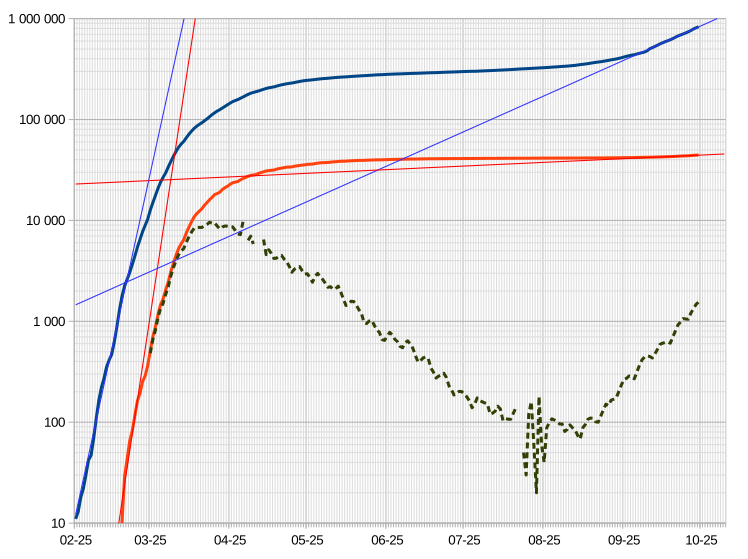
If the image does not load automatically click this link to see it.*


DURING the daily updates of the new cases and deaths due to Covid19 infection the speaker usually makes reference to one or more charts. To the best of my knowledge the only person from the media who has drawn attention to the fact that the charts are drawn with a ‘log scale’. Here the word ‘log’ is shorthand for the word ‘logarithmic’. What this means is that each division on the vertical (left hand side) shows equal ratios. So 100 is ten times more than 10, 1,000 is ten times more than 100, 10,000 is ten times more than 1,000, so these show as the same size division on the scale.

This has two advantages. The first is that small numbers of cases at the start of the UK pandemic and large numbers as we have now and in the foreseeable future can be shown on the same scale. More importantly when cases (or deaths) are plotted on a log scale the slope of the line can be used to calculate the rate of increase, or to put it another way, the number of days it takes for the number of cases (or deaths) to double. The steeper the line the shorter the time for the number to double.

In the chart the figures for cases and deaths are plotted with a thicker line; blue for cases, orange for deaths. The same colours have been shown to plot the thin lines which show the slope early in the pandemic and more recently.
**********************************************
* What is clear is that up to 17 March the daily rate of increase in the number of cases was greater than it has been in the period 27 March to 6 April and the rate of increase in the number of deaths was lower in the period 20 March to 6 April than it was before 20 March.
This is good news but the thick blue line will have to become more or less horizontal before we will know if the ‘lockdown’ and ‘social distancing’ measures have been effective.


The image which appears at the head of this article is the situation as it was on 5 April. Clicking on the image loads a larger version of that image. To get the most up to date image of the data click on the link below the image. Today 8 April this has been updated to show the number of confirmed cases and deaths up to Tuesday 7 April.

As you will see from the new image the slope of the curves in recent days has begun to decrease which is further good news. It is a hint, but only a hint, that the so called ‘lockdown’ and the social distancing are starting to have the desired effect of reducing the infection rate.
***************************

Saturday, 14 March 2020

We Are Following The Science! Oh Really?


by Les May

DURING the Apollo 8 mission to the moon one of the crew, Jim Lovell, pressed the wrong button on the flight computer.  That cleared the memory which held the data about the exact position and orientation of the command module.  As a result the flight computer ‘thought’  it was still on the launch pad so instead of the nose pointing forward along the flight path, it pointed more or less at right angles.  Using the astro-sextant to make sightings on various stars the crew were able to give the computer enough data to allow it to figure out the orientation of the module.

Getting back to Earth safely wasn’t magic or good luck, it followed from the fact that the physics of space flight is an exact science obeying the laws of motion formulated by Sir Isaac Newton in the seventeenth century.   Knowing the mass, velocity and the forces acting on an object we can predict exactly where it will be at any time in the future.

Like ecology, economics, politics and sociology, epidemiology is not an exact science. It uses the tools of science to analyse its data, presents its findings in numerical form and runs computer simulations, but unlike physics, it is not an exact science. Its predictions are ‘educated guesses’ based upon the collective experiences of it’s practitioners.  Those experiences come from investigating past outbreaks of some pestilence.  The educated guesses are in the form of ‘this is what happened last time with a similar disease.

The UK government could truthfully say it was being ‘led by the science so long as we were in the ‘containment phase’ of dealing with the spread of SARS-CoV-2, the name of the virus which causes the disease COVID-19.  Containment worked with the original outbreak of the first human transmissable SARS virus which was eventually brought under control in July 2003, following a policy of isolating people suspected of carrying it and screening all passengers travelling by air from affected countries for signs of the infection.  It has also worked with outbreaks of Ebola, so it is a tried and tested method.  That phase is passed. From now on the decisions are political ones.

As I understand the situation the government is assuming that about 60% to 70% of the UK population will become infected with SARS-CoV-2 and suffer from COVID-19, and that those that recover will resist further infection so the virus will die out, an assumption based upon the concept of ‘herd immunity’.

Now lets put some figures to this. The present population of the UK is about 60 millions. If we take the conservative estimate of a 60% infection rate that means that some 36 million people will be infected.  According to the World Health Organisation (WHO) the crude mortality rate (the number of reported deaths divided by the number of reported cases) is between 3-4%, (the Chinese experience suggests 3.9%), but the infection mortality rate (the number of reported deaths divided by the number of infections) will be lower.  Assuming that it is in the regions of 1% that suggests 360,000 deaths can be expected in the the UK in the space of a few months.

What I find remarkable is that the UK government seems so complacent about the spread of the virus. Compare this with the situation in China where there have so far been 82,000 cases reported and 3,200 deaths in a population of 1.4 billion people. (Figures correct at 13 March 2020)

Just because the UK government has decided that the spread of the virus can no longer be contained does not mean that we as individuals have to fall in with this view.  Older people in particular can to a large extent avoid placing themselves in a position where they might become infected, by avoiding meeting groups of people in confined spaces. This isn’t ‘panic’ it is rational behaviour.


***********************

Wednesday, 9 August 2017

Life-spans both North & South

MORE than one million extra people have died 'early' in the North of England than the South in the last 50 years, research shows.
An investigation of death records has revealed that people in the North are 20% more likely to die under the age of 75, with researchers describing their study as a "tale of two Englands".
The study, led by the University of Manchester, found there were 1.2 million more premature deaths in the North from 1965 to 2015 - and 14,333 more in 2015 alone.
Their figures also reveal there were 49% more deaths among 35 to 44-year-olds in the North than the South in 2015, and 29% more among 25 to 34-year-olds.
Lead researcher Professor Iain Buchan said: 'Five decades of death records tell a tale of two Englands, North and South.
'They are divided by resources and life expectancy - a profound inequality resistant to the public health interventions of successive governments.
'A new approach is required, one that must address the economic and social factors that underpin early deaths.'
The researchers defined the North of England as the North East, North West, Yorkshire and the Humber, East Midlands and West Midlands.
Meanwhile, the South comprised the East, South West, London and South East.
The study used data from the Office for National Statistics on the whole English population from 1965 to 2015.
The full results will be published in the BMJ's Journal of Epidemiology & Community Health.
A Government spokeswoman said: "This Government is committed to creating a society where everybody gets the opportunity to make a success of their hard work - regardless of where they are from."

Friday, 5 June 2015

Official Report Shows it Pays to be in a Union


OFFICIAL statistics shows the gap between the hourly earnings of union members and non-union members — the union premium — widened in 2014. 
Figures published by the Department for Business, Innovation and Skills (BIS) for 2014 show the trade union wage premium, defined as the percentage difference in average gross hourly earnings of union members compared with non members, is 8.1% in the private sector and 21.6% in the public sector. 
This is an increase from 2013 when the gaps were 7.2 % in the private sector and 19.9% in the public sector.
For all employees, the premium widened slightly from 16.7% to 16.7% in favour of union members.
Other key findings in the annual survey were as follows:
* Membership. Around 6.4 million employees in the UK were trade union members in 2014. The level of overall union membership was broadly unchanged from 2013.
* Private Sector.  Union membership levels in the private sector rose for the fourth consecutive year — an increase of 38,000 on 2013 figure to 2.7 million. However, union density in 2014 was 0.2 percentage points lower than 2013 at 14.2% among private sector employees, as the growth in membership lagged behind the growth of casualised employment in the sector.
* Gender. Women continue to outnumber men in terms on union membership. In 2014, the breakdown was 3.55 million women and 2.90 million men.
Women accounted for 55.0% of membership in 2014 against 54.8% the year before. 
* Ethnicity Union density was highest in black or black British ethnic group at around 30% in 2014. The proportion of union members among employees in Asian, Asian British, Chinese, mixed and other ethnic groups was below the average of a quarter (25%) for all employees.
Higher proportions of female employees belonged to a trade union than males for all ethnic groups. The largest difference was within the black or black British group in 2014 where the proportion of female employees who belonged to a trade union was just over a third (34%), compared with around a quarter (24%) for male employees.
* Collective bargaining. Employees who worked in larger workplaces (50+ staff) were more likely to be in a trade union and were more likely to have a trade union present in the workplace. The proportion of employees who belonged to a trade union in larger workplaces was a third (33%) in 2014, compared with around one in six (16%) in small workplaces with less than 50 employees.
Employees in larger workplaces were also more likely to have their pay affected by a collective agreement. The proportion of employees who had their pay affected by a collective agreement was around two in five (39%) in larger workplaces, compared with one in seven (15%) in small workplaces.
TUC general secretary Frances O’Grady said:
“Trade unions are essential for protecting workers’ interests. With 6.4 million members, unions are best placed to speak on behalf of working people, to combat growing inequality and help ordinary families through the crisis in living standards.
“Unions make workplaces better and safer places to work. Unionised workplaces are shown to be more protected from the impact of post-recession problems, such as shorter hours and lower pay — the union wage premium in the private sector increased to just over eight per cent. And union members are twice as likely to develop their skills than those in non-unionised workplaces.”
The BIS report can be downloaded at:-
www.gov.uk/government/statistics/trade-union-statistics-2014