SUCCESSIVE generations of Britain's working class it would seem are destined to endure a double hammering on the anvil of Tory economic policy and the cosh of the police truncheon. This multi-generationalional masochism is in some cases entirely self inflicted by the apparent inability of elements of the working class to agitate, educate and organise at grassroots level to vote for candidates who represent their class interests (The infamous Working Class Tory voter) or to establish working models of self-government outside of, and independent to the terminally corrupt Parliamentary system ,
( The Non-Parliamentary Road to Socialism ).
This pantomime more akin to a Dario Fo farce than a mature fully functioning democracy is abley co-facilitated and enabled by a neutered Blue Labour bureaucratic class hunkered down in their Town Halls bunkers and a sycophantic & quisling mainstream media promoting a 24/7 pro-government propaganda news agenda narrative.
No one should be surprised that former Goldman Sachs banker Richard Sharp is set to be appointed the Chairman of the BBC's board of directors after donating more than £400,000 to the Conservative Party since 2001 .It should come as no shock to any of us either that a rogue Johson administration will be expecting an imminent popular backlash and is pre-rigging the courts and legislature accordingly. Johnson after all bought the three water cannon he expected to have to deploy on the streets of London when he was Mayor way back in 2014 (although they were subsequently scrapped Johnson said later: We can’t use them at the moment. That is correct. We haven’t been given a general licence for their use. We will keep these devices in reserve and should there be another occasion when they might be a useful tool of crowd control, the Metropolitan police commissioner can make another application.)
More recently the arrest and ten thousand pound fine of a pensioner for organising a socially distanced protest in support of an increase on the paltry one per cent pay rise for NHS workers in Manchester, (Has GMP been consistent in handling protests during Covid? What police, protesters and Andy Burnham have to say... - Manchester Evening News) , and this weekend's effective banning of the vigil for Sarah Everard in Clapham by Metropolitan Police shows clearly which way the wind is blowing and the chilling effect it is set to have on future protests. The 1986 Public Order Act and the 1994 Criminal Justice Bill & Public Order Bill serve as just two reminders of how a reactionary state apparatus legislates to suppress not only political dissent but lifestyle choices such as New Age Travellers (The Battle of the Beanfield) and Britain's 1990's Warehouse & Acid House Counter-culture - both seen as a serious challenge to a moribund establishment by disaffected and creative youth.
This is merely history repeating itself as the state seeks once more to silence voices of dissent and prevent the free association of people as it has done for centuries from The Diggers of St.George's Hill in 1649, through to Peterloo, Red Clydeside, the 1984 Miners strike and the Poll Tax Riots of the 1990's and beyond.
The famous quote attributed to Emma Goldman: If I can't dance, I don't want to be part of your revolution seems likely to resonate loudly in Covid ravaged Britain as a government claiming to be Levelling Up might suddenly find the Levelling process goes in entirely an unexpected redistributionary direction. Britain's youth may be willing to accept curtailments to their individual freedoms & liberties this summer as a necessary precautionary measure to combat the transmission of Covid through our communities it is difficult to see how such draconian restrictions will be imposed or widely followed next summer (or the summer after that) without some kind of culture clash ensuing later if not sooner.
Local Public Space in Rochdale & the homeless
At the local level readers might want to ask their prospective ward councillors standing for public office in May what their personal views are on the anti-democratic measures lurking in the small print of Rochdale Councils Public Space Protection Order?
Local campaigners rejected the deeply flawed legislation on the grounds that:
The Council should not fine people who are homeless if they beg for money. We also believe banning people from giving out leaflets is a serious attack on our civil liberties. The other parts of the order are unworkable and will lead people, particularly young people, to be brought unnecessarily into the criminal justice system.
It would be interesting to see how many councillors have actually even read the locally drafted legislation they voted for which can also be readily deployed against union members on a legitimate picket line or require campaigners to ask permission before handing out leaflets on a street stall or holding a demonstration in the town centre?
If they want our votes sometime before May 6 is probably a good time to put them on the spot
The price of freedom truly is eternal vigilance!
In the meantime here's a summary of organisations calling for protection of the right to associate and protest:
Netpol:
Netpol have launched an urgent petition calling on the National Police Chiefs Council to adopt new guidelines to protect the right to protest – or explain why they refuse to do so. Add your name today. A Charter for Freedom of Assembly Rights | Netpol
Liberty:
In the coming weeks, MPs will vote again on the harmful Coronavirus Act – the biggest threat to civil liberties in a generation. Email your MP today and tell them to change course, scrap the Coronavirus Act, and replace it with a rights-focused approach, such as the Protect Everyone Bill. Liberty Human Rights
Amnesty International:
Amnesty International has condemed the conviction of Spanish rapper Pablo Hasél for “glorifying terrorism” and is calling on the Ministry of Justice in Spain to change the criminal code and defend freedom of expression.
Hasel has been sentenced to nine months’ imprisonment and six years’ disqualification from employment in the public sector. He has also been convicted of insulting the Crown and state institutions. In total, he will face a fine of almost 30,000 euros.
Esteban Beltrán, Director of Amnesty International Spain, said: “No one should face criminal prosecution for expressing themselves on social media or for singing something that may be distasteful or shocking. Expressions that do not clearly and directly incite violence should not be criminalised."
“Pablo Hasél’s imprisonment is an excessive and disproportionate restriction on his freedom of expression, but he is not alone in suffering the consequences of unjust laws: many other artists, journalists or activists have received heavy fines or long periods of exclusion from the public sector. It’s a sad consequence for our society: self-censorship for fear of repression.
If the articles of th“e Criminal Code are not amended, freedom of expression will continue to be silenced and artistic expression will continue to be restricted.”
* Source: Spain: Jailing of rapper is 'unjust and disproportionate' | Amnesty International UK
Green and Black Cross :
Provide volunteers able to help with legal matters arising from protest and actions only. An independent grassroots project set up in the spirit of mutual aid to support social and environmental struggles within the UK.
Excellent demonstration Bust cards can be downloaded from : Bustcard | Green and Black Cross
************************************************
APPENDIX :
[1].London Calling : The Clash ( Joe Strummer & Mick Jones ) 1979
EDITOR'S POSTSCRIPT:
BASED ON LIBCOM ACCOUNT.
Who is Pablo Hasél? And what is happening in Spain in regards to his case and the riots that followed?
Pablo Hasél is a 32 year old Catalan1 rapper and anti-fascist. As a rapper his songs generally focus on left-wing causes, armed struggle, and are frequently critical of the Spanish monarchy.2 The Spanish state has extremely retrograde laws regarding what may be thought of as ‘freedom of speech’. These include article 491 of the Spanish Penal code which calls for fines and prison sentences of up to two years for ‘Insults to the Crown’, and Article 578 which calls for similar punishment for ‘glorifying terrorism’. These laws are used disproportionately against people on the left and anarchists, while far-right individuals and neo-nazis are rarely if ever charged or sentenced to jail time.
Pablo Hasél has repeatedly run afoul of these laws. He has refused to censor his message and because of this he has been prosecuted for the content of his lyrics, especially his references to historical armed groups such as GRAPO3, and criticism of the king and the Royal family. In 2018 he was found guilty violating Article 578 and 492 and was ordered to enter into prison two years later in February of 2021. Hasél refused to voluntarily turn himself in, instead issuing a public statement and barricading himself among supporters inside Leida University. Riot police fought their way into the university and took him into custody on February 16th. His arrest and the underlying anger felt among a large segment of mostly young people in Catalunya and throughout the Spanish state led to almost a week of rioting especially in Barcelona, but also in Madrid, Valencia, the Basque Country and smaller cities like Vic, Iruñea (Pamplona), Lleida and Granada.
The widespread nature and strength of the rioting surprised many among the Spanish status quo, however it is clear that a tension has been building for quite some time as the Spanish state continues to expose and even flaunt its authoritarian nature.
RESIDENTS of Madrid’s upscale Salamanca neighborhood have
been making headlines since Sunday with a series of street protests
against the government over its handling of the coronavirus crisis.
Demonstrators
have been using the words “dictatorial” and “oppression” to describe
their situation under the ongoing lockdown. Madrid, the epicenter of the
coronavirus pandemic, is still in the early stages of a national deescalation plan that is expected to end in late June, if there are no new spikes in transmission.
The
protests reflect a view, held by some in Spain, that the state of alarm
introduced in mid-March to combat the coronavirus pandemic is really an
excuse for the central government to grab extra powers. Prime Minister
Pedro Sánchez, of the Socialist Party (PSOE), heads a minority
government and he has been facing growing difficulty to secure enough
congressional support for back-to-back extensions to the state of alarm.
The
sentiment mirrors similar feelings elsewhere in Europe, where
protesters from across the political spectrum are beginning to
demonstrate against prolonged confinement measures (see box below). A
recent report by Spain’s Civil Guard underscores the risk of social unrest in Spain if confinement measures are prolonged.
On
Wednesday, around 100 locals banged on pots and pans on Núñez de Balboa
street, without respecting social distancing rules. There were couples,
families and people with dogs. Some marched with face masks that had
tiny Spanish flags embroidered on them; others waved enormous flags
instead. The demonstrators called for the government to resign.
“I
pay my taxes and we have a government that is doing nothing,” said
María Jesús, 56, who was out with her husband Rafael, 60, and their son
Pelayo, 16. “That is why I am walking and protesting. You see these
gloves? I paid for them myself. And this face mask? I’ve paid for it,
too.”
“We’ve even had to pay for our own [coronavirus] test,” added her husband. “It cost me €80”
Wealthiest 1%
The
Salamanca district is named after a 19th-century marquis who was
instrumental in the area’s development. It is home to more than 150,000
people, including the wealthiest 1% in all of Spain and the wealthiest
3% in the Madrid region. Household income here is an average €50,376,
compared with €33,000 in the region and €28,417 in Spain.
Asun
(“I won’t tell you my surname, and you never ask a woman about her
age”) is a civil servant who has been protesting every day since Monday.
“You’d think we were criminals with so many police around. There is no
freedom. You should publish that [Pablo] Echenique and several other podemitas
live around here,eh?” she said, alluding to leading members of the
leftist Unidas Podemos group, which is the junior partner in Spain’s
coalition government.
“We are in a dictatorial system,
and I know what I’m talking about,” said Magdalena, a local resident who
works as a lawyer. “They are applying a decree that bans our freedom.”
The
demonstrations began on Sunday night. Several residents say that a
collective protest sprung up after several dozen youths gathered under
the balcony of an apartment that was blaring out loud music. Minutes
later, a police van showed up and handed out fines to 12 members of the
public for violating the lockdown rules. Several residents criticized
the police presence, crying out “Freedom!”
By Thursday,
however, the street protests had all but disappeared, with just a few
scattered people marching and chatting with reporters. One of them was
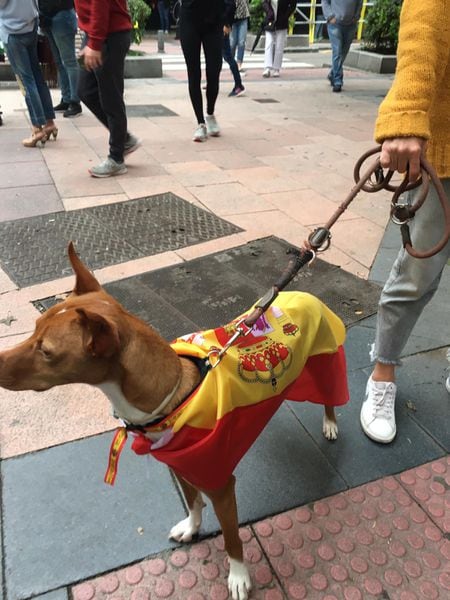
Laura Domínguez, 39, whose dog Barri wore a Spanish flag as a cape. “I
am here because I am sick and tired,” said Domínguez, wearing a face
mask and holding a cigarette. “They’re creating a country of idlers. And
now they want to take everything away from me.”
Barri the dog wearing a Spanish flag.Manuel Viejo González
On Núñez de Balboa street, nearly 50% of residents voted for the conservative Popular Party (PP)
at the last general election, held in November 2019, followed by the
far-right Vox with 23%, the center-right Ciudadanos with 6.7%, and the
Socialist Party (PSOE) with 5.4%. The leftist Más País and Unidas
Podemos attracted less than 1% of the vote.
The regional
premier of Madrid, Isabel Díaz Ayuso of the PP, has been encouraging
these street demonstrations. “I hope people will go out on the street –
the events of Núñez de Balboa are going to seem like a joke then,” she
recently said. Meanwhile, Madrid Mayor José Luis Martínez Almeida, also
of the PP, said this week that “as long as [safety] conditions are
maintained, everyone is free to voice their opinion.”
Vox
leader Santiago Abascal has been pushing for anti-government
demonstrations and challenging authorities to ban them, arguing that
this would prove that fundamental freedoms are being violated. At a
recent session of Congress to extend the state of alarm, Abascal said
that his party would apply for permission to hold demonstrations against
the government on the streets of Spain’s main cities, but that in order
to respect social-distancing measures, the protests would be held
inside vehicles rather than on foot.
MANCHESTER’s People’s History Museum aims to depict all political strands that comprise Britain’s rich labour tradition but one aspect is notably absent. There’s more to politics than voting and the anti-Parliamentary ideas and artifacts of the hugely influential anarchist Peter Kropotkin (1842-1921) have been exiled to the museum’s storeroom.
When the institution opened in London in 1975 Kropotkin’s desk and chair were prominently displayed and visitors learnt from attached brass plaques that they’d previously belonged to radical campaigner Richard Cobden but when the collection moved to Manchester these exhibits were curiously removed. Curiously because Cobden is strongly associated with Manchester, where he founded the 'Anti Corn Law League', was MP for Stockport then for Rochdale, lived for years at nearby 19, Quay Street, has a statue erected to his memory in St Anne’s Square and a bust on view in the Town Hall. As activists have successfully campaigned for blue plaques memorialising Kropotkin’s former homes in Bromley and Brighton, so now with the approaching centenary of his death on 8th, February 1921, what better time to restore these key exhibits to public view? WHOSE HERITAGE?
'HERITAGE' in Britain generally promotes a ruling class perspective with stately homes, art galleries and statues of the “Great and Good” predominant. Since the 1893 foundation of the Independent Labour Party Britain’s official labour movement directed most its time, money and energy into getting Labour governments elected and few resources were spared for independent working class education and preserving, recording and presenting the artifacts and history of workers’ struggles. To secure adequate resources the Manchester museum treads a perilous path between faithfully recording campaigns for freedom and equality whilst not upsetting establishment sources of funding. From its roots in the labour movement the museum has over the years moved into the heritage industry, successfully widening its popular appeal and funding-base but along the way it’s quietly succumbed to 'ideological cleansing', gently edging anarchism out of the picture in order to represent Parliamentary power as the ultimate goal of past struggles.
There’s no denying that Parliamentary politics dominate the labour movement but revolutionary ideas and movements were and remain a vital thread in the tapestry. There’s more to labour history than campaigns for the franchise and it’s essential that displays also reflect the continuing battle for ideas within the movement. With the Cobden connection and the fast approaching centenary (Feb 2021), it’s time Kropotkin’s artifacts along with an explanation of anarchism’s political significance were restored to the museum’s public galleries. Slippery Slope from Limehouse to Manchester
THE collection was begun in the 1960’s by enthusiastic members of the 'Trade Union, Labour and Co-operative History Society' who eventually secured exhibition space at Limehouse Town Hall. The museum’s moving spirit and founding curator was Harold Fry who’d started work in a brush factory at the tender age of eleven before campaigning for years to persuade the Labour movement to value its own history, 'because it is not yet history conscious. The movement must know where it has been to know where it is going… we want to educate the public, to balance the history of the ruling classes, which they are taught, with the people’s history'. On 19th Monday 1975 Prime Minister Harold Wilson officially opened the 'National Museum of Labour History', accompanied by Michael Foot, Barbara Castle, Hugh Scanlon and Clive Jenkins, and in an ominous gesture of vacuous popularism donated his pipe for exhibition,'but not the famous clogs in which he is said in some speeches to have trudged as a ragged urchin to Milnsbridge Council School' (Clement Attlee’s pipe is on reverent display in the current museum).
The museum remained in Limehouse until 1985 when it was promised a new, larger home at the redundant Mile End Baths. In the course of conversion it was discovered that the baths was contaminated with asbestos and on so the collection was packed away and remained in storage until a funding offer was made by Greater Manchester authorities. A new trust was formed and in 1990 the collection went on display again, initially occupying part of the old 'Manchester Mechanics Institute' in Princess Street, in 1868 the first meeting place of the Trade Union Congress. In 1994 the collection moved into its present home in a beautifully restored hydraulic pumping station on the banks of Manchester’s river Irwell. Still officially registered as the 'National Museum of Labour History' on moving north the institution re-opened under the new, establishment-friendly title of the 'People’s History Museum'. In an apparently continuing quest for ever greater de-politicisation and vacuity, the collection now bills itself as the 'National Museum of Democracy'. If this trend continues perhaps Clement Attlee’s pipe will soon be confined to storage lest it be viewed as an incitement to revolution! The Anarchist Prince IRONICALLY, throughout the three decades Kropotkin lived in England he was welcomed rather than feared by 'civilised society'. As an internationally respected geographer and scientist as well as an acknowledged, if alienated, member of Russia’s aristocracy his ideas and activities were even sympathetically reported by the London Times. 'Mutual Aid', Kropotkin’s classic rejoinder to T. H. Huxley’s interpretation of the social consequences of Darwinism will forever serve as eloquent testimony to the cooperative impulse that underlies anarchism and indeed all progressive politics. Sadly for Kropotkin’s last years in England he alienated former anarchist comrades by supporting the war against Germany but retained friendships with local members of the Brighton labour movement. When he departed for Russia in 1917 he took with him seventy tea chests of books and papers but presented his desk to Brighton Trades Council (who subsequently donated it to the museum).
This episode in itself offers any museum worth its salt an ideal opportunity to pose important questions of political loyalty to interested visitors. Finally returning to Russia on 12th June 1917 Kropotkin’s support for the revolution but opposition to the Bolsheviks might similarly raise critical questions in the mind of anyone viewing Kropotkin exhibits, and reading interpretive boards about his life. - 'Labour History Museum'– - Lively Debating Chamber or Necropolis? - Despite my reservations about the some of the innovations, the museum’s administrators have worked wonders keeping the collection together, conserving the artefacts, providing imaginative attractive displays and continuing to offer free admission. Everyone involved deserves to be heartily congratulated. This year (2019) the “Manchester & Salford Anarchist Bookfair” returned to the museum increasing the impetus to restore anarchist content to the galleries. 'People’s History' isn’t a lost world of clog dancing, Hovis adverts and chimney sweeps, it should stimulate political questions about the past, present and future. It is a vital debate that recognises Parliament may be a political preoccupation for many but it’s not the realisation of labour’s 'New Jerusalem'. The return to public view of Kropotkin’s furniture won’t change the world or frighten the horses but it might stimulate debate and attract the interest of a younger generation turned off by traditional politics. Why not visit the museum yourself, hand in a card (or email - Katy.Ashton@phm.org.uk) requesting the return of Kropotkin’s desk before the 8th, February 2021 centenary of his death? Refusing to vote isn’t anarchy in action if you do nothing to promote positive alternatives - Stand up for Kropotkin’s chair! Christopher Draper (Dec 2019)





 Posts
Posts


