TODAY The Sunwebsite announced: 'Sex workers in Britain are being forced to choose between poverty or
risking Coronavirus to see their clients, it has been claimed. 'And prostitutes are now pressuring the government to recognise them
as workers so they can claim state benefits and avoid having to walk the
streets. 'It comes as industry leaders warn prostitution must be decriminalised to avoid spreading the infection and keep workers safe. 'Prostitution is not illegal in the UK but related activities, such as
pimping, kerb crawling, and running a brothel, are unlawful.'
The problems of sex workers are obviously to all in the current climate. Clearly it's difficult to practice 'Social Distancing' if you're working 'on the game' as they may say.
Carl Spender in a column on the anarchistFreedom News websiteon Apr 3rd wrote: 'People are being criminalised for coronavirus offences that don't exist'.
He was excited about what he called 'front
line coppers are running around like heavily armed headless chickens'.
Comrade Spender was particularly exercised by an arrest by theBritish Transport Police (BTP) of a found 'loitering between platforms' at Newcastle Central station last Saturday. Charged with failing to comply with requirements of the Coronavirus Act 2020. It doesn't surprise me that to learn that the British Transport Police wrongly charged a 41 woman from York, using the wrong legislation. When I was arrested in 1997 together with an Irishman and three goats, the Manchester branch of the BritishTransport police similarly used the wrong procedures. On that occasion the lower court found against me, but the Crown Court quashed that judgement later when it was found that while the Transport Police were right to remove the goats but that did not entitle them to remove the humans. From that encounter I found that the British Transport Police are generally regarded as the poor relation of the police service.
However, in keeping with the fashions of the left Comrade Spender is more interested in the woman's ethnic nature, because in a footnote he draws attention to the French police's focus on St. Denis in Paris: " ‘people the police don’t like
the look of’ is a heavily racialised category'," and he concludes: 'In
France, for example, 10%
of fines for violating lockdown conditions have been issued to the
~100,000 residents of the Parisian suburb of Saint-Denis, an area
which is famously home to many migrants and people of colour.'
When I first went to Paris in 1963, Belleville was the multi-ethnic neighbourhood
Belleville is a colorful and multi-ethnic neighbourhood home to many Spanish Civil War refugees, but the last time I went to Paris a few years ago, Saint-Denis was notorious or famous for its brothels and street-walkers.
LAST SATURDAY the Financial Times leader writer began an editorial thus: 'A dispiriting election has produced a seismic outcome. Britain's political landscape has been redrawn as it was by Tony Blair's New Labour victory in 1997, or Margaret Thatcher's win in 1979. The Conservative landslide is a vindication of Boris Johnson's strategy of going all-out for a new Brexit deal and building his campaign around delivering it.... Yet the result, combined with the Scottish National party's surge in Scotland and nationalist gains in Northern Ireland, will strain the integrity of the UK.'
At the same time in an e-mail written immediately following the election Dave Smith secretary of the Blacklist Support Group, which has been consistently loyal to the Labour Party wrote: 'This is an awful result for the entire labour movement. 'Whatever people's thoughts on Corbyn or Brexit; the Labour manifesto
commitments on workers rights, NHS & public services,
renationalisation of rail & utilities, house building and the
climate were supported by the majority of the population. All these
things are now at risk from a right wing Johnson government.'
Yet prior to the election in another e-mail he had wisely warned us: 'working people should never place dewy eyed trust in politicians,
lawyers or union leaders to solve our problems for us; continuing to build a movement remains essential.'
But what really happened under the Attlee Labour Government of 1945?
MILITARY BLACKLEGS & the 1945 LABOUR GOVERNMENT
Dave Smith does well to remind us that we should not 'place dewey eyed trust in politicians' etc. for within six days of the Labour Government taking office in 1945, it sent conscript troops into the Surrey Docks, London, to break a ten-week-old strike against a wage-cut....
Yet in a Labour amendment to the Military Training Bill, in Hansard on May 12th, 1939, this same Labour Party had declared: 'No conscript should be required to take duty in aid of the civil power in connection with a trade dispute, or to perform, in consequence of a trade dispute, any civil or industrial duty customarily performed by a civilian.'
Surely there is some inconsistency here?
THE GREAT ILLUSION
In 1959, on the Aldermaston CND march, some trade union critics, who described themselves as 'syndicalists', not unlike Dave Smith of the Blacklist Support Group today, claimed at thattime: 'we believe many sincere but starry-eyed Labour supporters have already half-forgotten the events during those six years in which every Socialist principle was betrayed by the politicians... [and that] It is no service to the working class for the truth to be hidden, however embarrassing and unpalatable it may be for some people.'(How Labour Governed 1945-1951 - DIRECT ACTION PAMPHLET: Publications Committee, SWF).
THE LABOUR PROGRAM in 1945
Like Len McCluskey said last week about the panicky policy incontinence of the current Labour Party, the 1945 Labour Government, with a vast majority, had an economic programme based on two principles - 'a give-away programme and state control of economic functions'.
Dave Smith in his generally depressing Tweet continues to argue in this gloomy vain:
'For blacklisted construction workers, our hope for a public inquiry into the Consulting Association scandal now
appears to be off the agenda for the next few years at the very least.'
Bro. Smith was here pinning his faith on Page 48 of the Labour Manifesto:
'We
will establish public inquiries into historical injustices including
blacklisting and Orgreave, and ensure the second phase of the Grenfell
Inquiry has the confidence of
all those affected, especially the bereaved families and survivors.'*
When I last spoke personally to Dave Smith in 2015, at a Blacklist Support Group conference on 'Bullying, blacklisting and whistleblowing' at a two-day event at the University of Greenwich, I expressed my concerns and doubts about his hopes about getting a future Labour Government to solve the problem of blacklisting etc. by creating a distinguished public inquires. Since 1979, when the alternative newspaper RAP had first exposed Cyril Smith, I long had the experience of seeking public inquires owing to the work I had put in to get something done about child abuse in Rochdale and beyond. Sadly, by the time the inquiry will finally get to publish its report many of the alleged victims will be beyond help.
The Blacklist & the Consulting Association
Tameside Trade Union Council in Greater Manchester, has been involved with what later became known as the 'BOYS ON THE BLACKLIST' during the Daf dispute in Manchester's Piccadilly in 2003. That was well before it had been finally confirmed that the blacklist actually existed in 2009** by subsequent events in which the Information Commissioner raided an office of the Consulting Association in Droitwitch, Cheshire.
As the Financial Times leader above indicates the political landscape of the UK has changed substantially. But it is not the end of history which some may claim. The nationalist issues both in Scotland and Northern Ireland, as the FT editor suggests, may still come back to haunt the Tory Government.
Dave Smith is right in his blunt response to be 'gutted' by the outcome! It is a slap in the face for what passes for the British left. But we at Northern Voices
have always been clear that we have historically even less faith in
politicians than Dave Smith has ever had. George Orwell told the poet
Stephen Spender that he always avoided going to cocktail parties to mix with literary folk for fear it may interfere with his own critical judgement of their literary work.
Could it be that being based and rooted in London that Dave Smith and some of the Blacklist Support Group, may well have become too close to the some of the Labour politicians down there and that it could have clouded their judgement?
In the years since the late naughties that I have known them; Dave Smith and the Blacklist Support Group, have always struck me as one of the most decent phenomena on the British left in this country bar none, aside perhaps from my own personal friends among the Boys on the Blacklist in the North of England, and I don't think that those associated with my own political persuasion among the English anarchists are a patch on them. Other parts of the British left, especially including the British anarchists, who have presented us with the politics of a shabby little shocker. Although I believe that Dave Smith and the Blacklist Support Group are wholly committed to fairness and common decency they will be well aware that the Labour party, when in Government, has failed to make serious in-roads towards the abolition of British blacklisting.
Despite what Dave Smith declares about us placingour faith 'dewey eyed trust in politicians'; I fear that these honourable activists may suffer from being too trusting of people inside the Westminster bubble.
****************
* Page 48 of the Labour Manifesto:
"We
will establish public inquiries into historical injustices including
blacklisting and Orgreave, and ensure the second phase of the Grenfell
Inquiry has the confidence of
all those affected, especially the bereaved families and survivors. We
will also consider a public inquiry in the case of Zane Gbangbola.
We will require judicial warrants for undercover operations and retain the Mitting Inquiry into undercover policing.
We
will release all papers on the Shrewsbury 24 trials and 37 Cammell
Laird shipyard workers and introduce a Public Accountability Bill".
The Blacklist
Support Group are proud to have stood shoulder to shoulder on shared
platforms for more than 10 years with campaigners fighting for justice
for Orgreave, Grenfell,
Zane Gbangbola, victims of undercover political policing, the Shrewsbury
Pickets and Cammell Laird ship workers. We have demanded and fought for
a public inquiry for over a decade - its is our campaigning
that has led to this manifesto commitment. We
therefore whole heartedly support this pledge towards getting the truth
we, and other working class miscarriages of justice, deserve. But working people should never place dewy eyed trust in politicians,
lawyers or union leaders to solve our problems for us; continuing to build a movement remains essential.
** 'During 2008/09 the Iinformation Commisioner's Office carried out an investigation into employment
blacklisting in the construction industry. As part of that
investigation, the ICO seized information from a company called The
Consulting Association. Some of the information we seized amounted to a
'blacklist' of individuals who were considered to pose a risk to their
employers if employed within the construction industry.'
***
Following the blacklisting scandal the Labour Government came forward
with regulations. These regulations are so weak that they will not
deter blacklisting. The only recourse for someone who has been
blacklisted still remains taking a case to an employment tribunal and
financial loss has to be proved. UCATT has constantly argued for the
regulations to be strengthened. They necessary changes are:
Make blacklisting a criminal offence
When a blacklist is discovered all those on it are automatically told.
An automatic right to compensation for everyone blacklisted.
For the regulations to be widened from the narrow confines of “trade
union activities” to the wider “activities associated with trade
unions”. Ensuring trade unionists can’t be blacklisted for taking
unofficial industrial action, such as a ban on voluntary overtime.
Review:'Lessons of the Spanish Revolution 1936-39'
by Vernon Richards (introduction by David Goodway).
£15.00 ($21.95) Published by PM Press / Freedom Press.
reviewer Brian Bamford
Spanish Civil War &
Sinful Post-Hoc Reasoning *
VERNON RICHARDS, a former long-term editor of the anarchist newspaper Freedom, in his introduction to the First English Edition (1953) of his 'Lessons of the Spanish Revolution' made a modest admission of his own limitations as he tried to counter his critics: 'Some have cricised me for being wise after the event and for writing on events of which I was but a spectator from afar. I mention these criticisms as a warning to the reader of my limited qualifications for dealing with such a complex subject. But I feel I should in my defence also point out that that most of the criticisms I have made in this book were expressed by me in 1936-1939 in the columns of the journal Spain and the World.'
When recently I spoke to the historian David Goodway, who wrote the introduction for this current PM PRESS edition, he suggested that his distance from the events in Spain allowed Vernon Richards to be more 'objective' in his analysis. His remark did not entirely surprise me both because it reflected the view of other people in the Freedom group with whom I have discussed this matter, but additionally this approach fits with what Dr. Goodway argued when I attended one of his lectures at a Northern Radical History Network event in Bradford in April 2013, where he passionately argued that historians in the nature of things all develop a narrative, and then go on to relentlessly pursue the advocacy of that perspective. Thus, history becomes a form of the art of advocacy and polemical presentation.
'History is what historians do'?
'History is what historians do', declared Isaiah Berlin in his book 'The Proper Study of Mankind'.
Post-hoc reasoning is the fallacy where we believe that because one
event follows another, the first must have been a cause of the second.
In some cases this is true, but other factors may be responsible.
Did the decision of the CNT to participate in the governments first in Barcelona and later in Madrid lead to a degeneration of the integrity of the whole of the Spanish anarchist body politic? Was the leadership to blame for the compromise of principles or was it also a dereliction of duty on the part of the rank and file in the CNT?
In Chapter XX Vernon Richards responds to some of the critics of the original English edition.who claimed he had 'over-emphasised the faults of the leaders of the CNT-FAI' and 'had been "over-charitable" to the rank and file members of the revolutionary organisations.' Richards admits these criticisms are 'valid, though we (he) also believes that we (he) has erred in the right direction!'
He argues further: 'The rank and file saw - or "instinctively felt" - more clearly than the leaders, and we (he) have no doubt in our mind that the action of the workers in raising the barricades in Barcelona in May 1937 was a last desperate attempt to save the revolution from strangulation by the Jacobins and the reactionary politicians who had insinuation by themselves once more into positions of power. Barcelona in May 1937 was to the Spanish Revolution what Kronstadt, sixteen years earlier, had been to the Russian Revolution.'
The seeds of the 'Lessons of the Spanish Revolution'?
VERNON Richards admits in his Introduction (1953) that his historical account would never have been written but for the publication of the first two volumes of La CNT en la Revolution Espanola by Jose Peirats. Other sources he gives are Diego Abad de Santillan's Por que perdimos la guerra and Gerald Brenan's Spanish Labyrinth.
Recently Stuart Christie told me that Vernon Richards had written this history in response to Felix Morrow's Revolution & Counter-Revolution in Spain (New York: Pathfinder, 1938). I haven't been able to confirm this but in his Biographical Postscript in 1972 Vernon Richards welcomed 'more material.... from.all quarters on the left' including Felix Morrow's book.
Stuart Christie e-mailed me to say: 'My recollection of Vero’s book was that it was an attempt to respond to
Felix Morrow’s half-decent 'Revolution and Counter-Revolution in Spain’.
What is notable about Felix Morrow's Trotskyist account here is that he, like so many Marxists, focuses on the correct political leadership and he argues that the anarcho-syndicalist CNT 'had changed little since its origin in the Cordoba Congess of 1872' and being 'Hopelessly anti-political, it played no role in bringing the Republic', adding 'Spain would not find its ideological leadership here'.
Mr. Morrow concludes his analysis: 'Thus, the (Spanish) proletariat was without leadership to prepare it for its great tasks, when the republic arrived. It was to pay dearly for this lack!'
What Morrow is doing here is using apriori or cookbook thinkingin which he and Leon Trotsky use to make sense of the Spanish context in the historical background and development of the Spanish Civil War and to create a blueprint for what to do. He takes the view that what was needed in the Spanish conflict was a 'Bolshevik methodology' (p6 of 'Revolution & Counter-Revolution in Spain' pub. by Pathfinder) arguing: 'The making of the Soviet Union and its achievements - a peasant country like Spain - were extraordinarily popular in Spain. But the Bolshevik methodology of the Russian Revolution was almost unknown. The theoretical backwardness of Spanish socialism had produced only a small wing for Bolshevism in 1918.'
And yet most of the Spanish anarchists rejected the Bolshevik model. Indeed,one of the main concerns of the adherents of the CNT and the anarchists in the FAI in July 1936, was to avoid what they saw as the errors associated with the development of the Russian Revolution. Vernon Richards presents it thus in Ch. IV entitled 'ANARCHIST DICTATORSHIP OR COLLABORATION AND DEMOCRACY': 'The dilemma of the "anarchist and confederal dictatorship" or "collaboration and democracy" existed only for those "influential militants" of the CNT-FAI who, wrongly interpreting their functions as delegates, took upon themselves the task of directing the popular movement. '
Mr. Richards begins by saying: 'The first mistake, it should be remembered, was made in the early days of the struggle, when an ill-armed people were halting a carefully prepared military operation carried out by a trained and well-equipped army, which no one, not even some of the "influential members" of the CNT-FAI, imagined could be resisted.'
Richards concludes: 'The slogan of the CNT-FAI leadership - "the war first, the revolution after" - was the greatest blunder that could have been made.'
He supports this with a quote from Diego Abad de Santillan: 'We knew that it was not possible to triumph in the revolution if we were not victorious in the war. We even sacrificed the revolution without noticing that that sacrifice also implied the sacrifice of the objectives of the war.'
Against this there is the view of Paul Preston, perhaps currently the most widely read historian in the English language on the Spanish Civil War, who argues: 'While exhilarating to participants and observers such as George Orwell, the great collectivist experiments of the autumn of 1936 did little to create a war machine.... The May events witnessed by Orwell in Barcelona were provoked by the need to remove obstacles to the efficient conduct of the war. Despite incorporating the working class militias into the regular forces and dismantling the collectives, Negrin's government still did not achieve victory - not because its policies were wrong but because of the international forces arrayed against the Republic.'
Shortly before I embarked on this review one of Preston's former students sent me this e-mail: 'The
bottom line is Paul’s (Preston) fundamental and unshakeable belief that the
absolute priority on the Republican side of the Spanish Civil War should have been to
focus on the conventional
war effort and not on the Revolution, which was detrimental to that
effort — and his total support for the actions of the Negrin government
and the integrity of Negrin himself.'
On the 15th, July 2016, during an interview with the historian Ian Kershaw, entitled 'The Last Days of the Spanish Civil War', Paul Preston had even claimed that Negrin was 'the Churchill of the Spanish republic - the great War Leader.'
The
main danger in philosophy, as Lars Hertzberg identifies it, is the danger
of apriorism, the idea that we can tell how things“must be”. It strikes me that some English historians like Sir Paul Preston and Dr. David Goodway readily embrace apriorism: Preston in 'The Spanish Holocaust'** and Goodway in his claim that all historians pursue and advocate a preconceived narrative.***
Yet Isaiah Berlin in his monumental book The Proper Study of Mankind wrote:'History does not reveal causes; it presents only a blank succession of unexplained events.' In Sir Paul Preston's interview above with Ian Kershaw, Preston said that he intended to write a book about the 'guilty men'and specified Largo Caballero as a principle culprit in this respect. Similarly Mr. Richards reveals his own bias when commenting on Burnett Bolloten's book, which he otherwise admires, he writes: 'The new material I think presents the socialist/trade union leader Largo Caballero in too favourable a light - as a victim of intrigues - whereas he was an old fox, as are all trade union leaders - not least the anarcho-syndicalist variety, such as Lopez, Peiro, and Pestana.' I remember Jim Pinkerton, the former International Secretary of the old Syndicalist Workers' Federation, once told me that Vernon Richards would never join a trade union because it was not in his nature to do so. At one point in this book he even describes a trade union as if it were what the sociologists call a 'total institution': 'And trade unions just like other self-contained concentrations of human beings, such as prisons, armies, and hospitals, are small-scale copies of existing society with its qualities, as well as its faults.'
Like Vernon Richards I've spent some time in prison in the UK, and in the summer of 1963, I was even held in a dungeon in a small village in the province of Segovia, and I can tell him that there is a vast qualitive difference in these experiences to being a rank and file member of a trade union in either the UK, in the T&G in Gibraltar, or in the La Linea branch of the CNT in Spain.
Mr. Richards demonstrates his apriorism in the section subtitled 'Anarchism and Syndicalism' which begins by declaring: 'In organisations with a mass following, the small anarchist minority can only retain its identity and exert a revolutionary influence by maintaining a position of intransigence.'
Then Richards concludes by telling us and the Spaniards struggling to tackle the privations of the Civil War, that: 'Thirty years earlier, Malatesta, with that profound understanding of his fellow men which inspired all his writings, had clearly seen the effects of the fusion of the anarchist movement with the syndicalist organisation...'
In reviewing this book it is clear that it is well worth reading the present work, for as Jose Peirats in 1954 wrote: 'It is important to anarchists to draw the lessons of the facts and actions of their own movement.' Yet Peirats argues Richards's book which extols Malatesta and anarcho-communist insurrection over the anarcho-syndicalist General Strike has flaws as well as virtues. Indeed I seem to recall that Peirats book on The CNT in the Revolution Espanola arguing that the anarchists were in fact 'too insurrectionary' in so far as they seized the towns and then neglected the small pueblos.
And yet, though I would have you read these histories I am mindful of what Peirats said about the Vernon Richards' Lessons of the Spanish Revolution, he declared: 'este obrita' (small work) is too 'severo' and 'demasiado lateral' (too bias) and 'selectivo'. Peirats concludes that 'none of his (Richards's) statements will be contradicted by history' but it is necessary 'to give to facts their relative importance.'
We must be aware that all these historians Richards, Goodway, and Preston are guilty of apriorism. Both Richards and Preston, have criticised Orwell for his original naivety about both the situation in Spain when he went to Spain. That, in my view, makes Orwell's observations more reliable because it helps him to observe the unfolding of events without the clutter of preconceived notions.
Lars
Hertzberg takes up this question 'apriorism' by addressing an issue that was
absolutely fundamental for a philosopher like Wittgenstein: the question of honesty.
According to Hertzberg, Wittgenstein always regarded honesty as an
issue in philosophy, and the question of what it means to “try to
keep philosophy honest” is unavoidable for anyone working in the
Wittgensteinian tradition. Hertzberg is not saying that philosophers
in that tradition are more honest than others. His point is rather
that for Wittgenstein“a
concern with one’s intellectual honesty is internalto
the difficulty of philosophy”.
In the case of the historians like Richards, Goodway and Preston, their primary concern is the art of advocacy.
When Peirats writes it is necessary 'to give to facts their relative importance' it is because he is conscious that Richards has undervalued the experience of the heat of the moment in the context of the Spanish Civil War. When I wrote in Freedom an obituary for Frederica Montseny**** in January 1994, Vernon was critical complaining to Charles Crute that it was too sympathetic to 'someone like her' and that that I hadn't refered to his own book. Frederica had joined the republican government as a Minister but had later admitted that it was a mistake.
Helenio Capellas, the Catalan anarchist whose father was in the same Los Solidarios group as Durruti and Garcia told me in the 1990s that while Durruti was not so bright, Spanish anarchism had a lucky escape when Garcia Oliver didn't succeed in dominating the anarchist movement, because he would have proven to be a bit too much like an anarchist Lenin.
This is what Peirats means when he claims Richards is too severe on 'individuals' by which Richards means those guilty folk who joined and supported the republican government: I remember in 1964 reading in a glossy Spanish Civil War history publication on a news-stand, that was produced by people sympathetic to Franco, and it claimed that the effect of anarchists joining the government was shocking in its effect on Spaniards in the 1930s.
“Propuesta Premio Nobel de la Paz al Generalísimo Franco”
In 1964, General Franco's Spain commemorated 'XXV años de paz franquista : sociedad y cultura en España hacia', and I was with my family in the Andalucian town Ronda
in the August of that year when the festival was in full swing; indeed 1964 was
also the year that Franco was nominated for the Nobel Prize for Peace. At that time I was just discovering Ronda a town which Ernest Hemingway and Ava Gardner spent time, but it was also where my one-year old eldest son caught a dose of hay fever and started to vomit and failing to keep his food down. A visit to the local Chemist - we could't afford a doctor - who gave us suppositories (Spain at that time depended on imported French medicine and it meant using suppositories for more ailments than constipation) which cured him within a couple of days.
But such everyday problems are trivial to the historian who works on a grand scale. The problem with the historians according to Tolstoy is that 'Everything is forced into a standard mold invented by the historians: Tsar Ivan the Terrible,... after 1560 suddenly becomes transform from a wise and virtuous man into a mad and cruel tyrant. How? Why? - You mustn't even ask...'
This is what Dr. David Goodway has already admitted above and it is something which truly represents the poverty of the historians. At least Goodway was honest about that, But Vernon Richards, unlike his companera Marie Louise Berneri, never went to Spain during the Civil War. He later, after 1958 helped to set-up a resort on the Costa Brava. In that way he had contact with the Catalans and found that in the rural areas the people in the villages 'talked openly, because they knew who could not be trusted in the community, whereas in Barcelona, for instance, you did not know your neighbour at the next cafe table and therefore talked openly at home or outside away from the crowds.' That seemed consistent with my own experience in Alicante in 1963 and later in Andalucia; I remember what a shock it was in 1967 when I went to live briefly in Portugal, in Elvas, and found the Portuguese talking freely in bars about politics.
The texture of life & 'unreal histories'
or how historians get fat?
When Isaiah Berlin***** addressed what Tolstoy had to say about the historians he quoted from the War and Peace, epilogue, part 1, chapter 1: 'If we we allow that human life can be ruled by reason, the possibility of life [i.e. as a spontaneous activity involving consciousness of free will] is destroyed.'
According to Berlin: "Tolstoy wanted to write a historical novel whose 'principal aims was to contrast the 'real' texture of life, both of individuals and communities, with the unreal picture presented by historians. Again and again in the pages of War and Peace we get a sharp juxtaposition of 'realty' what 'really' occurred - with the distorting medium through which it will later be presented in the official accounts offered to the public, and indeed be recollected by the actors themselves - the original memories having now been touched up by their own treacherous (inevitably treacherous because automatically rationalising and formalising) minds. Tolstoy is perpetually placing the heroes of War and Peace in situations where this becomes particularly evident."
What we have in these histories of the historians is what Tolstoy calls the 'great illusion' which he sets out to expose. The historian Paul Preston in the interview already referred to with Ian Kershaw, related about when he went to Spain: 'Of course the Spain of the late 1960s, was much nearer to the Spain of the civil War than the Spain of today, ... original memories.' He also made a joke to Kershaw: 'I was thin when I went to Spain'. Since then he's made a good living writing about little else.
It is because of this defect attributed to the historians so clearly perceived by Tolstoy, that explains why George Orwell's 'Homage to Catalonia' with all its limitations is in the end is so much more a populat and influential to the work of the professional historians of the likes of Paul Preston. As I write this Sir Paul Preston himself is having to admit his debt to Gerald Brenan, formerly a member of the Bloomsbury Group; with Lytton Strachey, Virginia Woolf, John Maynard Keynes, and E. M. Forster, and later author of The Spanish Labyrinth: an Account of the Social & Political Background of the Spanish Civil War. Brenan was more of an anthropologist than a historian and besides the SpanishLabyrinth wrote about village life in Andalucia, as was Julian Pitt-Rivers who wrote People of the Sierra a study of the village of Grazellema a short bus ride from Ronda. Franz Borkenau produced an eye-witness accounts in the The Spanish Cockpitas a sociologist who visited Spain in the midst of the war in 1936 and 1937. Even Vernon Richards and Jose Peirats were really autodidacts rather than professional historians, and I believe they were better off for this.
I together with my young wife lived for over a year in the home of a recently widowed seamstress and her two daughters, Conchita and Pepita, in the fishing village of Denia. It was there that my eldest lad was born in August 1963. Vernon Richards refers in his biographical postscript to Margarita Balaguer, an eighteen-year-old seamstress in a haute.couture fashion house 'which she had attempted unsuccessfully to collectivize found the liberation of women the most rewarding of all the revolutionary conquests. For as long as she could remember she had fought the accepted notion that 'men and women could never be friends.' Now she found she had better friends among men than among women. A new comradeship had arisen." I don't know what my seamstress landlady, Senora Lola, in Denia, would have had to say about that all those years ago when we went to tidy-up her dead husband's niche in the cemetery on All Souls Day in 1963. Last month, some 65 years after General Franco was nominated for the Nobel Peace Prize, the socialist goverment of the acting Prime Minister of Spain, Pedro Sanchez has had the remains of its former dictator from the state mausoleum in the Valley of the Fallen, where he was buried in 1975, for reburial in a private grave, and Sanchez claims it is a step towards national
reconciliation, the exhumation was the most significant move in years by
Spanish authorities to lay the ghost of the general whose legacy still
divides the country he ruled as an autocrat for nearly four decades. Meanwhile Catalonia is in crisis over the imprisionment of the Catalan nationalist leaders, and a poll by the
pollster 40dB for EL PAÍS is suggesting that Spain which will be holding its fourth general election
in four years his coming Sunday, and yet the new vote is not likely to
break the prolonged political stalemate, according to a survey by the
pollster 40dB for the newspaper EL PAÍS.
* Logic and Sin in the writings of LUDWIG WITTGENSTEIN by Philip R. Sheilds: Bertrand Russell was fond of relating the following story about Ludwig Wittgenstein's student days at Cambridge: "he used to come to my rooms at midnight and, for hours, he would walk backwards anf forwards like a caged tiger. On one such evening, after an hour or two of dead silence, I said to him, 'Wittenstein, are you thinking about logic or about your sins?' 'Both,' he said, and then reverted to silence." .'
**Danny Evans in the Bibliographical Postscript to 'Lessons of the Spanish Revolution' writes: 'Paul Preston, has moved in the opposite direction to the drift of specialist historiography, providing increasingly caricatured depictions of Spanish anarchists in his later work, most notably 'The Spanish Holocaust' (London: Harper Press, 2013).'
*** Dr. Goodway in his portrayal of the job of the historianat the 4th Northern Radical History Network meeting held on Saturday 20 April 2013, in Bradford
**** In November 1936, Francisco Largo Caballero appointed Montseny as Minister of Health. In doing so, she became the first woman in Spanish history to be a cabinet minister.[2] She was one of the first female ministers in Western Europe (but preceded by Danish Minister of Education, Nina Bang and Miina Sillanpää of Finland). She aimed to transform public health to meet the needs of the poor and the working class. To that end, she supported decentralized, locally l-responsive and preventative health care programs that mobilized the entire working class for the war effort. She was influenced by the anarchist sex reform movement, which since the 1920s had focused on reproductive rights and was minister in 1936 when Dr. Félix Martí Ibáñez, the anarchist director general of Health and Social Assistance of the Generalitat de Catalunya, issued the Eugenic Reform of Abortion, a decree that effectively made abortion on demand legal in Catalonia. Once in exile took the view that it was an error for the anarchists to have participated in the republican government in 1936.
***** The Proper Study of Mankind: An Anthology of Essays by Isaih Berlin (PIMLICO) 1998.
REVIEWING a recent interview involving the academic Ruth Kinna, the critic Les May asks on this blog about the way she tackles the question about the attitudes of English anarchists to democracy. Here Les May suggests that she hesitated and appeared to stumble when the interviewer asked her whether anarchists believed in democracy. Mr. May puts this down to the abysmal way in which some modern anarchists have handled themselves when confronted with political, moral and intellectual differences. He probably has in mind people being roughed-up, shoved around and sent packing at anarchist book fairs and other events. The list is long but the recent exclusions of Helen Steel has excited interest, and not just on Mums Net. This raised another issue: the crude hierarchical nature of the anarchist's methodology in so far as some of them seem more than willing to defend minor celebrities like Ms. Steel but hold back from backing 'lesser' figures who fall foul on some political point of order.
At the Liverpool Anarchist Book fair last year, where a blacklist was in operation and tolerated, even by Milan Rai, the editor of Peace News failed to give his full backing to people who were blacklisted there. Mr. Rai who accepts that the practice of a blacklist was unfair in Liverpool, non-the-less he didn't let it get in the way or prevent him from doing his own book promotion at the same event. Political expediency seems to be name of the game among the political libertarians of all shapes and sizes. Moral compass, it seems, takes a back seat.at all levels among the English, particularly when it gets in the way of business. The New from Nowhere set who were organising the Liverpool Bookfair, were more worried about losing business through the bad publicity that ensued than upholding any moral standards.
Les May writes: 'Democracy isn’t just about voting, it’s also
about how we treat people we disagree with.'
What is democracy, we might ask?
The book 'School for Dictators' by the Italian novelist Ignazio Silone, has a character called Thomas: the Cynic who declares: 'Democracy is universal sufferage plus certain conditions. The Greeks
who were the first to experience it, [and] described four of them as
follows: isonomia, or equality of rights before the
law; liberty (which is a word plain enough in itself); isocratia
or political equality; and isegoria, or
freedom of speech.'
Mr. May asks: 'Why
is it that people who claim to follow a political philosophy which
extols personal freedom, trust in the individual, working for the
collective good and personal responsibility, so often turn out to be
authoritarian when they band together in groups?'
What maybe puzzling Mr. May, who has been around the English anarchists at least since the Freedom Anarchist Ball in the early 1960s, is that some anarchists today are actively repressing others and trying to prevent them presenting alternative viewpoints.
But it is not only Milan Rai at Peace News who has fallen short and failed to be consistent in his stand against the persistent censorship, bullying and gagging among the adherents of anarchism in this country. Pensioned-off academics like David Goodway and Peter Marshall who wrote 'Demanding the Impossible: A History of Anarchism', both sit on a committee 'Friends of Freedom Press' which oversees a blacklist which named several northern anarchists. This blacklist was compiled by a Freedom incomer from East Anglia Simon Saunders who also works as a hack for the Morning Star.
As Les May writes in his article: 'There’s
no shortage of examples of such authoritarian behaviour which have
been recorded on the Northern Voices blog, some in recent weeks. Why
do they do it?'
We live in troubling times in which politics on all fronts in this country has now been generally discredited by a degree of intolerance. It is surprising that in some respects it is at its worst among the anarchists and among the readers at book fairs.
QUITEby chance I saw part of the interview with Professor Ruth Kinna who
is a professor of Political Theory at Loughborough University. She
was being asked about her new book ‘The
Government of No One: The Theory and Practice of Anarchism’.
In a short article I
wrote in May ‘Just
Pick Up The Litter’
I briefly explained that,
along with Marxism, as
a political philosophy, I
think it’s
a dead duck, though
for diametrically opposite reasons.
That
does not mean that the ideas it embodies have no place in our present
day discourse and actions.
Kinna
did a good job of explaining what some contemporary anarchists
mean by it, but I was a bit troubled when she appeared to stumble a
little when the interviewer asked whether its adherents believed in
democracy. She did not seem to give a hundred percent assurance that
that is the case. Democracy isn’t just about voting, it’s also
about how we treat people we disagree with. Her hesitancy set me
wondering.
Why
is it that people who claim to follow a political philosophy which
extols personal freedom, trust in the individual, working for the
collective good and personal responsibility, so often turn out to be
authoritarian when they band together in groups? How can they claim
to be free themselves if they object, sometimes violently, when
others express a view different from their own?
There’s
no shortage of examples of such authoritarian behaviour which have
been recorded on the Northern Voices blog, some in recent weeks: see below for a few instances* . Why
do they do it?
We have taken the unusual step of publishing two reviews of the controversial booklet'Shit Wigs and Steroids: Anarchism's (and the left's) Tolerance of Delusion'. We have done this because in the current climate we believe this publication, whatever its flaws, offers a valuable insight into developments on the strange shores of the British political left and beyond. It needs to be read, because too many people are what we would call 'skedaddlers', ducking and dodging all requirements for moral compass in a social context like the current trends and fashions encouraged by the Gender Recognition Act. The authors of the two reviews on this Blog offer different perspectives in their approach to the text. Both are experienced reviewers; Les May reviewed 'Smile for the Camera: The Double Life of Cyril Smith'* and Chris Draper wrote 'Who Killed Freedom?: an unauthorised history'**. In the past Freedom newspaper would have had the courage to run alternative assessments together with follow-up correspondence, always encouraging controversy. Nowadays, Freedom in all its forms offers a less challenging body of work both intellectually and in propaganda terms. One might have thought that Milan Rai, the editor of Peace News, who was at the Liverpool Bookfair when the incident described in the book occured, and its author was accosted, detained and roughly expelled, would be willing to review it, and certainly it might be expected that it would be a worthy subject of debate on a thread on Libcom? Any problems in the contents ought to be left to the readers to access its value. Whatever it shouldn't be censored by the supercillious southern anarchists who think they can decide what is suitable for us northerners to consume.
THIS shocking booklet should be read and acted upon by everyone claiming allegiance to anarchism for there are no innocent bystanders. I was intimately involved when the author was thrown out of last year’s 'Liverpool Anarchist Bookfair' and I witnessed the appallingly authoritarian behaviour of the organisers. As he observes this was but a single incident in a growing catalogue of oppressive, exclusionary and often violent acts perpetrated by bigots claiming to be anarchists. The author fairly concludes that, 'Anarchism has pretty much become a Wendy house for children to play in'.
The central argument is that the key role of class in the everyday oppression of millions of people has been displaced by the adolescent politics of personal identity and doctrinaire opinion is imposed and enforced by censorious authoritarians. 'The massive attention paid to identity politics has utterly distracted from attention to real problems and issues in the world – capitalist greed, poverty, injustice, war etc. In this respect, identity politics is the ultimate counter-revolutionary ideology and has utterly divided the left. Much worse, people are now afraid to say what they think and are being turned off politics for good by this laughable charade.'
The author accurately identifies the takeover of anarchism by poseurs exploiting gender issues to gain a dominant role that enables them to define the limits of permitted opinion, dictate what’s labelled 'hate speech' and who’s excluded for imperilling their self-declared 'safe spaces'. A determined, dominating minority has been allowed to take over as pusillanimous comrades refuse to challenge bullying behaviour. I witnessed this lack of solidarity at Liverpool and previously saw the same cowardice at a 'Manchester Anarchist Bookfair' from which other comrades were unjustly excluded.
At the Liverpool workshop from which the author was expelled, as the 'Inquisition' burst in I requested that they circulate amongst comrades present the leaflet the 'excluders' claimed comprised 'hate speech' so vile that their 'victim' be immediately thrown out. It seemed to me that those attending the workshop should judge whether he needed to be excluded or not but the 'Witchfinders' insisted that he go and the rest of us passively defer to their authority. I objected that this was hardly, 'anarchism in action' and managed to retrieve a copy of the banned leaflet from our 'blasphemous' author before he was led away.
The author accurately observes, 'Anarchist bookfairs have become social occasions for marginalised reality shy people. They are not progressive or libertarian and are isolated from the real world by maintaining "door policies". This keeps them and their delusional self-importance safe from most of us outside their social scene.'
And it’s certainly true that, 'This publication is in sharp contrast to the jokers patting themselves on their back in London, who remain – as ever – isolated from the real world but hope to be seen as a credible mouthpiece for current anarchist thinking.'
But the shocking contents of this pamphlet are not entirely warranted or welcome. Like the author, I am also a 'northern working class anarchist', and can claim even longer allegiance to the cause (approx 50 years) yet I don’t like his language. Authoritarian behaviour comes in different guises and labelling people, 'ponces', 'idiots' and 'creepy-looking fucked up men' is intimidatory and undermines the persuasiveness of his argument. I don’t think people should be excluded for not conforming to middle class modes of expression but I do believe anarchists should empathise with others and not needlessly offend. Instead, this pamphlet rejoices in the use of aggressive, macho language; 'cocks in frocks', 'confused fuckers', 'couldn’t give a shit', 'What a fuckin’ joke'! I personally challenged Pablo, one of the 'excluders' at the Liverpool Bookfair and found him utterly robotic in his narrow-minded bigotry but I don’t think it’s fair, funny or clever for the pamphlet to depict Pablo with, 'I love Franco' and a swastika added to his photograph.
The author is wrong to insist that, 'When people politicise irrelevant lifestyle choices the bigger picture of dealing with class oppression as an argument is just pushed to one side by them as they politicise their insignificant individual decisions as radical positions – such as veganism…' Unpicking the myriad authoritarian, exploitative threads that bind together our oppressive society is an essential, complex, ongoing task that would need to continue even beyond any successful revolution. I fully acknowledge the political importance of class but I also believe that 'the personal is political' and it is wrong to dismiss other people’s experience of oppression as trivial, irrelevant or less important than our own perception of class. After all, Russia destroyed Capitalism but maintained authoritarian control.
Anarchism requires more than turning the other cheek or looking the other way and though hundreds signed a petition supporting Helen Steel many more (including some of the signatories to Helen’s petition) looked the other way when less well-known or popular comrades were victimised. Anarchists must take personal responsibility and I regret that the author (or authors) of this publication choose to remain as anonymous as most of the exclusionary 'Witchfinders' they deplore. There’s much of interest and importance in this pamphlet and I would urge comrades to read it and respond by intervening everywhere and on every occasion that you witness authoritarian, exclusionary behaviour. As this publication never said, for evil to triumph it only takes good men, women and those of gender-fluid identity to do nothing.
"Shit Wigs and Steroids: Anarchism's (and the left's) Tolerance of Delusion"
'BOOKFAIRS & BULLSHIT'
This booklet is an A5 size 24-page critique of identity politics which challenges what it sees as the dominant politics of a 'wannabe'
London based elite who are setting themselves up as a mouthpiece for
current anarchist thought in the UK. It claims to be rooted in a
northern working-class perspective based on anti-authoritatianism. It
is a collective project that questions what it sees as the 'bogus claims of the transgender headcases' ; it entitles itself under the e-mail address: newoffensive01@gmail.com
Only Guardian readers regard the EU as a kindly club linking the
lives of European citizens. In reality theEU is a
profoundly undemocratic instrumentof multinational
corporations organised to overwhelm the defences of local
communities against predation by untrammelled capitalism.
Like all advanced capitalist enterprises the EU offers an array of
“incentives” to complicit politicians, lecturers, news agencies
and other assorted pipers who play their tune.
It is not a federation as EU laws do not pass UPWARDS to Brussels
from local or national assemblies but DOWN from Brussels to be
rubber-stamped into UK law.
EU policies redeploy workers around Europe in service of a single
multinational market with no concern to create or maintain
sustainable local communities. Post-Communist Romanian industry and
agriculture was considered “overmanned” by the EU so Romania was
invited in and a third of its workforce lured abroad, driving down
local wages elsewhere and leaving behind “lean” farms and
factories as rich pickings for EU “investors”.
Politics shouldn’t be run by remote bodies and individuals
living lives far removed from those they adversely affect. The EU is
anathema to anyone who values localism. “EU Regional Policy” is
a fig leaf, a distraction from the glaring effects of EU economics –
cash galore for capitalist hubs like London, Paris, Brussels,
Frankfurt etc and the transport links between – whilst most of our
local economies and communities are devastated.
2 Brexit or Betrayal?
Parliament claims to represents the people. Anarchists believe
Parliament is a mere distraction device, diverting fundamental
opposition down harmless channels.
To contain increasing opposition to the EU, on 9th June
2015 Parliament voted by 544 to 53 to hold a National
Referendum.
Government spent £9,300,000 publishing a glossy 16-page pro-EU
propaganda booklet delivered to every household in the UK. This gave
dire warnings against voting for Brexit; “Voting to leave the
EU would create years of uncertainty and potential economic
disruption. This would reduce investment and cost jobs. The
Government judges it could result in 10 years or more of
uncertainty…” (pg. 8).
The booklet advised voters, “The EU referendum is a once in a
generation decision” (pg.16) and assured us, “This is
your decision. The Government will implement what you decide”
(pg.14).
The referendum held on 23rd June 2016 offered a simple,
stark alternative, either – “Remain a member of the European
Union” ( ) or “Leave the European Union” ( )
Thirty-three and a half million people took part, the largest ever
vote and more than double the usual turnout for UK Euro elections.
Most voted “Leave the European Union” (16m stay, 17.5m
leave).
On the 29th March 2017Parliament voted by
498 to 114 to trigger “Article 50”and exit the
EU by 29th March 2019. It was a dishonest act of utter
hypocrisy.
MP’s are almost without exception wedded to the Corporate
Capitalist system of which the EU is a cornerstone, a system
rejected by voters yet most MP’s are determined to subvert the
referendum result and continue business as usual.
It truly is the “Hotel California” syndrome. At best, Theresa
May’s pitiful “Agreement” means we nominally check out but can
never leave without the permission of the EU!
3 Fooling all the People all the Time?
Back in 1884 William Morris and his anarchist chums parted company
with erstwhile comrades who insisted there really is a Parliamentary
road to socialism. Morris and his newly founded Socialist League
warned that Parliament offers nothing more than a career ladder
for fake socialists and a smokescreen for the rich and powerful.
Plus ca change.
Today in London, a group of Trans Exclusionary Radical Feminists
(TERFs) attempted to join the Mayday march with a transphobic banner.
After being challenged by the London Anti-Fascist Assembly (LAFA) and
other members of the parade together with two members from Edinburgh
Antifa, the TERFs then called the march stewards who also agreed that
their group and their transphobic message was not welcome. LAFA and the
march stewards then removed the TERFs from the demo. The TERFs then
called the police. Police Liaison officers turned up and the TERF group
spoke with them. Cops initially asked the folks to leave the march but
the march stewards stepped in to explain that the TERFs were causing the
problems. It comes as no surprise that the TERFs were not then asked by
the cops to leave, but the stewards were then able to peacefully
convince the TERFs that they should leave.
LAFA said in their statement: ” A group of TERFs turned up at the May Day march in London,
yelled abuse at a bloc of feminists and sex workers and briefly unfurled
this banner. Comrades from LAFA, AFN groups including Edinburgh Antifa and
friends on the demo including queer and trans comrades peacefully stood
in front of the banner. The TERFs responded by taking our pictures and
attacking us however we continued to hold our ground and resist
peacefully. They yelled “male violence” at us despite our group
including people of many genders and yelled “racist” at us despite our
group including black people, Asians and latinx. mino
The Terfs called the march stewards on us, telling us they’d
remove us but instead the stewards took our side. The march was
stewarded mainly by Turkish and Kurdish leftists who’ve seen us at many
of their demonstrations and today they responded by showing solidarity
with us. The terfs then called the police on us. The police tried to
remove us but the march stewards explained to them it was the Terfs who
were causing the problems. Together with the stewards including older
trade unionists and Kurdish and Turkish comrades we were able to
collectively and peacefully remove the Terfs from the demonstration.
TERFs claim to be feminists but they receive funding from right
wing extremists, Christian fundamentalists and wealthy individuals
linked to pro life organisations. Their aim is to divide and weaken the
feminist movement and to divide and weaken the working class. TERFs act
in the interests of the bosses and the patriarchy, they are not our
comrades, they are enemies of our class and the anti fascist movement
and we will continue to confront them wherever we find them.”
Trans Exclusionary Radical Feminists are no strangers to calling the
cops on transgender folk, and today showed that they will do so even
when there are other marginalised groups and individuals present. There
were “organisations representing Turkish, Kurdish, Chilean, Colombian,
Peruvian, Brazilian, Portuguese, West Indian, Sri Lankan, Indian,
Pakistani, Bangla Deshi, Kashmiri, Cypriot, Tamil, Iraqi, Iranian,
Irish, South African, Nigerian migrant workers & communities plus
many other trade union & community organisations.”
UPDATE 3/05/2019
After the Mayday incident, the TERFs proceeded to spread a claim that
one of LAFA members racially abused a black woman by using the n-word
against her. A video in proof of this claim was produced.
Since this claim is doing rounds online, we would like to clarify some things.
The video’s audio is very unclear.
A person who holds a degree in linguistics and works full time in the field of morpho-syntaction had run it through the PRAAT software,
through the spectogram and analysed the formants. This returned the
result that the person accused said “fucking bigot”, and not the n-word.
A nasal “n” sound is most similar to vowels and does not show up on the
spectogram like the bilabial “b” did. The woman at the video is also a
Spanish speaker and does not pronounce the “t” at the end of the word.
Towards the end of the video the black woman says “called me a
n*****, called me a n*****”. That’s not the Spanish speaking woman and
there are clear accent differences.
The fact that the woman in question said “fucking bigot” and not the n-word was confirmed by several witnesses.
What’s more, the TERFs keep insisting that the alleged abuser is a
white man. Let’s clarify this too. She is a cis woman. A woman of colour
for that matter, and an active member of several groups. To call her a
man for publicity purposes is shameful to say the least.
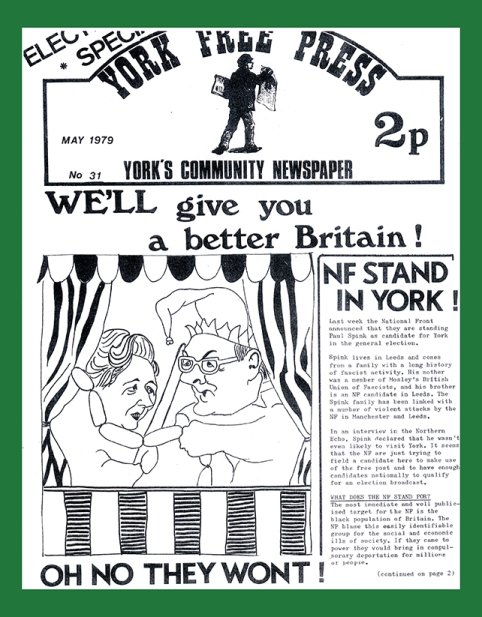
THATwas my introduction to “York Free Press”, one
of the best and most enduring of the “alternative newspapers” that for a
decade or two enlivened Britain’s culture and politics.
It was 1976 and I was an idealistic young teacher living and working
in York and aggrieved at an article I’d read in a recent issue. York’s
selective school system was about to be “comprehensively” reorganised
but the YFP article argued for incorporating six-form colleges which I
considered a device for keeping an A-Level elite away from less academic
plebs. YFP claimed to be open to everyone and advertised weekly
meetings upstairs in the Lowther on King’s Staith so I turned
up one evening expecting a row and instead was welcomed in and invited
to write a rejoinder. I was utterly disarmed, it wouldn’t happen at Socialist Worker! I was already a libertarian socialist but this bunch of scruffy student hippies turned me 100% anarchist and so I’ve remained.
Actually they weren’t all scruffy hippies, Vaughn Harvey was but Tony
Zurbrugg (who now runs Merlin Press) was already a serious-minded
libertarian-communist permanently clad in an RAF greatcoat, Danae and
Howard Clarke (later of “War Resisters International”) were smart-casual
and always smiling, Danny Golding “The Ayatollah” (nowadays Labour
loyalist) was too humourless to qualify as a real hippy but there was
always a supporting cast of “occasionals” who couldn’t be asked to turn
up every week. That was an attractive feature of YFP, you helped at
whatever level you felt comfortable with. Most political groups demand
so much that they retain only fanatics. YFP enjoyed regular “bring food
and drink to share” socials so less active supporters kept in touch and
made friends with regular “collectivists”.
Around 1978 we organised a national 'PAPERS EVERYWHERE!'conference-jamboree
weekend at York University. We invited every community paper we could
think of and people from about eighty titles turned up. It was wonderful
exchanging papers, experiences, ideas and what little technical
expertise we’d acquired. I was especially impressed by a rather posh
Sheffield guy who single-handed ran The Totley Independent, which
he gave away free and financed by taking ads from small shops and
tradesmen. He stuck out like a sore thumb amongst an array of vaguely
alternative-socialists but was content to paddle his own canoe. It
showed the potential of the format. Some titles such as Islington Gutter Pressand Rochdale Alternative Paper (RAP), which I believe sold 8,000 copies per issue, were real big hitters whilst others, like the Totley,were
happy to nurture community spirit and less intent on exposing scandal
and corruption. RAP revealed Cyril Smith’s dirty deeds forty years
before the commercial press dared touch the story.
I think two things sparked the birth of the alternative press, the
“swinging sixties” do-it-yourself politics and certain technical
developments in printing. Lead-typesetting was no longer involved and
the new process required less skill and cost. Like other papers, at YFP
we used ordinary typewriters to produce the text and trimmed, then glued
the result to a large sheet of cartridge paper. Other articles were
stuck alongside the first to build up a newspaper page with spaces left
for photographs which had to be “screened” and treated separately.
Headlines were the real pain – LETRASET!
Headlines were produced by a
sort of transfer process. You bought these rather expensive “Letraset”
transparent plastic sheets with individual black letters affixed to the
undersides. By scribbling on top of the required letter it detached from
the sheet and adhered to the paper placed underneath You had to build
the headline a letter at a time, any misspelling meant you must discard
your first effort and start all over again and keeping it all level and
evenly spaced was a tedious task. Sometimes we had lots of tables and
space to lay out the paper but often we managed in someone’s cramped
bedroom with people coming and going and ideas, jokes and arguments
flying back and forth.
YFP was a monthly with a price of 2p and 1,000 print run, sold door
to door with a network of local shops selling on the basis of sale or
return. It was a struggle to keep it going but the paper survived long
after I left York. I was always a bit of a populist, keen to present the
politics in an attractive wrapping and my favourite all-time article
was, “The Great York Fish and Chip Survey!” Every Thursday for
three months we’d sample 3 or 4 different local chip shops, weigh the
portion of chips and the fish and then assess the price, quality etc.
Finally we tabulated the results and published a league table to great
reader acclaim! Is that petit bourgeois politics or anarchy in action?
Every article was subject to the deepest of political analysis – “Is it
ideologically sound?” – was the inevitable dilemma.
The balance of collective responsibility and initial initiative at
YFP remained problematic. When a character calling himself “Euston Arch”
joined us he immediately began arranging music events in the name of
YFP and only afterwards seeking collective approval. When he signed us
up to a potentially disastrous gig featuring “Wayne County and the
Electric Chairs” at the Mecca Ballroom we accepted responsibility and
survived but immediately expelled him from the collective. After we
printed a story by a guy who told us he was literally kicked out of his
York bedsit by the landlord as a uniformed policeman stood idly by
(illustrated by a cartoon of a cop shielding his eyes) I received a
threat to sue from The Police Federation (my address, 1 Newton Terrace,
was the published editorial address). We agonised whether to apologise
and “correct” the story or stand firm and take the consequences.
Fortunately, within days the local straight press published an account
of the same landlord doing the same thing to someone else so we lived to
fight another day.
Anarchism rather than socialism characterised the alternative papers
movement. Although lots of Marxists were individually supportive they
tended to regard papers like YFP as trivial compared to their party
newspapers whilst Tories and Labour Party types regarded us as
scurrilous troublemakers. Although I wanted the paper to become a sort
of local Private Eye, both funny and muck-raking, whilst at YFP
I established an abiding interest in researching radical history. I
interviewed a founder member of York Communist Party who claimed workers
were more interested in politics in the old days and all he had to do
in the twenties was ride his bike along a road, ring a hand-bell and
people would come out of their houses and he’d start an impromptu
discussion on socialism. He described how difficult it was to keep up
with the ever-changing political line emanating from Moscow and how he’d
finally been expelled from the CP when “I zigged when I should have zagged”!
In 1979 I researched and YFP published a series of articles on
“Fascism in York in the 1930’s” which revealed a continuity of not only
Blackshirtideas with current National Front candidates but the same
local families were still organising attacks on socialist opponents.
There were so many good stories and so many great times and in 1980 I
was sorry to leave but keen to start another scurrilous rag elsewhere,
but that’s a story for another day…




 Posts
Posts


