Showing posts with label Durham. Show all posts

Wednesday, 13 November 2019

Commemorating Norman Cornish: Pitman Painter

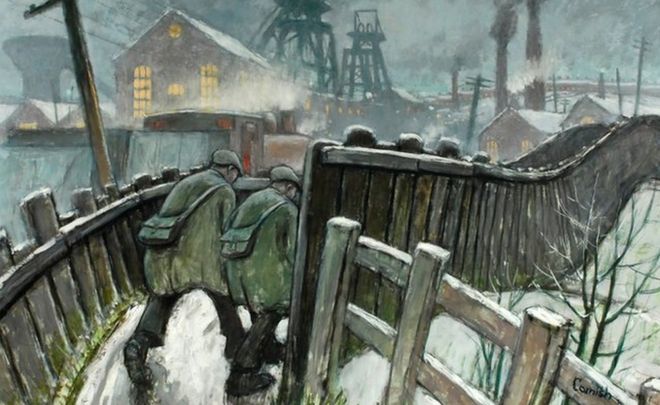
 Pit Road, Winter by Norman Cornish
Pit Road by Norman Cornish depicts miners striding to work on a cold grey morning

A SERIES of exhibitions about a miner turned artist have been announced to mark a century since his birth. 

Norman Cornish, a former miner of Spennymoor, County Durham, was known for his paintings of life in the industrial North East.

He was a student of the Pitman's Academy at The Spennymoor Settlement set up in the 1930s to give mining families access to the arts.

Durham Council said six venues would host shows throughout the year.
One of the first shows, Norman Cornish, A Slice of Life opens at the Mining Art Gallery, Bishop Auckland Market Place on 6 April and will run until 13 October 2019.

Norman's son John Cornish said: "We are very proud of the esteem in which my father's work is held by the public and we hope the planned exhibitions and events will serve to reinforce the region's pride in its cultural heritage."
Cornish was awarded an Honorary Doctorate of Arts by the university in 2012. He died in 2014.
Later this year, four further exhibitions will be announced at Gala Gallery in Durham and the Greenfield Gallery in Newton Aycliffe.
Cornish's former home from the 1950s and 60s is set to be recreated as part of the Remaking Beamish Project 1950s town, which is expected to conclude the centenary events.

Thursday, 28 September 2017

Charles Mowbray - anarchist revolutionary &

  Forest Gate-unemployed champion
by John Walker
CHARLES Mowbray (1856 - 1910) can lay claim to fame to be one of Forest Gate's most controversial political figures. He was an anarchist, who mixed with the Who's Who of the British political left in the last two decades of the nineteenth century and married the daughter of a Paris communard. 

He was imprisoned for inciting riots and spent some time politically agitating in America, from where he was deported.  He ended up in Forest Gate, with his third wife and children, working on Tariff Reform for the Tory party. This is his story.

Charles Wilfred Mowbray was born at Bishop Auckland, Co. Durham in  late 1856 and as a young man served in the Durham Light Infantry. He worked most of his life as a tailor. He married Mary, with whom he had five children (Charles, John, Richard, Grace and Frederick) in 1878.  Mary Mowbray turns out to be a minor political celebrity, being the daughter of the French Communist Joseph Benoit, who'd been active in both the 1848 revolution and the 1871 Paris Commune. She ended up with a huge funeral, locally at Manor Park cemetery - see later.

Charles Mowbray  didn't leave much record of his first contacts with revolutionary ideas, although his obituary in the Shoreditch Observer in December 1910 sheds some light. It described him as:

Once a sinewy, athletic black-haired determined man with the blazing eyes of a fanatic and a tempestuous eloquence that stirred many an open-air meeting. He became a socialist nearly thirty years ago, and joined the Socialist League.
He read widely and moved to London, living in the notorious Boundary Street (the Old Nicol) slum in Whitechapel, in the 1880's.  It is there his revolutionary politics began to flourish, as he came into contact with socialists, anarchists and communists living in the area, greatly politicised by many of the Jewish immigrants who had fled the pogroms in Russia and were determined to organise politically - from afar.

 As his obituary mentions, he joined the Socialist League at its foundation in 1884 - the organisation most closely associated with Walthamstow-born William Morris - and he described himself as an "anarchist/communist".  He became a prominent street corner speaker/political agitator, calling for rent strikes and fairer treatment of workers. He was popular with fellow tailors in the area, and has been called: "One of the greatest working class orators who ever spoke in public".


Walthamstow's William Morris, with
 whom Mowbray joined political
 forces with in the 1880's
When the police began to harass open-air meetings in 1885, he was one of those involved in a major agitation in Dod Street and Burdett Road in Limehouse in September of that year. 

On 20 September, following this meeting, he was beaten by the police there and arrested for obstruction along with other speakers.

William Morris felt that Mowbray "had done the most" but he was set free.  The publicity and outrage created by the arrests meant that 50,000 people turned out in support at Dod Street the following Sunday.


A court sketch of Mowbray,
 at one of his trials
He was again arrested at a free speech rally in Trafalgar Square on 14 June 1886 and was fined £1 with costs.

For more go to:   www.E7-NowAndThen.org, @E7_NowAndThen 

Wednesday, 27 July 2016

Blacklist Current Agenda

1. Blacklisting, Bullying & Blowing the Whistle 
Blacklist Support Group are co-hosting a major employment rights conference in September at the University of Greenwich.
Bringing together activists & academics, politicians, unions and lawyers to expose the hidden underbelly of the modern workplace. Confirmed contributors include: John McDonnell, Michelle Stanistreet, Gail Cartmail, John Hendy, Roger McKenzie, Art Against Blacklisting - many more speakers to be announced.
Come along, spread the word and be part of setting the political agenda on workers rights (plus on Friday evening there will be a Blacklisting Victory party with live music & DJs)
http://www.gre.ac.uk/business/services/events/events/current/BlacklistingBullyingBlowingtheWhistle


2. When Len McCluskey said that that MI5 could be covertly undermining the Corbyn leadership, he was condemned as a conspiracy theorist. Perhaps his critics should take a look at the evidence of legal democratic campaigns being infiltrated by undercover police and the security services. 
http://www.theguardian.com/politics/2016/jul/22/intelligence-services-using-dark-practices-against-jeremy-corbyn
https://www.theguardian.com/uk-news/undercover-with-paul-lewis-and-rob-evans/2015/mar/13/covert-police-unit-spied-on-trade-union-members-whistleblower-reveals

3. Video shown at UNITE Policy Conference in Brighton 
Bill Harvey, Jessica Sparrowhawk, Sandy MacPherson, Bridgett & Darrel Crapper represent

4. Solidarity
Solidarity - Wood Street Cleaners 
Wood Street cleaners have WON the London Living Wage but have voted unanimously to stay on indefinite strike until their sacked union reps are reinstated. 
Day 50 on strike - protest - Time for our entire movement to mobilise in support of this heroic dispute.
5pm Wednesday 27th July 

Solidarity with the striking Offshore workers 

Solidarity with the Durham TAs

Solidarity with Hazards conference - this weekend

5. Davey Hopper R.I.P.
Blacklist Support Group wish to send condolences to the famioy and friends of Davy Hopper, Durham NUM. Funeral this Friday. 

6. The short film 'Apologies' by Lucy Parker about the blacklisting scandal is showing as part of an exhibition from Tuesday this week until 28th August
Jerwood Space, 171 Union Street, Bankside, London, SE1 0LN. 

7. Corbyn keeps pushing the case for blacklisted workers at Durham & Tolpuddle 


Blacklist Support Group

Saturday, 30 April 2016

Chesterfield’s 'Anarchist of the Abyss'


by Christopher Draper

FOR seven weeks in 1903 Jack London dossed down with drifters and derelicts in East End lodging houses.  On returning to America, Jack famously published his account of these exploits as the hugely influential, 'People of the Abyss'.  Three years earlier, a Chesterfield anarchist published an account of life in common lodging houses drawn from a lifetime’s experience tramping around the North as a militant navvy.  Andrew Hall’s historic account has been completely ignored and his activism unappreciated, until now.

Hall was defiantly bottom drawer, a navvy who looked, lived and spoke the part and no intellectual slouch. According to the local paper, at a Hull 'Paris Commune Commemoration' in 1893, Andrew 'traced back the history of the fight now pending for more bread and more pleasures of life for the toilers…He held that it was better to die fighting than starve like a rat in a hole.'  Andrew Hall was a navvy with attitude.

Born in Coatbridge in 1851, as a teenager Andrew laboured in coal mines until, aged 17, a protracted strike forced him to leave home and seek work south of the border.  On the tramp around Newcastle, Bishop Auckland and Durham, Andrew slept in common lodging houses until he found employment navvying on the railways. After a period in the early eighties employed on the 'Hull to Barnsley', Hall followed the line south to London. 

Years wielding a pick in cold, wet, dangerous conditions meant “Navvy Hall” didn’t need lectures from metropolitan soap box agitators to hate bosses but he lapped up their ideas of an organised fight back. In 1886 Andy joined the Hampstead branch of Britain’s first Marxist party, the Social Democratic Federation (SDF).

To militants of the SDF Andrew certainly looked the business. In complete contrast to frock-coated, top-hatted stockbroker Henry Mayhew Hyndman, the party’s self-appointed leader. Hall’s fustian jacket, flat cap and twisted muffler shouted “navvy”. Both cap and jacket were flamboyantly discarded as Andy invariably introduced himself to audiences with the words, “I’m Andrew Hall the navvy!” Crowds loved him but the authorities despised the rabble-rousing “Navvy Hall”. 

Hall’s agitational ability was immediately exploited by the party elite who allotted him a prime spot on the “Number 2 platform” at the NW corner of Trafalgar Square for their Sunday 29th August 1886 demo. The rambling resolution put to the crowd concluded by urging the SDF, “to secure for the producing classes collective control over the railways, shipping, mines, factories, machinery and land…and to recommence at once their vigorous agitation in favour of the organization of the labour of the unemployed.”

The press denounced the rhetoric but praised the attire of most platform performers, 'Nearly all the orators wore red ties, scarf, rosette, ribbon or red flowers. Not a few were well dressed and wore top hats'. Sartorial standards were maintained by the socialists at the evening’s celebratory dinner, 'The company might have been one entire and perfect bourgeoisie in the predominance of black coat and the hat of civilisation…one of the few exceptions was the navvy Hall, who literally came in his working clothes, though they were very clean ones and who sat at meal with his shirt sleeves tucked up and showing the brown arms as high as the elbows and in his belcher twisted with nautical freedom round his sinewy throat.'

In September Hall was arrested for “obstruction”, along with comrade Ernest Rossiter, for speaking from a chair in Bell Street, London. According to police, “He was surrounded by about 500 people, entirely blocking the roadway and footway…During the meeting three cabs passed along Bell Street and had to pull up and stop, while the speakers got off their stand and a way was made through the crowd for them to pass. The cabmen and the fares were booed by the crowd and one cab and fare was followed and chased into Edgeware Road.”
Religionists and temperance soap-boxers who caused similar obstruction were ignored by public authorities who confined their efforts to driving socialist agitators off the streets.

A month later, the Sussex Courier, suggested the SDF’s new roving agitator was guilty of more than obstruction and dress-code faux pas, intimating that, “Navvy Andrew Hall whose outrageous threats and language towards the upper and trading classes” had incited Tunbridge Wells’ socialists to embark on an incendiary spree causing considerable damage to three commercial premises. 

On 9 November 1886, the day of the London Lord Mayor’s Show, Andrew Hall, Tom Mann and comrades organised an unofficial Trafalgar Square counter-demonstration to draw attention to the plight of the unemployed and the public’s right to free speech. It was promptly banned by the authorities but as a defiant crowd gathered, “Andrew Hall -  who previous to addressing the crowd, took off his coat and rolled up his shirt sleeves – said, amid great cheering, that they meant to show Sir Charles Warren that no unauthorised and irresponsible Chief Constable was to be allowed to proclaim a meeting of British subjects…at no distant date the working men would raise in their strength and sweep away the last vestiges of despotism…The speaker’s gesture bespoke a considerable acquaintance with the art of self-defence – Looks as if he wanted to hit him a clip under the jaw – remarked a critical bearer – and this won him the sympathy of the crowd.”

“The resolutions had scarcely been passed when the police…commenced to clear the Square. The foot police pushed and elbowed the people off as well as they could and were aided by mounted police. A body of Life Guards was sent by Sir Charles Warren and immediately rode up”. Andrew’s politics were too revolutionary for the SDF, not straightforward Marxism nor undiluted anarchy but more an iconoclastic libertarian communism. He was deeply suspicious of constitutional politics and a powerful advocate of insurrection. 

After the Trafalgar Square demo the SDF sent Hall north. According to the Times, “The relief of the unemployed is becoming a serious question in Northampton. Many persons are out of employment and meetings of Socialists and the unemployed are held on Sunday mornings. A London Socialist named Hall appeared at the police-court yesterday with a following of unemployed and Socialists. He asked the magistrates for assistance and on account of his behaviour was ordered out of the place. Hall then harangued the crowd outside the Town-Hall…Hall advised the men to attend the police court in hundreds next morning and show the magistrates they would not be trampled on by the police nor by the upper classes…The following day police arrested two local men assisting Hall’s campaign. They were questioned and following their eventually release an open-air demonstration was held on the large market square, when the navvy Hall made a bitter speech against the Corporation.”

The following Sunday Andrew was recalled to London to speak from the platform at another mass demo in Trafalgar Square. “Sir Charles Warren has at his disposal not less than 4,000 men, nearly a hundred of whom are mounted… and two guns of the Royal Horse Artillery battery will be located in the vicinity of Charing Cross…loose stones and debris, which might be used as missiles were removed from the streets…” but they needn’t have worried, the socialists were well behaved. Not so the following February when Hall played a leading role in disrupting a religious service at St Paul’s Cathedral. The SDF issued the following (abbreviated) statement, “The Archbishop of Canterbury has been asked to preach to the unemployed next Sunday in St Paul’s Cathedral on a text chosen by one of our comrades, Let him that stole steal no more but rather let him labour…Modern Christianity is essentially a middle-class creed with a capitalist paradise here and hereafter held up before its votaries to cheer them on in their struggle for personal gain on earth and individual glorification in Heaven.” Andrew and chums secreted themselves inside the Cathedral whilst most of the demonstrators stayed outside with banners and flags, “Most of which were red but some were black with white letters…one sentence ran, I was hungry and ye gave me no meat . Another was, I was naked and ye clothed me not. The red flags were
surmounted by caps of Liberty”. “That the purpose of the gathering was to disturb the congregation and to scoff at religion was very early seen…The doors were closed and then there were heard by those under the dome the sounds of speech-making and cheering…from the spot where the disturbance occurred came the navvy Andrew Hall.” No arrests were made and Navvy Hall continued campaigning for revolution without regard for the approval of the authorities or the party hierarchy.

In February 1887, after the authorities banned a torchlit parade Andrew had organised to pass through the West End he held a token demonstration at Clerkenwell Green. Torches were defiantly lit, Hall’s incendiary rhetoric delivered and an hour’s frenzied window smashing and riot ensued before the police finally regained control of the streets. A few weeks later, after one of Andrew’s SDF colleagues was harassed and then arrested by police, Hall organised an “Indignation Meeting” at Marble Arch that thousands attended. “Mr Hall (a navvy who took his coat off to speak though a few snowflakes were falling) said that for the future when one comrade was arrested Sir Charles Warren would find that ten men would jump into the breach (Cheers).”

By 1888 Andrew had already accrued eleven arrests and considered it expedient to go navvying on the “Towcester & Olney”. Revisiting Northampton he supported the SDF election campaign with Hyndman but his help proved a two-edged sword as the local candidate observed, “The press boycotted (his campaign) until the services of Navvy Hall were obtained and no sooner did he use rough language that his remarks were inserted.” Hall’s rough language offended polite society and Mr Hyndman was not amused but this only encouraged Andrew to ditch SDF Marxism and embrace the anti-parliamentary politics of the Socialist League (SL).

In 1889 Navvy Hall moved north to Chesterfield where he helped Raymond Unwin start an SL inspired socialist group and attracted the favourable attention of Edward Carpenter. In June, Edward cycled over from Millthorpe with his friend Jim Shortland, “with a bicycle between us, to Chesterfield for an evening meeting in the market-place. There is a navvy there – Andrew Hall – a regular rough looking chap who lives in a common lodging house, who speaks on Socialism every Sunday evening. He has read a lot of history and all sorts and speaks well. There was an attentive audience of 400 to 500.”

On Sunday 1st June 1890 the pair shared a platform, “In the morning Andrew spoke on Brimmington Common and in the evening a large audience assembled in the Market Place and in spite of the rain kept together and listened attentively to the addresses given by comrades Hall and Carpenter”. In Sheffield, a couple of weeks later, “Our comrade Andrew Hall, from Chesterfield, addressed some very large meetings.” Two weeks after that, in Nottingham, Andrew addressed a conference of socialist clubs. Hall returned to Nottingham in late July where his militant brand of socialism was much appreciated, “Andrew Hall of Chesterfield gave three stirring addresses to very large audiences. He created great interest by the way in which he spoke of gaining our object by any means. He advocated the same methods in defence of our cause as were used against us. We are expecting some lively meetings when our comrade again visits us which he has promised to do in a few weeks time.” When he visited Leicester in early August, “Hall’s evening address was truly eloquent and the audience was much impressed.” The Hull dockers were equally impressed a couple of weeks later, though the unappreciative police arrested him for “obstruction”. Fined five shillings plus costs, Andrew refused to pay and was sent down for seven days. When Tyneside libertarians founded Newcastle Communist Anarchist group in December, Navvy Hall was the man they chose to headline their first public event where he “addressed a large workmen’s meeting on the Quay and in the evening spoke against Parliamentary action.”

Andrew’s fiery spirit struck a chord with Sheffield navvies who begged him to represent them against the bosses. In autumn 1890 the Working Man’s Times reported that, “Mr Andrew
Hall, the Secretary of the Sheffield and District General Labourer’s Union has been actively engaged during the past weeks organising men at various firms in the town and much credit is due to him for the energy he has shown in that direction…We are bound to admit that whilst admiring the ability of the lecturer, we think such statements as ”that if all capitalists went to ---- tomorrow we could do without them”, are calculated to do more harm than good and would counsel moderation on some of these points.” Forty years on one old labourer recalled Andrew’s militancy in the Sheffield Daily Independent, “Navvy Hall’s policy was Strike first and negotiate afterwards!”

It wasn’t long before Andrew’s men exercised their collective muscle as trouble erupted at Messrs Samuel Osborne and Company’s Rutland Works. After a foreman tried to discipline eight labourers the rest came out in sympathy and instructed the management to negotiate through Secretary Hall. “The men have today chalked the walls with the word STRIKE and on the door has been written: Don’t come to work here there is a strike!” 

Invariably labelled “Socialist”, Navvy Hall’s politics were roughly anarchist and he often accompanied well-known libertarian speakers on the most advanced platforms. In November 1890 Andrew commemorated the judicial killing of the Chicago anarchists alongside Cores, Samuels, Charles and Maguire at Leeds. At another Commemoration alongside Cores, Creaghe, Samuels et al at Sheffield Hall was “received with the utmost enthusiasm by the large audience”. By then Andrew’s fiery rhetoric had begun to worry the more pacific Carpenter faction. George Hukin recorded his own anxiety in a letter to Carpenter, “I suppose you’ll have heard how Andrew Hall during his speech dropped to his knees and, well I’ll give you his own words; “With the shadow of the rope hanging over me, I call upon each of you to vow with me that we will never rest till the murder of our Comrade has been avenged, blood for blood and life for life” and etc. There was a good big meeting and nearly everybody held up their hands for the vow. I must say I didn’t like the proceedings much – too much blood and vengeance about it.”

Undeterred, in 1891 Andrew commemorated Chicago at the old Alhambra Palace in Porter Street, Hull alongside anarchists Naewiger (future biog), Gustav Smith, George Cores and Chas Reynolds. His political principals proved more enduring than his union career. Despite adding the endorsement of Tyneside labourers to his appointment by the Sheffield men he soon met opposition from union “moderates”. As local unions merged to create a national organisation a bureaucratic mentality and strike-averse policy developed, which Hall virulently opposed and he didn’t expect any support from Sheffield Trades Council; “The gravamen of the charges was that that body was the tool of the Liberal Party and that it was doing nothing in the interests of the working classes…The working classes did not get a fair share of what they produced and would not do so as long as they had trade union officials who were drawing their £2, £3 and £4 per week for doing nothing. He did not believe in paying such high salaries. They ought to be paid at the same rate as when they were working in the shop and then they would not go among the better classes for he found when they did and they got onto Town councils and other offices they were no good to working men.” In 1892 Hall resigned in disgust from the union he’d help create. 

Throughout the 1890’s Hall was based at the Beehive Common Lodging House, Knifesmith Gate, Chesterfield. The Derbyshire Courier published a brief description, “The rooms on the ground floor are dark and the ceilings low and broken. The walls of the bedrooms on the ground floor are damp and the floor is paved with bricks. The living room for the lodgers is dark, its floor is in bad repair and it is unfit for use. The scullery and pantry are roofed with glass skylights which are in a very bad state of repair. The back yard is small and its surface in bad repair as are the also the floors of the slop-closet privies. Only three of the eight bedrooms on the first floor are fit for use…” but according to Andrew it was preferable to other doss houses. At Alfreton “there’s three men, or if there is a double bed, six men for each bed (or rather bundle of rags, which is a more accurate description) every 24 hours: the moment one man gets out there is another waiting to take his place”.  

In March 1893 Andrew Hall revisited Hull to speak at the Liberty Club Commune Celebration (as referred to in the introduction). Andrew “held that the worker was kept, in a large extent, in ignorance by the parson who sometimes stated that it is God’s will that some people should be poor…it was the will of the profit monger and sweater. He referred to the gallant conduct of the soldiers of ’71 who, when ordered to fire on the people, refused to do so, and fraternised with the people. He held that it was better to die fighting than starve like a rat in a hole; and a bullet at a barricade was more preferable than a crust in a slum. He held that a man who starved was a coward.” 

Andrew spent the summer of 1893 navvying at the Loughborough sewage works. By September he was back at the Beehive when a fellow lodger and his mate were killed navvying in separate incidents at Calow tunnel. Thomas Carrigan was crushed by a fall of dirt in a “shoot hole” following the death just the day before of John Morris who was hit by a runaway wagon. Mr Busby, the coroner made no criticism of safety on site, simply recording both fatalities as “Accidental death”. 

Without abandoning his revolutionary ideas in 1893 Andrew Hall joined the newly founded Independent Labour Party (ILP) and the following July at a huge gathering in Sheffield he spoke from the platform alongside Labour luminaries Keir Hardie, Pete Curran and Emmiline Pankhurst. Ignoring ILP policy, Andrew continued to also speak up for anarchism. As late as November 1896 Hall was billed alongside Louise Michel, Joseph Perry, Alfred Marsh, John Turner, Will Banham and Herbert Stockton (future biog) at what Freedom described as “the largest ever commemoration of the Chicago anarchists” at Holborn Town Hall. 

As the century came to a close so (almost) did the English anarchist movement, eclipsed by Labourism. Andrew Hall was too old for navvying and in September 1900 was glad to accept an offer of employment as live-in manager of the Beehive. As a local personality, the editor of the Derbyshire Times commissioned Andrew to reflect on his lifetime’s experience of common lodging houses across the North. The result was a fascinating series of articles published in the paper as, “Sketches of Lodging House Life”; and then nothing.

In 1905 Chesterfield Council condemned the Beehive as “unfit for human habitation” and it was pulled down without a murmur from Andrew. Where was he? He wasn’t among a handful of anarchists whose activism survived until the 1910 syndicalist revival and he never rose through the ranks of the Labour Party. Did he just retire from activism or perhaps succumb to early death and an unmarked grave? 

Peace & Love
Christopher Draper
(Northern Anarchist Lives – 4)
(NAL: 1 Oldham Anarchism, 2 Lupton from Leeds, 3 A Liverpool Nut Case…next month… NAL 5 – “Frank Kapper’s Cunning Plan”)

Wednesday, 22 October 2014

GMB 'CROCODILE TEARS' PROTEST!

GMB “CROCODILE TEARS” PROTEST IN WOLVERHAMPTON
THURSDAY 23RD OCTOBER TO SHAME LIZ KEATES CARILLION HR MANAGER WHO BLACKLISTED 139 WORKERS
Managers like Liz Keates shedding crocodile tears now for her part in blacklisting 3,213 workers won't wash, neither will the Nuremberg Defence of "just following superior orders” says GMB
GMB will hold a protest demonstration in Wolverhampton on Thursday 23rd October to shame Liz Keates, Head of Employee Relations at Carillion plc named who was in Parliament as a blacklister. She has yet to come clean and apologise for the hurt and damage she did blacklisting 139 workers. See some examples below.
Blacklisting came to light when in 2009 the ICO seized a Consulting Association database, run by Ian Kerr, of 3,213 construction workers and environmental activists used by 44 companies to vet new recruits and keep out of employment trade union and health and safety activists.
This is the third date in a national “Crocodile Tears” protest tour to shame 63 construction industry managers named as blacklisters who have yet to come clean and apologise for their actions. See notes to editors 1 for the 10 dates in the first leg of a national tour and notes to editors 2 for the list the 63 managers and where they worked.
The details of the protest are as follows:

At 11am Thursday 23rd October,
Outside Carillion,
Birch Street
Wolverhampton, WV1 4HY
At the protest there will be a person in a crocodile suit accompanied by union members with flags and banners and slogans “Nuremberg defence on blacklisting won’t wash” and “Blacklisters come clean”.
GMB representatives from Carillion at Swindon PFI Hospital will be there. 51 GMB members are pursuing claims at an ET to hold Carillion to account for race discrimination, bullying and harassment and victimisation that Liz Keates failed to deal with at the hospital after 21 days of strike action in 2012. GMB members work as porters and housekeepers in catering and cleaning and other support roles. GMB members demanded that Carillion management act to stop the culture of bullying on the contract and for an end to discrimination in the application of pay and conditions on the contract.
Liz Keates (LK), Head of Employee Relations at Carillion plc was named by Ian Kerr as the main contact for Carillion / Crown House Engineering and Tarmac. She joined Crown House Engineering, which was part of Tarmac, in 1998.
The initials LK appear 92 times against 75 different individuals in the blacklist files while working for the company 3271/81, the code used for Crown House Engineering, Carillion and Tarmac. 64 separate workers have been refused work after Liz Keates checked their records with The Consulting Association. 11 of these were refused work twice and 2 workers refused work three times.
Carillion, and associated companies, have been described by Sir Robert McAlpine Ltd as ‘heavy users of the Consulting Association in terms of the amount of information provided by the Carillion Third Parties on workers. Further, the number of occasions on which the Carillion Third Parties are recorded as refusing employment to workers is particularly high compared to other members of the Consulting Association.’
These are some examples:

    · An electrician from Edinburgh blacklisted in 1977 applied to 3271/81 in March 2003, 26 years later and was not employed by LK.· An electrician from Dundee, blacklisted in November 1976 applied to work for 3271/81 26 years later in September 2002. LK given details and was not employed.
    · A pipefitter from Suffolk blacklisted in 1978 for being an alleged ‘strike leader’ in 1998 applied to 3271/81 and was not employed. He applied again in 2000, LK given details and not employed.
    · An electrician from Liverpool put on the blacklist by Costain in 1993 applied to work for 3271/81 in 2000, in 2003 and 2005. LK blacklisted him 3 times.
    · An electrician from Warrington was put on the blacklist by Haden Young with the comments ‘would not re-employ – assistant shop steward” applied to 3271/81 in 2003, LK given details and not employed.
    · An electrician from Essex was put on the blacklist in 1977.’ Applied to 3271/81 26 years later in 2003, LK given details and not employed.
    · Same contact, same outcome for a Glaswegian plumber blacklisted in 1978 when applying to 3271/81 for a job in October 2000, 22 years later.
    · One electrician from Tooting applied to 3271/81 on 4 occasions in 2000, 2002 and 2003. Refused work all four times, three of those times by LK.
    · A pipefitter from Essex was put on to the blacklist in 1980 because he was spoken to by a journalist from the Morning Star and their replies formed a feature article in the paper. Because of this he was not employed by LK in 2002 when he applied to work for 3271/81.
    · An electrician from London blacklisted by Morgan Est on the Jubilee Line’ in 1998 was refused work by LK and 3271/81 at their Norfolk & Norwich Hospital site. Another electrician from Gateshead was also refused work on this hospital site in 2000.
    · An electrician from Braintree, blacklisted in 1985 for being ‘politically motivated’ was refused work in 2003 by LK and 3271/81.
    · In 1977 an electrician from Manchester found himself put on the blacklist for being ‘mixed up with a left wing organisation’. He applied for work in 2003 with 3271/81, LK given details and not employed.
    · An electrician from Glasgow was put on the blacklist in 1978 as an ex-employee of Balfour Beatty. Despite further information stating that a company ‘experienced no problems’ with him and ‘did not regard him as an activist’ he applied to work for 3271/81 twice in 2002. On both occasions LK was given details and not employed.
    · A welder from Kent was put on the blacklist in 2000 by LK for being a ‘main agitator with mechanical sub-sub-contractor at Pfizer, Kent.’ After this he was refused work twice by Skanska.
    · A joiner from Hartlepool applied to work for 3271/81 on the GCHQ, Cheltenham contract. Danny O’Sullivan at Kier blacklisted him in 1997 for having been ‘drawn along by the course of events at JLE. Not in front-line of action’. He was refused work by LK in 2002 and again in 2003.
    · An electrician from Glasgow, blacklisted in 1974 for being a deputy shop steward at the Methil Power Station Site applied to 3271/81 for the Hymires Hospital contract in 2000. LK was given details and did not employ.
    · An electrician from Durham, blacklisted in 2003 by Costain at Barrow Power Station was refused employment twice in 2003 by LK.
    · An electrician from Croydon, blacklisted in 1985 was refused work by LK on their Gatwick Airport contract in 2000.

    On October 16th there was a hearing in the High Court on compensation for 122 GMB members blacklisted by Carillion and other construction employers on claims served in November 2013. GMB’s claims were joined with a further 449 claims by other unions and parties at a High Court Hearing in July 2014. The next hearing is 17th December
Talks between GMB and lawyers for Balfour Beatty, Carillion, Costain, Kier, Laing O’Rourke, Sir Robert McAlpine, Skanska UK and VINCI PLC on a compensation scheme broke down in June over the amount of money being put into the scheme. Employers have unilaterally launched a cut price scheme GMB estimates will cost less than 2% of the combined profits of the eight construction firms.
So far 1,724 out of the 3,213 on the list know they are on blacklist and of these 570 cases are covered by claims in the High Court. That leaves 1,489 still to trace. See notes to editors for details of where those blacklisted come from.

Justin Bowden, GMB national officer, said “Liz Keates and the rest might have thought they had got away scot-free, so shedding crocodile tears now for the systematic blacklisting of 3,213 building workers and environmentalists won't wash, neither will the Nuremberg Defence of "just following superior orders".
These so-called HR Professionals who ran the blacklists for the construction companies knew exactly what they were doing and they need to either apologise, come clean and say what they did, or get used to accounting in public for the damage they did to those they blacklisted and their families, especially with the Public Inquiry Labour has pledged after the next election.
Just as the construction companies who paid their wages are being called to account in parliament, the courts and the media, every single one of these secret blacklisters will have their role dissected in public.'
End
Contact Carolle Vallelley on 07912 181 476 or Justin Bowden on 07710 631351 or Maria Ludkin 07956 632 657 or GMB press office at 07921 289880 or 07974 251 823
For information on High Court action contact Leigh Day: David Standard 07540 332717 or Michael Newman 0795 223 9358 or Chris Benson on 07795425649.
For people to identify more names on the blacklist call please call Phil Read at GMB on 07840 897997 or email him blacklisted@gmb.org.uk
Contact Dave Smith 07882 579 452 re Blacklist Support Group
Notes to Editors
1 The dates for the first leg of the Crocodile Tears Tour are as follows:

    · Darlington - 21 October Lynne Day, Personnel Director, Cleveland Bridge: · Leeds – 22nd October Valerie Bennison, HR for Head Office Directorates and SCS at Child Maintenance Group, DWP: Quarry House, Quarry Hill, Leeds,
    · Wolverhampton 23th October Liz Keates of Carillion, Birch Street
    · Sandy Bedfordshire 28th October Paul McCreath, HR Director, Kier Group: Tempsford Hall, Sandy, Bedfordshire SG19 2BD..and Kathy Almansoor, Group Employee Relations Manager, Kier Group: Tempsford Hall, Sandy, Bedfordshire
    · Glasgow 29th October Gerry Harvey, HR Development Director at Balfour Beatty Engineering Services: Lumina Building, 40 Ainslie Road, Hillngton Park, Glasgow
    · Aberdeen 30th October Kevin Gorman, Vice President HR, Harland Group: Ocean Spirit House, 33 Waterloo Quay, Aberdeen AB11 5BS.
    · Reading University Tuesday 4thd November for lecturer in HR Shelia Knight, EMCOR.
    · London Wednesday 5th November Paul Raby, Group HR Director, Balfour Beatty: 130 Wilton Road, London SW1V 1LQ.
    · West Midlands on Monday, 10th November 2014 details to be confirmed.
    · Cheshire Tuesday 11th November - Arnold Nestler, Human Resources Services Director, AMEC: Booths Park, Chelford Road, Knutsford, Cheshire, WA16 8QZ.
2 Managers named as blacklisters- to be part of Crocodile Tears Tour 2014/15. (Most initial are from the files of those blacklisted.)
· Michael Aird (MA) - Balfour Kilpatrick - Glasgow
· Kathy Almansoor (KA) - Kier Group – Sandy, Bedfordshire
· Dave Aspinall (DA) - Carillion / Crown House - Wolverhampton
· Alan Audley (AA) – Vinci - Watford
· John Ball (JB) - Carillion / Crown House - Wolverhampton
· Ron Barron (RB) - CB & I – Tonbridge, Kent
· Valerie Bennison (VB) – Whessoe - Darlington
· Ernie Boswell (EB) - Kier Group – Sandy, Bedfordshire
· Richard Bull (RB) - HBG Construction (BAM) – Colindale, London
· Iain Coates (IC) – Emcor – Kew Bridge, Twickenham
· David Cochrane (DC) - Sir Robert McAlpine – Hemel Hempstead, Hertfordshire
· Ann Cowrie (AC) - Balfour Beatty Civil Engineering - Edinburgh
· Tony Crowther – AMEC – Knutsford, Cheshire
· John Dangerfield (JD) - Balfour Beatty Scottish & Southern - Basingstoke, Hampshire
· Lynn Day (LD) - Cleveland Bridge UK – Darlington
· John Dickinson (JD) – Skanska – Rickmansworth, Hertfordshire
· Frank Duggan (FD) - Carillion / Crown House - Wolverhampton
· John Edwards (JE) - Carillion / Crown House - Wolverhampton
· Kevin Gorman (KG) - Carillion / Crown House - Solihull
· Elaine Gallagher (EG) - Balfour Kilpatrick - Glasgow
· Gerry Harvey (GH) - Balfour Kilpatrick - Glasgow
· Roy Hay (RH) – Tarmac - Solihull
· David Hillman - Sir Robert McAlpine – Birmingham
· Keith Horner (KH) - Ballast Wiltshire
· Dianne Hughes (DH) – Tarmac / Crown House - Solihull
· Geoff Hughes (GH) – Costain – Maidenhead, Berkshire
· Greg Ingleton (GI) – Emcor – Kew Bridge, Twickenham
· Prue Jackson (PJ) - Haden Young - Watford
· Vince James (VJ) - Balfour Beatty Scottish & Southern – Basingstoke, Hampshire
· Armar Johnston (AJ) - Balfour Kilpatrick – Livingstone
· Liz Keates (LK) - Carillion / Crown House - Wolverhampton
· Sheila Knight (SK) – Emcor – Kew Bridge, Twickenham
· Ian Leake (IL) - Taylor Woodrow, Watford
· Tim Llewellyn (TL) - Walter Llewellyn & Sons Ltd, Eastbourne, East Sussex
· Alf Lucas (AL) – Mowlem
· Bridget May (BM) – Nuttall – Camberley, Surrey
· Cullum McAlpine - Sir Robert McAlpine – Hemel Hempstead, Hertfordshire
· Paul McCreath (PM) - HBG Construction (BAM) – Colindale, London
· Steve McGuire (SM) - Morgan Est plc – Warrington
· John Morrison (JM) - Morrison Construction - Edinburgh
· Arnold Nestler (AN) - AMEC – Knutsford, Cheshire
· Lisa O’Mahoney (LOM) - Laing O’Rourke – Dartford, Kent
· Danny O’Sullivan (DOS) - Kier Group – Sandy, Bedfordshire
· Sandy Palmer (SP) - Carillion / Crown House - Wolverhampton
· Harry Pooley (HP) - Rosser & Russell - Watford
· Derek Price – Morgan Ashurst – Stratford upon Avon
· Stephen Quant (SQ) – Skanska – Rickmansworth, Hertfordshire
· Paul Raby (PR) - Balfour Kilpatrick - Glasgow
· Murray Reid (MR) - NG Bailey – Ilkley, West Yorkshire
· Roger Robinson (RR) - Carillion / Crown House - Wolverhampton
· Sylvia Smith (SS) - Laing O’Rourke – Dartford, Kent
· Trevor Spice (TS) – Costain – Maidenhead, Berkshire
· Lisa Stevenson (LS) - Shepherd Engineering Services - York
· John Stoddart (JS) - SIAS Building Services - Keighley
· Alan Swift – Crown House Technologies - Manchester
· Pat Swift (PS) - BAM Nuttall - Guildford
· Alan Thorniley (AT) – Vinci - Watford
· Brian Tock (BT) - Carillion / Crown House - Solihull
· Ken Ward (KW) – Costain – Maidenhead, Berkshire
· Trevor Watchman (TW) - Balfour Beatty Major Projects – Redhill, Surrey
· Steve Wigmore – Crown House Technologies - Solihull
· Allison Wilkins – Skanska – Rickmansworth, Hertfordshire
· Carolyn Williams (CW) - Haden Young - Watford