AS the windfall fruit began to fall from the trees earlier this month the spectre of a second wave of the virus emerged in Europe.
On October 9, the Spanish government declared a state of emergency in Madrid on Friday, wresting control of efforts to fight the spread of COVID-19 from local authorities in a region that is experiencing one of Europe’s most significant coronavirus outbreaks.
The step, which took immediate effect and lasts for two weeks, forcing Madrid's regional authorities to restore restrictions on travel that had been introduced by the national government but were struck down the previous day by a Madrid court ruling.
That successful legal challenge by Madrid officials was part of a long quarrel between the country’s main political parties over their coronavirus response. Those differences, and the changing rules, have often dismayed and confused local residents.
The Madrid region’s 14-day infection rate of 563 coronavirus cases per 100,000 residents is more than twice Spain’s national average of 256 and five times the European average rate of 113 for the week ending Sept. 27.
The central government’s measures prohibit all nonessential trips in and out of the capital and nine of its suburbs, affecting some 4.8 million people. Restaurants must close at 11 p.m. and stores at 10 p.m.. Both must limit occupancy to 50% of their capacity.
The national government had ordered police in Madrid to fine people if they left their municipalities without justification. More than 7,000 police officers will now be deployed to ensure the restrictions are observed, Interior Minister Fernando Grande-Marlaska said.
The Spanish government announced the state of emergency after a hastily arranged Cabinet meeting in the wake of the court ruling. Health Minister Salvador Illa said the previous measures would come back into force and that only the legal framework for them was changing.
He told a press conference it was “undeniable” that there is community transmission in the Madrid region, not just isolated outbreaks, at a crucial juncture as winter approaches and respiratory problems increase.
“Action is needed, and today we couldn’t just stand by and do nothing,” Illa said. “It’s very important that this doesn’t spread to the rest of the country.”
Yet Madrid’s conservative regional government opposed those restrictions, saying they were draconian and hurt the economy. Madrid’s regional president, Isabel Díaz Ayuso, said her own, more moderate measures were enough to fight COVID-19.
A Madrid court on Thursday [8/10/20] upheld the regional government’s appeal, saying the national government’s imposition of restrictions violated people’s fundamental liberties.
Between Madrid and Manchester one cannot help but notice the looking-glass nature of the two disputes; as the Madrid regional authorities are politically conservative in opposing the national government, while in Greater Manchester the resistance is largely Labour with a sprinkling of local Tory MPs in places like Bury etc.
Today, in England, the Boris Johnson's government has just confronted a similar situation with regard to Manchester as the region's mainly Labour politicians and Mayor's oppose the central government's insistence that a three-tier is imposed. The Greater Manchester Mayor, Andy Burnham, has been in the forefront mobilising the opposition and demanding more support, but he urges that the people of Manchester to obey the law, and fall-in with the requirements of the government's new severe three-tier restrictions.
Last Saturday in an editorial leader in the Financial Times wrote: 'With events moving at such speed, and Mr Johnson's regional approach coming under strain, a circuit-breaker shutdown across England, too, now seems a question of when, not if.'
The FT editor took the view that if the goverment imposed a 'precautionary break' now, it might 'avert the need for a vastly more damaging indefinate national lock-down' later on.
Despite this, it now looks like the governmant is taking a chance on a regional approach to the problem. Just watch this space!
ANARCHISM IS not a very well understood doctrine in British politics. I realised this when Tameside Trade Union Council first published a booklet commemorating the 60th anniversary of the Spanish Civil War in 2006 with Durruti on the cover. The then delegates of the Greater Manchester County Association of Trade Union Council clearly didn't appreciate the publication at the time, but during the meeting a large party of French trade unionists from the CGT [communist] happened to be present and while many of the local English trade unionists held back the French delegation waded-in to buy up most of the commemorative booklets we had to hand, and even later following me to the toilets to get extra copies.
It struck us at the time how utterly frigid the English trade unionists were compared to their French 'communist' CGT comrades.
This thought occurs to me now as I now with sadness write my friend and comrade, Stuart Christie's obituary. I remember that sometime after Stuart wrote the first volume of his autobiography 'GRANNY MADE ME AN ANARCHIST', I wrote a critique of it entitled 'God Help the Anarchist movement that Needs Heroes'. This in turn led to a bitter altercation between me and Stuart on the website 'Libcom' in which I believe he labelled me 'an arsehole'. However, in 2006, it was a measure of Stuart's nobility that when I invited him to write an introduction to Tameside TUC's Spanish commemorative booklet he had no hesitation in agreeing to do the job.
He probably did it because he knew me from when I first met him in Paris in August 1964, when he was about to go on to embrace the risky venture in his ill-fated journey to Madrid and ultimately to a Spanish jail for his part in a proposed attempt to assassinate General Franco. At that time we were all staying in a 'safe house' with Germinal Garcia at his apartment near Place de la République*. My wife Joan and I were returning from Spain, having first worked in Denia, Alicante throughout 1963, and later on in early 1964 moved on to La Linea on the border with Gibraltar where I worked for the MOD at the Gibraltar airport. While in Denia my eldest lad was born at the clinica there in September 1963. While in Spain and later Gib. we had taken photos of the conditions in the shanty towns in Barcelona and we sent back reports on working conditions over there for the FIJL publication Nueva Senda. At that time we were being debriefed, and thought Stuart may have been on a similar mission to us, but soon found out that they had other plans for him. At one stage he asked for our advice and was naturally interested in our own experiences.
Stuart was still in Carabanchel jail [Madrid] when my family again returned to Spain in early 1967 on our way to work in Gibraltar having had difficulties working as an electrician in Rochdale following my involvement supporting the national engineering apprentice strikes in November 1964 and February 1964. Having been blacklisted by the British MOD and throughout Gibraltar with private companies with contracts with the MOD and other contracts with the British authorities the only place on the Rock that I had a serious chance of work was with the Gibraltar City Council, supported by the Transport & General Worker's Union and Albert Risso who had close links with Sir Joshua Hassan the Chief Minister.
The anarchists on Gibraltar at that time were active within the Transport & General Workers Union and were basically anarcho-syndicalists. Stuart identified with the syndicalists, and had fallen under the influence of Bobby Lynn who he says 'had become the backbone of the Glasgow anarchist movement'. I'd stayed with Bobby Lynn in the Gorbals in 1961 and he gave me his copy of 'The Sexual Revolution' by Wilhelm Reich. Bobby was a member of the Syndicalist Worker's Federation when I stayed with him in 1961. As news leaked of Stuart's arrest Peter Turner [FREEDOM EDITOR] had contacted Bobby Lynn in Glasgow and up there they had assured him that Stuart was so dedicated to the peace movement and that it was not likely that he was guilty as claimed by the Spanish authorities. This may have influenced the report in the syndicalist Direct Action which took the line that he must be innocent, and Wynford Hicks on behalf of the anarchists argued on TV news that he was probably the victim of an 'agent-provocateur'. Another Freedom editor Vernon Richards argued more sensibly that it mattered little whether Stuart was innocent or guilty the anarchist position should be to support him.
For my part I knew what had taken place, but anticipating returning to work in Spain and expecting to continue to help the group of young Spanish exiles of the FIJL involved with the failed attempt, I decided to remain silent. Stuart himself had not been prudent before his departure for Spain and had actually participated in a BBC2 program entitled 'Let Me Speak' hosted by Malcolm Muggeridge. Muggeridge, who had been a friend of George Orwell, had often identified morally and intellectually with Tolstoy and anarchism.
In his autobiography 'MY GRANNY MADE ME AN ANARCHIST'[2004] Stuart documents the sequence of events in the summer of 1964:
'In mid-July Salvador and Bernado [Gurucharri] told me I should be ready to leave for Paris by the end of the month. Everything was now in hand for my trip to Spain. Shortly before I left... I was invited to appear on what later turned out to be, for me, an almost disastrous chat show called Let Me Speak, on ...BBC2. Having a small spectrum of anarchists, with me and another young lad called Vincent Johnson representing the "revolutionary anarchists" Muggeridge asked me if I was sincere in my revolutionary aims...would I, for instance, given the opportunity, assassinate Franco?" It was an unlucky shot in the dark, for that was pretty damn close to what I was hoping to do. What could I say but yes?.'
It is an extraordinary admission for a revolutionary anarchist to make! I doubt that the Spaniards I knew in Paris or in Spain in the 1960s would have made such a confession on the BBC or before going on a mission such as Stuart anticipated. It's almost as if he had a death wish or secretly wanted to get caught. When we knew him in Paris in August 1964 he was hopelessly naive and clearly knew little of the reality of everyday Spanish life or working conditions. He struggled to pronounce the Spanish word for 'workers'.
On page 107 of his autobiography he writes: 'I may not have been wise or competent in what I did or the way I went about it, but I did not have the benefit of hindsight'.
Never mind 'hindsight' given what he had done did he have the benefit of foresight or even a glimpse of common sense? I say this knowing, as Stuart did, that other people suffered as a consequence of what he did and the mistakes that he and his handlers made at the time. I also say this as a friend of Stuart who exchanged correspondence with him regularly over the last few years, and had documented and detailed our differences in my earlier pamphlet. One thing that troubles me is not that he wore a kilt, but that he sported a war resister badge of a broken rifle on his chest while walking around Paris in 1964 as he carried our one-year-old son Deon. He told us that he'd visited Paris the year before in the Spring; it was more 'romantic' than in August. Being romantic was probably what attracted most people to Stuart as it was part on his charm.
Yet, when we had visited Ken Hawkes, then secretary of the Syndicalist Workers Fed., and his wife before we went to Spain in February 1963, the worst winter since 1947, they treated us to a bottle of Champagne as we'd just got married and reminded us to remove our Ban the Bomb badges before we left their house on Parliament Hill for Spain. I wonder why none of us thought to urged Stuart Christie to take off his tell-tale War resister badge?
I suppose that in August 1964, we were all a bit intoxicated by the atmosphere of a time in which Franco had just celebrated 25-years of peace, and a pale-faced Salvador Gurucharri and others had just been released from jail. In Paris, at that time, we were all in high spirits as things seemed to be moving in the right direction.
While there Stuart met other major figures in the exiled Spanish anarchist movement, the organised FIJL [Fed. of young libertarians] around the Internal Defence (DI), and including militants of long standing like Octavio Alberola* and Luis Andres Edo.
In his autobiography he describes what he did as 'the act of an adolescent' and he quotes a verse from Longfellow:
'A boy's will is the wind's will,
and the thoughts of
youth are long, long thoughts.' [page 120]
On reflection he goes on to admit: 'Now it will seem like to many a foolish, naive, impulsive act...'
and
'I cannot claim, either, that it was entirely altruistic - my motives were certainly in part a desire for excitement and adventure.'
On reflection he goes on to admit: 'Now it will seem like to many a foolish, naive, impulsive act...'
Essentially he was doing what we had done a year earlier when we went to Spain to escape from what then seemed like dreary Manchester; he was he says not satisfied with what would now be called 'gesture politics' of petitions and protests, and sought to engage directly with a struggle in Spain. Foresight or prudence would make cowards of us all; it was not part of his engaging personality at that time. It set Stuart outside the smelly little left wing orthodoxies which he left behind. Yet it led him to get a 'GO TO JAIL' card to a Madrid prison cell, and was for him a life changing event.
Once in Paris Stuart had made contact with the action groups of the exiled Spanish anarchist movement, organised around Internal Defence (DI) and involving militants of long standing like Octavio Alberola and Luis Andres Edo. As such during his disastrous mission he was later arrested in Madrid and charged with the possession of explosives. These were intended for an attempt on Franco’s life and he was sentenced to 20 years imprisonment. Thanks to a continuing international pressure he was freed after 3 years.
Why was General Franco and the Francoist regime so susceptible to international public opinion in the 1960s?
I think it was in his book 'The Face of Spain' [1950] that Gerald Brenan tried to explain the mellowing of the Franco regime. In that book he explained how the Falange and those who adhered to Franco began invest in real estate and escape the relative poverty of the 1940s and 1950s. We too quickly forget that it was not just the Spanish working-class that suffered after the Civil War, but the Spanish middle-classes experienced insecurity also. My boss Senor Such told me of how in the 1940s everyone in the fishing village where I lived and worked in 1963-4 had suffered depravation after the war and some had to eat cats. Later on it had become possible to make some progress and by the time we got there in the early 1960s things were looking up as the tourists began to arrive and with the development building work on the costas things were much more prosperous for many including the low-level Falangists. This allowed some softening of the regime which may some helped Stuart Christie escape with what turned out to be a relatively short sentence of 3-years in the end. Had he been arrested some ten years earlier for the same offence it may have been an altogether different story, but by the mid-1960s the supporters of the Franco regime felt much more secure than they had been during the Second World War or in its aftermath when to some extent Spain had been isolated internationally.
* FOOTNOTE: In the early hours of 11 May 2011, 86-year-old Germinal García, a militant of the Juventudes Libertarias (FIJL) and the Paris Local Federation of the CNT in the 1950s and 1960s, passed away (in Paris). At the end of the Spanish Civil War, 13-year old Germinal had been interned in Argeles-sur-Mer concentration camp where an unknown English woman, to whom he was ever grateful, cared for him. Stowing away on a Danish freighter, the Kitty Skov, from the port of Barcelona, he escaped to the United States, where he remained for a time in New York, passing himself off as a French citizen, returning later to France to became active in the anti-Francoist struggle. Shunning the limelight, but always in the background with his strong sense of solidarity, Germinal’s apartment in the Rue Lancry was a safe haven for comrades who had escaped from Franco’s Spain — and for guerrillas such as Quico Sabaté whenever he was in Paris (it was also used by Stuart Christie prior to his trip to Spain in 1964). For that and for his ongoing service to the libertarian movement, Germinal won the respect and friendship of all who knew him. With his passing, we have the satisfying memories and the privilege of having known the friendship of a good comrade. Germinal’s remains were cremated in Paris on 17 May 2011.
Octavio Alberola, May 12, 2011
SEE ALSO https://www.facebook.com/TheOrwellSociety
The Orwell Society - Home | Facebook
The Orwell Society. 1.4K likes. The Orwell Society aims to promote the understanding and appreciation of the life and work of George Orwell. Join here:...
www.facebook.com
RESIDENTS of Madrid’s upscale Salamanca neighborhood have
been making headlines since Sunday with a series of street protests
against the government over its handling of the coronavirus crisis.
Demonstrators
have been using the words “dictatorial” and “oppression” to describe
their situation under the ongoing lockdown. Madrid, the epicenter of the
coronavirus pandemic, is still in the early stages of a national deescalation plan that is expected to end in late June, if there are no new spikes in transmission.
The
protests reflect a view, held by some in Spain, that the state of alarm
introduced in mid-March to combat the coronavirus pandemic is really an
excuse for the central government to grab extra powers. Prime Minister
Pedro Sánchez, of the Socialist Party (PSOE), heads a minority
government and he has been facing growing difficulty to secure enough
congressional support for back-to-back extensions to the state of alarm.
The
sentiment mirrors similar feelings elsewhere in Europe, where
protesters from across the political spectrum are beginning to
demonstrate against prolonged confinement measures (see box below). A
recent report by Spain’s Civil Guard underscores the risk of social unrest in Spain if confinement measures are prolonged.
On
Wednesday, around 100 locals banged on pots and pans on Núñez de Balboa
street, without respecting social distancing rules. There were couples,
families and people with dogs. Some marched with face masks that had
tiny Spanish flags embroidered on them; others waved enormous flags
instead. The demonstrators called for the government to resign.
“I
pay my taxes and we have a government that is doing nothing,” said
María Jesús, 56, who was out with her husband Rafael, 60, and their son
Pelayo, 16. “That is why I am walking and protesting. You see these
gloves? I paid for them myself. And this face mask? I’ve paid for it,
too.”
“We’ve even had to pay for our own [coronavirus] test,” added her husband. “It cost me €80”
Wealthiest 1%
The
Salamanca district is named after a 19th-century marquis who was
instrumental in the area’s development. It is home to more than 150,000
people, including the wealthiest 1% in all of Spain and the wealthiest
3% in the Madrid region. Household income here is an average €50,376,
compared with €33,000 in the region and €28,417 in Spain.
Asun
(“I won’t tell you my surname, and you never ask a woman about her
age”) is a civil servant who has been protesting every day since Monday.
“You’d think we were criminals with so many police around. There is no
freedom. You should publish that [Pablo] Echenique and several other podemitas
live around here,eh?” she said, alluding to leading members of the
leftist Unidas Podemos group, which is the junior partner in Spain’s
coalition government.
“We are in a dictatorial system,
and I know what I’m talking about,” said Magdalena, a local resident who
works as a lawyer. “They are applying a decree that bans our freedom.”
The
demonstrations began on Sunday night. Several residents say that a
collective protest sprung up after several dozen youths gathered under
the balcony of an apartment that was blaring out loud music. Minutes
later, a police van showed up and handed out fines to 12 members of the
public for violating the lockdown rules. Several residents criticized
the police presence, crying out “Freedom!”
By Thursday,
however, the street protests had all but disappeared, with just a few
scattered people marching and chatting with reporters. One of them was
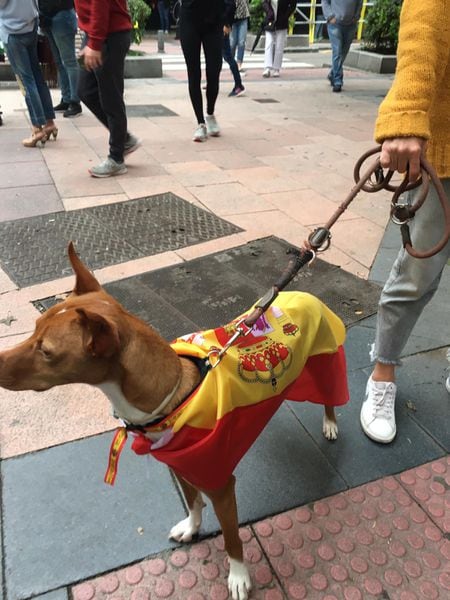
Laura Domínguez, 39, whose dog Barri wore a Spanish flag as a cape. “I
am here because I am sick and tired,” said Domínguez, wearing a face
mask and holding a cigarette. “They’re creating a country of idlers. And
now they want to take everything away from me.”
Barri the dog wearing a Spanish flag.Manuel Viejo González
On Núñez de Balboa street, nearly 50% of residents voted for the conservative Popular Party (PP)
at the last general election, held in November 2019, followed by the
far-right Vox with 23%, the center-right Ciudadanos with 6.7%, and the
Socialist Party (PSOE) with 5.4%. The leftist Más País and Unidas
Podemos attracted less than 1% of the vote.
The regional
premier of Madrid, Isabel Díaz Ayuso of the PP, has been encouraging
these street demonstrations. “I hope people will go out on the street –
the events of Núñez de Balboa are going to seem like a joke then,” she
recently said. Meanwhile, Madrid Mayor José Luis Martínez Almeida, also
of the PP, said this week that “as long as [safety] conditions are
maintained, everyone is free to voice their opinion.”
Vox
leader Santiago Abascal has been pushing for anti-government
demonstrations and challenging authorities to ban them, arguing that
this would prove that fundamental freedoms are being violated. At a
recent session of Congress to extend the state of alarm, Abascal said
that his party would apply for permission to hold demonstrations against
the government on the streets of Spain’s main cities, but that in order
to respect social-distancing measures, the protests would be held
inside vehicles rather than on foot.
CARE HOMES across Western Europe
have been ravaged by coronavirus and in Spain alone there have been more
than 16,000 deaths, many around the capital Madrid. The true number may
never be known, but families are asking why so many of their elderly
relatives were lost.
Around lunchtime on 8 March, Rosana Castillo met up
with some close friends not far from her house in Lucero, a
working-class neighbourhood in west Madrid, and, as they did every year,
joined a protest to mark International Women's Day. They gave each
other a warm hug, held hands and marched to chants of "Down with the
patriarchy" and "Feminism will win".
Spaniards, then, could still
venture freely outside and coronavirus, which had already killed several
hundred in Italy, felt more like someone else's pain. Castillo, a
60-year-old retired primary school co-ordinator, had seen a few people
on the underground wearing surgical masks as a protection, but thought
most of them were probably tourists. "We weren't really talking about it
here," she said.
But it was preying on her mind. She had visited
Carmela, her 86-year-old mother, hours before at Monte Hermoso, the
care home near the square where the women had gathered. Arriving at the
main gate, Castillo was told she could not come in. A worker said two
residents had contracted Covid-19, the disease caused by the virus, and
visits had been suspended.
Castillo had seen Carmela, who had
advanced Alzheimer's, three days earlier, when her mother was discharged
from hospital after a week's treatment for breathing difficulties. The
doctor told her Carmela was going to be fine, that her case was not
related to the virus even though she had not been tested.
To
Castillo's frustration, the worker said nothing else and went back
inside Monte Hermoso. As she exchanged phone numbers with some
relatives, Castillo saw another worker rushing away, covering her mouth
with a piece of cloth. They had known each other for a long time but
when the woman left, without stopping to talk, Castillo became
suspicious. "At that moment," she told me, "I felt something wasn't
right."
It was already widely known, first from China, then Italy, that
elderly people with existing health issues were especially vulnerable to
the virus. Yet in Spain, where a fifth of the population is above 65,
or some 8.9 million people, the government of Prime Minister Pedro
Sánchez had announced little in response.
As Castillo followed
news of the outbreak, she wondered if enough was being done to protect
her mother or, indeed, anyone else. Unable to visit Carmela, who had
lived there for five years, her only source of information came from
infrequent, and usually very brief, phone calls from Monte Hermoso. No
matter how much Castillo asked, few things were said.
Consuelo
Domínguez, a long-time friend, coincidentally, also had her mother
living in Monte Hermoso, a red-brick, private centre with large windows
and rooms for up to 130 residents. She, too, struggled to get details.
Both daughters knew some staff had gone into isolation with coughs and a
fever, the most common symptoms of Covid-19, and were pretty sure there
was more going on.
Coronavirus was spreading in Spain at an
alarming speed and, on 14 March, the prime minister imposed a state of
emergency with a nationwide stay-at-home order. No-one was truly safe.
On that afternoon, Domínguez received an unexpected call from Monte
Hermoso. The worker was "very tense," she said, "you could feel it."
Surreptitiously, Domínguez was told that 70 people had been infected
with the virus and at least 10 patients had already died. "I was
frightened," she said. Domínguez called her friend. "I couldn't believe
it," Castillo recalled. "We weren't being told the truth."
Castillo and Domínguez alerted journalists and, on 17 March, Monte
Hermoso became national news. Only then did the Madrid government
reportedly become aware of the devastating outbreak. Nineteen people
were already dead.
In the evening, Castillo received a call from
Monte Hermoso. Her mother, who shared her room with another woman in
similarly poor health, had a fever. "It shocked me," Castillo said. She
knew Carmela was unlikely to survive.
The relatives created a WhatsApp group, and
disturbing messages flowed in. "Staff were very nervous... Some
[residents] were even a little bit delirious," said one of a visit two
days before they had been halted. Aurora Santos, whose mother was also
at Monte Hermoso, recalled seeing residents unwell in the cafeteria
around the same time. "We didn't know anything the management had done,"
she told me, "the protocols they had followed, nothing".
She
joined Castillo and Domínguez in gathering information. They believed
patients with symptoms had not been separated from those without, before
the virus spread rapidly through the home. Staff who had been in
isolation after falling ill were reportedly not being replaced, while
those who continued to work were having to do longer, exhausting shifts.
Lacking adequate protection, workers had to make face masks at home.
"We were trying to help, our loved ones were there," Domínguez said.
"Why weren't they being honest with us?"
Monte Hermoso, it turned
out, was not alone. In fact, nobody seemed to know the true scale of
what was going on. For years, Carmen Flores, head of the Patients'
Defenders ombudsman group, had warned about precarious conditions in
some of Spain's 5,417 care homes. "The amount of messages we were
getting those days was insane," Flores told me. "I was thinking: You
can't let these people rot."
Three in every four homes in Spain are privately run and many
patients, like Carmela, have some of their costs publicly funded. José
Manuel Ramírez, president of the federation representing social care
managers, said fees received by the residences had not changed in the
past decade, a result of years of austerity in Spain.
Many
companies had to carry out savings somewhere to make a profit, claimed
Flores, who also alleged that some lacked equipment even in normal
times, while many operated with minimum staff. (Workers' unions also say
staffing was insufficient, which Ramírez rejected.) A worker at one
care home where more than 90 patients died told me: "For a long time we
had been saying something serious would happen. The conditions were
unsustainable. This isn't a surprise at all."
Crowded hospitals
were having to turn away patients from care homes and send them back,
often to die. Many residences did not have oxygen bottles, crucial in
treating a disease known to cause severe respiratory problems, or even a
doctor - Monte Hermoso, Castillo said, had one doctor, who most days
worked only in the mornings.
The Spanish government had
centralised the purchase and distribution of medical material amid a
worldwide run, so the homes asked officials to send tests and protective
kits. However, Ramírez alleged they were not given priority, and
pictures emerged of carers wearing gowns made of plastic bags. "There
was nothing that could be done without support," he said. "It was a
catastrophe."
The army was deployed to disinfect 1,300 care homes and Monte Hermoso
was one of the first. Margarita Robles, the defence minister, said
patients, in some places, were found abandoned without care, sometimes
dead in their beds, the bodies left for funeral services to retrieve. "Un horror," Flores told me.
Almost
6,000 people have now died in nursing homes in Madrid, after showing
Covid-19 symptoms. Spanish public prosecutors are investigating possible
crimes including manslaughter for neglect, mistreatment and
abandonment.
"I think there was a lot of wrongdoing," said
Castillo. "These people couldn't shout or say they were unwell. They
died in silence and alone." Monte Hermoso has not replied to interview
requests by email; when contacted by phone, an employee told me they
would not talk to journalists.
MY
wife Joan and I were there from 12th November till 19th on a brief
holiday. Easy to find:- interesting food, beautiful buildings
especially the and amazing Gaudi ones and cosmopolitania. Much less
easy to find:- developments in the conflict there, their root causes
and possible lessons for left libertarians.
Barcelona
is the capital city of Catalonia. It has it’s own culture and
language, distinct from Spain. It is the wealthiest of Spain’s
regions. Catalonia has been a part of that country for hundreds of
years but time has not stopped the longing for independence from
Madrid. Many Catalonians oppose independence citing gloomy prophesies
of economic suffering. Equally worrying forecasts were made about
Brexit ruining London’s financial district. Doubting such fears a
multi-million pound office block is planned for “the city” by one
such firm. Another worry for the anti-independence people is that
other provinces might also fall from Madrid’s power. Brussels is as
much to blame for that reaction as Madrid.
Feeling
sorry for the locals, Joan and I found that tourist bookings were 40%
down on previous years. Great bars and restaurants almost empty. We
can blame media hype about cops beating up those trying to have a
referendum months ago. What happened was that Madrid sent in it’s
own cops to do it. That is because the central government could not
trust the local Barcelona cops who are paid by that city.
Then
as now both both sides have been using increasingly hostile language.
Pro-independence Catalonians feel that their contribution to the
civil war was all about that struggle. Maybe what we heard was too
emotive but I can only report what I heard. But the problem comes as
much from Brussels as Madrid.
On
the t.v. we saw big Euro boss Jean Claude Juncker. His body language
and the subtitles clearly showed one message “there will be no
regional autonomy, there can be none – I have spoken”. Arrogant,
pig headed or just doing his job???
Throughout Europe there are
requests and demands
for regional autonomy in different forms, Solidarity is needed across
the continent for these struggles. We need a new international
brigade. This time with anti-militarists, thinkers, negotiators and
street performers. Please visit Barcelona soon to up-date the above
report.
The Free North Campaign is a socialist, republican campaign group that
calls for ever-greater autonomy and self-government for the North of England. We do not support any single political party but stand in solidarity with progressive independence and regionalist movements around the world. We believe in the radical devolution of political and economic power away from
the London-centric elites to localcommunities and municipalities.
SOLIDARITY WITH CATALONIA!
The
Free North Campaign sends its support and solidarity to the people of
Catalonia in their historic struggle for freedom and independence
from the Spanish state.Irrespective of
whether
the October 1st referendum was legal or not (in the eyes of the
Spanish government and courts), the violent response of the Madrid
government must be condemned as a criminal act
.
The
European Union must also be condemned for its predictably inadequate
response to the oppressive Francoist tactics of the Rajoy government
and the national police force.
The
EU has demonstrated that its main concern is protecting the interest
of Europe’s ruling elite, rather than defending the citizens of
Europe. During the Scottish referendum, the British
establishment used a combination of fear and insincere sycophancy to
encourage Scots to vote No. In contrast, the Spanish state
broke bones, smashed heads open, stole ballot boxes and closed
polling stations. Anyone who was undecided about Catalan
independence before the referendum can surely no longer be ambivalent
about the issue now.
Catalan
Nationalism contains liberal, conservative and left-wing shades of
opinion. Our political sympathies naturally lie with those on the
left; in the Catalan Parliament this is represented by the Republican
Left of Cataloniaand the anti-capitalist Popular Unity Candidacy
(CUP).
Fundamentally
any region which seeks to separate itself from a repressive and
reactionary state deserves the support of progressives. Independence
alone will not inevitably lead to social and economic justice, but it
can significantly speed up the pace of radical change and deal a
decisive blow to the ruling class.
******
The Free North Campaignwelcomes all supporters who broadly
agree with our principles.
Email us at: freenorth@hotmail.co.uk
and followthe twitter account @Free_North.
For a ‘Council of the North'
Political leaders from Leeds, Merseyside, Manchester Newcastle and West Yorkshire
met recently to discuss forming a body to speak on behalf of Northern interests.
Andy Burnham, the metro mayor of Greater Manchester said:
“If the North is to get the investment it has been promised, and fulfil its vast potential, we must come together, work together, and speak with one voice. “Today’s meeting was an important step
towards achieving that. The North of England is getting organised and can no longer be ignored.”
Steve Rotheram, the metro mayor of the Liverpool City Region, said:
“The UK is simply too London-centric and we need to be inventive and determined if we are goingto off-set its disproportionate influence andshare of national resources.”
IT now seems that Spain has was given an effective veto over the Brexit deal last Friday, when the EU
Council's draft negotiating guidelines said Madrid could exclude
Gibraltar.
It has been claimed Spain took this advantage when Theresa May failed to specifically mention
Gibraltar in her Article 50 letter on Wednesday - prompting claims of a
rift with the peninsula's government.
In the Spanish newspaper of record, El Pais yesterday, the journalist Lucia Abellan in an article entitled 'Spain could veto the application of a pact over Gibraltar between the EU and London' wrote: 'This situation leaves the British colony in a legal limbo that is able to force a negotiation between Madrid, and London.'
There have been continual tensions in the relations between Spain and Gibraltar since the days of General Franco in the 1960s, when I first worked in Gibraltar. I was living in Gibraltar at the time of the 'British We Are, British We Stay' referendum in 1967, shortly after which General Franco closed the frontier with La Linea completely.
Before that over 10,000 Spanish workers had been crossing that frontier from the Spanish towns of La Linea, San Roque and Algecirasto work in the dockyards and at the airport for the MOD each day. Today, similar numbers of Spaniards still work in Gibraltar despite the decline of the MOD as an employer. If Spain closed the frontier restricting this movement of labour then Gibraltar would have difficulties replacing the Spanish labour. It wouldn't be so easy to bring in labour from Africa as happened when the frontier was closed in the late 1960s under Franco.
MANCHESTER's Instituto Cervantes
presents this coming Wednesday 7th December, at 6.30pm, the launch of the
project ‘Methodology of Spanish football in the UK: Sports excellence’, by
Spanish coach, Ángel López. The talk, which is free of charge and open to the
general public, will “analyse the Spanish methodology and the English
football’s current scene, with the aim of finding new ways of collaboration
regarding the training of managers, both at professional and lower levels”.
The main goal of this project is
to organise conferences and seminars on the Spanish methodology on football at
the clubs’ premises, at the English Football Association and also at the
Manchester’s Instituto Cervantes. Moreover, the project intends to offer
Spanish classes “with specific football terminology” to all the colleges,
academies and clubs interested, and it is aimed both at football players,
coaches and managers. Likewise, there is a view to organise after-school
activities about football and summer camps in Spanish for kids and teenagers.
López points out “the remarkable
conditions for working in English football, from professional categories to
academies”. However, this goes against “the shortage of native coaches in the
Premier League as well as in the best leagues in the world”. Hence, this
project could lead to joining forces with local managers, to foster talent and
expertise. The Spanish coach highlights that “we should not forget that England
invented football, therefore it deserves our admiration and respect and always
look to contribute and collaborate with them”. According to López, Manchester
is the perfect place to develop this project, as today it is “the nerve centre
of world football”, he claims.
About the author
Ángel López is a National Football
Coach with the Madrid Football Federation and Graduate in Physical activity and
Sport Sciences from the Polytechnic University of Madrid. Furthermore, he holds
a Master´s Degree in Physical Training in Football. He has a wide experience as
an Assistant Coach at the Spanish First League with Getafe FC and he has also
trained teams at the Romanian Professional Football League and the Asian
Champions League.
Among his many merits and
achievements, it should be noted out that he was the youngest assistant and
fitness coach in the Spanish La Liga in 2014 and 2008, respectively.
SEEN from the besieged parliaments of Athens and Madrid, from the shuttered shops and boarded-up homes in Lisbon and Dublin, the single currency has turned into a monetary choke-lead, forcing a swathe of economies – more than half the Eurozone’s population – into perpetual recession. The Greek economy has shrunk by a fifth, wages have fallen by 50 per cent and two-thirds of the young are out of work. In Spain, it is now commonplace for three generations to survive on a single salary or a grandparent’s pension; unemployment is running at 26 per cent, wages go unpaid and the rate for casual labour is down to €2 an hour. Italy has been in recession for the past two years, after a decade of economic stagnation, and 42 per cent of the young are without a job. In Portugal, tens of thousands of small family businesses, the backbone of the economy, have shut down; more than half of those out of work are not entitled to unemployment benefits. As in Ireland, the twentysomethings are looking for work abroad, a return to the patterns of emigration that helped lock their countries into conservatism and underdevelopment for so long. Why has the crisis taken such a severe form in Europe?





 Posts
Posts


