
Britain’s biggest trade union has commissioned a barrister to
examine allegations that union officials colluded with a covert
blacklisting operation financed by major firms to prevent certain
workers from being employed.
The move has been ordered by the head of Unite, Len McCluskey, and
follows calls
by blacklisted workers to set up an independent inquiry into the
claims of collusion, which is alleged to have spanned at least 20
years to 2009.
The barrister is to scrutinise documents that were disclosed in a
high court lawsuit that led to construction firms apologising and
paying
compensation amounting to around £75m to 771 blacklisted workers.
Some documents appeared to show that trade union officials had
passed information to the blacklisters, including private warnings
not to hire specific workers they deemed to be politically awkward.
Individual workers were labelled “militant” or a “troublemaker”
by union officials, according to the files.
In signed statements, managers who ran the blacklist alleged that
union officials wanted to prevent disruption on industrial sites and
helped to deny jobs to some of their own members.
For more go to https://www.theguardian.com › Politics › Unite
Showing posts with label Rob Evans. Show all posts
Showing posts with label Rob Evans. Show all posts
Wednesday, 30 August 2017


Monday, 15 May 2017
Cambridgeshire Spy Cop - Cops Out!

Undercover Spy-cop Andy Coles (photo - The Guardian)
Today, The Guardian disclosed that the woman, known only as 'Jessica', is taking legal action against the police, alleging that Coles groomed and manipulated her.
Last Friday, he was accused of grooming a 19-year-old activist into having a sexual relationship with him while he was working undercoverin the 1990s.
Mr. Coles has said: 'There have been news reports over the weekend about which I am unable to comment. This coverage is significantly impacting on my ability to carry out my duties as deputy police and crime commissioner.
'I have therefore today tendered my resignation with immediate effect, which [the] police and crime commissioner, Jason Ablewhite, has accepted.'
He disclosed that the allegations have been referred to the Independent Police Complaints Commission to be investigated.
Rob Evans in the Guardian reports that Jessica, who had called for his resignation, said today:
'I am relieved. He has done the right thing.
'This is just the start of what is going to be a long legal process to try and get some answers from both him and his superiors.'
Saturday, 8 April 2017
Union Bosses Who Blackballed Their Members!
Why hasn't McCluskey probed bent officials before?
Why didn't Mrs. Cartmail interview Whistleblower Wainwright?
Why are blacklisted workers still waiting for justice?
by Brian Bamford
***
GUARDIAN journalist. Rob Evans last Monday wrote that 'blacklisted workers want an inquiry by a legal expert to
interview trade union officials and victims, and see if information
was handed over deliberately.'by Brian Bamford
***
Now Unite, the UK's biggest trade union, is facing calls to set up an inquiry into claims that union officials gave information to a clandestine blacklisting operation funded by major firms and enabling them to deny jobs to certain workers.
Long suspected details of the alleged complicity have emerged in documents prepared for a high court action following which construction firms apologised and paid compensation totalling around £75m to 771 blacklisted workers. The evidence of the complicity of trade union officials and managers has led to a group of 41 blacklisted workers to call on Unite to commission an independent inquiry into the claims.
Why hasn't McCluskey probed bent officials before?
The election for the new Unite General Secretary closes on the
19th, April, and the existing general secretary Len McCluskey has said
that he will 'set up an independent union inquiry to investigate all
evidence made available' to him of collusion by union officers in blacklisting. But
Mr. McCluskey has been the general secretary of the Unite union for
years, why has it taken so long for him to offer an inquiry? Couldn't
he have done this earlier?Meanwhile, the Unite union's acting general secretary, Gail Cartmail has said: 'Only a full public inquiry with judicial authority will fully explain the depth to which the state and employers colluded to deny construction workers employment.'
'Unite has campaigned legally, industrially and politically to win justice for blacklisted workers and to ensure the disgusting practice of blacklisting is ended once and for all. Blacklisting is an industrial crime, the blame for which lays squarely at the door of the construction companies..'
Yet, Ms Cartmail herself conducted her own investigation in 2011 on behalf of the Unite union, and on the 2nd, November 2011, this Northern Voices Blog stated that her report 'cleared the union officer':
'THE Report and investigation into 'alleged Officer collusion in Blacklisting in the construction sector' conducted by an Assistant General Secretary of Unite, Gail Cartmail, has concluded that: 'Despite considerable effort I have not discovered evidence against officers' of the union. She writes that while 'I accept that this may disappoint some activists, who are justifiably angry and who have suffered ... great injustice arising from Blacklisting', she urges that 'workers officials of the union are also entitled to dignity at work and in the absence of any proof I trust that such allegation of collusion (in Blacklisting) will now desist.'
She was telling us to 'desist' is asking questions about collusion in 2011, but now she's calling for a public enquiry because she knows the victims of blacklisting are still disgruntled and telling people to 'desist' is not politic.
In her report in 2011 Mrs. Cartmail wrote 'Alleged collusion by union officials' seems to place great stress on the allegations of one man Mr. James Simms, who was a former employee of a predecessor union and has since been employed by Beaver Management Services Ltd and has claimed to have a 'CD-ROM with the names of union officers on it complicit in the Blacklisting of members'. She concluded that Mr. Simms that getting information from Mr. Simms was like extracting teeth.
But Jim Simms was not the most promising whistleblower with regard to the expose of the blacklist in the British building trade. The credit there must surely go to the former electrician and whistleblower, Alan Wainwright, not Jim Simms?
Why didn't Ms. Cartmail interview Whistleblower Wainwright?
THE whistleblower Alan Wainwright wrote a letter to Gail Cartmail, on Monday, the 23rd, July 2012 which he has placed on his own Blog: July - alan wainwright & the construction industry blacklist - blogger www.alanwainwright.blogspot.com/2012_07_01_archive.htm : :
Dear Mrs Cartmail
Re Construction Industry Blacklisting
'I was the whistleblower in this matter and provided the evidence which eventually exposed this via David Clancy at the ICO in March 2009. Three years on and we now appear to be making a start at holding the companies accountable for this, but I cannot help but feel that we could have saved at least three years if Mr Simpson had acted when he first came into possession of the evidence in 2005/2006.
'I'm therefore now writing to appeal to you to investigate Derek Simpsons' lack of enthusiasm to investigate and act upon this in 2005/2006 and provide the reasons behind this...
'I've held senior positions at Crown House Engineering (National Labour Manager), Drake & Scull and Haden Young and during those periods of employment the companies paid the union subscriptions of the members as part of a benefits package. The union also received two pounds per week for every agency worker placed on the sites as part of an 'agency workers membership scheme' set up by the Luton office under Harry Hughes. This was a simple head count system and payment made monthly if I recall correctly. I understand the unions received in excess of one million pounds a year from the companies in question under these schemes at the time.
'Although Mr Simpson has now retired, I do believe he receives a handsome pension and a luxury house to live in. I cannot see how this can be justified, as in my opinion he was in a prime position to do something about this and chose not to do so. Mr Clancy had no more or no less evidence than Mr Simpson three years previous but Mr Simpson chose to do nothing about this.'
Mr. Wainwright concluded his letter:
'As you may be aware, Guney Clark Ryan are about to lodge their case to the courts. We may never get full justice for these people, but I think they are at least owed some honesty about why a major union of which many were members did nothing to help them.'
Yours sincerely
Alan Wainwright
Mrs Cartmail in her reply wrote:
'.... The purpose of your letter was specifically in relation to what you identify as a wasted opportunity on the part of the retired Amicus/Unite General Secretary Derek Simpson who you believe should have done more arising from your correspondence in 2005/2006.
'As you point out Mr Simpson is now retired. The union has no capacity to secure Mr Simpson's cooperation in an investigation. The union recently reviewed Mr Simpson's post retirement benefits, which were subsequently adjusted to the extent that this was possible.
'I empathise with your frustration however do assure you that Unite now gives priority to representing members known to be Blacklisted and is proactively working to achieve better law.'
Kind regards
Gail Cartmail
Readers must decide for themselves why Mrs. Cartmail didn't interview a vital witness such as Mr. Alan Wainwright when she was doing her investigation for the Unite union into blacklisting in 2011?
Why are blacklisted workers still waiting for justice?
TO better understand Gail Cartmail's growing involvement within the campaign against the blacklist, we need to understand the development of the Blacklist Support Group, and
how the Rank and File construction worker's campaign began to have
political impact, prominence and profile. At some point Mrs. Cartmail
recognised this and decided to assimulate herself within the workings of
the Blacklist Support Group.
This can clearly be detected in her letter responding to Alan Wainwright in 2012:
Dear Alan
'Your
effort and those now organised within the Blacklist Support Group has
been tremendous in exposing the practice of Blacklisting in the
Construction Industry.'Since February 2011 I have led for the union as AGS for a number of sectors including construction. Over the past 12 months I have learned about different aspects of the ICO raid of the Consulting Association, subsequent litigation and legislative changes introduced by the Labour Government. In the process I have met and come to know many workers who have been the victim of Blacklisting in the industry.
'Both Unite's predecessor unions supported numerous members complaints to their employment tribunal where their application to the ICO showed they were on the Blacklist. We have renewed encouragement to members to bring cases forward. Unfortunately as you probably know the settlements in respect of such cases is relatively low and poor comfort to workers who struggle to find employment commensurate with their qualifications.
'Over the past we have endeavoured to campaign against Blacklisting and work with the Blacklist Support Group on a number of fronts including legal challenges on grounds of disclosure of information and human rights...'
Yet the truth is that the conversion of the of the Unite leadership and that of the politicians within the Labour Party to the campaign against the blacklist for those of us who stood on the lonely picket lines in Manchester, was indeed a slow uphill process. It was only when the Blacklist Support Group became a political bandwagon following the raid by the Information Commissioner in 2009 of the offices of the Consulting Association run by Ian Kerr that things took off.
Alan Wainwright was clearly aware of this in his correspondence with Mrs. Cartmail in 2012:
'I note your comments about the current contribution from the union, but this is simply too little too late and is perceived by some I speak to as just jumping on the bandwagon. I put it to you again that these people are at the very least owed an explanation and an apology of why a major union of which many were members did nothing to help them at the time.'
Jumping on a political bandwagon is one thing Mrs. Cartmail, delivering justice is quite another!
Sunday, 26 March 2017
Loneliness of the Longdistance Whistleblower!
- 'I feel compelled to comment. There is no doubt that Mr. Wainwright's
help in exposing this blacklisting scandal, was absolutely invaluable to
many building workers. This was because he was a 'blacklister' turned
'whistleblower' and had valuable inside information. However, when he
gave evidence to the Scottish Affairs Select Committee, he was asked at
what point he realised that there was something reprehensible or immoral
about blacklisting construction workers.
'Many people (including those on the Scottish Affairs Select Ccommittee) felt that he did not act as he did, because his conscious pricked him, but because he had been shit on by the company he worked for when he raised the issue of alleged corrupt practices and they took detrimental action against him. Some people feel that he really blew the whistle because he was a disgruntled employee who wanted to get back at the company that he worked for.
'There is nothing surprising about this and people often do blow the whistle for similar and not unrelated reasons, rather than acting in the public interest.
'Mr Wainwright refers to his meeting with Ian Kerr. As I understand it, Kerr said in his evidence to the SASC, that Mr. Wainwright had said that Tarmac (the company he worked for, now Carillion) did not need his services because they had their own information about construction workers and could operate their own blacklist.
'Understandably, Mr Wainwright will now want to minimise his involvement in this scandalous practice of blacklisting, and engage in ex-post facto rationalisations. No doubt, Alan will be happy to expand on these matters and answer questions about this, when he meets trades unionist to talk about his role in the blacklisting of construction workers.'
Alan Wainwright: The lonely life of a construction industry whistleblower
by Rob Evans Friday 15 May 2009 01.00 BST
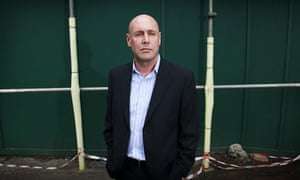 |
Blacklist
whistleblower, Alan Wainwright. Photograph: Christopher Thomond How former manager exposed how workers were being secretly blacklisted. |
ALAN WAINWRIGHT is a whistleblower who appears to have had a
significant hand in changing government policy. The one-time
construction manager used his inside knowledge to expose the clandestine
use by companies of blacklisting that has prevented trade unionists and
alleged "troublemakers" getting jobs.
He has trodden the familiar path of a whistleblower – battling for a long time in obscurity while being ignored by those in power: "It was demoralising not to be believed." Like other whistleblowers, he suffered for going public – losing his job, having no income, using up all his savings to live, experiencing a lot of stress, and fearing he would be evicted from his home: "It affects your relationship with your children, who are the most important thing in my life."
Industrial strife
Wainwright, 45, grew up in Deeside, north Wales. He started off as an
electrician then ran a recruitment agency before being recruited by the
Tarmac construction firm.His whistleblowing story starts in 1997 when he was the national labour manager at an engineering company, Crown House (then a Tarmac subsidiary). He had been told by a senior manager that construction companies paid a private investigator, Ian Kerr, for information to "ensure that certain workers did not gain employment on their projects". He was told to meet Kerr because the vetting was being extended to Crown House's labour force.
"He [Kerr] definitely made it clear that they were undesirable people who had a history of causing disruption to projects," Wainwright says.
He had two meetings with Kerr, who said that many construction firms supplied him with details of workers on his database. As an example, Wainwright was shown a list of more than 100 names. According to Wainwright, Kerr said that when someone applied for a job, the company would forward their name to him so he could check his database. Wainwright said that if a worker was rejected, a simple "no" would come back, with no other explanation.
Wainwright's department faxed a weekly list of names to Kerr; later the lists went to Tarmac's head office: "It was very discreet, a closely guarded secret. It was made clear to me that I was not to discuss it with anybody, and I didn't." However, something was stirring in his mind: "I knew deep down that there was something wrong with it."
Yesterday, Laing O'Rourke, which now owns Crown House, said that in recent years it had bought companies which had paid Kerr, but this had been stopped. In 2000, Wainwright briefly worked for the Drake and Scull construction firm. He said his managers sent him a list of 500 workers, with their national insurance numbers, which it had received from rival construction firm Balfour Beatty. He said the listed workers had been employed on three large construction projects that had seen a lot of industrial strife, and that the list was distributed to managers to ensure some workers were not employed. The memo, dated August 2000, advised him to "keep this information confidential".
The Emcor construction company, which owns Drake and Scull, said it was aware of the list described by Wainwright: "We have employed individuals named on that list, at the time and subsequently. We do not condone blacklists."
By 2004, Wainwright was a manager for Haden Young, a subsidiary of Balfour Beatty. Within a year, he came across what he thought was fraud by employees, but says his bosses were not interested in finding out the truth – a claim they deny. "The management shunned me," he says. "It got to the point where I felt very isolated, alone and alienated. It was one of the most distressing periods of my life." He initiated a grievance complaint against the company, but began to worry that he himself would be branded a troublemaker.
In a letter to his head office in July 2005, he wrote: "The company operates a blacklisting procedure for new recruits and hired temporary agency workers to check for any previous history of union militancy, troublemaking."
Copies of Haden Young faxes from the time show lists of names being faxed to head office so that, he believes, they could be vetted.
Yesterday Balfour Beatty said it did "not condone the use of 'blacklists' in any circumstances and has taken steps to ensure that none of our companies use such services." In 2006, Wainwright quit Haden Young but lost an employment tribunal claim. He was by then convinced that he had been blacklisted as he had applied unsuccessfully for more than 150 jobs. He believed he had to make a concerted effort to expose the blacklisting if he were ever going to get work. He set up a website and posted names of hundreds of workers he believed had been blacklisted to alert them.
Unfair dismissal
He linked up with workers who thought they were being blacklisted,
shared his inside information with them and gave evidence for them in
industrial tribunals. Three workers won their case in 2007 for unfair
dismissal when a tribunal concluded that a "disgraceful" blacklist did
exist in the construction industry. A Guardian article on the cases last
June caught the attention of the Information Commissioner, Richard
Thomas, the official privacy watchdog. He investigated because he was
worried that workers were unfairly being denied jobs. As Wainwright had
met Kerr and still had documents concerning the alleged blacklisting, he
was able to help him. Investigators raided Haden Young premises and
tracked down the elusive Kerr to a nondescript office in Droitwich,
Worcestershire. In February, they raided Kerr's premises and seized a
secret database of 3,200 workers, effectively finishing the
66-year-old's business.Thomas then named 40 construction firms including Balfour Beatty, Sir Robert McAlpine, Laing O'Rourke, Emcor and Crown House, which he said had been clandestinely using the database to vet potential workers. According to Thomas, the firms bought details of the individuals' trade union activities and work record from Kerr. Workers were said to be labelled, for example, as "Communist party", "lazy and a trouble-stirrer", "Do not touch" and "Irish ex-army bad egg". Among the entries was one on Wainwright recording how he had helped blacklisted workers.
Now the jovial Wainwright is happily out of the construction industry and working for a concert ticket business.
He is animated about who are the ultimate culprits – the directors of the construction companies. "Ian Kerr is not the primary cause of this. The companies set him up in business, funded his existence from the start, and each name on the list would have been provided by the companies. The directors took the decisions to join the system."
He is not ready to celebrate the end of blacklisting yet as he is waiting to see if Mandelson manages to draw up a proper law to eradicate it. "I am cautiously optimistic, however," he says.
Alan Wainwright's new blog on the construction industry blacklist is now live
Alan Wainwright: the CV
Born Chester 1963.Career 1979-1989, qualified electrician; 1989-1993, managing director of own recruitment business; 1993-2000, national labour manager, Crown House; 2000, business improvement director at Emcor Drake & Scull; 2001-2004, human resources consultancy work; 2004-2005, production manager, Haden Young; 2006-present, concert ticket buyer, after 200 unsuccessful job applications.
Family Divorced, son 21 and daughter 19.
Interests Writing, performing and watching live music.
Subscribe to:
Posts (Atom)

 Posts
Posts


