Stuart Christie: a Scottish anarchist writer and publisher. Who when aged 18, Christie was arrested in Madrid while carrying explosives to assassinate the Spanish caudillo, General Francisco Franco. He was later alleged to be a member of the Angry Brigade, but was acquitted of related charges.
Born: July 10, 1946, Partick, Glasgow, United Kingdom
Died: August 15, 2020
Movies: The Angry Brigade: The Spectacular Rise and Fall of Britain’s First Urban Guerilla Group
Organizations founded: Anarchist Black Cross Federation, Cienfuegos Press
STUART Christie was an anarchist who had quality and consistency as well as quantity and a prolific output. From the early 1960s when he first engaged with Bobby Lynn and the Glasgow anarchists to his death bed listening to 'Pennies from Heaven' Stuart sternly stuck to his beliefs dedicated to a classical version of anarchism.
My last contact with Stuart was an unusually brief e-mail from him last November in which he wrote: 'Bearing up, Brian. Hope you are too. Un abrazo!.'
However I must offer a health warning, as in the 56 years since we first became acquainted in Paris in 1964, our paths have been very different. His commitment was to internationalist view while mine since the 1960s when I lived and worked in Spain has been mostly more parochial. My engagement with the anarchist movement in Spain and later Gibraltar was very different from that of Stuart even though we were functioning in the same organisation: the FIJL (DI). My role was purely one of propaganda and intelligence, and at no time was I involved in the violent activist deeds which were designed to discourage tourism or strike at General Franco.
My task and that of my then wife, Joan, was the much more humdrum; in my case one of working on the tools as an electrician, and delivering Butane Gas to the villages on the Cabo San Antonio in Alicante. Much more boring than 'daring-do' and prison life, but a way of soaking-up Spanish culture and everyday life as it was lived by many young Spaniards at that time who migrated to the coast from places like Albacete and Andalucia: working a six day week and paid 750 pesetas. Meanwhile, our FIJL campaign against Spanish tourism clearly failed, yet fortunately less tragically than Stuart's failed mission to kill Franco.
Among the many obituaries published on Stuart the most perceptive that I have yet seen has been that of the historian Julián Casanova in El País 'El escocés de la FAI que trató de matar a Franco' Casanova argues that Stuart Christie believed that 'a fusion of different forms of resistance such as the workers, the students, the greens into the language of political anarchism. Just as Bakunin, thought it was possible to harmonise individualism with the socialist collectivism.' Casanova writes: 'He [Stuart] liked the men of action, but in reality he [Stuart] and his wife Brenda went on to propagate forms of idelogy with various cultural manifestations, which demonstrated the force of culture with ideas.'
'
Stuart's wife Brenda died last year aged 70 years, from cancer. Casanova writes: 'The obituaries now record that his prime intention was to kill Franco. Yet he was a committed anarchist using his pen and the engaged in cultural aggitation, in times when the revolutionaries with "consciences" have past into history. Anarchist solidarity, that reflects on the concequences of industrial capilalism, nuclear disarmament, and abuses by the State. He was a Scot who would have loved to live in the golden epoch of Spanish anarchism.'
Julián Casanova knew Stuart Christie from when he met him at Queen Mary College, London, in the Autumn of 1985. At that event were other hispanistas like Ronald Fraser, and he speaks warmly of the seminars, dinners and debates over the Spanish Civil War, Franco, the monarchy, Juan Carlos and the transistion.
It strikes me that Casanova understood Stuart better than most of us.
by Brian Bamford In a comment on this NV Blog John Pearson
said: 'The British ruling class can take lessons from no-one on efforts to "bury the past, hide it, and sanitize it".
& that 'Those Black Lives Matter protesters in Bristol, descendants of slaves,
many of whom will have been trafficked by Colston's company, were not
erasing history they were making history.' *
***********
THE LAST timeI was in Bristol it was at the invite of the Bristol Radical History Group at a Bookfair in 2011 to give a talk on 'The varieties of historical investigation and experience'. The Bristol Radical History Group has been at the forefront of the campaign against the slave trader Edward Colston whose statue was recently toppled in Bristol. **
Marxists writers often vary between those like John Pearson, who credit the British ruling class as superbly cunning little Machiavellian's, and those who rate the boss class as little more than incompetent buffoons.
In Bristol it was, where over recent years my friend Roger Ball would take folk on a pedestrian stroll round the city to appraise and provide an alternative view of the ‘cult of Colston’ that was said to "form part of our city’s
‘identity’."* Only to culminate at Bristol Cathedral, to
discuss 'how the institutions of the Church of England and the Merchant
Venturers collide within the education of our children to promote
Colston as a Parable of the Good Samaritan.'
George Orwell once remarked that 'whether the British ruling class are wicked or merely stupid is one of
the most difficult questions of our time, and at certain moments a very
important question.'
As long as I have lived my life the British Empire has been in a state of decline. Men like Edward Colston, were a bygone thing even between the wars. As Orwell argued in The Lion & The Unicorn: 'Men like Clive, Nelson, Nicholson, Gordon would find no place for themselves in the modern British Empire. By 1920 nearly every inch of the colonial empire was in the grip of Whitehall.'[1941]
Yet it is unlikely that either Comrade Pearson or Dr. Ball would ever venture to unleash their passions against the constipated clerks who had by then taken over from the empire builders of yesterday. So as long as I have been alive its been the clerks that have been in the driving seat, but no one is going to launch a war against these clerks and managers, because these are the very people who sign the cheques and give the research grants so that these post-modern historians can get awarded their PhDs. These constipated clerks are the modern managerial class who have taken over not just in the universities; and you just don't look a gift horse in the mouth.
Instinctively both John Pearson and Roger Ball will identify with the clerks who among other things administer our universities and so vividly contrast with the one-time empire builders, because it is now as fashionable as it was in the 1930s for the shallow leftists to look down on physical prowess and snigger at the very idea of Englishness.
The last time I saw Roger Ball was at the Casa Club in Liverpool on the 8th, June 2018, at an event organised by Ian Gwinn and was entitled 'Fuck May 1968'; at that time Roger had been anxiously scouring the thoroughfares of the city looking for suitable architectural monuments to condemn owing to their links with slavery. Though I have great respect for the research work Roger Ball has put into this issue, I do share the concerns of others like Derek Pattison and Les May about as to what will be the logical outcome of this kind of fetish for censorship.
***********************************
* After popular demand the Countering-Colston group are re-running their recent history walk.
Starting with St Mary Redcliffe church,
this walk takes in other historic Diocese of Bristol churches in the
city centre where ‘the life and work’ of Edward Colston is still
provided religious legitimacy on an annual basis.
Along the way we will share the most
recent historical research regarding this man’s involvement with the
transatlantic slave trade and discover how the Victorian elite created a
‘cult of Colston’ that is now said to form part of our city’s
‘identity’.
At our final stop, Bristol Cathedral, we
discuss how the institutions of the Church of England and the Merchant
Venturers collide within the education of our children to promote
Colston as a Parable of the Good Samaritan.
CHARLES CHARALAMBOUS, Editor ofLabour Internationalist, questions my treatment of the argument set out in his editorial: '“Thinning out the herd”: austerity kills'. He is responding to my posted critique'ON CERTAINTY' IN THE Coronavirus'.
He asks:'what do you (Northern Voices) think of the basic argument set out in the statement?'
He says: 'the argument is based on a Marxist perspective over three
pages, and the statement draws definite conclusions, which Labour
Internationalist endorses.'
He confirms: 'We cannot (nor would we want to) predict the medical impact of Covid-19,
but what we can say is that the evolution of the virus outbreak into a
pandemic was enabled by a capitalist system that prioritises profit and
the interests
of big business over the well-being of the population, and that those
wrong priorities will probably continue to result in deaths which could
have been avoided.'
He further asks:'Do you disagree with the argument that the deliberate underfunding of
the NHS over many years, designed to encourage the creeping
privatisation of various components of the NHS and the promotion of a
healthcare "market" that involves profits and shareholder
dividends, is a major reason for the NHS's lack of resources and
capacity to respond to the virus's impact in a timely and appropriate
way?'
What is wrong with this form of reasoning?
We have got to distinguish between the effects caused by government policies from other effects outside their control. The political scientists, Christopher Achen and Larry Bartels, have demonstrated 'Democracy for Realists (2016)' that often shows voters punish politicians for outcomes that are clearly not under their control, including natural events such as shark attacks, droughts and floods. To these we might, I suppose, add pandemics such as the current Coronavirus.
Mr. Chahalambous wisely qualifies his position by saying he can't predict the 'medical impact of Covid-19' none-the-less he says the'evolution of the virus outbreak into a
pandemic was enabled by a capitalist system'.
The Origins of the virus
What we do know is one doctor in China tried to warn the world in December, and he,
too, is now a statistic after dying from the virus in January.
A
sad and disturbing part of this epidemic is the story of Dr. Li
Wenliang, an ophthalmologist at Wuhan Central Hospital, which is the
epicenter of COVID-19.
Dr. Li found seven confirmed cases of respiratory disease and coronavirus infection in his hospital in late December 2019.
He
messaged his medical school classmates in WeChat, the Chinese social
network, on Dec. 30, 2019. His WeChat post was shared in multiple
internet platforms and gained wide attention.
We also know that the local
authorities in Wuhan reprimanded Dr. Li for making false comments on the
internet. He was then forced to sign a letter of admonition and promised not
to repeat the transgression.
After the admonition, Dr. Li went
back to work in Wuhan Central Hospital where he examined a patient, who
was a storekeeper at Huanan Seafood Market with glaucoma and fever.
Sadly, he became infected with coronavirus, which eventually took his
life.
That was the initial sequence of events that led to the medical development of the virus throughout the world. The
virus is presumed to have an animal origin with animal-to-human
transfer at the Huanan Seafood Wholesale Market in Wuhan, China. The infection became human-to-human and is now a global pandemic.
It suggests that in a strict hierarchical system such as in China that the local authorities in Wuhan sought to do what they thought would please their bosses in Beijing, and thus their first reaction was to clamp down on the whistle-blower Dr. Li. Consequently the underlings misread the situation.
Cookbook Explanations & Remedies
Whenever I engage with a tract based on a Marxist perspective such as Mr. CHARALAMBOUS offers here from the Fourth International, Ifeel as if I'm reading a book on French Provincial Cookery. I feel that something's being cooked-up for me that comes from some rigid recipefrom a tired cook, who can't be bothered to think outside the ideological box.
I'm not saying Mr. CHARALAMBOUS hasn't thought through his analysis. Indeed not, as he has a closely considered position, and he is modest enough to admit that he can't predict the 'medical impact of Covid-19', but he insists the 'evolution of the virus outbreak into a
pandemic was enabled by a capitalist system'. Nor would I say that our government was well prepared for a pandemic such as Covid-19. Clearly it wasn't. Especially when compared with Germany that was so much better prepared to tackle the virus and has checked more than 350,000 people in the past week alone,
the Robert Koch Institute public health group said Tuesday in a report. Germany also benefits from other health-care advantages, including one of the
continent’s highest rates of hospital beds in relation to population
size.
Germany has a powerful weapon in the battle to contain Covid-19: a
wealth of private laboratories that are helping it test more than 50,000
people a day.
The country had already tested about 920,000 people through
late March and checked more than 350,000 people in the past week alone,
the Robert Koch Institute public health group said Tuesday in a report.
That may still understate the country’s total effort, since not all the
laboratories that have done assays have yet submitted numbers for last
week.
Germany’s widespread testing -- still not as comprehensive as
many there would like -- has enabled better tracking of the
coronavirus’s spread than in many other European nations. The country
benefits from other health-care advantages, including one of the
continent’s highest rates of hospital beds in relation to population
size.
The fact is as Wittgenstein wrote: 'It is hard to tell someone who is shortsighted how to get to a
place.Because you can't say “Look at
that church tower ten miles away over there and go in that direction".'
We should all by now be coming to realise that in the current crisis we are all shortsighted!
Claims & Predictions
What we at Northern Voices hold to, as I tried to explain when I wrote my post 'ON CERTAINTY' in the Cronavirus', is that maybe 'Uncertainty, the twin of certainty, cannot be
banished from human affairs..'
Yet, Mr. CHARALAMBOUS writes:
'what we can say is that the evolution of
the virus outbreak into a pandemic was enabled by a capitalist system
that prioritises profit and the interests of big business over the
well-being of the population, and that those wrong priorities will
probably continue to result in deaths which could have been avoided. So,
the alternative to capitalist barbarism is socialism, which starts with
defending the interests of the working class against the interests of
the capitalists.'
He insists:'the argument is based on a Marxist perspective over three
pages, and the statement draws definite conclusions'
But which version of the Marxist perspective is he and his followers employing here?Most thinkers these days realise that the social sciences can't prophesy future historical developments with any degree of accuracy because of the many variables involved in human affairs and the unintended consequences of human actions. A pandemic had been predicted; five years ago, Microsoft co-founder Bill Gates gave a TED Talk had been warning that the world was not ready to take one on - but no one could prophesy that it would come from a wet market in Wuhan and how it would then develop.
Karl Popper* has written: 'It should be mentioned.... that Karl Marx himself was one of the first to emphasize the importance, for the social sciences of these unintended consequences.' And he writes that '[i]n his more mature utterances, he [Marx] says that we are all caught in the net of the social system. Popper adds: 'The capitalist is not as not the demoniac conspirator, but a man who is forced by circumstances to act as he does; he is no more responsible for the state of affairs than the proletarian.'
This sociological view of Marx has been disregarded by Marxists and Popper claims it has been replaced by a 'perhaps for propaganda reasons, perhaps because people did not understand it - and a Vulgar Marxist Conspiracy Theory has replaced it.'
Conspiracy Theories
Charles Charalambous in his editorial “Thinning out the herd” writes: The UKgovernment'chose a strategy based on the theory of “herd immunity”, which means survival of the fittest: let the virus work its way through the population, who will gradually build up immunity, and if hundreds of thousands of older and weaker citizens die, well tough luck.'
He said: '[the] initial response to the crisis (for at least one month) was to ignore the views of epidemiologists and immunologists around the world who were calling for urgent practical measures to limitand confront Covid-19.'
This is not true because on March 27th, Tim Harford wrote in his column in the FT:
'When I read about a
new disease-modelling study from the University of Oxford, I
desperately wanted to believe. It is the most prominent exploration
of the “tip-of-the-iceberg hypothesis”, which suggests that the
majority of coronavirus infections are so mild as to have passed
unrecorded by the authorities and perhaps even unnoticed by the
people infected. If true, many of us — perhaps most of us in Europe
— have already had the virus and probably developed some degree of
immunity.'
Clearly Charles Charalambous had seemingly overlooked the Oxford University model when he wrote that the Johnson government chose to 'ignore the views of epidemiologists and immunologists'. Clearly initially the government chose to follow the 'tip-of-the-iceberg' Oxford study rather than the grimmer Imperial College study which has now been adopted of a current 'lock down'.
This then leads to a kind of conspiracy theory based on a kind of catastrophic gradualism that allows in a form euthanasia in which is an attitude of "let it thin out the herd" and so, for him, it ultimately proves 'the bankruptcy of the capitalist system: let the older and weaker citizens die, which ultimately will lighten the burden on the NHS and the pensions system.'
Karl Popper does not assert that conspiracies never happen, but he does say 'they are not very frequent, and they do not change the character of social life.' If Charles Charalambousis is asserting that people with a taste for eating pangolins or bats in a wet market in Wuhan, China is evidence of a capitalist conspiracy, then I think the Labour Internationalist are scrapping the bottom of the barrel. * Conjecture and Refutations: The Growth of Scientific Knowledge (1963) by Karl Popper
On Being Cock-Sure about Covid-19 by Brian Bamford
SHORTLY before he died, Ludwig Wittgenstein wrote: "I do philosophy now like an old woman who is always
mislaying something and having to look for it again: now her
spectacles, now her keys."*
This humility of the philosopher contrasts with the terrifying certainty that is being thrust upon us daily by various forces from the political left and the right.
Yet it fairly describes the dilemma facing governments at the moment over the coronavirus pandemic.
Today I have had two e-mails in my in-box: one a Special Issue (March 2020) of
Labour Internationalist, containing a dramatic statement dated 24 March
2020 on the Covid-19 pandemic by the Organising Committee for the
Reconstitution of the Fourth International (OCRFI), and another from 'Defend Our NHS'is now confidently declaring: 'The coronavirus letter you’ve just been sent by Johnson is a lie.'
And the Labour Internationalist with bold determined conviction in a subtitle declares: 'The failed capitalist system and the governments that serve its interests: they are guilty and responsible for the growth of the coronavirus pandemic!'
'Wishful Thinking'
It is not only the Marxists who are brimming over with confident conclusions, in that case catostrophic conclusions, but we all like to embrace wishful thinking. Tim Harford in his recent column in the Financial Times warned: 'Wishful thinking is a powerful thing', and he went on to write: 'When I read about a new disease modelling study from the University of Oxford, I desperately wanted to believe. It is the most prominent exploration of the "tip of the iceberg hypothesis", which suggests that the majority of coronavirus infections are so mild as to have passed unrecorded by the authorities and perhaps even by the people infected.'
If true? That could mean that many of us have already had the virus and have probably developed some degree of immunity to it.'Herd Immunity' was the concept that in the earlier stages of this crisis the government seemed to be following.
Yesterday, Gideon Meyerowitz-Katz, an epidemiologist Sydney, Australia, wrote an essay inScienceAlert on this approach: 'It's hard
to predict things in a pandemic. The situation changes so much on
a daily basis that everything you thought you knew last week is wrong
by the end of the day. Things are changing so fast that even the
solid certainties that we thought we were sure of – the
reproductive rate, the symptoms of the infection, the key to making a
good quarantine – are suspect and need to be re-evaluated.'
Despite all the bluster of the cock-sure political lobbyists in the current crisis, there are still a lack of reliable facts and data to form firm conclusions.
Gideon Meyerowitz-Katz continued: 'But among all this uncertainty, I can say for sure that there is one
thing that I would never have seen coming: the discussion about herd
immunity. It is so out of the blue that the first time a journalist
asked my opinion on whether it was effective for the coronavirus, I
literally laughed out loud because I assumed they were joking.'
About 15-years ago another epidemiologist, Prof. Ioannidis, published a study entitled 'Why Most Published Research Findings Are False'. He wrote on March 17th, this year, that Covid-19 'might be a one-in-a-century evidence fiasco', because some infections are being missed, and we have no idea how many. Consequently we have no idea how deadly Covid-19 actually is.
Hence, there is still no certainty to how things will turn out with the pandemic.
'The will to certitude'
Wittgenstein's 'On Certainty' was a text that can plausibly be interpreted as an
anthem against the human will to certitude and mastery of the world.
Most obviously, it reminds us that uncertainty is an intimate, everyday
matter. There is a personal dimension of the experience of not knowing
exactly who we are, what our world is and where both we and our world
are heading. Big talk of global spikes and planetary spectres of
uncertainty is one thing. Daily living with uncertainty is another.
This is why particularly we shouldn't be surprise if the Marxists around Labour Internationalist want to declare a forthcoming catastrophy in the making owing to capitalist government's handling of the pandemic. Or that a lobby group for the NHS want to use the current crisis as part of its campaign strategy to get more funds. There’s a French proverb that runs rien n’est sûr que la chose incertaine
(nothing’s certain but uncertainty). This could easily be a motto for
democracy. Considered as a political form and as a whole way of life,
democracy is like no other. The totalitarian or authoritarian mind craves the comfort of a political line that resolve the uncertainties.
But how do the uncertainties of our age compare with the great religious
turmoil of the late medieval and early modern period, masterfully
analysed by Jean Delumeau:
the fears of damnation and death mobilised by the church and compounded
by episodes of military violence, famine, disease and the widespread
belief in witchcraft and other forces of magic?
The unknown consequences of the current crisis could well give rise to political delusions or even religious expectations. We could anticipate that uncertainty is fickle and capricious tormentor of the human condition and conviction.
**************************************
* Nothing is forever. Uncertainty, the twin of certainty, cannot be
banished from human affairs. Not even taxes and death are certain, we
could say. Although Wittgenstein doesn’t put things this way, truth
claims, paradoxically, stir up doubts about truth. Truth is a
contaminant of truth. Its yearning for certainty calls into question
things that are taken for granted. Nothing is certain but the
uncertainty of the unforeseen. Hence Wittgenstein appeals for greater
humility about what we know, or suppose we know.
LEFTISM
gets itself into bogged down into certain delusional mythologies, one
of which concerns the romanticisation of the working work, the heroic
proletarian toilers and tillers of the earth, preordained
by Marxist gospel to act as the historical revolutionary agent to
overthrow capitalism. Marx had been pretty disparaging about peasants
and 'rural idiocy', instead he and his
fellow 19th century socialists felt that a newly emergent class of
industrial labourers would shape up as the critical agents of modernity.
Alas
some 140 years after Marx's death the working classes across the globe
remain as distant from this pre-ordained enterprise as they ever were.
Indeed it seems quite the converse; the working class as hitherto
constituted has played a most passive if indeed not reactionary role.
Leftist
pretensions to scientific rigour can no longer disguise the romantic
fallacy and cognitive bias of 'The Superior Virtue of the Oppressed'.
As Bertrand Russell tartly observed 'Marx was the Wordsworth of the
proletariat; its Freud is still to come."
David Selbourne has dissected this fallacious intellectual
cul-de-sac as:
'prodigies of useless intellectual labour, whose largely metaphysical character is determined
by the metaphysical nature of the problems to which they seek a
solution At the lowest political level, however masked by intellectual
sophistication, they can descend to disappointed abuse of the working
class for having failed to live up to middle-class
socialist expectation. Theories, as we have seen, of 'consumerism', of
the 'deferential' working class, of the 'long catalepsy' of the British
working-class movement, of a class consciousness 'subordinate' in its
very 'texture' to the 'hegemony of the bourgeois',
all have silently inscribed within them the figure of a politically
defective proletarian who is the obverse of the archetypally active
class hero of socialist romance, first cousin to Dyden's noble savage.'
A
truth which can still barely be alighted upon in progressive circles,
'socialism' is a not a product of the working class worldview, instead
it
is a quixotic interloper of sorts, a radical import of déclassé
intellectuals who had reason to take issue with the corrosive workings
and hardships of industrial capitalism. The wage labourers of course
bore the brunt of the exploitative economics that coerced
them to work in the most degrading of conditions and had active
interests in agitating for improvements in their lot. However
'labourism' isn't 'socialism', whereby the former is to be realised in
seeking redress to particular grievances and privations rather
than the latter politically undefined and radical goal of usurping the
settlement of the day. Conservatism presented itself in the passivity of
the general population and the consequent isolation and containment of
dangerous radicals and agitators who threatened
to bring anarchy to social order.
Marxism
has had the unenviable task of confronting this conspicuous turd in a
swimming pool with a battery of impressive rationalisations. Chief
amongst these is the infamous idea of false consciousness which has
been taken as an unfortunate slur on character in the same way ignorance
as a descriptor is taken as an insult even though a concise definition
isn't morally pejorative.
Marxists
have also proved adept at accounting for a multitude of countervailing
tendencies that militate against economic immiseration, such as the
co-opting of 'bourgeois' sociology's 'embourgeoisment thesis' of middle
class expansion, thereby muddying the waters of class conflict via a
bought off 'aristocracy of labour'.
Leftist
intellectuals then have erred in projecting a radical telos onto the
working class arena, ignoring the utilitarian and individualistic basis
to labour politics and the voluntarist and anti-statist ethos that
marked these communities. They have also been oblivious to the deep
structural incorporation of working class material resources into the
capitalist system through mortgage and hire purchase.
However
other sociologists have attempted to sidestep the theoretical travails
of working class conservatism and the 'deviant' class voter by pointing
out the not unsurprising reality of hegemony by way of the deep state ancien regime
of a living museum pageantry (monarchy, parliament, church, armed
forces, public schools, civil service, BBC) which naturally defaults us
all to the dominant culture.
Ironically this confinement to functionalist observation and impotent
commentary rather nullifies Marx's famous 11th thesis on Feuerbach which
implored for more action and less philosophical windbaggery!
It's the culture, stupid
The
class voting sociology (Marxism ‘lite’) of the post war years is now
having to contend with the other belated but uncontroversial driver of
voting
behaviour - culture! As analysists are now recognising, voters are
motivated by cultural issues which may not easily be subsumed within an
economic paradigm and furthermore may actually be oppositional to the
traditional material class interests. Bourdieu's
ideas on social and cultural capital have helped to redress the balance
by giving due prominence to education and the cognitive repertoire that
help to constitute social class in the modern era.
Many
left revisionists had already discerned that traditional class based
politics were becoming problematic with declining working class vote
share
from the 1960s onwards alongside a new counter cultural zeitgeist. With
deindustrialisation poised to pulp much of manufacturing and decimate
organised labour, Hobsbawm and Gorz wrote in unflinching terms of the
likely recalibration of socialist politics.
Gorz talked of moving away from class politics in favour of the 'new
social movements'. This turn to identity and culture politics followed
in the wake of disenchantment with the 'backward' working class. However
such doubling down on the new politics exacerbated
the cultural and intellectual chasm between the liberal campus radicals
and the more socially conservative blue collar workers, leading to a
further breakdown of the previous broad based social alliances between
the classes.
Working class Hobbesian attitudes to the Welfare State
Fern
Brady writing for TheGuardian was taken aback by the distinctive
authoritarian attitudes towards benefit claimants, particularly the
unemployed
and disabled. Those without obvious physical markers of disability were
often the target of an inglorious brutalism unveiled in her
interviewees who amply demonstrated
(an)
'internalised...Thatcherite every-man-for-himself mentality, wanting
benefits for themselves but resenting anyone else getting
a handout...it went in a circle, anger constantly directed at other
victims of the coalition government's Welfare Reform
Act instead of the politicians and policymakers responsible.'
Houtman
et al drawing on Bourdieu’s work discerned the recourse to a
'deserving/undeserving' criteria in relationship to limited
social capital and associated authoritarian attitudes which also were
marked by penalising attitudes for 'out-groups' and fringe communities.
So
ought we really to be surprised at this abundance of working class
authoritarianism? Again Selbourne is illuminative on precisely
this point:
‘...any
form of illiberalism in the human-as worker can come to be discounted
or recycled as an aberration from
the norm of a supposedly instinctive or class, predilection for
progressive, fraternal and democratic solutions to social and economic
problems. That history does not reveal the latter unequivocally, to put
it mildly, is inconvenient. Indeed, illiberalism
is as much an ideological choice of direction as any other and more
explicable, in conditions of insecurity or fear of unemployment, than
many’
In
critically disabusing leftism of its ludicrous 'salt of the earth'
workerism, it is not my intention to deny the very real and toxic nature
of capitalism and I continue to
desire even if without much hope that a saner politics emerge to reign
in the excesses of our times. However we need to face up to the
increasing intellectual bankruptcy of the left. We are now very much at
the whims of the political right who continue to
exploit the post liberal environment in their canny take on working
class sensitivities. 'White van conservatism' and Boris's new 'Workers'
Party' are set to run the show into the distant future.
I have drawn on the following essays/books/articles during the writing of this article:
The Superior Virtue of the Oppressed, (1937) Bertrand Russell
Against Socialist Illusion (1985), David Selbourne
'Murder in the Central Committee'(Asesinato en el Comité Central)is a novel by the Catalan novelist and Marxist writerManuel Vázquez Montalban,who wrote the book in 1981. The plot of the book is about how during a meeting in Madrid of the Central Committee of Spain’s Communist
Party a crime is committed when there is a brief power failure. The lights are back on a few
seconds later, but in that short span of time the Secretary General,
Fernando Garrido, is killed, stabbed in the chest. (1)
Who stabbed Dave Douglass?
ON the day of the Glorious Twelfth of August this year a stabbing was enacted at the meeting of the Friends of Freedom Press Directors at Angel Alley in Whitechapel in London's East End; the stabbing was announced when Steve Sorba told the Freedom Friend's directorate meeting that the highly respected former miner Dave Douglass had embarrassed his fellow Director colleagues by favouring a booklet which questions some of the stranger aspects of gender politics and their censorious brethren; describe as 'Cocks in Frocks' in the contentious booklet.*
THE statement below from 'NEW OFFENSIVE' comes from one of the author of the controversial booklet 'Shit Wigs & Steriods'. A recent consequence of this publication has been that the former public schoolboy Simon Saunders employed by Freedom had urged the Friends of Freedom Company Secretary, Steve Sorba, to ban a formerly appointed Friend of Freedom director, the highly respected ex-miner Dave Douglass from South Shields. The reasoning for this effective constructive dismissal and no-platforming of Dave Douglass was that he had been accused of commenting sympathetically on this booklet. In a panicky email issued on the eve of the weekend before the meeting of the Freedom Friends directors, Secretary Sorba was to declare to his fellow directors in an e-mail:'It has been brought to my attention that Dave Douglass has made public comments supporting a pamphlet which is fundementally transphobic (and in places homophobic as well).' **
Dave Douglass told Secretary Sorba that nothing he had ever said was 'transphobic' or 'homophobic'!
Yet as Secretary Soba insisted that he had 'embarrassed the "committee"', Dave Douglass agreed to take the bullet as he didn't want to be on a committee that was 'embarrased' by him in such a way. In other words just as in Vázquez Montalban's noir detective novel Spanish Communist Party's Secretary General,
Fernando Garrido, is killed, stabbed in the chest so Dave Douglass wasn't stabbed in the back, but he was stabbed in the chest by Secretary Sorba acting at the behest of posh public schoolboy Simon Saunders, a Morning Star hack using his smart phone weapon he sometimes uses for blacklisting folk. ***
Northern Voices believes that Freedom should adopt an approach which encourages free debate and we avoid a party-line in our columns. How can an organisation that claims to be anarchist possibly uphold a postion that seeks to avoid drama and controversy? Clearly Secretary Sorba is a businessman, a manager and a Director, but has not understood anything about anarchism. Moreover, Secretary Sorba is short-sighted if he believes that he can have a quiet life by disposing of Dave Douglass in this way: does he not realise that by seeking to avoid complicated issues like this merely allows them to fester. Dave Douglass is merely the canary in the coal mine for Secretary Sorba, Simon Saunders and Freedom Press. We judge this by considering the statement of support for Northern Voices below; it states that those who are those who are attacking Dave Douglass, Helen Steel**** and those who support free speech will 'wipe the floor' with the enemies of liberty and free discussion. After the debacle that led to the closing of the London bookfair when Helen Steel was surrounded, bullied and intimidated for defending free speech, Freedom hesitated before finally adopting a stand supporting the 'Cocks in Frocks. It seems now that they backed the wrong horse.
Solidarity Statement for Northern Voices from 'New Offensive':
I WANT TO STATE that the New Offensive Booklet:‘Shit Wigs and
Steroids’ is a series of short articles and it contains
considerable references to more in-depth discussions around the subject
of Transgender. These articles are by Women, Lesbians
and Gay activists, victims of male violence and many other critical
thinkers on the subject of gender politics. The gang of us who put it
together are not connected with Northern Voices, so seeing the same
tactics used on some of us used on yourselves, shows
patterns of censorship that are in no way acceptable, fair, just or
logical.
We are proud to have done this booklet and to see the positive
impact it is having. Our use of language, is the language that we use.
We are not conservative in our approach, nor approach issues touching us
as working class people with the privilege of objective viewpoints.
Class privileges? we are exempt of!
We had proof readers and discussions covering all aspects of the
booklet (yes there are a few spelling errors in spite of our abilities).
We are engaged with many people in this discussion, both in England
and amongst other European working class radicals and anarchists. We
are very pleased to state we are in this (as always) for the long game.
We hope to force people out of their self identified
‘safe spaces’. We will name and confront them if they have played roles
in trying to shut down or discredit working class activists, or
bullying them into silence.
Those of us who put the booklet together and stand proudly by it
are not lightweights intellectually. We are seeing it picked up by all
kinds of people that are open to discussion. We understand Simon
Saunders declared the booklet ‘homophobic’, considering
it is in defence of lesbian and gay identity, we do expect an
explanation of such absurd claims. We are proud to stand our ground. As
working class people.
Basically we don’t give a fuck if you find our ‘crude’ language
demeaning, abrasive, provocative, or threatening. At ‘New Offensive' we
still have a sense of humour, irony and determination to straighten out
some bullshit.
We hope any future attention our publication gets will actually
focus on the blacklisting of activists, the right to self defence, and
the rejection of authoritarian and bogus ideologies etc.
'Door policies'to publiseed events simply seem to protect a minority
of people from ridicule, scrutiny and the harsh criticism of their Thatcherite indulgent identity politics.
One point that is clear is that anyone looking seriously at gender
politics, has to include prisons; Suicide rates; sexual
abuse; health and inequalities; class bias; and the enviromental brutalisation
of the working classes. To see gender politics, just
being reduced to nothing in the hands of the likes of Pablo, Steve
Moss, Simon Saunders (public school boy) is beyond cringeworthy. To look
at Transgender as an issue without looking at'De-Transitioning'; drug
dependancy; the erasing of Lesbian and Gay
identity; health issues; etc. etc. is irresponsible.
So rather than being supporters of the issues surrounding gender
and sexual politics, this group of wannabe gate-keepers, are silencing
the issues on the very subjects they claim to be the champions
of. Thankfully the discussion does exist outside
of their declared safe spaces. The discussion is now in full flow without
them!!
From us at 'New Offensive' it is time to call out these sponging
bastards . When Rob Ray (Simon Saunders) comes to terms with the wider discussions around Transgender, he might also take a look at his
own class privilege and the way he is using that as a weapon to
demonise, control and shut down working class anarchists. So quite
simply, Solidarity with you at Northern Voices, we are proud
to see you take this stuff seriously. Shit Wigs and Steroids is us
documenting the absurdity of the situation for the wider working class
movement and for sincere discussion amongst class struggle anarchists .
'WE ARE LOOKING FORWARD TO WIPING THE FLOOR WITH A FEW PEOPLE'.
(1) Murder in the Central Committee (Spanish: Asesinato en el Comité Central) is a 1982 Spanish thriller film directed by Vicente Aranda. It stars Patxi Andión and Victoria Abril.[1] The plot follows a private detective, an ex-communist and former CIA
agent, who travels from Barcelona to Madrid to discover the identity of
the assassin of the leader of the Spanish Communist Party who was
stabbed during a blackout while presiding over a meeting of the party's
Central Committee. The film is a thriller with ironic political
overtones.
The script was written by director Vicente Aranda. It was based on a book of the same name by Manuel Vázquez Montalbán, one of a series of novels that featured the character of a hard-boiled detective called Pepe Carvalho. It was adapted for the screen the year after its publication.[2]Asesinato en el Comité Central was Aranda’s first work shot in Madrid instead of his native Barcelona. The film received a cold commercial response.[3]
'Murder in the Central Committee' (1981) has Pepe leaving his
beloved Barcelona to investigate the murder of the General Secretary
of the PCP and is a profound -- and often hilarious -- commentary on
the changing face of post Cold War Europe.
QUITEby chance I saw part of the interview with Professor Ruth Kinna who
is a professor of Political Theory at Loughborough University. She
was being asked about her new book ‘The
Government of No One: The Theory and Practice of Anarchism’.
In a short article I
wrote in May ‘Just
Pick Up The Litter’
I briefly explained that,
along with Marxism, as
a political philosophy, I
think it’s
a dead duck, though
for diametrically opposite reasons.
That
does not mean that the ideas it embodies have no place in our present
day discourse and actions.
Kinna
did a good job of explaining what some contemporary anarchists
mean by it, but I was a bit troubled when she appeared to stumble a
little when the interviewer asked whether its adherents believed in
democracy. She did not seem to give a hundred percent assurance that
that is the case. Democracy isn’t just about voting, it’s also
about how we treat people we disagree with. Her hesitancy set me
wondering.
Why
is it that people who claim to follow a political philosophy which
extols personal freedom, trust in the individual, working for the
collective good and personal responsibility, so often turn out to be
authoritarian when they band together in groups? How can they claim
to be free themselves if they object, sometimes violently, when
others express a view different from their own?
There’s
no shortage of examples of such authoritarian behaviour which have
been recorded on the Northern Voices blog, some in recent weeks: see below for a few instances* . Why
do they do it?
IN
1960 I joined the Young Socialists and as soon as I was old
enough voted Labour. I still do. But I also had a subscription to
‘Freedom - the Anarchist Weekly’.
What
interested me was what is usually called ‘Direct
Action’;
don’t wait for someone else to do it for you, do it for yourself.
It stlll does. Don’t just grumble that there’s a lot of litter
in the street,pick
it up and put it in the waste bin. That’s practical anarchism at
work.
As
a practical political philosophy I concluded
that like Marxism its a dead duck, but for a diametrically opposite
reason. Marxist governments can plan roads and build power systems,
but can’t make sure there are enough toothbrushes in the shops.
You need markets for that because markets are the
way
that information about shortages is
fed back from consumers to producers.
At
least some of the brands of Anarchism would be able to solve the
toothbrush problem, but I am sceptical that it could ever solve the
problem of building a power grid. (And please don’t trot out the
‘We would keep it local’. That’s fine so long as there’s a
wind blowing to turn your local turbine. And
when it isn’t … ?)
It
was all a long time ago. Nowadays
I content myself with counting
the self righteous jargon words in pieces
like that below.
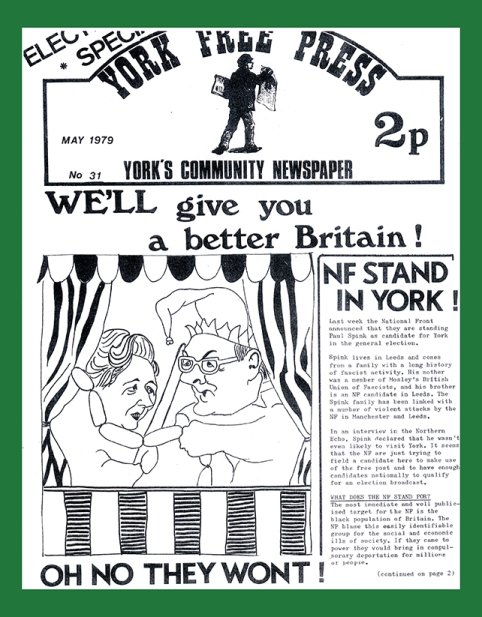
THATwas my introduction to “York Free Press”, one
of the best and most enduring of the “alternative newspapers” that for a
decade or two enlivened Britain’s culture and politics.
It was 1976 and I was an idealistic young teacher living and working
in York and aggrieved at an article I’d read in a recent issue. York’s
selective school system was about to be “comprehensively” reorganised
but the YFP article argued for incorporating six-form colleges which I
considered a device for keeping an A-Level elite away from less academic
plebs. YFP claimed to be open to everyone and advertised weekly
meetings upstairs in the Lowther on King’s Staith so I turned
up one evening expecting a row and instead was welcomed in and invited
to write a rejoinder. I was utterly disarmed, it wouldn’t happen at Socialist Worker! I was already a libertarian socialist but this bunch of scruffy student hippies turned me 100% anarchist and so I’ve remained.
Actually they weren’t all scruffy hippies, Vaughn Harvey was but Tony
Zurbrugg (who now runs Merlin Press) was already a serious-minded
libertarian-communist permanently clad in an RAF greatcoat, Danae and
Howard Clarke (later of “War Resisters International”) were smart-casual
and always smiling, Danny Golding “The Ayatollah” (nowadays Labour
loyalist) was too humourless to qualify as a real hippy but there was
always a supporting cast of “occasionals” who couldn’t be asked to turn
up every week. That was an attractive feature of YFP, you helped at
whatever level you felt comfortable with. Most political groups demand
so much that they retain only fanatics. YFP enjoyed regular “bring food
and drink to share” socials so less active supporters kept in touch and
made friends with regular “collectivists”.
Around 1978 we organised a national 'PAPERS EVERYWHERE!'conference-jamboree
weekend at York University. We invited every community paper we could
think of and people from about eighty titles turned up. It was wonderful
exchanging papers, experiences, ideas and what little technical
expertise we’d acquired. I was especially impressed by a rather posh
Sheffield guy who single-handed ran The Totley Independent, which
he gave away free and financed by taking ads from small shops and
tradesmen. He stuck out like a sore thumb amongst an array of vaguely
alternative-socialists but was content to paddle his own canoe. It
showed the potential of the format. Some titles such as Islington Gutter Pressand Rochdale Alternative Paper (RAP), which I believe sold 8,000 copies per issue, were real big hitters whilst others, like the Totley,were
happy to nurture community spirit and less intent on exposing scandal
and corruption. RAP revealed Cyril Smith’s dirty deeds forty years
before the commercial press dared touch the story.
I think two things sparked the birth of the alternative press, the
“swinging sixties” do-it-yourself politics and certain technical
developments in printing. Lead-typesetting was no longer involved and
the new process required less skill and cost. Like other papers, at YFP
we used ordinary typewriters to produce the text and trimmed, then glued
the result to a large sheet of cartridge paper. Other articles were
stuck alongside the first to build up a newspaper page with spaces left
for photographs which had to be “screened” and treated separately.
Headlines were the real pain – LETRASET!
Headlines were produced by a
sort of transfer process. You bought these rather expensive “Letraset”
transparent plastic sheets with individual black letters affixed to the
undersides. By scribbling on top of the required letter it detached from
the sheet and adhered to the paper placed underneath You had to build
the headline a letter at a time, any misspelling meant you must discard
your first effort and start all over again and keeping it all level and
evenly spaced was a tedious task. Sometimes we had lots of tables and
space to lay out the paper but often we managed in someone’s cramped
bedroom with people coming and going and ideas, jokes and arguments
flying back and forth.
YFP was a monthly with a price of 2p and 1,000 print run, sold door
to door with a network of local shops selling on the basis of sale or
return. It was a struggle to keep it going but the paper survived long
after I left York. I was always a bit of a populist, keen to present the
politics in an attractive wrapping and my favourite all-time article
was, “The Great York Fish and Chip Survey!” Every Thursday for
three months we’d sample 3 or 4 different local chip shops, weigh the
portion of chips and the fish and then assess the price, quality etc.
Finally we tabulated the results and published a league table to great
reader acclaim! Is that petit bourgeois politics or anarchy in action?
Every article was subject to the deepest of political analysis – “Is it
ideologically sound?” – was the inevitable dilemma.
The balance of collective responsibility and initial initiative at
YFP remained problematic. When a character calling himself “Euston Arch”
joined us he immediately began arranging music events in the name of
YFP and only afterwards seeking collective approval. When he signed us
up to a potentially disastrous gig featuring “Wayne County and the
Electric Chairs” at the Mecca Ballroom we accepted responsibility and
survived but immediately expelled him from the collective. After we
printed a story by a guy who told us he was literally kicked out of his
York bedsit by the landlord as a uniformed policeman stood idly by
(illustrated by a cartoon of a cop shielding his eyes) I received a
threat to sue from The Police Federation (my address, 1 Newton Terrace,
was the published editorial address). We agonised whether to apologise
and “correct” the story or stand firm and take the consequences.
Fortunately, within days the local straight press published an account
of the same landlord doing the same thing to someone else so we lived to
fight another day.
Anarchism rather than socialism characterised the alternative papers
movement. Although lots of Marxists were individually supportive they
tended to regard papers like YFP as trivial compared to their party
newspapers whilst Tories and Labour Party types regarded us as
scurrilous troublemakers. Although I wanted the paper to become a sort
of local Private Eye, both funny and muck-raking, whilst at YFP
I established an abiding interest in researching radical history. I
interviewed a founder member of York Communist Party who claimed workers
were more interested in politics in the old days and all he had to do
in the twenties was ride his bike along a road, ring a hand-bell and
people would come out of their houses and he’d start an impromptu
discussion on socialism. He described how difficult it was to keep up
with the ever-changing political line emanating from Moscow and how he’d
finally been expelled from the CP when “I zigged when I should have zagged”!
In 1979 I researched and YFP published a series of articles on
“Fascism in York in the 1930’s” which revealed a continuity of not only
Blackshirtideas with current National Front candidates but the same
local families were still organising attacks on socialist opponents.
There were so many good stories and so many great times and in 1980 I
was sorry to leave but keen to start another scurrilous rag elsewhere,
but that’s a story for another day…
Northern trade unionists confront police at Roberts Arundel
IN Nov 2006,the anarchist historian, Nick Heath* reflected upon his experiences in the UK anarchist movement since the 1960s, and the lessons on organisation and politics he finds valid for anarchists today. His observations include the idea that '[o]rganisational responsibility and discipline should not be
controversial'. [see 'The UK anarchist movement - Looking back and forward'posted on libcom].
Part
way through his long account he ponders the problems of the failures of
anarchists since its high point in the early to mid-1960s
during the rise of the peace movement: 'One of the shortcomings that they had highlighted was the lack of
industrial activity. As Brian Bamford, whom I do not often agree
with, has pointed out: “At the time of disputes at Roberts-Arundel
in Stockport**, Pilkington’s Glassworks in St Helens***, the strikes and
stay-in occupations at Upper Clyde Shipbuilders and in engineering,
the miners struggles in the 1970s, the anarchist influence was tiny”
(Freedom 6 August 1994)'
This year it is the 50th anniversary of the Roberts Arundel strike in Stockport, and Stockport Trade Union Council has put on an exhibition to commemorate the occasion.
At the time of the strike at Roberts-Arundel in 1966, mentioned in the above quote from Freedom, the Manchester Anarchist Group [MAG] was far bigger than the small International Socialist body with only 20 members locally and most of whom were students. Both Colin Barker and his then friend and fellow sociologist John Lee, who later like me became an ethnomethodologist, were anxious to engage with me and some of the local working-class anarchists. They knew that I had been involved in the national strikes of the engineering apprentices in the early 1960s, and still edited the apprentice paper Industrial Youth that came out of those disputes; both Colin and John were keen to collaborate with us with a view of building up their own I.S. group. The trouble then was that most of the Manchester anarchists in the MAG didn't have any affinity with factory workers and trade unionists. They were good on peace demos etc. waving their black and red flags, but it was as if they were frightened of engaging with genuine workers at their places of work.
When I was sacked for supporting the apprentices at Robinsons in Rochdale in 1965, the MAG refused to come down because they said they didn't want to be 'authoritarian', and tell the apprentices what to do! Again in 1966, when I was given my marching orders at Tomlinsons up Milnrow the MAG held aloof yet again steering clear of the factory gates. In similar circumstances I doubt that Colin Barker and I.S. would have been so timid, but by that time I had already decided to return to Spain, where I had a job waiting among the more practical and proletarian Gibraltar anarchists.
Under the influence of Ron Marsden, and Alan Barlow**** when the Manchester anarchists discussed the Roberts-Arundel dispute at a meeting at Mother Macs pub in central Manchester, the meeting was swayed and persuaded to not attend a support meeting called by the International Socialists [IS] to support the Roberts-Arundel strikers, the reasoning at that time being that they didn't want to swell the support for the trotskyists in IS. This is significant and relevant to what Mr. Heath is saying, yet I believe both he and Colin Barker draw the wrong conclusions in arguing that the anarchists and international socialists needed a national organisation or party.
In an interview with Colin Barker, now a retired sociology lecturer, in 2015 in the publication RS21 (Revolutionary Socialism in the 21st Century) vividly describes the situation he found himself with the IS in 1966 at the time of the Roberts-Arundel dispute: 'We
were a group of about twenty people. We’d got the building workers,
and we were talking on very friendly terms with one or two CP
engineers. By then I think we’d recruited one or two. We look as if
we’re going to recruit significant numbers of militant workers to
the branch – I don’t want to exaggerate, but we’re a little bit
confident, a little bit rooted. We’re distinctive. We don’t know
that you can’t do things – that’s quite important, we don’t
know of any limits to what we can do. So we take initiatives, try
things out, sometimes they don’t work and sometimes they do. This
is in ’67 – the next year of course everything changed.' (rs21on
Clearly the advantage that the Manchester International Socialist had in 1965 was not that of a mass organised party, but rather that of disciplined organised body but rather an imaginative tendency that was willing to act on its own initiative. By acting outside the box the IS was enabled to have a great impact in regional industrial disputes such as Roberts-Arundel in Stockpost and at Pilkingtons in St Helens.Meanwhile, the Manchsester anarchists who were so heroic in the peace demos in central Manchester were too timid when it came to turning up at the factory gates.
Drawing up a neat historical narrative
Like all historians
Mr. Heath provides us with neat narrative to explain what was wrong, and
how the anarchist decline could have been avoided in the past, but also
how its continuing fall in the present and in the future can be
stemmed: i] The historic issue, according to Mr. Heath, was that there was 'The increasing frustration with the swamp of pacifism, liberalism
and vague humanism'.
ii] Two now
defunct bodies entitled ASA (Anarchist Syndicalist Alliance) and ORA
(Organisation of Revolutionary Anarchists) were potentially Mr. Heath's
ideal tools for social change, but he writes the 'ASA ran
out of steam pretty quickly'.
[I personally was one of the
founding members of this short-lived ASA organisation, which was set-up
around 1970 from remnants of the old Manchester Syndicalist Workers
Federation, and went on to play a role in the Courtaulds Arrow Mill
strike involving mainly Asian workers in Rochdale, and later to successful campaign for shop stewards in
textiles inside the National Union of Textile & Allied
Workers*****]. iii}On the other hand, Heath writes that 'The ORA had started moving away from
the swamp as a result of the dockers and miners struggles and the
influences of French libertarian communists.'
Mr. Heath quotes from an ORA booklet entitled 'Towards a history and critique of the anarchist movement in
recent times' by K. Nathan. R. Atkins, C. Williams [ORA pamphlet no1.
1971]to support his diagnoses about the rise of Trotskyism and the fall of anarchism in the late 1960s and earlier 1970s: 'The IS [the International Socialists which later became the SWP] would
not have attained their size and influence such as it is if a decent
libertarian organisation had existed. It is an unholy mixture of
libertarian and Leninist groups. The attempt by Cliffe (sic) to
compete with IMG by out-trotting Mandel will make this alliance
increasingly unstable. BUT do we have any capacity to attract these
comrades? In fact, the flow has been the other way. Good comrades
(for the most part industrial militants rather than students) have
been lost without anyone attempting to understand why.'
He argues that that was a
true analysis and remains so today. Hence, he claims, that in
spite of what he calls 'the decline of Leninism' it was a 'lack of effective organisation', that has meant that anarchism will be at a standstill
until we rectify this problem of organisation.
What
this shows is that Nick Heath has a mechanistic Marxist approach to
organisation that is rooted in a form of deterministic thinking that is
part of the problem. The main problem among the anarchists, which has
been amply demonstrated in most recent times at the London Anarchist
Bookfair etc., is a psychological inability to engage with real people
in the real world. Some of the left don't have an engaging relationship
with working people. This has been a long term problem which no amount
of management, membership cards, statements aims and principle, mission
statements, or tick lists can solve.
Because Mr.
Heath has been a white-collar office worker (a librarian) for much of
his life he looks at the problem in a top-down way so that all he comes
up with are cookbook solutions. In the same way his close colleague
Mike Ballard - now a retired local authority housing manager - has a similar
cultural problem. Commenting in another essay entitled 'Anarchist communism in Britain, 1870-1919', on the libertarian organisation founded in 1960 called 'SOLIDARITY', Mr. Heath writes: 'Their wilful failure to translate this into the establishment of a
national organisation was a disaster, as International Socialism (the
precursor of the Socialist Workers Party) was able to build on this
territory abandoned by Solidarity (and by the Anarchist Federation of
Britain). They failed to engage as fully with the Anarchist movement as
much as they could have, as their contributions at meetings and
conferences could have considerably strengthened the class struggle
current within it.'
Thoughts on aspects of northern anarchism
There were some protests from southerners and Mr. Heath's type of 'organisational anarchists', when on November 2011, Sidney Huffman wrote his interesting 'Message from a North East Anarchists' on libcom:
'We believe the anarchists may actually be the single largest radical
tendency in the North-East and wider North, yet we remain largely
invisible, rarely initiating action ourselves and instead just tagging
along in ones and twos with events organised by the left and liberals.
We have repeatedly found anarchists who have joined Trotskyist parties
simply because they couldn't find an organised anarchist presence here.
Older comrades coming out of premature retirement spend 6 months looking
for political anarchists and cannot find any during that time. It is
not good enough. If we are serious about change, we have to step up and
make ourselves visible.'
What's interesting
about this statement and some of the protesting comments that followed
it, is the implied organisational and activist nature of what is being
proclaimed. Sidney Huffmann writes about 'tagging along in ones and twos' on other people's events tail-ending other left protests.
In response to Mr. Huffman, Tom Harrison wrote on libcom that the 'SF [Solidarity Federation] and AF [Anarchist Federation] have been turning out regularly at the sparks
strikes/demos/blockades in London, bolstering picket lines and generally
providing the much needed solidarity for these workers. There was a
particularly good SF turnout at the sparks demo on November 9th ... just
watch this vid
and you can see their placards at many point. We're also organising and
attempting to link student militancy with worker militancy.'
Mr.
Heath will recognise from this that despite his efforts nothing has
changed today from the stagnant pond from which anarchists seems unable
to escape. Of course, anarchists in London may have put out more flags
as seen on the video on the electrician's demo, but that is not news.
What would have been news would have been if like Tameside Trade Union
Council they had been in the forefront of the campaign against the
blacklist moving motions to the TUC, manning lonely picket lines in the
early hours since 2003, in the DAF dispute or at the Manchester Royal
Infirmary in 2009. If Mr. Harrison is saying the anarchists are a kind
of rent-a-mob available on street demos well that is part of the problem, because
despite all the talk of organisating they don't seem to have the
initiative to build serious enterprises themselves apart from bookfairs.Now because of narrow-mindedness of some anarchists even bookfairs are becoming a problem for the anarchiststo organise.
What Mr. Heath failed to grasp when he considered the Roberts Arundel strike (in his quote from Freedom
above) was that the lesson from that strike was that the Manchester
anarchists in 1967 failed to engage with the workers in dispute because
they were afraid of real workers at the factory gate. They didn't know
how to address a real worker then, and they still have problems today.
Even in the run up to the campaign against the blacklist in the
naughties people like Nick Heath's mate Mike Ballard, a former housing
manager at Manchester City Council, was describing the Manchester
electricians as not being involved in class struggle because they were
taking 'individualuist' actions by setting up pickets
rather than collectivist actions. Mr. Ballard came up with that claim
at a meeting of the NAN in Burnley, of course it was before the
Information Commissioner made his successful raid on Ian Kerr's office
in 2009, and before Kerr pleaded guilty for keeping an illegal data-base
at his trial at Knutsford Crown Court.
Abstract Anarchists & the ethnographic approach
The
folly of the mechanistic managerialist approach of both Mr. Heath and
Mr. Ballard is evident given that the subsequent development of the
struggle of the 'Boys on the Blacklist' in Manchester,
which Tameside TUC has been in the forefront of since 2003: had this
handful of electricians often acting in opposition to the official
union, using their own initiative not engaged in a series of small
pickets around Manchester after 2003, the office of the Consulting
Association, managed by Ian Kerr, would never have been raided by the
Information Commissioner in Droitwich Spa in 2009. Consequently, the
blacklist with over 3,000 names of building workers would never have
been exposed.
In the mid-1970s, the criminologist Ian Smith and other anarchists used to talk about the contrast between the 'sectarian syndicalists' and 'shop-floor syndicalists' in the ASA, Now we have very opportunistic 'abstract anarchists' like Mr. Heath and Mr. Ballard to contrast with more ethnographic approaches of others anxious to listen to the public.
What
Nick Heath may have in mind when he envisages a future anarchist
organisation is something like what Ken Weller and member of SOLIDARITY, talked about when he described the influence of the British Communist Party in 1956: 'People can’t realise how big an apparatus it was. There were the
embassies, the Friendship Societies, the printshops, the front
organisations, the unions; 120 were employed by the Electrical Trades
Union alone. There were all the agencies of the Soviet government, Tass
[the Soviet news agency], the Moscow Narodny Bank, all these sorts of
things were full of people; I mean, the Soviet Weekly alone employed a
network of people who were distributing agents for the paper, and so on.'
It
must have been exactly like George Orwell said in the 1930s about it
paying some folk to adopt a commie position, but to accomplish that kind
of body among the anarchists would require something more substantial
than what Nick Health has to offer with his own small-scale Anarchist
Federation (AF) with all of its one hundred members paying their fees,
and with perhaps a possible trans-gender platform to stand upon with its
own estimated constituency of 0.1% of the national populous. That
would in any case be a very different approach from that experienced by
anarchists in the early 1960s, when anarchism was at last part of a
genuine social movement; that is the peace movement and the Committee of
100.
With the 'People in the Streets', as Vernon Richards described the peace movement in Freedom in the 1960s, the anarchists had a significant role to play on Ban the Bomb demos and in the Committee of 100 sit downs. Yet
when the social struggle moved to the picket lines, trade unions and
factories after the Roberts Arundel strike in 1967, where the communists
had the great advantage, the Manchester anarchists had very little
grasp of what was required. Only in the struggles for shop stewards up
in Oldham and Rochdale in the failing textile industry such as at
Courtaulds Arrow Mill in 1972, did the anarchists of Manchester have an
impact, and then again in London in the building workers' struggles,
anarchists like Peter Turner had a role to play. None-the-less, in the
significant disputes of the late 1960s at Pilkington Glassworks in St
Helens, Upper Clyde Shipbuilding [UCS] and in engineering sit-ins,
the miners struggles in the 1970s, the anarchist influence was tiny.
* Nick Heath leader of the Anarchist Federation.
** Roberts Arundel strike from 1966-68 of engineering workers against dilution and cheap labour.
*** Pilkington strike in St Helens of glass-workers in the Municipal & General Workers Union [now GMB] in which the workers, frustrated by both the union and the bosses, attempted to set up an independent union.
**** Ron Marsden and Alan Barlow came to Manchester in 1964 and joined the Manchester Anarchist group [MAG], which was then meeting st that meeting in the Lord Nelson in Salford. The MAG had been founded earlier by Graham Lee and James Pinkerton, then International Secretary of the Syndicalist Workers Federation [SWF]. Marsden from Preston, and Barlow originally from Liverpool, had recently become members of the SWF, and were hoping with the help of the Liverpudlian Vincent Johnson also of the SWF, to form a faction within the MAG and drive it in a 'class struggle' direction.
***** COURTAULDS INSIDE OUT: CIS ANTI REPORT No.10. Produced in co-operation with The Transitional Institute. ******





 Posts
Posts


