Showing posts with label Private Eye. Show all posts

Friday, 5 March 2021

Rochdale's Return to 'ROTTEN BOROUGHS'!

by BRIAN BAMFORD
DESPITE recent efforts to sanitise the news from Rochdale, this week saw the return of the town to the ROTTEN BOROUGHS' columns of PRIVATE EYE with the revelation of a local council-run home, which Ofsted has not named owing to 'safeguarding reasons', at which the inspectors found that there had been little or no control over the residents despite the fact that according to The Eye 'it only provides care and accomodation for six young people at most'.
The Eye reports: 'Following their visit, inspectors reported one girl known to be at risk of child sexual exploitation had shown staff "significicant amounts of money" she had collected while absent from the home....Two children who had gone missing for five days phoned the home and asked to be collected. A staff member told them there was no transport available. As Ofsted reported: "the children remained missing and at risk of harm until the following day".'
Last March, Ofsted classified the home as as "good", but reassessed it in January "following police involvement". The Eye concludes: 'The home has now been barred from taking in any more children until it can prove they will be safe.'
The Eye bemoans the general war cry of the Rochdale Council which when confronted with this kind of child neglect and abuse, which has a local history dating back to Cyril Smith and the grooming of young girls, arguing: 'Haven't we heard it all before?'
****************************************************

Saturday, 23 May 2020

Unite's Len McCluskey & the lucrative libel lawyers

THE current PRIVATE EYE's TUC NEWS column reminded the Unite union's membership of 1.1m that though they may be worried for their jobs or in fear of Covid-19, their union is assuring the libel lawyers that they can count on bounteous harvest of refreshers following the lucrative case of Turley v Unite the Union.  Totting-up the costs of the trial which took up 7-days of court time, legal experts have told Private Eye 'the premium would be around £200,000' and the 'final bill to its luckless members members [of Unite] may be not far short of £2m.'

The Eye concludes:  'London's libel lawyers won't be going hungry any time soon.'  


However, only last January Ms Anna Turley was claiming on twitter that:
At that time Guido Fawkes reported these developments on his Blog:
'In the latest development, the former MP has published a letter from her solicitors declaring given Unite’s failure to pay up, “The only conclusion we can draw is that your clients have deliberately chosen to cause further distress to Ms Turley or they are incompetent. Which is it?”, going on to say'
“We have prepared enforcement papers that will permit bailiffs to attend at your clinets’ premises to enforce the two final judgements. We shall issue these when the Court opens on Monday morning if the full judgement debts, together with ongoing interest, have not been satisfied.”
Guido Fawkes claimed:
This is much more entertaining than the Labour leadership contest…
UPDATE: Unite and Skwawkbox have finally coughed up

And Private Eye described the squabble as 'even by Labour's internecine standards it was a vicious fight.'

And then Ms. Turley was to announce on twitter:
The judgement of Justice Nicklin J held that Unite was responsible for the defamatory statement because its Director of Communications sent the Second Defendant [Skwawkbox] a press summary fully aware that he intended to publish an article which would identify the Claimant and contain substantially the same defamatory sting about her 'being dishonest'.

The Defendant's Unite and Skwawkbox had claimed the Claimant “should have known” she was ineligible for Unite Community membership, but his Lordship emphasised that, even if that had been so, negligence is unlikely to provide an objective basis upon which to reasonably suspect dishonesty [134].

Skwawkbox the website that published the offending report had claimed that Turley, then Labour MP for Redcar, had called the leader of Unite an 'arsehole' and had joined Unite at cut price rate reserved 'exclusively for the unwaged' so she could 'undermine Jeremy Corbyn'.  Steve Walker, who runs Skwawkbox  according to the Mail Online 'Mr Walker, .... is the sales director and CEO of a company called Foojit, which provides mailing solutions to the NHS.'

Meanwhile Ms. Turley managed to lose her Redcar seat at last December's general election when the Labour Party backers Unite had declared in the High Court that she was 'not fit to be an MP'.  The £84,500  paid to Turley in aggravated damages, should help ease the pain of this defeat.  Probably Unite and its leader, Len McCluskey, now wish they had settled out of court when Turley's solicitors offered a settlement last June, if Unite agreed to pay her £25,000.  Now because the union refused this compromise it must now pay interest of 8% on the costs.  By rejecting this offer, it also lost the right to demand that Turley's legal advisors prove their costs were reasonable.

Ms Turley, MP for Redcar before losing her seat in the General Election, has said she was 'thrilled and relieved' after winning the case

****************************

Thursday, 26 December 2019

The Data Death Ship for anti-Brexit team

ACCORDING to the Xmas issue of Private Eye both Jeremy Corbyn and Jo Swinson had 'hard data telling them they would go down to an epic defeat if they gave prime minister Boris Johnson the election he craved.' 

What followed was what we now know to be a disaster.  

 Naomi Smith, cheif executive of the pro-European campaign group Best for Britain, commissioned a highly expensive 'multi-level poll' of British political attitudes. In June's Peterborough by-election it it prediction of Labour's vote share was only 0.6% off the actual result.  Private Eye claimed the Best for Britain researchers had considered what would happen if the Brexit Party leader, Nigel Farage, had decided to help the Tories. In the 2017 general election, Ukip didn't stand in hundereds of constituencies with pro-Brexit MPs. 

Best for Britain took their findings to the Lib Dem's cheif executive Nick Harvey, and Rhiannon Leaman, Swin's cheif of staff.  They continued to disbelieve the figures until the 28th, October when they voted to overturn the provision of the Fixed Term Parliament Act and give Johnson his election. 

The Best for Britian then tried Labour's James Frith, Anne Turley and other Labour backbench MPs were more receptive.  They were, according to Private Eye, aware that many of their voters hated Corbyn.  Private Eye added:  'They also knew they were just a handful of Commons votes from securing a second Brexit referendum.'

But Corbyn ordered Labour MPs to back an election saying:  'This is a once in-a-generationh chance to build a country for the many, not the few.'  'Bring it on' cried his sidekick Laura   Pidcock.  Swinson,and Turvey lost their seats. and Johson won his predicted majority.

******************

LABOUR LOSING ELECTIONS: Six in a Row

THE STATISTICAL SPIRIT: Can they count to six?

FREELANCE journalist, Elenor Penny wrote in the Independent on the 14th, December:  'This new politics, embodied by Jeremy Corbyn, has lost it first electoral showdown.  But the circumstances of its defeat should embolden us... Losing this battle was always an option.  Losing the war is unthinkable.'

Yet, surely this 'electoral showdown' is now no less than the sixth attempt that, according to Private Eye, that Corbyn has lost out?  If we count last May's European elections, in which the Labour Party came third, and the four sets of local elections under his leadership, it was the sixth contest in which he had floundered and come to nowt.
*********

Friday, 13 September 2019

The Horror Stories of Agency Workers

 Agency Worker Binman Dies while sick on the job
UNTIL recently when the Unite union passed a policy decision last year the union had no proper policy on the employment of agency workers.  In January 2018, a scandal occured in Greater Manchester in Bury Council's waste depot at Bradley Fold when a manager and an agency worker was in a scuffle following a dispute in which the boss had dismissed the agency worker's appeal that after 8-years working full out as a refuse worker for Bury Council he should be taken on full time.

The local police were informed about the incident when the manager sporting a black eye contacted them.  Following further inquires the police asked the branch secretary for a crime number but Human Resources at Bury MBC said the refuse manager, Glenn Stuart, had reported the incident and only he could supply the crime number and Mr. Stuart faled to reply to a union request for more information on this case.

The agency worker had told the local Unite branch secretary that the police wer reluctant to act because it was only his word against the manager and there were no other witnesses as the incident occured in the office of the manager and the blinds were down.

London Death of a Binman

On the 25th, July, a 45-year-old man became ill while labouring on a shift on a Veolia refuse lorry whe temperatures hit 37C.  The man, who has not yet been named, working for only his second day on the job collapsed while emptying bins in Thornton Heath, south London.  Private Eye reports that the man 'wasn't a Veolia employee, but had been hired in as cover from an agency.'  Also neither Veolia nor Croydon council made any public statement about the death until they were force to do so by the local media.

Local anecdotal reports from the staff of Veolia has suggested that the lad had been feeling unwell and had rung up his spervisors to ask if he could go home,  It is alleged that he was warned that if he didn't finish his shift, he wouldn't be given further work.

Despite this a later announcement  issued to the Croydon Guardian newspaper by Veolia now contradicts the earlier statement.  Veolia's new story has been changed to say that the agency worker was taken ill 'without warning'Private Eye reports that so far Veolia's PR word spinners have refused to explain why they changed their story.

********************

Tuesday, 4 June 2019

Election Fraud Rewarded with Finance Job

Why is 'Two Votes' Rana Welcome on Rochdale Town Council?
Cllr. 'Two Votes' Faisal Rana

LABELLED by Private Eye as a 'Rotten Borough' because of its Council's tolerant acceptance of Cllr. Faisal Rana's mis-doings in helping himself to two postal votes when he was elected in May 2018 local elections, the Rochdale Labour Party has now decided to reward him with the Cabinet position of Assistant Portfolio Holder for Finance.  

It is not the first time that the self-confessed fraud Cllr. Rana has held this position, he was in the job before he accepted a caution from the Greater Manchester Police for election fraud.  As a concession he humbly stood down at that time, and it was argued that he had been punished for his untoward behaviour at the time.

Fortunately the Lib Dem and Conservative opposition to the Labour Party administration on Rochdale Council is about as floppy as a bunch of wet lettuces and are unlikely to refuse to work with the blatant fraudster Cllr. Rana the Councillor for Spotland and Failinge ward.  When a no confidence motion against Cllr. Rana was put to the Rochdale Council, the Labour Councillors, as expected backed the fraudster, but for some reason the leader of the Lib Dems didn't show for the vote.

It should in fairness to Cllr. Rana be pointed out that he has a large property portfolio in Rochdale and beyond,. This may have impressed the council leader Allen Brett and perhaps is the reason he got the assistant Finance portfolio job.
We must await further developments to see if anyone has the guts to oppose Cllr. Rana's new appointment.  Who knows perhaps Rochdale Council will again come to the attention of Private Eye's Rotten Borough's coloumn?.

*************


Monday, 20 May 2019

Double-dealing & union blackballs?

UCATT was the trade union that merged with Unite in January 2017.  It was also the union that had allegedly full-time union officers who according to the current Private Eye 'shopped their "comrades",' and 'Blackleg', in the same journal writes:  'Two years ago, Unite general secretary Len McCluskey and assistant general secretary Gail Cartmail promised an inquiry into union officials' collusion with the big building firms - but there's still no sign of it.'

In December 2016, an open letter signed by blacklisted construction workers was circulated:

'.... one issue threatens to cause internal friction: possible union collusion in blacklisting.
Some years ago, both UCATT and UNITE carried out internal investigations into possible union involvement in blacklisting. But that was at a time when barely any of the documentation was available.
'Since the High Court, all that has changed. The employers were forced to provide witness statements and disclose 40 years worth of documentary evidence. It is now in the public domain that officials in both unions were recorded as the source of information on Economic League and Consulting Association blacklist files. Some of those named, remain senior officials in UNITE and UCATT to this day. Every union activist in construction knows who the named officials are, as does every major employer.'

Gail Cartmail had called for a 'full public inquiry with judicial authority'.  

Now Private Eye reveals 'The joint head of Unite Construction, formed in January 2017 when Ucatt trade union merged with Unite, is Jerry Swain, who is also a Unite national officer.  Despite the tardiness of Unite, scores of blacklisted trade unionists have received compenstation, having taken their cases to the high court.  Among them was bricklayer Brian Higgins who presented evidence to the court in pre-hearings that union officials were the source of information given to construction firms about union activities in 1992, 2002 and 2003.'

Private Eye adds:   'Although the officials' names were redacted in pre-hearings of the high court case, Higgins subsequently obtained an unredacted copy of his file.  Among those who were said to have shopped their "comrades" was one, er, Jerry Swain, from 1991 to 2016 the London and South East regional secretary of Ucatt.  Just fancy that!'


***********

Friday, 15 March 2019

What RAP Said About Smith in 1979

by Les May

IN his evidence to the Independent Inquiry into Child Sexual Abuse (IICSA) David Steel said:

'It is unfortunate that some sections of the media have chosen to extract certain passages of evidence and present them without the full context.

'The inquiry has a serious and sensitive job to undertake and spinning evidence to generate sensationalist headlines only serves to distract from panel's search of the truth.'

This is undoubtedly the case, but what Steel himself said seems to show a degree of confusion about what was published about Smith in 1979. In addition he claims that he found out about Smith from material in Private Eye. What he does not mention is that he was contacted by the joint editors of Rochdale Alternative Paper (RAP) prior to this. He also seems to have been influenced in what he said by so called ‘evidence’ which has been spun to generate sensational headlines since 2012.

Today I listened to three people voice there opinion about Steel’s action (or lack of action) on the BBC2 Politics Live programme. They clearly knew nothing about what Steel knew or did not know in 1979, but it did not stop them holding forth.

In order to clarify what Steel would have known in 1979 about Smith’s antics I have appended below the material published in the May and June 1979 editions of RAP.

Rochdale Alternative Press (RAP)
May 1979 (Number 78)

RAP has obtained evidence that, during the 1960’s, Cyril Smith was using his position to get lads aged 15 – 18 to undress in front of him in order that he could get them to bend over his knee while he spanked their bare bottoms or let him hold their testicles in a bizarre ‘medical inspection’.
The evidence comes from the interviews conducted by RAP over the last six months and in the form of statements made on oath before a solicitor. The allegations are not new – some were originally made as long as 15 years ago, but they were made in statements to the police during their investigation of these allegations in 1969/1970.
There is also disturbing evidence to suggest that that police investigation may not have had its proper end.
RAP decided last September to investigate the allegations in order to determine the facts in an area dominated ever since by rumour. This was prompted partly by the stance Smith had adopted in the Thorpe affair. And partly by the fact that his position as M.P., like his election campaign, was totally based on his personal character of “Smith the Man” – there was part of that man which has to date been concealed and which we feel to be sufficiently disturbing for it to be made public.
Here we present the results of our investigation:

(1) THE POLICE INVESTIGATION
The investigation, carried out by Lancashire Constabulary’s Task Force, started some three years before Cyril Smith first became Rochdale’s MP. It lasted for around 6 months.
It was stimulated by allegations made by a young Rochdale man while he was being questioned by police in connection with charges of indecent behaviour, in Risley. In the course of his examination he claimed there was, in effect, one law for the powerful and another for the poor. He alleged that Cyril Smith had done similar things but got away with it.
Cyril Smith was then Alderman, Chairman of the Education Committee, and soon to be prospective Parliamentary Candidate for the local Liberal Party which he had not long ago rejoined .
The young man concerned had been a resident of the Cambridge House Boy’s Hostel, on Castlemere Street. That hostel then became the focus of the police investigation as they interviewed not only its residents but its committee members - including Bill Harding, Harry Halstead, Alan Lovick and Ron Watson, who were asked questions about the role of the committee members in discipline and medical examinations.
These committee members, while admitting with various degrees of reluctance that they had been interviewed by the police, all denied then, as they did again to RAP, any knowledge of improper activities within the hostel. Some of the residents however had clear and, both to us and to some of the police, convincing memories.

(2) THE HOSTEL
The hostel had been set up by the Rochdale Hostel for Boys Association, a voluntary group formed late in 1960 under the joint inspiration of Probation Officer Bill Harding, its chairman, and Cyril Smith, its secretary. With the aid of Rotary Club money to guarantee its rent for the first two years, the assistance in renovations of the Round Table, and of other committee members like Alan Lovick who provided cost price furnishings, the doors of Cambridge House were opened as a hostel for working boys in February 1962.

[Clipping inserted within the main body of the article]...
“We earnestly hope that we have found for boys a home in which they can find the right moral character building influence.” Smith at the 1964 AGM of the hostel.

It had room for 20 boys, though it average less. The solid basis of its membership was a dozen lads who were apprentices with Whipp & Bourne. They had originally been employed in the firm’s Scottish works but were moved to Rochdale when that closed down. Increasingly, residents were also recruited from the ranks of those in care or from broken homes.
It closed at the end of 1965, primarily through lack of funds and, in particular, because after a lengthy debate, the council endorsed the decision of its Children’s Committee not to increase the grant it was giving to the hostel, by the additional £700 they were being asked to. Strangely, there is no mention of the hostel project in Smith’s autobiography ‘Big Cyril’ which was published in 1977.

[Clipping inserted within the main body of the article]...
“I believe there is a place for corporal punishment....there is a place in law for a good hiding.” Smith in the Rochdale Observer, 21 April 1979.

(3) THE STATEMENTS
During the investigation the police took statements from 7 or 8 of the boys who had lived at the hostel and from at least one who had not. RAP has traced 10 ex-residents and one who, though never having been at Cambridge House, made a statement to the police.
Of the 10, three have nothing but praise for Cyril Smith. The other 7 have all made allegations which fall into one or both categories:
BEATINGS
They have described to us Smith’s role in providing discipline. Two extracts from sworn statements given to us illustrate the procedure:
(1) From a man now married with 4 children and living in Rochdale, describes how, while at the hostel and aged about 16 he took a day off work from the job Smith had arranged for him. His absence from the job was reported to the hostel and he was interviewed by Smith:
“He gave me the choice between accepting his punishment and leaving the hostel. I said I would accept his punishment...He took me into the Quiet Room. He told me to take my trousers and pants down and bend over his knee. When I had done that he hit me four or five times with his bare hands on my bare buttocks.”
(2) From a man, single, living and working in Rochdale, then aged about 15, describes how after he had been reported for a minor offence:
“Cyril Smith found out that I had taken some money. He asked me if I would accept his punishment or be dealt with by the authorities. I said I would accept his punishment. He told me to take my trousers and pants down and bend over his knee. He trapped my hands between his legs. He hit me many times with his bare hand and I pleaded with him to stop because he was hurting me. This took place at the hostel. Afterwards he came to my bedroom and wiped by buttocks with a wet sponge.

MEDICALS
We have been told by Dr Ian McKichan, then Rochdale’s Police Doctor, who provided medical services to the hostel and now lives in Rugby that Smith was often present at the medical examinations. Some of the ex-residents we interviewed have stated on oath that they had what they took to be medical inspections from Smith himself. For example, from the sworn statement of a man who lives locally in a new house:
“After a few days in the hostel I was given a kind of medical examination by Cyril Smith. He told me to take my trousers and pants down. He held my testicles and told me to cough.”
We have had similar experiences described to us by more than one other person.

(4) OUTSIDE THE HOSTEL
Our investigation led us to someone who never was a resident of the hostel but who turned out to have also made a statement to the police. He still lives locally with his wife and family and holds a good job. He was one of the many young men Smith has helped over the years. In his case the help came about 1967, after the hostel had closed, in the form of an offer of a job at Smith’s Springs. He took it.
Increasingly, the lad’s parents – he was about 16 – turned to Smith for help in coping with his adolescent adventures. He still remembers Smith telling him that he would help him to sort himself out, but that he would do it his way. And that whenever he did something wrong, he would have his trousers taken down and receive a beating.
On three occasions, the now family man remembers, Smith took him into the front room of his parents’ house after they had reported his misbehaviour to him. On each occasion Smith endeavoured to remove his trousers and bend him over his knee, even to the extent of a wrestling match when met with resistance from the lad.

[Clipping inserted within the main body of the article]...
“Its not a very friendly gesture, publishing that, all he seems to have done is spank a few bare bottoms.” David Steel’s Press Office, 22 April 1979.

(5) Jack McCann M.P.
During the course of the police enquiry, in 1970’s early months, Smith sought help. He visited Dr McKichan in Rugby. He called at the house of a local man who had fostered one of the boys from the hostel . That lad had made a statement to the police and Smith’s visit appeared to have had the purpose of seeking ways of reducing the credibility of the statement.
He also turned to Jack McCann, the then labour M.P. for Rochdale. He had earlier turned to the same man for help in getting his M.B.E. award of 1966. We have had described to us a late night session between Smith and McCann who had been brought over to Rochdale from his home in Eccles for the purpose. The meeting ended with McCann offering offering to make representations on Smith’s behalf.
Jack McCann’s widow, Alice, remembers her husband being asked to help Smith. We know that McCann was concerned about the situation in which he found himself since, though a man of close confidence, he actually discussed it with one associate in the course of a train journey between London and Manchester. That confidant still vividly remembers the conversation and told RAP that McCann had said that he had taken the matter up with the Chief Constable.
Beyond that hint, we have not been able to find exactly what McCann did, or if anything he did had any bearing on the result. Certainly the Chief Constable concerned told RAP he has no memory of ever meeting him. But there is one disturbing discrepancy in the stands now being taken.

(6) THE D.P.P.
The police, at the conclusion of their investigation, appear to have taken the view that there was sufficient reason to warrant a court’s verdict. A file was certainly drawn up by the Officer in charge of the Task Force Team for submission to the Director of Public Prosecutions.
From that point the story becomes disturbingly confused over the issue of whether the file actually reached the D.P.P.
It has always been believed by those in the know that the file was indeed sent to the D.P.P. And that the D.P.P. returned it marked for no further action on the basis of insufficient evidence.
That was what the investigating team were told. That is also what associates of Smith and then the local leading political figures in the Town – who were officially informed of the proceedings – also believed. That was what Smith himself was told by the investigating officer.
An approach to the D.P.P. however failed to confirm that. On our first request for information, the D.P.P.’s press office agreed to answer the question of whether or not the file had been received by them. After making the appropriate search, we were told that they had failed to find such a file. A further approach brought the official statement from the Director: “The D.P.P. cannot trace such a case being referred to us, but cannot confirm or deny receiving it.”
The Director did confirm that, under the then applicable regulations the “Chief Office of Police shall report to the D.P.P. offences....which include indecent offences upon a number of....young persons.”
We also wrote to Sir Norman Skelhorn, the man who was the Director of Public Prosecutions at the time of the investigation. RAP’s letter was forwarded to him by one of his Club’s, the Athenaeum. On Wednesday 25th April we received a phone call from someone claiming to be Sir Norman, on holiday and from a coin box phone, who said that he could remember nothing at all about such a case.
RAP also interviewed Mr. Palfrey, the Chief Constable of Lancashire at the time. He agreed that such a file “should have been sent” but said “I can’t say for sure whether the file was sent or not.” He told us to approach Police HQ. Which we have done several times. Their final comment was “We decline to comment.”

[Clipping inserted within the main body of the article]...
“I believe that a politician’s private life is his own affair and should remain so unless private behaviour jeopardises his political role. I suspect that most men and women have a skeleton rattling round in their cupboard and I think it should be allowed to remain there unless it can be proved that its exposure can right some injustice done to another person.” ‘Big Cyril’ (1977) Smith’s Autobiography.

(7) SPECIAL BRANCH
The file, kept since at Preston, the HQ of Lancashire Constabulary, came to the centre of national events in February/March 1974. Then there was discussion of a possible coalition between the Conservatives and the Liberals. The possibility, if that happened, of leading Liberals holding Ministerial posts, prompted the Special Branch to acquire a copy of the Preston file on Smith which was taken, with special security precautions, to London.

(8) CYRIL SMITH
Throughout the police enquiry Smith asserted his innocence of the allegations. He told his friends at the time that it was a case of an attempt to damage him politically. He pointed to the home backgrounds and records of some of the ex-residents of the hostel as evidence of their lack of credibility. In his interview with the police, with his solicitor present, he denied all the allegations made against him. We have no reason to believe that he would do anything other than that today. RAP wrote to him asking for an interview to discuss the serious issues raised by our investigation, but he did not reply.

(9) WHY NOW?
This is not, though it will be suggested it is, a smear campaign in the middle of an election. Our investigation started, as our records show and those we talked to can confirm, last October when the election was still thought to be a year away. When we published our last issue – which announces the date of this one – we did not know that this issue would be just a few days before an election.
The fact is that our findings compel us to publish. Rochdale is being asked to elect a man as M.P. on a purely personal basis. His election material makes but passing reference to the Liberal Party. Smith himself has consistently and consciously personalised the issue. Once we became convinced that he had, over a period of years, interspersed his undoubted good work with a clear abuse of his position for personal ends, we felt had no choice but to make it that part of what Rochdale’s electors should be asked to take into account.
It had already been reported to us, before publication, that Smith intended to issue a libel writ. That did not alter our conviction that the men we had interviewed were telling the truth. Nor our view that they should not have been left with the indelible mark of their experiences at the hands of Smith. For too long, it is they who have effectively been branded as wrongdoers.

(10) CONCLUSION
It is not RAP’s function to pronounce on guilt or innocence. We do however believe that the investigation of 1970 should have resulted in a court case. We cannot but believe, like many of the men we interviewed, that had the allegations involved a less prominent person, it would have had exactly that result.
We do find Smith guilty of the charge of hypocrisy, over his role in the Thorpe affair. At the very least he might have been expected to remain silent. He did not. We have established that Smith was a major source of the Press’s information on the Liberal Party’s affairs at the time. He was reporting, at his own initiative, the most confidential of conversations with his leader, direct to the Daily Mirror.
We accept that Smith may neither have committed or, even if the evidence gathered by the police investigation had led to prosecution, been found guilty of any criminal offence. But the practices described in the statements made to both the police and RAP must be condemned, not for any sexual content which may be read into them, but because they present a serious abuse of authority.
Private preferences are, and should remain, personal business. The use of public position for personal gratification at the cost of exploitation of others must be prevented.

There is also cause for concern in the question of whether the file in this case reached the D.P.P.’s office. RAP believes that this should be the subject of a full and impartial investigation.


Rochdale Alternative Press (RAP)
June 1979 (Number 79)

RAP’s revelations concerning Cyril Smith published in our last issue was a story in which the national press have been interested for a long time. What prevented them from publishing previously was the laws of libel – which still prevent them from publishing it now. RAP has not received a libel writ from Smith.
Once the story was out the media interest continued. Several taxis from Manchester offices of newspapers arrived at Rochdale newsagents to buy a dozen copies each. The People sent its representative, Harold Holborn, accompanied by a Rochdale Observer reporter! John Derricot of the Mail, Bill Jenkins of the Sun, Mike Nally of the Sunday Observer, Chris Bryer of Granada, Chris House the crime correspondent of the Sunday Telegraph, and the news editor of the Star have all had conversations with us about the story.
Libel of course remains the problem, as of course it has been ours. Clearly what we have said about Smith is defamatory. The only defence therefore against libel is that what we have said is true. Our London lawyer’s advice was simple: if you know it to be true, print it. We did.
The one national paper with enough courage to carry the story so far was Private Eye. It’s edition of May 9th ran a summary of the RAP story as its lead article. It repeated the allegations RAP had made and included the extracts from sworn affidavits made by the young men concerned. Private Eye has frequently received libel writs from politicians. It was not received one in this instance. ‘

David Steel: MP's assault on lads in Rochdale

by Brian Bamford
LORD Steel, the former leader of the Liberal Democrats, has today been suspended by the party owing to his admission made to a child abuse inquiry about how he handled allegations about the late Rochdale MP Cyril Smith in 1979.

Yesterday the Independent Inquiry into Child Sexual Abuse (IICSA) heard that no formal inquiry was held by the Lib Dem party into the claims against Smith, which were investigated by the police in  1969 but no prosecution was ever brought.

Addressing the the Independent Inquiry into Child Sexual Abuse on Wednesday (13 March), Lord Steel said he discussed the allegations with Smith in 1979, after reading a report claiming Smith had abused boys at Rochdale’s Cambridge House Hostel when he was a Labour MP.
Lord Steel said:  'What I said to him was, "What's all this about you in Private Eye?", and he said, rather to my surprise, "It is correct", that he had been in charge of - or had some supervisory role in a children's hostel, that he'd been investigated by the police, and that they had taken no further action, and that was the end of the story.'

[Editor:  Lord Steel is wrong in describing Cambridge House as a 'children's hostel'; it was in fact hostel for teenage lads of working age]

At the time he was abusing his powers over the lads at Cambridge House, Cyril Smith had also been serving as a prominent and influential Labour councillor in Rochdale in the 1960s before later becoming the Liberal and then Liberal Democrat MP for the town between 1972 and 1992.

Labour Councilor assaulted lads at Cambridge House

The claims that Smith had abused his powers by inflicting corporal punishment upon some teenage lads at Cambridge House Hostel in the 1960s innitially appeared in the monthly paper Rochdale's Alternative Paper in May 1979, and these claims were later given national prominence in Private Eye.  In 2012, these allegations  got extensive media coverage after Northern Voices and John Walker former editor of RAP, and Paul Waugh of the Politics Home website, prevailed upon the then Rochdale MP, Simon Danczuk to include Smith's activities at Cambridge House in his planned parliamentary speech on the sexual grooming of young girls.


Lord Steel also described how he recommended Smith for a knighthood in 1988 and said that he did not pass on any allegations about the sexual abuse of children because 'I was not aware of any such allegations other than the matter referred to…which appeared to have been fully investigated'.
And he said it had not occurred to him that children could still have been at risk from Smith.

'He admitted to me that the report was correct in that he had been investigated by the police at the time and no action taken against him.
'I had already told the inquiry in writing that in my opinion he had been abusing his position in Rochdale Council [that is to gain access to council-run children's homes], but that had been properly a matter for the police and the council, and not for me as he was neither an MP nor even a member of the Liberal Party at the time.
'I was in no position to re-open the investigation.'

 Lord Steel also described recommending Smith for a knighthood in 1988 and said he did not pass on any allegations about the sexual abuse of children because 'I was not aware of any such allegations other than the matter referred to…which appeared to have been fully investigated.'

The allegations that appeared in RAP and Private Eye in 1979, to which Lord Steel appears to be refering to, focused on claims of assault against the lads at Cambridge House rarther than the sexual matters that have been more recently developed in relation to Knowl View.


Lord Steel's nomination of Cyril Smith for Knighthood

In a statement released on Thursday afternoon commenting on the media reporting of the Inquiry, Lord Steel said::  'I am reinforced in my view by reading the previous report of the inquiry sent to me today, which says inter alia 'the Crown Prosecution Service found that the advice which had previously been given could not be faulted (given the law and guidance in place at the time)' and that the honours scrutiny committee had seriously considered his nomination for a knighthood and sent a 'warning of risk' letter to Margaret Thatcher as PM, and that 'clearly she took a similar view' as he was granted the knighthood.
'It is unfortunate that some sections of the media have chosen to extract certain passages of evidence and present them without the full context.
'The inquiry has a serious and sensitive job to undertake and spinning evidence to generate sensationalist headlines only serves to distract from panel's search of the truth.'
 
Lord Steel became the Liberal MP for Roxburgh, Selkirk and Peebles in 1965, and became the party's leader in 1976 after the resignation of Jeremy Thorpe, who later stood trial on charges of conspiracy and incitement to murder.

He was elected as an MSP when the Scottish Parliament opened in 1999, and was appointed as the parliament's first presiding officer.  He has been a life peer in the House of Lords since 1997.

*************

Monday, 4 March 2019

'Is this York Free Press?'


York Free Press: IS THIS YFP? – I’ve Come to Register a Complaint! by Christopher Draper


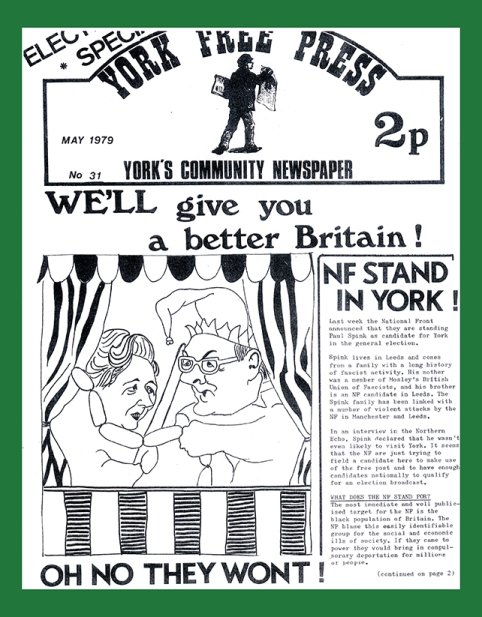
Cover of York Free Press, Issue 31, May 1979. Cartoon of Thatcher and Callaghan as Punch and Judy. Article about National Front standing for election in York.
York Free Press No.31, 1979 (C.Draper)

THAT was my introduction to “York Free Press”, one of the best and most enduring of the “alternative newspapers” that for a decade or two enlivened Britain’s culture and politics.
It was 1976 and I was an idealistic young teacher living and working in York and aggrieved at an article I’d read in a recent issue.  York’s selective school system was about to be “comprehensively” reorganised but the YFP article argued for incorporating six-form colleges which I considered a device for keeping an A-Level elite away from less academic plebs. YFP claimed to be open to everyone and advertised weekly meetings upstairs in the Lowther on King’s Staith so I turned up one evening expecting a row and instead was welcomed in and invited to write a rejoinder.  I was utterly disarmed, it wouldn’t happen at Socialist Worker!  I was already a libertarian socialist but this bunch of scruffy student hippies turned me 100% anarchist and so I’ve remained.

Actually they weren’t all scruffy hippies,  Vaughn Harvey was but Tony Zurbrugg (who now runs Merlin Press) was already a serious-minded libertarian-communist permanently clad in an RAF greatcoat, Danae and Howard Clarke (later of “War Resisters International”) were smart-casual and always smiling, Danny Golding “The Ayatollah” (nowadays Labour loyalist) was too humourless to qualify as a real hippy but there was always a supporting cast of “occasionals” who couldn’t be asked to turn up every week.   That was an attractive feature of YFP, you helped at whatever level you felt comfortable with.  Most political groups demand so much that they retain only fanatics.  YFP enjoyed regular “bring food and drink to share” socials so less active supporters kept in touch and made friends with regular “collectivists”.

Around 1978 we organised a national 'PAPERS EVERYWHERE!' conference-jamboree weekend at York University.  We invited every community paper we could think of and people from about eighty titles turned up.  It was wonderful exchanging papers, experiences, ideas and what little technical expertise we’d acquired. I was especially impressed by a rather posh Sheffield guy who single-handed ran The Totley Independent, which he gave away free and financed by taking ads from small shops and tradesmen.  He stuck out like a sore thumb amongst an array of vaguely alternative-socialists but was content to paddle his own canoe.  It showed the potential of the format.  Some titles such as Islington Gutter Press and Rochdale Alternative Paper (RAP), which I believe sold 8,000 copies per issue, were real big hitters whilst others, like the Totley,were happy to nurture community spirit and less intent on exposing scandal and corruption.  RAP revealed Cyril Smith’s dirty deeds forty years before the commercial press dared touch the story.

I think two things sparked the birth of the alternative press, the “swinging sixties” do-it-yourself politics and certain technical developments in printing.  Lead-typesetting was no longer involved and the new process required less skill and cost.  Like other papers, at YFP we used ordinary typewriters to produce the text and trimmed, then glued the result to a large sheet of cartridge paper.  Other articles were stuck alongside the first to build up a newspaper page with spaces left for photographs which had to be “screened” and treated separately. Headlines were the real pain – LETRASET!

Headlines were produced by a sort of transfer process.  You bought these rather expensive “Letraset” transparent plastic sheets with individual black letters affixed to the undersides.  By scribbling on top of the required letter it detached from the sheet and adhered to the paper placed underneath  You had to build the headline a letter at a time, any misspelling meant you must discard your first effort and start all over again and keeping it all level and evenly spaced was a tedious task.  Sometimes we had lots of tables and space to lay out the paper but often we managed in someone’s cramped bedroom with people coming and going and ideas, jokes and arguments flying back and forth.

YFP was a monthly with a price of 2p and 1,000 print run, sold door to door with a network of local shops selling on the basis of sale or return. It was a struggle to keep it going but the paper survived long after I left York.  I was always a bit of a populist, keen to present the politics in an attractive wrapping and my favourite all-time article was, “The Great York Fish and Chip Survey!”   Every Thursday for three months we’d sample 3 or 4 different local chip shops, weigh the portion of chips and the fish and then assess the price, quality etc.  Finally we tabulated the results and published a league table to great reader acclaim! Is that petit bourgeois politics or anarchy in action? Every article was subject to the deepest of political analysis – “Is it ideologically sound?” – was the inevitable dilemma.

The balance of collective responsibility and initial initiative at YFP remained problematic.  When a character calling himself “Euston Arch” joined us he immediately began arranging music events in the name of YFP and only afterwards seeking collective approval.  When he signed us up to a potentially disastrous gig featuring “Wayne County and the Electric Chairs” at the Mecca Ballroom we accepted responsibility and survived but immediately expelled him from the collective.  After we printed a story by a guy who told us he was literally kicked out of his York bedsit by the landlord as a uniformed policeman stood idly by (illustrated by a cartoon of a cop shielding his eyes) I received a threat to sue from The Police Federation (my address, 1 Newton Terrace, was the published editorial address).  We agonised whether to apologise and “correct” the story or stand firm and take the consequences.  Fortunately, within days the local straight press published an account of the same landlord doing the same thing to someone else so we lived to fight another day.

Anarchism rather than socialism characterised the alternative papers movement.  Although lots of Marxists were individually supportive they tended to regard papers like YFP as trivial compared to their party newspapers whilst Tories and Labour Party types regarded us as scurrilous troublemakers. Although I wanted the paper to become a sort of local Private Eye, both funny and muck-raking, whilst at YFP I established an abiding interest in researching radical history. I interviewed a founder member of York Communist Party who claimed workers were more interested in politics in the old days and all he had to do in the twenties was ride his bike along a road, ring a hand-bell and people would come out of their houses and he’d start an impromptu discussion on socialism. He described how difficult it was to keep up with the ever-changing political line emanating from Moscow and how he’d finally been expelled from the CP when “I zigged when I should have zagged”!

In 1979 I researched and YFP published a series of articles on “Fascism in York in the 1930’s” which revealed a continuity of not only Blackshirtideas with current National Front candidates but the same local families were still organising attacks on socialist opponents. There were so many good stories and so many great times and in 1980 I was sorry to leave but keen to start another scurrilous rag elsewhere, but that’s a story for another day…
********

Thursday, 7 February 2019

Dante's Inferno, Seumas Milne & Europe

by Brian Bamford 

'I've been wondering what that special place
in hell looks like, for those who promoted
Brexit, without even a sketch of a plan how
to carry it out safely.'  
                                      Donald Tusk.
***********
IN his book 'Movements in European History' [1921] D.H. Lawrence commenting on Dante and the Renaissance, wrote that in the time of Dante in the fifteenth century:
'Europe then was not like Europe now.  If a man were a Christian, all countries were his, for everywhere was the one Church of which he was a son.... What did it matter if a man were English or French or Spanish?  He was a European, a member of Christendom.  He travelled along the roads where all travelled, and on the full high-road every European was at home.... So the student leaving Italy would calmly take the great north road, to come home through the Alps to Germany, walking often on foot without any fears....  Nobody asked if he were English or Irish or German or Italian.  He spoke in Latin to the monks and was received as one of themselves.'

Similarly, A.J.P. Taylor began his book 'English History 1914-19145':
'UNTIL August 1914 a sensible, law-abiding Englishman could pass through life and hardly notice the existence of the state, beyond the post office and the policeman.  He could  live where he liked and as he liked... He could travel abroad or leave his country for ever without a passport or any sort of official permission.'  


Dante et Virgile  Capocchio, an alchemist, attacked by Gianni Schicchi, 
who impersonated the dead Buoso Donati to claim his inheritance, 
*******
In a way the European Union in the 20th century was an attempt to recover this lost world of the yesterday.  Perhaps it was a vain expectation given that since the First World War and the horrors that followed it, so many of us have now become hooked on the nation state.  There is not that many men like Dante knocking around these days or even a George Orwell, who may yearn to understand the bigger picture with a geo-political vision.

Instead today we're blessed with the likes of Chris Draper and Seamus Milne.  This week in Private Eye 'Ratbiter' pointed out that 'Any young supporter who voted Labour in the belief that the party was pro-European should have watched as their leader Jeremy Corbyn took his strategy and communications director Seumas Milne to an emergency Brexit meeting with Theresa May last week.'

Comrade Milne it turns out  'has opposed the EU as intensely as Tory Brexiteers Jacob Rees-Mogg and Boris Johnson-but for much longer'.  As a schoolboy Comrade Milne wrote a manifesto as a Maoist candidate in a mock election at Winchester College in 1974:  'We would withdraw from NATO and the EEC; that was a year after the UK joined the European Economic Community, as it was then called.'

'Ratbiter' in Private Eye claims that the schoolboy Comrade Milne of 1974 soon swapped his loyalties from Mao to Stalin, and when the Berlin Wall came down in 1989, Seamus switched his passions from Soviet communism to what 'Ratbiter' now calls 'the Russian gangster regime that succeeded it'.  Private Eye notes that Jeremy Corbyn took this public schoolboy Comrade Milne to meet with Theresa May rather than his Brexit Secretary, Keir Starmer. 

D.H. Lawrence in his work 'Movements in European History' writes that '[p]erhaps the most wonderful century in all our Europe's two thousand years is the fifteenth century. .. Then lived the greatest painters, great poets, great architects, sculptors, scientists and men of learning, such had not been seen before.'

Following the First World War the nation state with its frontiers and tariffs came to dominate the culture of Europe with what Benedict Anderson has called 'Imagined Communities'.  Then came the glorification of the nation state which ended up with the Second World War and the Cold War.

*************