Showing posts with label shaun greenhalgh. Show all posts

Sunday, 6 October 2019

Forger Shaun Greenhalgh gives interview at Bolton Museum

 By Saiqa Chaudhari Education Reporter
HE fooled the world's art experts with his incredible talent and gained international notoriety after it was revealed an "Egyptian Relic" he sold to Bolton Museum was a fake ­— created in a garden shed.
Now master forger Sean Greenhalgh is returning to Bolton Museum for a rare public interview to coincide with the airing of a new BBC series.

Mr Greenhalgh said: "Bolton Museum is the place that inspired my love and interest in art.
“I am sorry for what I did and so grateful for this opportunity to give something back.
“I hope the pieces I have made will bring in even more people to my hometown museum, which is a fantastic place that everyone should come and visit." 

He will be talking exclusively to Museum Collections Manager Sam Elliott about his past ­— which led to him being locked up ­— and forthcoming BBC Four series "Handmade in Bolton".

He created four historical objects for the programme using traditional methods and materials.
All four items ­— a jewelled eagle brooch, an alabaster carving, a ceramic plate, and a rock crystal bottle ­— will be on display in Bolton Museum’s foyer from October 7.

It is only the third time Mr Greenhalgh has set foot inside the museum, following his release from prison in 2010.

He created several hundred forgeries, which were sold to many museums as well as royalty and even an American president.

Among his forgeries was the infamous ‘Amarna Princess’, which was acquired by Bolton Council for £440,000. A British Museum report authenticated the figure as 3,300 years old.

In July this year, Mr Greenhalgh visited the museum with a film crew and director Waldemar Janusczak to get inspiration for the ceramic plate he was making for the BBC show.

The BBC Four series will air October 7, 9, 10, and 13 at 7.30pm.

Mr Greenhalgh’s question and answer session will take place on Friday, October 11 from 7pm to 8.30pm, in Bolton Library.

Tickets for the interview are £5 and all proceeds will go to the Mayor’s charities.

To reserve a seat visit https://shaungreenhalgh.eventbrite.co.uk or book in at Bolton Central Library. Places are limited.

Mr Greenhalgh will also be signing copies of his book, A Forger’s Tale: Confessions of the Bolton Forger, which will be available to purchase after the interview.

******************

Monday, 20 February 2017

Bids for Shaun Greenhalgh art hit record on day

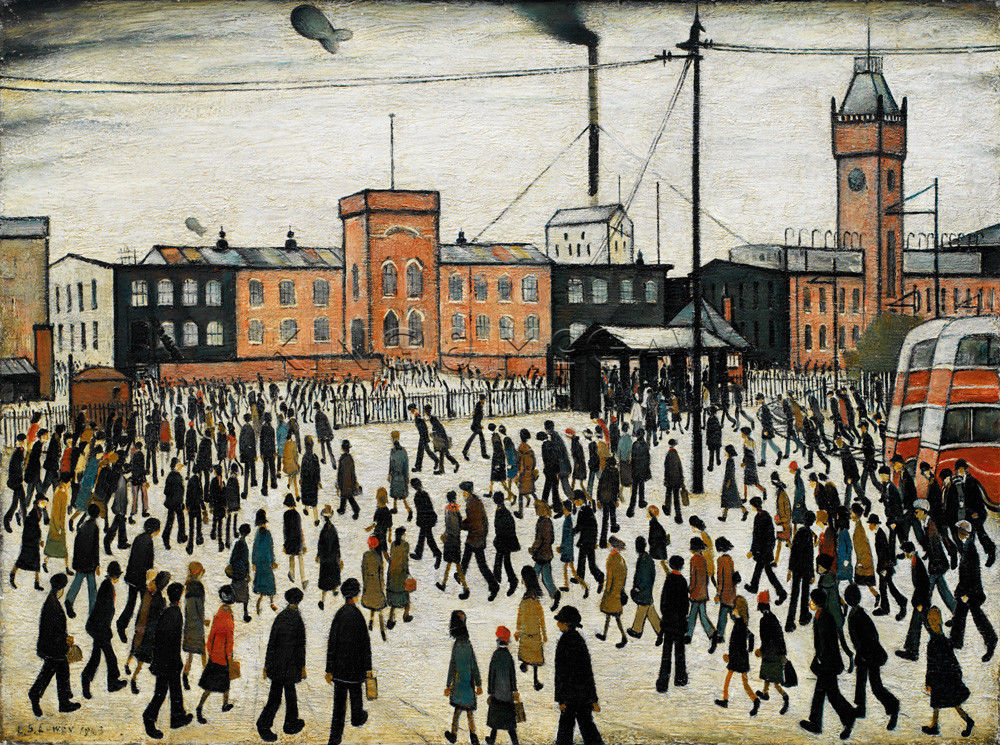
'Going to work' (1925) by L.S.Lowry
THREE paintings in the style of Lawrence Stephen Lowry by the Bolton artist Shaun Greehalgh, beat their reserve prices when they went on sale at the Bolton Auction Rooms today.  People at the auction rooms reported that the pictures were bought after a bitter series of telephone bids came in.
The reserve prices in the auction house catalogue was given as £1,000-£2,000 in the case of each painting.
On the day, a spkesman for the auction house told Northern Voices that one of the paintings went for £5,700, and the other two went for £5,100.
Shaun Greenhalgh was born in 1961, and became famous after the British Museum examined some of his work before two of his reliefs were submitted to Bonhams auction auction house in 2005, its antiquities consultant Richard Falkiner spotted 'an obvious fake'.  Then Bonhams consulted with the British Museum about various suspicious aspects, and the Museum then spotted several unlikely anomalies.
The Greenhalgh's family became known as the 'the garden shed gang'.  They built up an elaborate cottage industry at Shaun's parents' house in The Crescent, Bromley Cross, South Turton, which is  north of Bolton town centre.[
Shaun Greenhalgh had left school at 16 with no qualifications.   A self-taught artist, he had been influenced by his job as an antiques dealer, he worked up his forgeries from sketches, photographs, art books and catalogues.  He attempted a wide range of crafts, from painting in pastels and watercolours, to sketches, and sculpture, both modern and ancient, busts and statues, to bas-relief and metalwork.  He invested in a vast range of different materials - silver, stone, marble, rare stone, replica metal, and glass.  He also did meticulous research to authenticate his items with histories and provenance (for instance, faking letters from the supposed artists) in order to demonstrate his ownership.  Completed items were then stored about the house and garden shed. The latter probably served as a workshop as well.
Shaun's father, George Greenhalgh, who fronted as the sales operation of the fakes – produced by Shaun, died in October 2014 at the age of 91.
Since his Dad died, Shaun Greenhalgh has produced several paintings in the style of Lowry which went on sale in Bolton today, and bringing more than double their reserve price.
The three successful pictures at the auction included 'Going to work'; 'Coming from the mill'; and 'Before kick off', all framed oil on canvas after L.S.Lowry, and painted by Shaun Greenhalgh in 2015.


Friday, 29 April 2011

NEW FAKES IN BOLTON EXHIBITION

FAKE WORKS created in the style of famous artists Banksy and Tracey Emin will feature in a prestigious exhibition at Bolton Museum. These previously unseen pieces will form part of the Fakes and Forgeries exhibition, which opened at the museum on Saturday, April 16 and will continue till July.

The exhibition, which was created by the Metropolitan Police Service’s Art and Antiques Unit, also includes the Amarna Princess statue crafted by convicted Bolton forger Shaun Greenhalgh. The Amarna will form the centrepiece of the exhibition, which was launched at the Victoria and Albert Museum (V&A) in January last year.

There will be a reconstruction of Shaun Greenhalgh’s garden shed – where he made his forgeries – and a collection of his other works, such as the Risley Park Lanx, Barbara Hepworth’s Goose, and Thomas Moran paintings. Other objects on display will include fake antiquities by John Andrews and forged silverware by Peter Ashley Russell, paintings by renowned forgers John Myatt and Robert Thwaites.

Robert Thwaites, a forger who made more than £120,000 from the sale of two fake paintings, was jailed for two years in September 2006. Thwaites tricked Antiques Roadshow art expert Rupert Maas into paying £20,000 for one of his copies. London gallery owner Maas sold on The Miser purported to be by John Anster Fitzgerald for a profit of 300%. Thwaites, from Leek, Staffs, made more than £100,000 from another Fitzgerald fake called 'Going To The Masked Ball'.

Since appearing at the V&A, the Art and Antiques Unit have introduced some Tracey Emin fakes by Jonathan Rayfern and added some different Banksy fakes. Jonathan Rayfern, a 32 year-old ex-art student from Manchester was sentenced to 16 months at the Manchester Crown Court last October. He had sold at least 11 fakes on Ebay including sketches on fabric and a pencil drawing and made about £26,000. Ten items had been sold to a Gallery owner in Warwick. In his defence he said that he had been trying to pay off loan sharks. Commenting on the Rayfern case at the time the 'artist' Tracy Emin said: 'My artwork is deeply personal and comes from my heart. It hurts and distresses me to see these fakes and forgeries that have no regard, respect or understanding of what I do.'

The free exhibition will appear at Bolton Museum until Saturday, July 2.

Estimating the chances of buying a forgery:

· Thomas Hoving, former director of the Metropolitan Museum of Art in New York, has estimated that up to 40% of the art market is comprised of some type of forged art.

· It has been suggested that only half of the 600 works supposedly painted by Rembrandt are genuine and as many as 10% of modern French paintings may be forgeries.

· The 20th century's most famous forger was Han van Meegeren, confessed in 1945 to having forged several Vermeers, including The Supper at Emmaus, which scholars had proclaimed a masterpiece.

· In the 1980s and 1990s, British forger John Myatt infiltrated the art market with fake Giacomettis, Ben Nicholsons and Graham Sutherlands.

· In the late 1980s, Eric Hebborn claimed he faked and sold more than 1,000 old-master drawings to institutions including the British Library.

Copies of Northern Voices 10 with our report on the Bolton forger Shaun Greenhalgh from Bromley Cross is still available. To obtain a copy send a cheque for £2.20 payable to 'Northern Voices' to: 52, Todmorden Road, Burnley, Lancashire BB10 4AH.

Wednesday, 20 April 2011

ART WORLD AGONIES IN BOLTON & PARIS

From the Garden Shed Gang in Bromley Cross to a Jewish Dynasty on the Parisian Right Bank

IS NO-ONE safe to speculate on the art market anymore? Only last Friday we had Detective Constable Lawson of the London Metropolitan Police Arts & Antiquities Unit, preaching in the Bolton Museum to a packed auditorium about the need to protect the British art market from the likes of forgers like Shaun Greenhalgh and his family, but today it is France that's in the news with reports of a police raid last January on the posh art research building of the Wildenstein Institute on the Paris Right Bank. The International Herald Tribune reports today: 'It was third police raid on the institute, and at the end of it, the investigators carried away armloads of art, including Degas drawing, a bronze sculpture by Rembrandt Bugatti and an Impressionist painting of a Norman cottage by Berthe Morisot.' It seems they had all been reported missing or stolen,some by Jewish families whose property was looted by the Nazis, and others by heirs who claimed that valuable stuff had 'walked' during settlement of their family estates.

In all about 30 works have been seized by the French police and it focuses an awkward floodlight on the Wildenstein clan: one of the most famous French Jewish families of art dealers going back generations. They are perhaps the most illustrious and trusted dealers in the international art world. Now the family is confronted with six civil cases against it by aggrieved families who insist their artwork has been stolen plus allegations of money-laundering and tax evasion under the criminal law now being pursued by French anti-fraud investigators.

In the 1990s, a writer Hector Feliciano produced a book, 'The Lost Museum: The Nazi Conspiracy to Steal the World's Greatest Works of Art', suggesting that in World War II, Georges Wildenstein worked with a Nazi big wig art dealer, Karl Haberstock, who bought and sold art plundered from Jews. The Wildenstein family took out a libel suit that failed in the Courts saying the Feliciano had not been irresponsible or negligent in his conclusion based on the records, but the finding declined to decide one way or the other whether Mr. Wildenstein had actually done business with the Nazis.

The story in today's International Herald Tribune suggests that for all their wealth and catergoria that the Wildenstein family is less noble that the Greenhalgh's up Bromley Cross in Bolton. The Greenhalgh swindle was a talented cottage industry of art fraud that probably netted less than £1 million and was mostly damaging to the reputations of the art experts at the British Museum who authenticated Shaun Greenhalgh's creations. Most of the proceeds were recovered by the police and relatively little had been spent by the family, although D.C. Lawson said last Friday that 'they had two new cars on the front drive and I have only got an 8 year-old jalopy'. It is claimed that Shaun intended to spend the money on providing for his mum and dad in their old age. The Wilderstein case is much more murky with Sylvia, the widow of Daniel Wildenstein the son of Georges, taking out a lawsuit against her step-sons, Guy and Alec, 2 weeks after her husband's funeral in 2001. She claimed that they had convinced her that her husband had died bankrupt and that if she didn't renounce her inheritance rights that she faced a huge tax burden. The French Courts restored her rights as an heir in 2005, in what the Herald Tribune calls 'a scathing decision, ordering her step-sons to pay her 20 million euros as an advance on a fortune variously estimated between 43 million euros and 4 billion euros.' The Court noted that a fragile Mrs. Wildenstein had been the 'victim of a calculated error' to 'induce her to renounce her husband's estate.'

While the Greenhalgh family in Bolton seem blissfully unaware of the popular support that they have generated for themselves and hide away from publicity, the stepson Guy Wildenstein hobnobs with President Sarkozy's Popular Movement Party, which he backs as a major donor and fund raiser. Hence, the French press fear that their Government is dragging its feet, and with the 10-year statute of limitation on tax evasion running out in December this year and the Budget Ministry now declining to say if an inquiry is underway, it seems that Guy Wildenstein and his brother Alec may not suffer the same fate as Shaun Greenhalgh.

Saturday, 16 April 2011

Expert Incompetence, Incompetent expertise

NORTHERNERS CROSS EXAMINE DETECTIVE LAWSON

DETECTIVE CONSTABLE Lawson, from the Metropolitan Police Arts & Antiquities Unit, stood his ground last night against a torrent of questions at a packed meeting of northerners at Bolton Museum & Art Gallery, dealing with the role of fakes and frauds in British art. Little old ladies from Bolton and beyond suddenly came to resemble Madame Defarge brandishing knitting needles as they pieced the smug, dissembling front of D.C. Lawson as he did his best to uphold the integrity of the London art establishment faced with the Greenhalgh trio's perpetuation of one of the most cheeky frauds in history. For 17 years the genius of Shaun and George Greenhalgh, from their Bromley Cross council house in Bolton, had undermined a pompous southern elite of 'experts' until in 2007, when they were convicted. Shaun Greenhalgh was sentenced to 4 years and 8 months, and his dad to a suspended sentence. Shaun was released from Preston Prison in March 2010 and returned to his dad's house on The Crescent in Bromley Cross, Bolton. Last night, one wag told me that he may now be in Amsterdam: presumably studying the Dutch School of Art.

Earlier at a preview of the exhibition, visitors who paid £5 apiece, had seen the case for the defence of the art expert represented on a notice thus: 'Features fraudulent artworks from real crime cases, this display shows how successful forgeries find a place in the art market, not because of the incompetence of the expert, but because of the changing strategies of the criminal.'

Above all, it seems, the London art market must be protected from the likes of Shaun Greenhalgh, and his Dad and Mum. Another notice declares that in Section 1 of the exhibition we must 'consider the nature of this crime on the London art market', and we learn that the other four Sections 'explore the extreme lengths fraudsters go in order to fool the (poor) experts'.

In a powerpoint presentation D.C. Lawson did his level best to side step and gloss over the embarrassment of the Art Capital's feeble handling of the Greenhalgh case; with a flourish he explained his part as a member of the Arts & Antiquities Unit saying: 'Our primary role is to protect the London art market' because fakes, like those of the Greenhalgh's, 'Do damage to the (art) institutions and experts who have been deceived.' The 'experts' and their 'expertise' must not be offended, particularly by northern folk working in their garden sheds. We must, said police officer Lawson, realise that with the credit crunch, declining property prices and uncertainty in the stock market, that pension funds (where the poor have their money as well as the rich) and other investors invest in the art market. Thus art becomes a defensive stock just like gold and commodities.

It was a fascinating presentation attended by big-wigs from down South as well as locals like us. D.C. Lawson had folk laughing from time to time and his talk brought up some serious issues. 'Who unmasked Shaun Greenhalgh?', asked one lady. 'It was the experts at the British Museum; they spotted a small spelling mistake in Shaun's work (on the Assyrian relief)', exclaimed D.C. Lawson. I interrupted: 'But this was not the case - it was not the British Museum who discovered the error - they repeatably authenticated Shaun's work; it was a specialist at Bonham's Art Auction House.' No doubt the British Museum and its director, Neil McGregor, had sent the Assyrian relief to Bonham's for a valuation so as to gloat over how good a bargain they had got out of stupid George Greenhalgh. D.C. Lawson never answered these questions preferring to assert: 'I don't support people who defraud other people.'

Another lady asked: 'Why don't you legitimise Shaun Greenhalgh, because I would be willing to pay money for his work?' Again no proper answer came back. Nor did the lady who asked if the London Metropolitan Police would be willing to donate the Amarna Princess statue to Bolton Museum. No joy again from D.C. Lawson!

Shaun Greenhalgh is undoubtedly a man of many talents and even the London Arts & Antiquities Unit admit that he is the most 'diverse forger' they have ever encountered: most forgers specialising in one artist, a narrow area or genre. But, as I pointed out he is the only one that is not making anything out of this work. The London Metropolitan Police are using it, as have the dramatists on TV who have made films of the 'Artful Codgers', the educationalists are using it to show how deceptions are committed on the art market but not Shaun Greenhalgh who produced it. It seems ironic that those propping up the art market and creating art as a commodity should benefit while the humble producer of the works is left to fend for himself. As I came away people snapped up Northern Voices 10 with our Greenhalgh editorial in it, one man said 'To me Greenhalgh is a hero!'

Thursday, 31 March 2011

Bolton Forger's Masterpiece on Show next month up North

ART FORGER Shaun Greenhalgh's Amarna Princess will be displayed in an exhibition at Bolton Museum on April 15th, as part of what the staff have entitled 'Fakes & Forgeries'. A neighbour of Shaun Greenhalgh on The Crescent, Bromley Cross, Bolton said it should have been entitled 'How He Foxed them All'. Last November Councillor Elain Sherrington, Executive Member of Adult Services in Bolton told the Bolton News: 'We are delighted to be chosen as the first venue outside London to host this prestigious exhibition.'

Yesterday one of the Metropolitan Police's art & antique unit's former officers involved in the Greenhalgh case in 2007 featured on Radio 4's Midweek program. In it he appeared to claim that the British Museum experts had discovered the fake in the characters on the Assyrian relief by Shaun Greenhalgh, but this was not the case: those experts and many other London experts were fooled by most of the work including the fake Amarna Princess. When Shaun's father presented what were purportedly three Assyrian reliefs of soldier and horses, from the Palace of Sennacherib in 600 BC to the British Museum in 2005 the experts there concluded they were genuine and were interested in buying them as they seemed to match a drawing by L.H> Layard in its collection. It was only later when Bonhams auction house antiquities consultant, Richard Falkiner spied what to him was 'an obvious fake' and informed the British Museum that some odd aspects were noticed. After that it took the Arts & Antiquities Unit at Scotland Yard 18 months to get round to arresting the Greenhalgh family.

Now Councillor Sherrington is anxious not to condone the criminal activity and she says: 'This exhibition educates the public about forgers, explains the techniques they used and how they were caught by the authorities and, rather than glamorising crime, will hopefully show that even the most artful of forgers is eventually brought to justice.' Amen!

To Northern Voices, the Greenhalgh case shows up the pompous folly of all those Metropolitan experts who were foxed by the northern Greenhalgh family. The case offers a dire warning to all those who put their faith in experts and so-called authorities of all descriptions. The Amarna Princess was first put on display at Bolton Museum at an exhibition opened by the Queen, and Shaun's father George was there for media photos. At next month's exhibition Detective Constable Ian Lawson, from the Metropolitan Police's Art & Antiquities Unit, will be giving a forgery talk in the museum's lecture theatre:; Tickets are £5 and include a preview of the exhibition.