Showing posts with label PSOE. Show all posts

Saturday, 16 May 2020

Revolt of 1% against Spanish covid-19 ‘oppression’

RESIDENTS of Madrid’s upscale Salamanca neighborhood have been making headlines since Sunday with a series of street protests against the government over its handling of the coronavirus crisis.

Demonstrators have been using the words “dictatorial” and “oppression” to describe their situation under the ongoing lockdown.  Madrid, the epicenter of the coronavirus pandemic, is still in the early stages of a national deescalation plan that is expected to end in late June, if there are no new spikes in transmission.

The protests reflect a view, held by some in Spain, that the state of alarm introduced in mid-March to combat the coronavirus pandemic is really an excuse for the central government to grab extra powers.  Prime Minister Pedro Sánchez, of the Socialist Party (PSOE), heads a minority government and he has been facing growing difficulty to secure enough congressional support for back-to-back extensions to the state of alarm.
The sentiment mirrors similar feelings elsewhere in Europe, where protesters from across the political spectrum are beginning to demonstrate against prolonged confinement measures (see box below).  A recent report by Spain’s Civil Guard underscores the risk of social unrest in Spain if confinement measures are prolonged.

On Wednesday, around 100 locals banged on pots and pans on Núñez de Balboa street, without respecting social distancing rules.  There were couples, families and people with dogs.  Some marched with face masks that had tiny Spanish flags embroidered on them; others waved enormous flags instead.  The demonstrators called for the government to resign.

“I pay my taxes and we have a government that is doing nothing,” said María Jesús, 56, who was out with her husband Rafael, 60, and their son Pelayo, 16. “That is why I am walking and protesting.  You see these gloves?  I paid for them myself. And this face mask? I’ve paid for it, too.”

“We’ve even had to pay for our own [coronavirus] test,” added her husband.  “It cost me €80”

Wealthiest 1%

The Salamanca district is named after a 19th-century marquis who was instrumental in the area’s development.  It is home to more than 150,000 people, including the wealthiest 1% in all of Spain and the wealthiest 3% in the Madrid region.  Household income here is an average €50,376, compared with €33,000 in the region and €28,417 in Spain.

Asun (“I won’t tell you my surname, and you never ask a woman about her age”) is a civil servant who has been protesting every day since Monday.   “You’d think we were criminals with so many police around. There is no freedom. You should publish that [Pablo] Echenique and several other podemitas live around here,eh?” she said, alluding to leading members of the leftist Unidas Podemos group, which is the junior partner in Spain’s coalition government.
“We are in a dictatorial system, and I know what I’m talking about,” said Magdalena, a local resident who works as a lawyer.  “They are applying a decree that bans our freedom.”

The demonstrations began on Sunday night.  Several residents say that a collective protest sprung up after several dozen youths gathered under the balcony of an apartment that was blaring out loud music.  Minutes later, a police van showed up and handed out fines to 12 members of the public for violating the lockdown rules.  Several residents criticized the police presence, crying out “Freedom!”

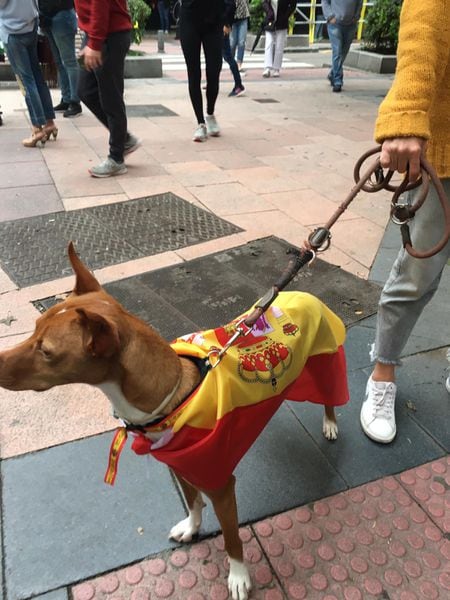
By Thursday, however, the street protests had all but disappeared, with just a few scattered people marching and chatting with reporters. One of them was Laura Domínguez, 39, whose dog Barri wore a Spanish flag as a cape.  “I am here because I am sick and tired,” said Domínguez, wearing a face mask and holding a cigarette.  “They’re creating a country of idlers.  And now they want to take everything away from me.”
Barri the dog wearing a Spanish flag.
Barri the dog wearing a Spanish flag.Manuel Viejo González
On Núñez de Balboa street, nearly 50% of residents voted for the conservative Popular Party (PP) at the last general election, held in November 2019, followed by the far-right Vox with 23%, the center-right Ciudadanos with 6.7%, and the Socialist Party (PSOE) with 5.4%. The leftist Más País and Unidas Podemos attracted less than 1% of the vote.
The regional premier of Madrid, Isabel Díaz Ayuso of the PP, has been encouraging these street demonstrations. “I hope people will go out on the street – the events of Núñez de Balboa are going to seem like a joke then,” she recently said. Meanwhile, Madrid Mayor José Luis Martínez Almeida, also of the PP, said this week that “as long as [safety] conditions are maintained, everyone is free to voice their opinion.”
Vox leader Santiago Abascal has been pushing for anti-government demonstrations and challenging authorities to ban them, arguing that this would prove that fundamental freedoms are being violated. At a recent session of Congress to extend the state of alarm, Abascal said that his party would apply for permission to hold demonstrations against the government on the streets of Spain’s main cities, but that in order to respect social-distancing measures, the protests would be held inside vehicles rather than on foot.

**************************************

Monday, 29 April 2019

Broken Politics on the Iberian Penisular

 by Brian Bamford
BROKEN-up politics has characterised Spain since the successful rise of Podemos and the Citizen's Ciudadanos party in the 2015 election.  After that the two-party system was over.  Now with the far right VOX party gaining 24 seats in yesterday's elections there is a real fragmentation in political life which mirrors events elsewhere in Europe.


This election came less than a year after Spain’s then prime minister, Mariano Rajoy, was defeated in a vote of no confidence owing to corruption in his Popular Party.  The leader of the socialist party (PSOE), Pedro Sanchez, then formed a minority government with the help of the Catalan separatists, leading his critics to accuse him of being too friendly with the independentistas.  
  
However, Sanchez was unable to hold this informal coalition together and last February he called a snap general election when he was unable to get a national budget through the Cortes parliament when the Catalan nationalists witheld their support owing to the problems over Catalan independence.

The issues of independence, identity and Spanish unity flavoured the election.  And yet, the most significant consequence of these elections was the fragmentation of the right and the centre right.  The most damaged party in these elections has been the conservative Popular Party, which has lost votes to both the far Right VOX and the more centrist Ciudadanos Citizen's party.


  Catalan Independence

The Catalan independence conflict originally came to a crisis in October 2017 when the Catalan separatists held an unconstitutional independence referendum, which drew 40% of eligible voters but saw a 90% vote to secede.  Three weeks later, Carles Puigdemont, the region’s president at the time, declared independence — leading to Spain’s deepest constitutional crisis since its return to democracy.

As a result, the Spanish government, then led by the Popular Party, fired the Catalan parliament, wrested control of the region, began arresting the movement’s leaders and called for fresh regional elections.

While separatists criticized the government for cracking down, some on the right argued the Popular Party was too soft on the independentistas.

Fragmentation of the Right

Consequently some Popular Party voters turned to VOX, which seeks to suppress regional autonomy in Catalonia.  A xenophobic party VOX echoes Franco’s nationalist rhetoric and follows the populist trend seen in recent years across Europe, stoking fear of immigrants and demonizing feminists.

On the other hand some other former Partido Popular voters seem to have drifted towards the centrist Citizen's Ciudadanos party.

The Catalan crisis and the rise of Vox have changed the debate in Spanish politics.
'This is not an election about the economy - a different situation from what we have seen in more than 20 years,' says Juan Rodríguez Teruel, professor of political science at the University of Valencia.

Despite widespread concerns about unemployment - which remains high in Spain compared with its European neighbours - it barely featured during the campaign and was raised during the debates only briefly

But Prof Teruel warns that the surge for Vox is coming at the expense of other right-leaning parties - the PP or Ciudadanos. And for the first time since the 1970s, the right is 'very fragmented' - something that could benefit opponents on the left.

'The main reason now to vote for the left-wing electorate is to avoid the potential coalition among right-wing parties,' Prof Teruel says. 
 
Ciudadanos, meanwhile, could feasibly support a coalition with the Socialists, despite publicly dismissing the idea.

'I'm not sure they could keep this position if the numbers give the potential of a coalition,' Prof Teruel says.

'The pressure on Ciudadanos will be very, very high.'

*********


Sunday, 5 November 2017

Reasons for the Catalan Crisis

'The elections in February [19]36 was celebrated with [the former Catalan President, Lluís] Companys* and his [Catalan] government [still] in prison, later what followed was the proclamation of the Catalan republic inside the federal Spanish republic.  Then with the victory of the Popular Front [parties] came amnesty [for Companys and the other Catalan politicians].  How it is that history repeats itself, unfortunately with other parameters, but without gun shots, physical violence, and despite the social break (the catalan society is divided in two parts)" '
Carlos Beltran:  former representative in the Madrid CGT / CNT 

GERALD Brenan, the anthropologist and historian (who lived in Spain from 1919 until his death in 1987), in his book 'The Spanish Labyrinth' (1962) wrote:
'Both linguistically and culturally Catalonia was originally an extension of the south of France rather than a part of Spain and, under the rich merchant class which ruled it during the Middle Ages, it acquired an active, enterprising character and a European outlook very different from that of its semi-pastoral neighbours on the interior plateaux.'

More recently in 2006, after lengthy negotiations a Socialist PSOE government had agreed a Statute of Autonomy of Catalonia that devolved further powers to the Catalan region in 2006.

This statute was put to a vote in the Spanish and Catalan parliaments and it was endorsed in a referendum in Catalonia.  At that stage, support for Catalan independence stood at just 14 percent. The conservative People’s Party (PP), then in opposition, promised to reverse the statute unilaterally and took the issue to the Constitutional Court. In 2010, the court struck down a large part of the statute.  The response in Barcelona was a huge demonstration of more than a million people under the slogan  'We are a nation. We decide.'

The following year, Rajoy’s PP won an outright majority in the general election.

As a consequence, the Catalan government and its supporters were annoyed and attempted to negotiate with Rajoy about what should happen next.  Rajoy refused to engage.  The results were to drive up support for independence, increased success for separatist parties in regional elections, the first of a series of attempts to hold a referendum on independence, and the replacement of the Catalan government’s centrist leader Artur Mas by the more radical Carles Puigdemont.  Thus it was Rajoy and his refusal to negotiate that almost single-handedly brought about the election of a majority-separatist government in Catalonia in 2016.

Meanwhile, a Madrid judge has jailed eight MPs involved in the Catalan government that had declared independence.   


Now with television channels showing images of police vans with flashing blue lights said to be taking the former ministers to different prisons, Catalans took to the streets in anger and disbelief.
There were protests in front of the Catalan parliament in Barcelona, the regional capital, with police estimating a crowd of 20,000.  Others gathered outside town halls across the region including 8,000 people in both Girona and Tarragona.

Marta Rovira, a lawyer and Catalan separatist lawmaker, briefly broke down in tears as she spoke to reporters in Madrid after the announcement of the detentions.
'The Spanish state is a failed state, a state that has failed democratically," she said. "I'm convinced we won't surrender, we won't, we will fight until the end.'

Carles Puigdemont, the fugitive former president of Catalonia, on Sunday handed himself over to Belgian police before a European arrest warrant invoked by a Spanish judge triggered his capture and detention.

Today, the Belgian vice-premier and interior minister stated that Madrid had overreacted and all efforts must be made to ensure that Mr Puigdemont and his colleagues get a fair trial if he is returned to Spain. Jan Jambon, who criticised the “silence” of the European Union on the issue, said:  'I am just questioning how a European Union member state can go this far and I am asking myself whether Europe is to have an opinion on this.'

*   Lluís Companys i Jover (Catalan pronunciation: [ʎuˈis kumˈpaɲs]; 21 June 1882 – 15 October 1940) was a leftist politician. He was the President of Catalonia (Spain), from 1934 and during the Spanish Civil War.
He was a lawyer and leader of the Republican Left of Catalonia (ERC) political party. Exiled after the war, he was captured and handed over by the Nazi secret police, the Gestapo, to the Spanish State of Francisco Franco, who had him executed by firing squad in 1940. Companys is the only incumbent democratically elected president in European history to have been executed.[3][4] [5]
*******

Sunday, 1 October 2017

Podemos, Catalonia, & Spanish labour

The left and self-determination
  Excerpt from 'INTERNATIONAL SOCIALISM' Issue: 155 
Posted on 29th June 2017 Héctor Sierra
PODERMOS and IU have refused to lend their support to the pro-independence majority.  They have argued that CiU waves the flag of independence to divert attention from its own role in implementing cuts and have accused CUP and ERC of helping whitewash its neoliberal record.  But CiU never really supported independence, embracing the cause only when it saw it was unstoppable.  And no one has done as much to unmask their responsibility for austerity in Catalonia as the CUP’s militants.
The current attitude towards self-determination by parties such as Podemos and IU has been typical of the Spanish left at crucial points in the country’s history.  Both the Communist Party (closely tied to the Soviet Union) during the Civil War (1936-9), and the Eurocommunist current during the transition to democracy, were dismissive of the nationalist movements, when not openly conceding to Spanish chauvinism.
IU claims to be interested not in any national struggle, but in the social struggle, missing the point that Catalan independence is interlinked with the most radical demands of society.  They pose as internationalists, but Catalan and Spanish nationalism cannot be equated. Spanish chauvinism is an ideology pumped out from the top of society, whose core components were devised by the Catholic Church and the fascist regime over 40 years and which today remains in the hands of the state.  What is commonly branded as Catalan (or Basque) nationalism is a much more complex affair, and does not lie firmly in the grip of the Catalan bourgeoisie.  Independence means different things for the different classes supporting it.  For instance, former Catalan president Artur Mas said in a visit to the US that an independent Catalonia would remain loyal to Nato—but among working class people there is a broad consensus that the country would not have an army.
Refusal to back independence has also been justified on the grounds that it weakens the unity of the Spanish working class.  But, while there have been repeated attempts to divide Spanish and Catalan workers, they have come from politicians and the media, not from below.  In fact, the national minorities are a ruling class’s recurrent scapegoat when it comes to diverting attention from issues such as austerity or corruption.  The way to achieve unity among workers is precisely through supporting the rights of Catalans and Basques, continuously under attack, and challenging scapegoating, something the Spanish left has largely failed to do.
Podemos’s talk of a multinational state, inspired by Errejón’s study of Bolivian politics, was refreshing at first. Iglesias and Errejón tried to appeal to left voters in Catalonia and the Basque Country by arguing that Podemos would bring about the democratisation of the Spanish state that would make possible a recognition of their national rights.  But while paying lip service to self-determination, in practice they have proved unable even to lend support to non-binding municipal initiatives for the democratic right to a referendum.  More recently, Iglesias has proposed a status of shared sovereignty as an alternative to independence.  This, of course, presupposes and is reliant on an eventual Podemos-led government.  Unlike these abstract prospect, the possibility of independence exists now and is within reach.
There is nothing inherent in the Catalan working class that makes it more left-wing than that of the rest of the state, and arguments of that kind should be challenged as they foster illusions about the viability of socialism developing within the limits of a single country.  An independent Catalonia could well end up being another capitalist state, controlled by its national bourgeoisie that goes on exploiting workers.  But there was nothing inevitable about Catalan society shifting to the left because of plummeting living standards. It has been the leading role of the Catalan left, along with the systematic work of the anti-fascist platform Unitat Contra el Feixisme (UCFR) in preventing fascist groups from tapping into the mood, that has ensured this was the case.  The same remains true when it comes to fighting for independence and defining its content.
The unmissable fact is that right now the left in Catalonia has a much more advantageous balance of forces than in the rest of the state, and levels of class confidence and consciousness are higher there—which is not to say that they cannot develop to the same extent everywhere else. Indeed, ensuring a victory for the Catalan left could be the way to achieve this goal.
The damage to the Spanish ruling class that the loss of Catalonia would cause is unimaginable; Catalonia makes a large contribution to the state’s revenues, with 18.8 percent of national GDP.  The centrality of national unity to the dominant ideology of the ruling class would also turn the event into a political earthquake.  A victory for independence would thus precipitate a crisis of unforeseeable consequences, throwing into chaos not only the PP but Spanish capitalism as a whole.
Socialism can only be achieved internationally, but by opening new prospects for the left in Catalonia and by breaking the consensus imposed by fascism in the transition to democracy, Catalan independence would advance the cause of the entire working class.  And, if a triumph of the Catalan left would be a positive development for workers in the rest of the state, what would the consequences of its defeat be?
Due to the need to look strong and stable, and the pressure exerted by the Spanish nationalist lobby, the PP has refused to negotiate with the Catalan parliament.  The pro-independence majority has pledged to organise a referendum on 1 October but all the calls on the central government to cooperate have fallen on deaf ears.  Likewise CiU and ERC have fruitlessly sought the intervention of the EU and third countries to lift the bar on a referendum.  The EU will not accept the unilateral separation of part of a member state, and the idea of being out of the EU sends shivers down the spine of CiU politicians.  As it becomes clearer that to go ahead with the referendum will involve an open confrontation with the Spanish state, and that they no longer control the process in motion, the risk exists that the Catalan bourgeoisie will instead try to strike a deal from above.  However, awareness that supporters of independence are running out of patience and will not accept more excuses complicates this.
Meanwhile, threats and attacks by the Spanish state have mounted. Individuals and associations have been brought to court for organising a non-binding referendum in 2014 that was ruled illegal. Activists of the CUP have also faced trial for burning pictures of the Spanish king at a public event. The main newspapers in Madrid and senior army officers have repeatedly asked the government to send the army in and suspend Catalan autonomy, as the constitution allows.
Only the CUP discounted from the beginning the possibility of an agreed referendum and has demanded the Catalan Parliament stop obeying laws coming from Madrid.  The work of activists in the CUP’s ranks and other left groups in the next months will be crucial to bring pressure from below to bear on the Catalan government.  A half-heartedly called referendum will give Rajoy the excuse he is awaiting to act.  An actual military intervention cannot be ruled out in the end. If this happened, nobody can seriously think that it would not be followed by an immediate clampdown on opposition everywhere else in the state and by new steps towards authoritarianism.  What the left does inside and outside Catalonia can prevent this scenario.  The leadership of Podemos and IU will act according to an electoral logic, but every activist, in these or other groups, who wants to challenge the system must actively support independence.  Solidarity with Catalonia can make a fundamental difference.
Conclusion: further destabilisation
It must not be forgotten that the PP is in office only because of the failure of all the other parties to form a government.  In the long run stability remains impossible and Rajoy does not rule out calling a new general election if the opposition PSOE, whose goodwill his government depends on, obstructs his work.
The PSOE say that they are the real opposition, not Podemos, while siding with the conservatives whenever stability is at stake. But they are deeply divided.  A managing board controlled the party for half a year after Sánchez’s removal, until in May a new leadership election took place.  Sánchez, although marginalised by the bureaucracy, stood again on an anti-Rajoy platform and beat Susana Díaz, the candidate of the establishment.  While this revived the talks of a hypothetical left coalition headed by PSOE and Podemos, the PSOE has since abstained in a motion of no confidence against Rajoy put forward by Podemos in June. It is uncertain to what extent the PSOE, still a pillar of the system, can be moved leftwards.  Nevertheless, the rebellion that has brought Sánchez back to power has exposed the noncomformity of a majority of the membership.
More importantly, the PP might have been able to mitigate the effects of the economic crisis temporarily, but the structural problems that brought the Spanish economy to its knees when the financial bubble burst remain untouched.  Investing in property and other forms of fictitious capital are still an important part of the economy, while productive investment and profitability remain low. This makes the Spanish economy extremely vulnerable to any upheaval in international markets in coming years.
Corruption remains rampant.  Hardly a week goes by without new scandals involving PP members coming to light.  While Rajoy has so far dodged any investigations, he is due to testify in court as a witness in relation to inquiries into senior party members close to him.  The Prosecutor’s Office for corruption is tightly controlled by the conservatives, so many cases do not lead to prison sentences, but corruption is an issue with the potential to unite people from all walks of life against the government.
As the dockers have shown, austerity can be fought.  The labour reforms can be repealed.  The Gag Law can be resisted. Rajoy’s government is weak and it can be brought down before 2020.
On the way to this goal, Podemos, IU and the unions are travelling companions, but the initiative must not be abandoned to their leaders.  If the left stands another chance to form a government, this should be welcomed and supported, without abandoning the critique of reformism or the building of a revolutionary party and without allowing mobilisation to decline again.
In making all this possible, the key issue that can alter the balance of power, throwing the Spanish state’s rulers on the defensive, is Catalonia.
Héctor Sierra is a Spanish socialist based in London and a member of the SWP.

Friday, 7 October 2016

Enjoying a Government-free life in Spain


by Brian Bamford

SPAIN has not had an elected national government  for the last 291 days.  Being Spaniards this is seen as a rather good thing.  Félix Pastor told the New York Times that 'No government, no thieves'. Mr Pastor is a language teacher who echoes the view of many voters who are fed up with the corruption and other scandals that have been rooted in the administrations of both of the two previous governing parties:  PSOE (Socialist) and the Partido Popular (Conservative)..

Following the last two national general elections since last December, no party has won enough seats or been able to form a coalition with another party to establish a government.  Hence for the first time in four decades of democracy Spain has a caretaker government which has minimal and very limited powers. 

While in the UK Theresa May has just told the Conservative Conference in Birmingham that government can be good, in Spain the people cast a contemptuous eye over the scheming politicians.  Last Saturday, the Socialists' leader, Pedro Sánchez, stepped down in a step that should help his party to agree to the re-election of Prime Minister Mariano Rajoy and a government led by his conservative Popular Party. 

The Spanish political party bosses may fear that the modern Spaniards are getting too used to a state with no government.  Both the English and the Spanish working-classes historically distrust their politicians, the only difference being that while the English take a passive attitude of scepticism towards politics often voting with a yawn, the Spaniards have historically confronted the politics of the state with an alternative politics of the streets, the community and the trade union.  To understand this it may be helpful to read George Orwell's 'Homage to Catalonia' for a glimpse of a form of socialism without the state.

Writing from Madrid the journalists Raphael Minder and David Zucchino write in Tuesday's International New York Times:.

'Spain's leaders warned that having no government would mean chaos and deprivation.  Instead, more than anything, the crisis seems to have offered a glimpse of life if politicians simply stepped out of the way.  For many here, it has not been all that bad.'

Last December, Spaniards were expecting a radical change in their politics with two new parties contending for the first time; these new parties Podemos and Cuidadanos had won a third of the parliamentary seats.  But no party has since been able to agree or muster a majority.  The Socialist PSOE party is now in melt-down. 

Spain is fortunate in so far as the 17 regional governments have extensive powers.  It is these that supply health care, education and many other needs of daily life.

Santiago Lago Peñas, an economics professor in Galicia, told the New York Times:

'For a Spanish citizen, the most relevant government is the regional government is the regional one.'

Outside of the capital in Madrid Spaniards are suspicious, and Ana Cancela, a civil servant told the New York Times:

'We already knew the politicians were corrupt, but now we also see that they can't even make politics work.'

The editor of the news website eldiario.es said:

'A lot of people said we would go to hell if we didn't form a government, but we're still here.'

We must wait to see what conclusions Spaniards draw from the current situation.

Wednesday, 6 January 2016

Squaring the Spanish Circle


SPANISH politics is in a state of shock following the latest elections which some now ask if this 'is the dawn of a new era?'    Following the result of the regional elections earlier this year it was not unexpected that the ruling conservative Popular Party (PP), which won a landslide victory four years ago, would suffer.  In the event it has now lost more than three million votes, leaving the PP of Prime Minister Mariano Rajoy with the most votes at 29% of the total turn out, and 123 of the 350 seats in the Spanish Parliament, but well less than an overall majority.  

The alternating big two-party system of the PP and the Socialist Party (PSOE) which has dominated Spanish politics since the death of Franco in 1975, could now be on its last legs.   

The main reason for this political 'ruptura' being the rise of the Podemos meaning 'We can' led by 37-year-old Pablo Iglesias, which got 20% of the vote just behind PSOE.  Podemos was founded as a far-left party by a group of university professors, and it went on to accuse not just a particular Government but what it called 'the regime of 1978' (the year of the Spanish Constitution). 

In a way the socialist PSOE suffered more tellingly than the conservative PP, for while the PP was hit after having implemented years of unpopular austerity policies, after years in opposition the socialist PSOE lost more than a million votes in the election, mostly no doubt to Podemos.   

Given the history of Spain with its roots in the Civil War and anarchism it is probably not surprising that what some are calling the 'new politics' is being pioneered in Spain and southern Europe.  With over 20% unemployment and the young hit hardest, it is surprising that the established parties didn't get a worse result given their involvement in cases of widespread corruption, cronyism, scandals and political incompetence. 

Yet, the old parties, both the PP and the PSOE, seem determined to hold out against the shock of the new.  The Spanish Prime Minister Mariano Rajoy in the run up to the elections refused to share a platform on TV with the new parties of Podemos and the Ciudadanos (Citizens), a kind of centre-right Podemos.  And, last Saturday in El Pais, the socialist general secretary of PSOE, Pedro Sánchez  was adamant that his party would not  unite 'the PSOE with a pact of the Left that respete the integrity of the Spanish territory' and if Podemos wanted a referendum for Catalan independence, a pact with them would not be possible:

'If Podemos insists on its condition of celebrating a referendum in Catalonia, an accord will not be possible.' 

The socialist PSOE won 90 seats against the 123 seats that went to the conservative PP, but Podemos got 69.and the centrist new party Ciudadanos had 40 seats.   

The Spanish economy is the forth-largest in the eurozone, yet it is hard to see how with a election result like this that it will be possible for any possible coalition of the parties to hold the fort without another election that can give a clearer result.  For the Spanish socialists their share of the vote has crashed by half from 44% to 22% in only two elections.  Yet this would still be enough to make them the King-makers but the two alternative choices for coalition with the PSOE are toxic:    the PSOE has made it clear it would not support the re-election of Mariano Rajoy, the prime minister and PP leader which would split the leftist elements of the party who would then turn to Podemos; and Pedro Sanzchez has said that he would not go into alliance with Podemos so long as it remains committed to an independence referendum in Catalonia, the north eastern Spanish region, historically anarcho-syndicalist, that has long been the centre of  secessionist aims.