Showing posts with label spanish culture. Show all posts

Sunday, 8 November 2020

Stuart Christie and the Spirit of Don Quixote

by Brian Bamford
REASSESSING STUART CHRISTIE IN CONTEXT
Stuart Christie: a Scottish anarchist writer and publisher. Aged 18, Christie was arrested in Madrid while carrying explosives to assassinate the Spanish caudillo, General Francisco Franco. He was later alleged to be a member of the Angry Brigade, but was acquitted of related charges. When he died he was probably the best know anarchist in the UK.
Born: July 10, 1946, Partick, Glasgow, United Kingdom
Died: August 15, 2020
************************************************************
From Shakespeare's Macbeth: "I dare do all that may become a man; Who dares do more is none." in Macbeth act 1
From Christie's 'My Granny...' on pages 32-33: 'I couldn't warm to Shakespeare in the classroom. He simply had no resonance with us. The language was remote and difficult, as was the historical period...'. (Rabbie) Burns* was my first encounter with the emotions and ideals I've since come to call socialism. Who could grow up to be anything but a class war socialist on reading Burns' clarion call to egalitarianism in "A Man's A Man For A' That".'
ON REVIEWING Don Quixote and Cervantes** in 'The LITERATURE OF THE SPANISH PEOPLE' Gerald Brenan writes: 'the KNIGHT of the DOLEFUL COUNTINANCE is mad, and that's that. But presently it dawns on us that his madness is confined to one thing - the belief, not itself irrational by the standards of that age, that the books of Chivalry were true histories. Once that is taken for granted, it was no more mad for him to attempt to revive the profession of knight-errantry than it was for a monk to imitate the Fathers of the desert.'
*************************************************************
WHEN CONSIDERING the role of Stuart Christie and his adventures on the Spanish peninsular in August 1964, we would do well to observe his likeness to the knight of the Doleful Countenance. We learn for instance that Don Quixote was conceived by Cervantes in a Spanish jail at a low water mark in his life. Much like, I dare say, Stuart's autobiography 'My Granny Made Me An Anarchist'.
Interestingly Gerald Brenan writes of Don Quixote: '...in so far as Cervantes intended the figure of Don Quixote to stand for anything, it was quite simply for a man who ruins himself and others by his romantic and generous illusions and by his over-confidence in the goodness of human nature.'
Moreover, Brenan claims: In the novel '...there is the contrast between the actual situation and what it appears to be to Don Quixote: there is that between his noble and exalted way of feeling and Sancho's peasant shrewdness and self-interest: and if one likes, that between the knight's wise and sane ratiocinations and his violent fantasies whenever the subject of Chiivalry enters his head.'
In all this it is hard to escape the feeling that the Stuart that I met in Paris in August 1964, already commited to carry explosive to Madrid, was so full of Rabbie Burns* and the Bonnot Gang. So wound-up was he on romance that he could have been a younger version of Lord Byron or a kind of blunt working-class Rabbie Burns; pioneer of the Romantic movement .
In El País, the historian Julián Casanova Ruiz has recently written in what I think is the best memorial of Stuart: 'Yet he was a committed anarchist using his pen and engaged in cultural aggitation, in times when the revolutionaries with "consciences" have past into history. Anarchist solidarity, that reflects on the concequences of industrial capilalism, nuclear disarmament, and abuses by the State. He was a Scot who would have loved to live in the golden epoch of Spanish anarchism.'
Julián Casanova's suggestion that Stuart Christie was steeped in the 'spirit of the older epoch of Spanish anarchism' implies that he was indeed a romantic soul. Quixote, who has gone mad owing to reading too many books about Chivalry, according to Brenan should not be regarded as 'lacking in shrewdness or being gullible by nature' because 'his delusion is a result of a long secretly sustained wish to rise above the dullness of his monotonous life, have adventures and distinguish himself.'
Any objective reading of Stuart Christie's autobiography will I think confirm that that in 1964 he was determined to escape his dreary life in Glasgow and somehow experience what he then believed the anarchist Holy Land. I felt the same about escaping Manchester and going to Spain in the winter of February 1963.
Alas, the actual Holy Land, as was shown in Don Quixote, was in reality somewhat more complex than any of us anticipated in our overwrought and vivid imaginations. Stuart was determine and he asked: 'Why did I, for the most part an unaggressive and easy-going person, commit myself to going to Spain to engage in an unspecified but violent campaign against the Franco regime?' and he continued 'I wanted to change the world because the world needed to be changed. Right in the middle of Europe, Franco was running one of the most brutal and represive regimes in modern history - he had killed more Spanish people than Hitler killed German Jews - and the Western democracies were now helping him to survive. Even now, while the civilized world was humming along to the songs of the Beatles and the Supremes.... the number of political dissidents being arrested and tortured by Franco's secret police was steadily increasing.'
Stuart's view here is clearly that of a foreigner looking at Spain in the early 1960s, and seeing it with eye of an outsider; the Spaniards I got to know between March 1963 and August 1964 both in the fishing village in Alicante where we lived and worked, and later on in La Linea de la Concepcion near Gibraltar, certainly did not have the feel of being downtrodden. The workers I worked with were mostly optimistic, cheerful and I felt they were more amiable than the workers I knew in England, we all seemed have enough money to live on, but I struggled to put something on one side for a rainy day.
All this everyday reality in the period 1964-67 when Stuart was in jail in Madrid was outside his grasp, and he was consequently able to decieve himself about the nature of Spanish life as it was evolving for most workers in the 1960s. Clearly in 1964, I was financially better off working 5-days for the MOD at the airport in Gibraltar, earning just over £8 for a 40-hour week; than when I was working a 48-hour week in Alicante at the Casa Such for 750 Pesetas (about £5).
Among other things, Stuart seemed to have been influenced by George Orwell's 'Homage to Catalonia', and Orwell wrote in an essay 'The Art of Donald McGill' that 'If you look into your own mind, which are you, Don Quixote or Sancho Panza?' and he wrote:
'Almost certainly you are both. There is one part of you that wishes to be a hero or a saint, but another part of you is a little fat man who sees very clearly the advantages of staying alive with a whole skin. He is your unofficial self, the voice of the belly protesting against the soul. His tastes lie towards safety, soft beds, no work, pots of beer and women with "volupuous" figures. He it is who punctures your your fine attitudes and urges you to look after Number One, to be unfaithful to your wife, to bilk your debts, and so on and so forth...'
It seems to me that these attitudes have been poetically displayed in the adventures of Stuart Christie and is amply demonstrated in his autobiography especially were he describes his chance meetings with many amiable fellow prisoners who he concluded to be 'champion' only to later learn that they had committed unimaginable crimes: someone he thought was a 'nice chap' turned out to be Gestapo officer awaiting extradition on charges of mass murder, or an OAS terrorist, a South American gangster, a professional assasin, an arms dealer, a rapist etc. Prison life is like that, you come across all sorts of folk, I don't know about Spain but in places like Strangways prison in Manchester there were clear hierarchies with the wife-killer and the murders at the top, and then people like debtors would be at the bottom, and in the 1960s, this last category were distinguished by having to wear brown, and these days I believe the child abuser is the lowest of the low.
Stuart had been brought up a protestant and he writes:
'Before I went to prison my world-view was black and white, a moral chessboard on which everyone was either a goody or a baddy. But the ambiguities in people I came across in prison made me uneasy and I began to question my assumptions about the nature of good and evil.'
Orwell felt that to be among Spaniards in Spain was to be in the best country in the world for a foreigner. The 10th, July 1967 was Stuart's 21st birthday, and the jefe de servicio agreed to use the infirmary dining room to organise a party for him. The menue was set-up with a kid goat cooked in wine with roast potatoes, ensalada, coffee, cheese and ice cream. Beer, wine and Spanish brandy were supplied. The cabaret was put on by a Philipino rock star who was inside for murdering his agent, together with a band of gypsies who singing and dancing flamenco. The 'do' lasted from 2pm to 11pm. Everyone ended up legless.
Anyone who has lived in Spain and worked among Spaniards in the 1960s will find this account perfect plausable. No wonder Stuart was later to favourably compare his Spanish prison experience with life in an English jail. Somehow the Spaniards conduct themselves a more human manner, sometimes it can be delightful as it was for me when I was detained in the barracks of the Civil Guards up in the province of Segovia after I'd failed to carry my passport as identification returning from a journey to report on a strike of miners in the Asturias. The Civil Guards were unbelievably kind and considerate, and their wives served me up a dinner fit for a King. Maybe a Spaniard who'd failed to carry his identity card would not have received such sympathetic treatment because, as the Gibraltarians have often noted, Spaniards can be cruel to each other; I note for example that Fernando Carballo, Stuart's contact in Madrid, was treated much more roughly in police custody: his wrists were hammered with the butt of a policeman's pistol while another 'systematically punched him in the kidneys and stomach'. (see 'Granny' page 165).
We learn from Gerald Brenan that 'Don Quixote grew out of Cervantes' long and painful experiences of frustration and failure' and he adds 'It thus deals with one of the classic themes of Spanish literature - disillusionment.' According to Brenan, who lived in Spain on and off from 1919 when he came out of the British army after the First World War, 'Spaniards who commonly set their hopes too high and expect a miracle to fulfil them, often come to feel themselves deceived by life.'
When we were in Paris in February 1963 and about to leave for Spain, Salvador Gurucharri our handler told me he was atheist who believed in the God of nature,and I've noticed this with other Spaniards over the years. Gerald Brenan in his book The Spanish Labyrinth writes about this importance of nature with regard to Bakunin: 'He (Bakunin) therefore maintains that a free society will necessarily create strong, open, outstanding men and accepts without fear a strengthening of those great conservative forces that govern societies - custom and public opinion, which are good "because they are natural".' Brenan writes 'Something must be said about this word "natural", for it is one of the keys to Bakunin's ideas.' Bakunin, rather like John Ruskin and the romantics, seems to have felt angish at the growing artificiality of modern life, Brenan claims that for Bakunin 'all artificiality in his eyes was bad, so all "nature" was good.'
Bakunin is recognised as having a great influence on Spanish anarchism.
When I set out to write this piece on Stuart Christie I had in mind a critique based on the idea that he was a romantic who had too much faith in actions like setting off small bombs that at best only got the coverage of a small column in a foreign newspaper outside Spain. Yet I've been seduced by re-reading Stuart's autobiography in conjunction with re-reading Gerald Brenan's Literature of the Spanish People.
Yet, I am aware of that some would have liked me to contrast Stuart Christie's approach to anarchism with that of David Graeber who also died in August this year. Graeber in the USA, and for example Colin Ward in the UK, took a more considered rationalist approach. When I thought about it I remembered what George Orwell said about Tolstoy in his essay 'Lear, Tolstoy and the Fool', in it he wrote of Tolstoy: 'Clearly he could have no patience with a chaotic, detailed, discursive writer like Shakespeare. His (Tolstoy's) reaction is that of an irritable old man pestred by a noisy child. "Why do you keep jumping up and down like that? Why can't you sit still like I do?".' What Orwell concludes is that people like the pacifist Tolstoy would 'make children senile'. On reflection my worry is that those of who argue for a more cerebral approach to life and social change may simply be urging that the young should become old before their time.
It would seem, from this point of view, that the journey for all of us is bound up in an eternal pilgrimage from the madness of youth to the senility of old age.
*****************************************************************
* Robert Burns (25 January 1759 – 21 July 1796), also known familiarly as Rabbie Burns, the National Bard, Bard of Ayrshire and the Ploughman Poet and various other names and epithets,[nb 1] was a Scottish poet and lyricist. He is widely regarded as the national poet of Scotland and is celebrated worldwide. He is the best known of the poets who have written in the Scots language, although much of his writing is in English and a light Scots dialect, accessible to an audience beyond Scotland. He also wrote in standard English, and in these writings his political or civil commentary is often at its bluntest.
He is regarded as a pioneer of the Romantic movement, and after his death he became a great source of inspiration to the founders of both liberalism and socialism, and a cultural icon in Scotland and among the Scottish diaspora around the world. Celebration of his life and work became almost a national charismatic cult during the 19th and 20th centuries, and his influence has long been strong on Scottish literature. In 2009 he was chosen as the greatest Scot by the Scottish public in a vote run by Scottish television channel STV.
As well as making original compositions, Burns also collected folk songs from across Scotland, often revising or adapting them. His poem (and song) "Auld Lang Syne" is often sung at Hogmanay (the last day of the year), and "Scots Wha Hae" served for a long time as an unofficial national anthem of the country.
** Wikipedia on Cervantes: Aside from these, and some poems, by 1605, Cervantes had not been published for 20 years. In Don Quixote, he challenged a form of literature that had been a favourite for more than a century, explicitly stating his purpose was to undermine 'vain and empty' chivalric romances.[61] His portrayal of real life, and use of everyday speech in a literary context was considered innovative, and proved instantly popular. First published in January 1605, Don Quixote and Sancho Panza featured in masquerades held to celebrate the birth of Philip IV on 8 April.[51]
********************************************************************

Wednesday, 23 September 2020

David Graeber (1961-2020): ethnographer, anthropologist and the study of everyday life

David Graeber (February 12, 1961 – September 2, 2020
David Graeber, anthropologist and anarchist author of bestselling books on bureaucracy and economics including Bullshit Jobs: A Theory and Debt: The First 5,000 Years, has died aged 59.
On Thursday Graeber’s wife, the artist and writer Nika Dubrovsky, announced on Twitter that Graeber had died in hospital in Venice the previous day. The cause of death is not yet known.
Renowned for his biting and incisive writing about bureaucracy, politics and capitalism, Graeber was a leading figure in the Occupy Wall Street movement and professor of anthropology at the London School of Economics (LSE) at the time of his death. His final book, The Dawn of Everything: a New History of Humanity, written with David Wengrow, will be published in autumn 2021.
THE GUARDIAN
Sian Cain
Thu 3 Sep 2020 16.18 BST
****************************
AS an ethnomethodologist I immediately recognise the anthropological approach of David Graeber. For example in an essay he asks:
'If there’s a line to get on a crowded bus, do you wait your turn and refrain from elbowing your way past others even in the absence of police?'
IN the 1990s, members of our Ethnography group John Lee and a colleague at Manchester University did some research work on queuing in France and found that although people didn't queue in a line at metro stations in Paris etc. there was none the less a pattern with rules that could be applied without any formal enforcement. I notice that in Spain that people didn't form lines at stalls in the market place but when approaching a stall simply asked the question 'Quien es el ultimo?'. Once that was known it was not necessary to stand in a rigid line and one could freely chat and wait one's turn.*
In the UK there are regional differences and Northerners will, I think, notice a difference between people using the Underground in London and between folk waiting for the No.11 bus in say Chelsea. The Underground will seem a rougher experience for the first time user I think.
The Spanish experience will also vary according to where you are and what context: villages and small shops have slightly different customs. In Morocco, I noticed that people sleep in the bus stations over night before catching an early morning bus. Tickets were often not on sale in advance of the bus ariving because touts would buy them up and offer them for resale at a premium. And when the bus arrived at Rabat bus station a wrestling match would break out as to who could get to the front. When this happen once to me and I was forced to wait flexing my muscles I ostentatiously took off my jacket and handed it to my wife; whereupon an observant man selling the tickets quickly arranged that we got a seat on the next bus.
TIM HARFORD the 'Undercover Economist on the FT' has examined the problem of queuing thus:
Mathematicians reckon the odds are against you. If you choose a queue at random, there will be a line on either side of you, and thus a two-thirds chance that one will be faster.
Economists take a more sophisticated view. David Friedman, for instance, argues that the relevant discipline is financial market theory. Choosing the right queue is like picking the right portfolio of shares: if it were obvious which shares were good value, they wouldn’t be good value any more. If it were obvious which queue would be quickest, everyone would join it. Naive attempts to “beat the market” will fail.
Then there is “efficient market” theory – you can’t out-perform a random choice of shares because public information is immediately incorporated into share prices. In truth, most markets are not efficient and thus it is possible for an informed decision-maker to beat them. Even if supermarket queues were efficient, no queue would be a superior bet, because expert supermarket customers would quickly join any queue that was likely to be quicker.
More likely, queues are not efficient because few have much to gain from becoming expert queuers. Some have other considerations, such as minimising the distance walked, while others shop rarely, so the calculations are more trouble than they are worth.
And unlike the stock market, which a financial wizard can make more efficient by outweighing the foolish decisions of small traders, in the supermarket a single expert queuer has a limited effect on the distribution of queuing times.
I can advise you to steer clear of elderly ladies with vouchers, but more advice would be self-defeating. Too many of your rivals would read it.
First published at ft.com.
Many on the left, including some anarchists, would regard this focus on queuing as trivial. Yet the queue is central to most people's lives. In some cases in some countries it has led to riots.
Yet, Davd Graeber, the anarchist, has written: 'The truth is we probably can’t even imagine half the problems that will come up when we try to create a democratic society; still, we’re confident that, human ingenuity being what it is, such problems can always be solved, so long as it is in the spirit of our basic principles — which are, in the final analysis, simply the principles of fundamental human decency.'
* How NOT to Queue in Spain
If there was one thing that would set aside a Brit from say a Spaniard more than anything else it would probably be their attitude to queuing.
Whether a Brit examining the etiquette of queuing in Spain, or - worse still - a Brit berating a foreigner´s lack of understanding of queuing etiquette in the UK one thing is clear : Queuing etiquette is - or lack of it - is quite possibly the one thing that will drive a mild mannered granny into in a raving psychotic.
I was having a conversation on this subject with my intercambio language exchange partner the other day : What exactly is the etiquette with regards to queuing in Spain, and ditto with the UK ?
Juanjo explained to me that there wasn´t any etiquette when it came to queuing in general in Spain. In smaller Towns and Villages it may be considered polite to let the elder generation go first in certain circumstance, however, in shops it was usual practice to simply ask "¿ Quien es la Ultima ?" - which means " Who is last one [in the queue]? ".
It seem that this is time honoured tradition that has served generations of Spaniards perfectly well for generations, ensuring that the last person to enter a shop knows who the customer to be served in front of them is. That way everybody knows there place and is free to wander off or chat with friends etc...
The system only becomes problematic when in wanders clueless Guiri and either jumps his place, or fails to inform the person entering the shop behind him, where his place in the queuing system is.
As far as said Guiri is concerned, the fact that there is not a linear column of people stretching neatly away from the counter, means that there is in fact no queue.
And because said Guiri is both unaware of the existence of the etiquette he alone is responsible for the total collapse of law and order in the local Panaderia, and quite often leaves the shop frustrated at the "bunfight" that he has just caused (see what I did ? that Grammar school education wasn´t for nothing ...) and convinced that the very concept of queuing in Spain does not exist.
Juanjo conceded that as far as getting served in a bar, restaurant or market stall was concerned then queuing, as us Brits would know it, didn´t exist, and he just laughed when I asked about the etiquette of queuing for public transport.
(Have you ever wondered why you never see bus loads of Spaniards at Alton Towers ?)
On the subject of Public transport, Juanjo told me he was almost lynched once whilst on a business trip to the UK when he saw his bus approaching whilst walking with colleagues towards the Bus stop. Worried that the Bus wasn´t going to hang about longer than was necessary to let the passengers get off he sprinted down the pavement and leapt onto the Bus - seemingly ignoring the column of passengers waiting in the rain. His British colleagues did the decent thing and let him do so, casually joining the end of the queue, and letting each of the passengers shoot him their best icy glare in turn whilst waiting their turn in the queue.
I explained that I wouldn´t have been at all surprised to hear that there would have been queues of British women waiting quietly in a queue to take their place for a lifeboat on the deck of the Titanic.
Even when waiting in the Casualty department of A&E you still see some people at the triage station smiling sheepishly as the duty nurse decides that the 9" nail that they have embedded through their eyeball warrants them jumping further along the queue than the guy who just stubbed his toe.
It´s a disease we Brits are born with and will more than likely never be cured.
***************************

Monday, 20 July 2020

Black Lives Matter Movement: A New Inquisition?

 a Spaniard questions new craze
by  Carlos Figueroa [Madrid]
Diego Mateo López Zapata in his cell 
before his trial by the Inquisition Court of Cuenca
IT IS VERY interesting to hear in the post below about this dance in Lancashire, related to Moors in UK!!!  Of course [in Spain] we have many traditions related to this 7 centuries, Santiago Matamoros, the parties in the East Coast called Moros y Cristianos...  My opinion is that this fight is related to the Black Lives Matter Movement, anti-slavery demonstrations and this sort of thing.  I know they threw Colton statue in Bristol... I don't like these new forms of "Inquisicion".

******************

Friday, 13 September 2019

Spanish Cinema Past & Present

MANCHESTER's INSTITUTO CERVANTES screens the film "Gary Cooper, que estás en los cielos..." by director Pilar Miró, on 25th September within the cinema series "Spanish cinema: past and future".
STORYLINE:
A woman nearing her forties, Andrea Soriana, has always pushed aside personal questions and romantic relationships in pursuit of professional success. Now a major illness forces her to reconsider her life--work, family, friendships, men-- causing a psychological and emotional crisis pushes her toward a drastic decision.


ORIGINAL VERSION WITH ENGLISH SUBTITLES SCREENING
AT 6:00 PM IN THE MAIN HALL
FREE ADMISSION
*****************

Friday, 6 September 2019

The 'New Offensive' on the Bullshit Generation?

&

SOLIDARITY STATEMENT from 'NEW OFFENSIVE'

Editorial note on background to 'New Offensive'

Constructive Dismissal at the Anarchist HQ:

'Murder in the Central Committee' (Asesinato en el Comité Central) is a novel by the Catalan novelist and Marxist writer Manuel Vázquez Montalban, who wrote the book in 1981.  The plot of the book is about  how during a meeting in Madrid of the Central Committee of Spain’s Communist Party a crime is committed when there is a brief power failure.  The lights are back on a few seconds later, but in that short span of time the Secretary General, Fernando Garrido, is killed, stabbed in the chest.  (1)


Who stabbed Dave Douglass?


 ON the day of the Glorious Twelfth of August this year a stabbing was enacted at the meeting of the Friends of Freedom Press Directors at Angel Alley in Whitechapel in London's East End; the stabbing was announced when Steve Sorba told the Freedom Friend's directorate meeting that the highly respected former miner Dave Douglass had embarrassed his fellow Director colleagues by favouring a booklet which questions some of the stranger aspects of gender politics and their censorious brethren; describe as 'Cocks in Frocks' in the contentious booklet.*

THE statement below from 'NEW OFFENSIVE' comes from one of the author of the controversial booklet 'Shit Wigs & Steriods'.  A recent consequence of this publication has been that the former public schoolboy Simon Saunders employed by Freedom had urged the Friends of Freedom Company Secretary, Steve Sorba, to ban a formerly appointed Friend of Freedom director, the highly respected ex-miner Dave Douglass from South Shields.  The reasoning for this effective constructive dismissal and no-platforming of Dave Douglass was that he had been accused of commenting sympathetically on this booklet.  In a panicky email issued on the eve of the weekend before the meeting of the Freedom Friends directors, Secretary Sorba was to declare to his fellow directors in an e-mail:  'It has been brought to my attention that Dave Douglass has made public comments supporting a pamphlet which is fundementally transphobic (and in places homophobic as well).'  **

Dave Douglass told Secretary Sorba that nothing he had ever said was 'transphobic' or 'homophobic'!

Yet as Secretary Soba insisted that he had 'embarrassed the "committee"', Dave Douglass agreed to take the bullet as he didn't want to be on a committee that was 'embarrased' by him in such a way.  In other words just as in Vázquez Montalban's noir detective novel Spanish Communist Party's Secretary General, Fernando Garrido, is killed, stabbed in the chest so Dave Douglass wasn't stabbed in the back, but he was stabbed in the chest by Secretary Sorba acting at the behest of posh public schoolboy Simon Saunders, a Morning Star hack using his smart phone weapon he sometimes uses for blacklisting folk.  ***


Northern Voices believes that Freedom should adopt an approach which encourages free debate and we avoid a party-line in our columns.  How can an organisation that claims to be anarchist possibly uphold a postion that seeks to avoid drama and controversy?   Clearly Secretary Sorba is a businessman, a manager and a Director, but has not understood anything about anarchism.  Moreover, Secretary Sorba is short-sighted if he believes that he can have a quiet life by disposing of Dave Douglass in this way: does he not realise that by seeking to avoid complicated issues like this merely allows them to fester.  Dave Douglass is merely the canary in the coal mine for Secretary Sorba, Simon Saunders and Freedom Press.  We judge this by considering the statement of support for Northern Voices below; it states that those who are those who are attacking Dave Douglass, Helen Steel**** and those who support free speech will 'wipe the floor' with the enemies of liberty and free discussion.  

After the debacle that led to the closing of the London bookfair when Helen Steel was surrounded, bullied and intimidated for defending free speech, Freedom hesitated before finally adopting a stand supporting the 'Cocks in Frocks.  It seems now that they backed the wrong horse.

** (
https://tinyurl.com/y3msflq6 )

***northernvoicesmag.blogspot.com › 2016/07 › pensioner-attacked-at-anarc...


 ***********

Solidarity Statement for Northern Voices from 'New Offensive':

 I WANT TO STATE that the New Offensive Booklet: ‘Shit Wigs and Steroids’ is a series of short articles and it contains considerable references to more in-depth discussions around the subject of Transgender.  These articles are by Women, Lesbians and Gay activists, victims of male violence and many other critical thinkers on the subject of gender politics.  The gang of us who put it together are not connected with Northern Voices, so seeing the same tactics used on some of us used on yourselves, shows patterns of censorship that are in no way acceptable, fair, just or logical.

We are proud to have done this booklet and to see the positive impact it is having.  Our use of language, is the language that we use.  We are not conservative in our approach, nor approach issues touching us as working class people with the privilege of objective viewpoints.

Class privileges? we are exempt of!

We had proof readers and discussions covering all aspects of the booklet (yes there are a few spelling errors in spite of our abilities).

We are engaged with many people in this discussion, both in England and amongst other European working class radicals and anarchists.  We are very pleased to state we are in this (as always) for the long game.  We hope to force people out of their self identified ‘safe spaces’.  We will name and confront them if they have played roles in trying to shut down or discredit working class activists, or bullying them into silence.

Those of us who put the booklet together and stand proudly by it are not lightweights intellectually. We are seeing it picked up by all kinds of people that are open to discussion.  We understand Simon Saunders declared the booklet ‘homophobic’, considering it is in defence of  lesbian and gay identity, we do expect an explanation of  such absurd claims.  We are proud to stand our ground.  As working class people.

Basically we don’t give a fuck if you find our ‘crude’ language demeaning, abrasive, provocative, or threatening.  At ‘New Offensive' we still have a sense of humour, irony and determination to straighten out some bullshit.

We hope any future attention our publication gets will actually focus on the blacklisting of activists, the right to self defence, and the rejection of authoritarian and bogus ideologies etc. 

'Door policies' to publiseed events simply seem to protect a minority of people from ridicule, scrutiny and the harsh criticism of their Thatcherite indulgent identity politics. 

One point that is clear is that anyone looking seriously at gender politics, has to include prisons; Suicide rates; sexual abuse; health and inequalities; class bias; and the enviromental  brutalisation of the working classes.  To see gender politics, just being reduced to nothing in the hands of  the likes of Pablo, Steve Moss, Simon Saunders (public school boy) is beyond cringeworthy.  To look at Transgender as an issue without looking at 'De-Transitioning'; drug dependancy; the erasing of Lesbian and Gay identity; health issues; etc. etc. is irresponsible. 

So rather than being supporters of the issues surrounding gender and sexual politics, this group of wannabe gate-keepers, are silencing the issues on the very subjects they claim to be the champions of.   Thankfully the discussion does exist  outside of their declared safe spaces.   The discussion is now in full flow without them!! 

From us at 'New Offensive' it is time to call out these sponging bastards . When Rob Ray (Simon Saunders) comes to terms with the wider discussions around Transgender, he might also  take a look at his own class privilege and the way he is using that as a weapon to demonise, control and shut down working class anarchists.  So quite simply,   Solidarity with you at Northern Voices, we are proud to see you take this stuff seriously.  Shit Wigs and Steroids is us documenting the absurdity of the situation for the wider working class movement and for sincere discussion amongst  class struggle anarchists .

'WE ARE LOOKING FORWARD TO WIPING THE FLOOR WITH A FEW PEOPLE'.


(1)  Murder in the Central Committee (Spanish: Asesinato en el Comité Central) is a 1982 Spanish thriller film directed by Vicente Aranda. It stars Patxi Andión and Victoria Abril.[1] The plot follows a private detective, an ex-communist and former CIA agent, who travels from Barcelona to Madrid to discover the identity of the assassin of the leader of the Spanish Communist Party who was stabbed during a blackout while presiding over a meeting of the party's Central Committee. The film is a thriller with ironic political overtones.
The script was written by director Vicente Aranda. It was based on a book of the same name by Manuel Vázquez Montalbán, one of a series of novels that featured the character of a hard-boiled detective called Pepe Carvalho. It was adapted for the screen the year after its publication.[2] Asesinato en el Comité Central was Aranda’s first work shot in Madrid instead of his native Barcelona. The film received a cold commercial response.[3]

 
'Murder in the Central Committee' (1981) has Pepe leaving his beloved Barcelona to investigate the murder of the General Secretary of the PCP and is a profound -- and often hilarious -- commentary on the changing face of post Cold War Europe.


*****************

Saturday, 13 April 2019

Quien es el último?:

WHO IS THE LAST ONE?
 The last shall be first. A saying of Jesus; in the Gospel of Matthew, Jesus declares that in the world to come, “The last shall be first and the first last.”

by Brian Bamford
A MONTH ago I was Bavaria with some women discussing the English art of queueing and I introduced the Spanish solution to the problem by saying that the Spaniards avoid queueing in an orderly way by standing in a crowd and when someone new turns up they simply ask:  'Quien es el ultimo?'  To which the Germans said:  'No German would ever admit to being the last one!'

I was put in mind of this discussion when I recently had occasion to point out to a lady councillor from Crewe involved with the International Brigade Memorial Trust that the International Brigades had left Spain on the 28th, October 1938 not 1939 as she had proposed on an inscription to commemorate two local volunteers.  Perhaps with justification she quickly argued:  'I would suggest that there were those who remained fighting alongside their Spanish comrades right up to the end after the IB had marched out of Barcelona.'

On their official departure the in October 1939 the International Brigaders had left behind 9,934 dead, 7,686 missing and had suffered 37,541 wounded.  But more than that it was later discovered by the international commission of the League of Nations overseeing the withdrawal of foreign volunteers, were to find about 400 International Brigaders in prisons in and around Barcelona, including Montjuich and the 'Carlos Marx' prison'.  Colonel Ribbing. the Swedish member of the international commission reported:  'As regards the international volunteers, they had sometimes been convicted for pure trifles, sometimes for definite and serious undisciplined behaviour.  Many stated they were accused of espionage and sabotage; most of them protested their complete innocence.'

To any decent person it must have seemed quite shocking that even though the Negrin republican government had agreed to the repatriation of the International Brigade prisoners, the international commission was to find some 400 had been left behind as late as January 1939 just as the nationalist troops were advancing on Barcelona.  
************

Saturday, 18 August 2018

Jamie Oliver Accused of 'Cultural Appropriation'

by Brian Bamford
JAMIE Oliver has been today accused of cultural appropriation for describing a new product as  'punchy jerk rice'..

A decision to label the microwavable rice 'jerk' has been criticised, because the product doesn't contain many of the ingredients traditionally used in a Jamaican jerk marinade.

'I'm just wondering do you know what Jamaican jerk actually is?', Labour MP Dawn Butler asked the celebrity chef.

Jamie claimed he used the name 'punchy jerk rice'..to show where he drew his culinary inspiration from. 

Jerk seasoning is usually used on chicken or fish.  The dish is often barbecued, and Jerk Rice is not an item for barbecuing.  The spice mix contains allspice and Scotch bonnet peppers - neither of which are on the ingredients list for Jamie's jerk rice product.

In October 2016, Jamie Oliver offended some Spaniards when he posted a link to a unorthodox paella recipe on his Twitter account which included chorizo: 

'Good Spanish food doesn’t get much better than paella,' the innocuous-seeming tweet read. 'My version combines chicken thighs & chorizo.' 

Furious replies came thick and fast:  'Come to Valencia to try the real paella and stop making ‘rice with whatever’, wrote Spanish journalist Vicent Marco.  'Your dish is everything but paella.'.  Other critics were less restrained.  'Your paella is an abomination,' wrote one.   'An insult not only to our gastronomy but to our culture,' said another.

When I lived in the fishing village of Denia, Alicante, in the days of General Franco, we used to go to Senora Lola's villa on the coast and after Salvador had dived to catch some sea urchins we would build a fire for the paella pan, which we would then eat a portion direct from the pan; as it was divided up equally.  When in 1919, Gerald Brenan, fresh from England where he was a member of the Bloomsbury Group,shared a meal of this kind with some local peasants he says he was immediately won over to the Spanish way of life.  Besides the sea urchin mussels and chicken, which was then cheaper than rabbit, we would include some of the chicken.giblets such as the heart.

Anna MacMiadhachain in her book 'Spanish Regional Cookery' wrote:
'The ingredients for a paella are fairly elastic and may include all kinds of seafood, including squid, prawns, lobster, mussels, clams, snail and pieces of white fish.  Chicken, rabbit and pork are the meats used,,, The methods of preparation differ too...'

Meanwhile, Francis Bissell in 'The REAL MEAT Cookbook' writes that 'According to Tinuca Lasala, a Spanish cookery teacher .... an authentic paella is not a multi-coloured mixture of fish, shellfish, chicken and sausage, decorated with stripes of pimento to look like the Spanish flag.  It is a rather plain dish, with a main ingredient of rabbit or chicken, to which in season might be added a handful of snails.'

Both the Spaniards in 2016, and the Jamaicans now, seem to be questioning the claims to authenticity of the brands now being promoted by Jamie Oliver.  Scotch bonnet chillies, de-seeded and finely chopped and 2 tsp ground allspice, seem to be the vital ingredients Jerk to go with chicken or fish.

In response to Jamie's concoction David Llewellyn wrote online: "On what planet can "garlic, ginger and jalapenos" be described as "Jerk"?

Although I must confess to using chorizo and tinned artichokes in my paella I haven't witnessed it used in dishes in Spain.  As for Jerk, my Jamaican relatives have made it for me, but I don't care for fierce Scotch bonnet chillies, and generally prefer jalapeño.

Cultural appropriation is defined as 'the unacknowledged or inappropriate adoption of the customs, practices, ideas, of one people or society by members of a typically more dominant people or society'.

Probably the most important ingredient in paella, I don't know about Jerk, but I suspect it is the variety of rice used that is vital.   Francis Bissell suggests Valencia or Arborio rice to get an authenticity paella, but I often use Carnaroli.  Alas, Carnaroli is a medium-grained rice grown in the Pavia, Novara and Vercelli provinces of northern Italy.

I don't know what the Senora Lola would have said.

********************

Friday, 26 January 2018

Photograph Exhibition at Cervantes in Manchester

The Instituto Cervantes of Manchester presents the photography exhibition 'Tierra Santa'  Date: January 31, 2018

ON January 31th, the event and the inaugural talk of 'Tierra Santa' will be held in the exhibition hall of Instituto Cervantes of Manchester, at 6.00 p.m.

The collection of exposed photographs captures the uniqueness of religions in relation to diversities, folklore and the context of Spain.

Through these images, a documentary project on rites of passage and cultural of Spain is collected, giving an introspective look on their own roots and memory. In which the renowned photographer, Guille Ibáñez, shows the viewer the possibility of knowing an exploration of the theater of religion and the way in which people and peoples build their mythology around these beliefs.

The inaugural event, organized together with the network of photographers of United Kingdom RedEye, will be attended by the author Guille Ibáñez, experts from the Metropolitan University of Manchester; who will offer different points of view on the subject and on the immersed culture behind photography. A different and transgressive exhibition that makes special reference to the
cultural iconography transmitted from generation to generation.

The exhibition will remain open to the public free of charge, in the exhibition hall of the Spanish institution, until April 3rd. Date: Wednesday, 31th January 2018.  Time: 6.00 p.m

Location: Instituto Cervantes Manchester FREE ENTRY. OPEN TO EVERYONE (+18).
For further information and enrolments: preman@cervantes.es or 0161 661 4201/1

Monday, 13 November 2017

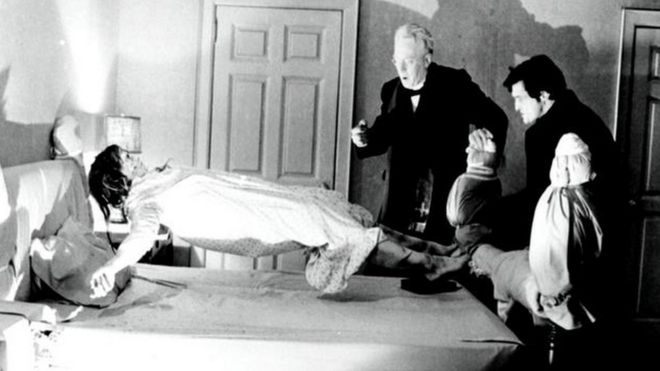
Catalan Leader to Exorcist Tune

still from The Exorcist in which a girl is levitating as two men watch, looking shocked
THE Spanish state broadcaster has been asked to explain why it ran the theme music to the 1973 horror film The Exorcist under a clip of the ousted Catalan leader Carles Puigdemont.
The theme is taken from Mike Oldfield's composition Tubular Bells.
It was played under Mr Puigdemont's voice in RTVE's flagship current affairs programme Informe Semanal last Saturday.
RTVE's own professional standards council said this was bad practice.
It started an investigation to find out who was responsible.
Informe Semanal - the title is Spanish for Weekly Report - has been running for 43 years on national television.
Last week it focused on the Catalan crisis. At about four and a half minutes in to the programme, Mr Puigdemont's clip came on, edited with Tubular Bells underneath.
Mr Puigdemont was saying that he and others were aware they might go to jail but would fight extradition.

Since the last government of Catalonia held a banned vote and declared the region independent, Spain's government has imposed direct rule, sacked the government, detained some Catalan leaders and called a snap election.

Tuesday, 8 August 2017

Challenging Tourismofobia in Barcelona!

 by Brian Bamford
ACTIVISTS in Barcelona have recently targeted tourists as part of a campaign against overcrowding, rising rents and house prices.  Responsibility for a recent attack on a sightseeing bus near the Nou Camp football stadium was claimed by Arran Jovent, a group linked to the anti-capitalist, Catalan pro-independence party, Popular Unity Candidacy (CUP).  

There is a precedent for the current anti-tourist sentiment that is now flourishing in parts of Spain that has a long history that goes back at least to 1963, when I was first there. 

 'The representative of financial institutions told us that the Spanish legislation was great.  He says this when people are taking their own lives because of this criminal law, I assure you—I assure you that I haven't thrown a shoe at this man, because I believed it was important to be here now to tell you what I’m telling you. But this man is a criminal and should be treated like one.'
  These words came from the anti-eviction activist Ada Colau 
in the Chamber of Deputies of Spain in February 2013.

In February 2013, Ada Colau who has since become the mayor of Barcelona, was giving a evidence to a Spanish parliamentary hearing.  Colau had helped to set up a grassroots organisation, the Platform for Mortgage Victims (PAH), which championed the rights of citizens unable to pay their mortgages or threatened with eviction. Founded in 2009, the PAH quickly became a model for other activists, and a nationwide network of leaderless local groups emerged.  

At that time people across Spain were joining together to campaign against mortgage lenders, occupy banks and physically block bailiffs from carrying out evictions. 

Ada Colau was there to discuss the housing crisis that had devastated Spain.  Since the financial crisis began, 400,000 homes had been foreclosed and a further 3.4m properties lay empty.  In response, Colau had helped to set up a grassroots organisation, the Platform for Mortgage Victims (PAH), which championed the rights of citizens unable to pay their mortgages or threatened with eviction. Founded in 2009, the PAH quickly became a model for other activists, and a nationwide network of leaderless local groups emerged. Soon, people across Spain were campaigning against mortgage lenders, occupying banks and physically blocking bailiffs from carrying out evictions.

Others believe Ada Colau and her supporters will have difficulties in transforming the two-party democracy that has ruled Spain since the days of General Franco.  

'I don’t think the ideas of a city can be based on what a citizen’s assembly wants – it’s absurd,' said Francesc de Carreras, a constitutional law professor at the Autonomous University of Barcelona. 'Democracy doesn’t mean that everyone expresses their desires and they come true by some miracle.
'It’s not a good idea to have citizens participate in these things. We’re not the ones who have skills in these areas,' he said. 'I don’t go into a restaurant and tell them how to cook.'

'The Barcelona model is in decline,' said journalist Marta Monedero, referring to the ideas that guided the city’s growth in the late 1980s and early 1990s and helped put Barcelona on the world map.  'The model was a way to understand the city and bring it closer to the people – there wasn’t a lot of money so they came up with things like having lots of squares and intensifying the social fabric of the city through organisations.'

Monedero recently co-edited a book called The Dream of Barcelona: A City in Which to Live or to See?, in which she and journalist Núria Cuadrado asked residents from various sectors of society about the issues facing the city.  What they found was that the model that had once been so successful in guiding the city was now deeply out of sync with everyday reality.  Unlike in the late 1980s, today around 17% of the city’s population is foreign born.  Housing activists say that some 15 residents a day were evicted from their homes in 2014.  Until recently like other cities across Spain, unemployment remains stubbornly in double digits, while the young and educated continue to leave the city in hopes of finding work abroad.
Image result for Eduard Masjuan Bracons
Eduard Masjuan*
In 2006, the anarcho-syndicalist Spanish CGT trade union federation in Barcelona at the request of Tameside Trade Union Council in Greater Manchester, sent an expert on urban housing, Eduard Masjuan Bracons, to speak at Manchester Friends Meeting House about the problems of urban living, housing, planning and design.  The then active Manchester Social Forum was also party to the invite of Eduard Masjuan from the Universitat de Barcelona (Historia Economica), and the Manchester electricians in the then EPIU branch 1400/07, who later were famously in the forefront in exposing the blacklist in the British building trade, were present at the presentation fresh from fighting a case at the Manchester Employment Tribunal. 

The Manchester electrician, Steve Acheson, told the meeting about the problems of health and safety and conditions on the building sites, and what at that time were perceived as being victimisation against trade unionists and safety representatives on the local building sites.  The Calalan academic, Señor Masjuan addressed the urban problems in the city of Barcelona:  the shifting of local residents out from the central barrios to the peripheral suburban areas; and the corruption that was evident in the politics of all parties in the city. 

The predicament of the residents of Barcelona and the electricians on the British building sites were not so dissimilar in 2006.  The young people of Barcelona could not afford the rising prices of appartments in the Catalan capital, and in the same way even today we learn that many of the construction workers who work on building sites can't afford to buy the buildings they are errecting.  

In 2013, when Ada Colau addressed the parliamentary committee, ten minutes into Colau’s 40-minute testimony she broke from the script.  Her voice cracking with emotion, she turned her attention to the previous speaker, Javier Rodriguez Pellitero, the deputy general secretary of the Spanish Banking Association:   
'This man is a criminal, and should be treated as such.  He is not an expert.  The representatives of financial institutions have caused this problem; they are the same people who have caused the problem that has ruined the entire economy of this country – and you keep calling them experts.'

When she had finished, the white-haired chair of the parliament’s economic committee turned to Colau and asked her to withdraw her “very serious offences” in slandering Pellitero.  She shook her head and quietly declined.

The 'criminal' video became a media sensation, earning Colau condemnation in some quarters and heroine status in others.  A poll for the Spanish newspaper El País a few weeks later revealed that 90% of the country’s population approved of the PAH.  The group’s work continued.  In July 2013, Colau was photographed in Barcelona being dragged away by riot police from a protest against a bank that had refused to negotiate with an evicted family.


*  Books by Eduard Masjuan:
    • E. Masjuan, H.M. Elena & D. Saurí, "Conflicts and struggles over urban water cycles: The case de Barcelona",
    • E. Masjuan, "La cultura de la naturaleza en el anarquismo ibérico y cubano", Signos históricos, 15 (2006), p. 98-122.
    • E. Masjuan, "El pensamiento demográfico anarquista: fecundidad y emigración a América Latina (1900-1914)", Revista de demografía histórica, (2004), p. 153-180.
    • E. Masjuan, "Medis obrers, conflictivitat social i innovació cultural a Sabadell (1877-1914)", Recerques, 47-48 (2004), p. 131-155.
    • E. Masjuan, "Procreación consciente y discurso ambientalista: anarquismo y neomalthusianismo en España e Italia, 1900-1936", Ayer, 46 (2002), pp. 63-92.
  • Altres publicacions:
    • E. Masjuan, Un héroe trágico del anarquismo español. Mateo Morral, 1879-1906, Barcelona: Icaria editorial, 2009.
    • E. Masjuan, "Élisée Reclus (1830-1905) i la nova cultura de la naturalesa en els medis obrers de 1900-1936", a Ciència i compromís social. Élisée Reclus (1830-1905) i la geografia de la llibertat, Barcelona: Residència d'Investigadors CSIC-Generalitat de Catalunya, s2007.
    • E. Masjuan, Medis obrers i innovació cultural a Sabadell, (1900-1939), Bellaterra: Servei de Publicacions de la UAB, 2006.
    • E. Masjuan, La Ecología humana en el anarquismo ibérico. Urbanismo orgánico u ecológico, neomalthusianismo y naturismo social, Barcelona: Icaria editorial, 2000.
    • E. Masjuan, "El urbanismo ecológico de Patrick Geddes y Cebrià de Montoliu", a Arturo Soria y el urbanismo europeo de su tiempo, 1894-1994, Madrid: Fundación Cultural del Colegio Oficial de Arquitectos de Madrid, 1996, pp. 51-65.

Friday, 9 June 2017

Juan Goytisolo: his ideas on politics & literature

by Brian Bamford
 Juan Goytisolo
1931-2017

THE Catalan writer Juan Goytisolo died last Sunday in Marrakesh.  Goytisolo, though born into a privileged family in 1931 - his father was imprisoned by the republican government during the Spanish Civil War, he had a difficult relationship with the Franco regime which censored his books, and he went to live in Paris permanently in 1956.

All his works had been banned in Spain until after Franco's death.

In France, mainly through his wife who was a writer and editor, he came to know the anarchist film director Luis Buñuel, as well as Sartre and de Beauvoir, Guy Debord, Camus, Raymond Queneau, Marguerite Duras and – especially – Jean Genet, who became a ‘moral, rather than literary’ mentor. Goytisolo has published over forty books, in various genres; his fiction, certainly since the 70s, is modernist in style and difficult to classify.  He is best known for his journalism, memoirs, and the novels that make up the ‘Alvaro Mendiola’ trilogy published between 1966-75.

He went into exile in France due to his 'total disagreement' with the Franco regime and the censorship it imposed.

He flirted with the communist party during the late 1950s, which brought him a four-month jail term, but he was inspired more by his opposition to the Franco dictatorship than by proletarian conviction.

He began writing at the age of 11, encouraged by his uncle Luis, and his first novels were published after attending law school.
His book Count Julian (1970, 1971, 1974) takes up, in an act of outspoken defiance, the side of Julian, count of Ceuta, a man traditionally castigated as the ultimate traitor in Spanish history.  In Goytisolo's own words, he imagines 'the destruction of Spanish mythology, its Catholicism and nationalism, in a literary attack on traditional Spain.'  He identifies himself 'with the great traitor who opened the door to Arab invasion. The narrator in this novel, an exile in North Africa like Goytisolo at the end of his life, rages against his beloved Spain, forming an obsessive identification with the fabled Count Julian, dreaming that, in a future invasion, the ethos and myths central to Hispanic identity will be totally destroyed.

In November 2014, Juan Goytisolo gave an online interview to the White Review with J.S. Tennant, in which he was asked about his attitude to Franco's Spain and his family background as well as questions on his view on the contempoary literature and the political situation: 
THE WHITE REVIEW—  Your works, and those of your two brothers, have continually recreated episodes from your family history to give a window onto Spain and Barcelona of the 1930s and ’40s. Has this semi-obsession with the period ever surprised you?

JUAN GOYTISOLO:
—  Well, the Civil War cast a long shadow and the death of our mother was a great shock. Later, I hated the Francoist regime and from the age of about 18 decided that this Spain was not my Spain. I lost my faith, became obsessed with the idea of escape, and read only banned books, which I sought out from among my mother’s shelves or in the back rooms of bookshops. 
 THE WHITE REVIEW:
—  You’ve written before that there’s no better reading experience than that of a banned book
 JUAN GOYTISOLO:
—  Oh yes, a book by Cabrera Infante has a lot more worth in Cuba than outside the country, for example…Censorship has the Midas touch – everything it infects turns to gold. Everything becomes politicised; censorship exists to get rid of politics, but in fact it achieves the reverse.
THE WHITE REVIEW:
—  You taught yourself Catalan when living in Paris, but did your mother speak it?
JUAN GOYTISOLO:
—  She was bilingual Spanish/Catalan, and mostly read books in French. When she disappeared, Spanish became the only language of the house. I was taught practically nothing in the religious colleges I was sent to – I learnt French and English on my own, after I’d moved away.
 THE WHITE REVIEW:
—  When the Arab Spring started in Tunisia you were one of the first to publically predict the same would happen in Egypt…
JUAN GOYTISOLO:
—  It was like all revolutions, which start with a great yearning for freedom. All those young people on the barricades, thinking they were going to create a democratic state within a short period, I said to them, ‘Look at Spain, from the first Constitution in 1812 until 1879 there was an absolutist monarchy, then a liberal monarchy, three civil wars, four dictatorships…’ In France it was the same, it started with the ‘Declaration of the Rights of Man’, then came the Terror, the Directorate, and Napoleon as emperor. Creating democracy is a slow and circuitous process.
THE WHITE REVIEW:
—  Do you see any solution to what’s happening in Syria?
 JUAN GOYTISOLO:
—  No, and for a very simple reason (as things tend to be) that it is not in the United States’ interest for either side to win. So they are waiting for each to exhaust itself –sacrificing, in the process, the Syrian people. The mistake was not arming the opposition forces when they could have made a difference, and before their radicalisation.
 THE WHITE REVIEW:
—  Could popular uprisings happen here in Morocco, or Algeria?
 JUAN GOYTISOLO:
—  Algeria suffered a terrible civil war in the 1990s. People don’t want anything to do with extremism. There were a few reforms here, some of them cosmetic, and free elections were allowed which were won by an Islamist party, but the king still holds most of the power.
 THE WHITE REVIEW:
—  Do you believe that literature created from the margins is always better than more popular, visible, forms?
JUAN GOYTISOLO:
—  I’ve always found a perspective from the periphery more interesting than one from the centre.  I learnt this from the Christian converts in Spain, the Jewish conversos, who maintained a critical view of society because they were marginalised.  (But of course there are also those who situate themselves at the centre of things are still great writers.)  In spite of what they say, I’ve never promoted heterodoxy for its own sake, but to widen the traditional Spanish canon by rescuing what Arab culture, that of the Jews, the Enlightenment, the Illuminati, the freemasons and encyclopédistes have bestowed us.  My mission has been to rescue all that’s been excluded for religious or ideological reasons.
He went into exile in France due to his "total disagreement" with the Franco regime and the censorship it imposed.

Thursday, 8 June 2017

'Anglo-Saxon embarrassment' in El Pais

The Anglo-Saxons have ceased to be, if ever they were, a democratic example for the world

by John Carlin in El Pais
OF the ancient democracies. so admirable in their scientific progress, so dominant linguistically, but today the United Kingdom and the United States are presenting a ridiculous front before the world.  For Donald Trump we don't have enough adjectives; the absurd reality is greater than any possibility of parody. The political spectacle that presents itself by the British is not so grotesque but it's equally confusing.  The Anglo-Saxons have lost, for sometime now, the democratic example for the world.
It's the same for both the 'labourista', Jeremy Corbyn, as it is for the 'conservadora', Theresa May, the principle candidates in the British elections this Thursday.  The result for me is that its impossible for me to vote for either of the two.  Both are stuck in the past:  Corbyn in his revolutionary dreams of Cuba, sandinistas, chavanistas;  May in an imaginary Golden Imperial  época in which classes know their place in the world, the rich eat cucumber sandwiches, the poor, steak and kidney pie, and the Europeans have no contamination over Old Albion with its 'Spanish tapas'; Rioja wine; panettone, prosecco y leaving out cultural influences.
The journalist writes:
'May se presenta, sin querer, como una estricta directora de colegio; Corbyn como un despistado profesor de geografía. '
'[Mrs] May, without wanting to, looks like a strict college director,  Corbyn looks like a clueless profesor of geography.'

But, in the end, [Mrs] May is frightened of the schoolchildren under her control, lets say - the electorate, and Corbyn has no more than a minimum idea of how to impose order in the class or help his pupils pass their exams.'

Both promise, of course, prosperity and equality; May based on cuts, Corbyn for more public spending. Few believe them. Partly because they do not convince as leaders, but mainly because neither has offered any concrete idea on how they plan to get the country out of the colossal mess it has gotten in with the vote in favour of Brexit in last year's referendum.

Talking about what they are going to do with pensions or public health when they do not offer any plans on how the hell the UK is going to leave the European Union without the economy collapsing makes no sense. If there is no money in the public coffers all talk about future prosperity or equality is pure smoke.
The banality of the British election campaign is a result of the deficiencies of May and Corbyn but, to be minimally fair to them, the decision of their English compatriots to leave the European Union has put them both in an impossible situation. They repeat the usual electoral mantras, try to project optimism, but the two know -May more clearly, because it has more information- that there is little to do: the future of the United Kingdom outside Europe is poor, irrelevant and obscure.

Monday, 20 February 2017

Spanish Civil War in Wakefield

Comrades
Wakefield Socialist History Group are holding a SPANISH CIVIL WAR event on Saturday 11 March, 1-4pm at the Red Shed (Wakefield Labour Club), Vicarage Street, Wakefield WF1 1QX.
The speakers are:
*Granville Williams (Granville is the editor a  new book, THE FLAME STILL BURNS: THE CREATIVE POWER OF COAL.  He is on the National Committee of the Campaign for Press and Broadcasting Freedom).
*Bob Mitchell (Bob is a former councillor and former Mayor of Wakefield.  He has a particular interest in poetry and the Spanish Civil War).
Admission is free.  There will be free light snacks.  Plus there is a bar with excellent real ale.
Fraternally
Alan Stewart
Convenor, Wakefield Socialist History Group

http://georgeorwell.org/SpanishCivilWar.htm

Monday, 6 February 2017

Francisco De Goya Artsy Link

Hi - my name is Alonzo, and I work at Artsy. While researching Francisco De Goya, I found your page: http://northernvoicesmag.blogspot.com/2011_01_01_archive.html.
I am reaching out to certain website and blog owners that publish content in line with our mission to make all the world’s art accessible to anyone. We hope to continue promoting arts education and accessibility with your help.
Our Francisco De Goya page provides visitors with De Goya's bio, over 235 of his works, exclusive articles, and up-to-date De Goya exhibition listings. The page also includes related artists and categories, allowing viewers to discover art beyond our De Goya page. We would love to be included as an additional resource for your visitors via a link on your page.
If you are able to add a link to our De Goya page, please let me know, and thanks in advance for your consideration.
Best,
Alonzo

"Imagination abandoned by reason produces impossible monsters; united with it, she is the mother of the arts and the origin of source of their wonders."
-Francisco De Goya

Friday, 23 December 2016

Torment and Corruption in British Jails


Specialist "Tornado" teams were sent into HMP Swaleside, on the Isle of Sheppey, Kent, after a disturbance at about 19:00 GMT on Thursday.
Meanwhile a prison spokeswoman said:
'The challenges in our prisons are longstanding and won’t be solved overnight but the justice secretary is committed to making sure our prisons are stable while we deliver wholesale reforms to the prison estate to help offenders turn their lives around and reduce reoffending.'
Meanwhile, a week ago rioting prisoners took over four wings of HMP Birmingham, setting fire to stairwells, destroying paper records and causing £2m in damage. It was the latest high-profile disturbance to break out in a jail, prompting Justice Secretary Liz Truss to warn that "long-standing" problems in the nation's prisons could take months to solve.

AN editorial in the Financial Times last Wednesday commenting on the state of British prison's being 'a national disgrace', quoted Fyodor Dostoyevsky as saying that 'the degree of civilisation in a society can be judged by entering its prisons'.

In 1971 or thereabouts, a prison officer in Brixton jail suggested to Stuart Christie then remanded in there of charges relating to the Angry Brigade, that he should write a comparative book about his experiences in Spanish and English prisons.  He was found not guilty when the case came to trial.  Later in his autobiography 'Granny made me an anarchist' Stuart Christie wrote:

'I discussed this with Miguel Garcia, my friend and former fellow prisoner, he agreed that it was the soullesness of British prisons that made them outstanding in the history of penology.  National characteristics come into it as well.  Cold cabbage, muddy fishcakes, soggy sponge lumpy custard and gnats' piss for tea would be considered a provocation diet in Spain.  The authorities offering it would be expecting a riot.  British prisoners have probably been conditioned by years of factory canteens, greasy spoon cafes and now Macdonalds. 

'But there was another striking difference between the two countries: British jails were run on a system of state socialism, where you get what your given ('Incentives' and 'earned privileges' are now the system).  Spanish jails in Franco'ws time were run along on much more humane lines inasmuch as there was some degree of choice involved.  You could work and earn more, or – and this is a punishment – not work and scrape by if you were prepared to do without things like fags and Serrano ham sandwiches.  You could have money sent in from outside and spend it in a fanteen or the prison restaurant.  Thus responsibility for the individual's quality of life in prison became his own, that of his family and his comrades.

'Like money everywhere, its circulation in jail leads to corruption, but it is also the one thing that eases tyranny.  Corruption certainly exists in English jails – albeit fitfully.  In Spain it was built into the system.  But for those who have illusions as to what can be achieved by the parliamentary system, a comparison of Spanish and English prisons would be interesting.'
As the prison spokeswoman said 'the challenges to our prisons are longstanding...'


Wednesday, 7 December 2016

Methodology of Spanish football in the UK


MANCHESTER's Instituto Cervantes presents this coming Wednesday 7th December, at 6.30pm, the launch of the project ‘Methodology of Spanish football in the UK:  Sports excellence’, by Spanish coach, Ángel López.  The talk, which is free of charge and open to the general public, will “analyse the Spanish methodology and the English football’s current scene, with the aim of finding new ways of collaboration regarding the training of managers, both at professional and lower levels”.

The main goal of this project is to organise conferences and seminars on the Spanish methodology on football at the clubs’ premises, at the English Football Association and also at the Manchester’s Instituto Cervantes.  Moreover, the project intends to offer Spanish classes “with specific football terminology” to all the colleges, academies and clubs interested, and it is aimed both at football players, coaches and managers.  Likewise, there is a view to organise after-school activities about football and summer camps in Spanish for kids and teenagers.

López points out “the remarkable conditions for working in English football, from professional categories to academies”.  However, this goes against “the shortage of native coaches in the Premier League as well as in the best leagues in the world”.  Hence, this project could lead to joining forces with local managers, to foster talent and expertise.  The Spanish coach highlights that “we should not forget that England invented football, therefore it deserves our admiration and respect and always look to contribute and collaborate with them”.  According to López, Manchester is the perfect place to develop this project, as today it is “the nerve centre of world football”, he claims.           
About the author         

Ángel López is a National Football Coach with the Madrid Football Federation and Graduate in Physical activity and Sport Sciences from the Polytechnic University of Madrid.  Furthermore, he holds a Master´s Degree in Physical Training in Football.  He has a wide experience as an Assistant Coach at the Spanish First League with Getafe FC and he has also trained teams at the Romanian Professional Football League and the Asian Champions League.
Among his many merits and achievements, it should be noted out that he was the youngest assistant and fitness coach in the Spanish La Liga in 2014 and 2008, respectively.

More information and bookings: cenman@cervantes.es  / 0161 661 4201/12