Showing posts with label spain. Show all posts

Sunday, 20 February 2022

Farewell, Brian

I first met Brian over fifty years ago, when we were launching Rochdale’s Alternative Paper (RAP); our friendship was cemented then and thrived until his sad demise last Friday.

Our first encounter was over a story I wrote, in which he displayed a number of characteristics that were, for me, to help define his life. Always a staunch trade unionist, for him the rights of his fellow beings trumped any formal structures. So, the story - in brief - was of a number of Asian workers who were being abused, discriminated against and under-paid on the night shift of Arrow Mill, one of Rochdale’s last functioning textile mills. Neither management nor textile trade union cared a hoot - the latter was happy to turn a blind eye. Brian’s instinctive decency and concern for his fellow worker came to the fore, and he was able to organise the shift, from the outside and provide support that saw many of their grievances addressed.

Brian’s pro-worker, anti-union bureaucrat stance was often to get him into trouble. Others will know more of his more recent struggles on behalf of the anti-black-listing campaigns.

The gratitude of many of those he supported at Arrow Mill remained until Brian’s dying days, as some, who had long departed Rochdale remained in touch. The fact “the lads” were recent Pakistani immigrants was of no concern to Brian. His support was driven by his discomfort at the injustice they experienced. That “colour blindness” later got him denounced as a racist, when he was vocal in condemning textile sweatshop labour in the town, because it was perceived, by the hyper-sensitive, to be anti immigrant, rather than pro workers rights and working conditions that had been fought for over the previous century and a half.

Brian played a significant role in helping uncover RAP’s biggest story, and later national scandal - the exposure of Cyril Smith as a child abuser. Brian knew some of the victims and helped RAP trace them, in the 1970s, and later assisted distinguished national journalist and son of Rochdale, Paul Waugh, with his revelations thirty five years later. He had no truck with the trashy “drama-documentary” on the subject published by local disgraced MP, Simon Danczuk and his side kick eight years or so, ago.

Brian assisted RAP in much of the unglamorous stuff too - the collation, folding and the distribution. It was early mornings and late nights, with zero recognition or reward, except for feeling that you were attempting to get messages of injustice publicised and showing solidarity with the under-dog. Brian was no glory hunter, although his struggles often gained attention, he never sought it.

Often intense and serious, Brian was not without a mischievous sense of humour, as many who recall his hearty cackle will testify. On one occasion in the 70s we persuaded him to stand as a candidate in the Rochdale municipal elections, to represent Rochdale’s Alternative Party (RAP). He stood in the town’s most affluent ward, which just so happened to be called Bamford (“Bamford for Bamford” had a certain campaigning appeal!). Among his pledges was to have a Travellers’ Site erected on Norford Way (the poshest road in town, which at the time housed a member of pop group 10cc and a Lancashire and England cricketer, as well as the area’s wealthier professionals and business owners. To nobody’s surprise and Brian’s great relief, he was spectacularly unsuccessful!

On a more serious note was Brian’s great love of Spain, brought about initially by periods working as an electrician in Gibraltar. At some considerable personal risk, he was involved in supplying anti-fascist resisters in Franco’s Spain with literature and materials he was able to smuggle over the border. He had little truck with other more celebrated anarchists who publicised their actions and put others at risk, as a consequence.

His periods in Spain engendered in him a love of the country, its literature and cuisine, and he was a dab hand at putting together a tasty Spanish culinary delight or two.

Brian has always been a polemicist and publisher - not only through RAP, but with any number of leftist/anarchist publications. The original, paper copy of Northern Voices and this blog being the latest manifestation. It is hard work, particularly trailing round newsagents and bookshops, often by public transport to deliver copies and pick up returns and payments. It’s the nature of small publications that they rarely get pride of place in shop displays, and sales can be hit and miss and often disappointing. Brian would not be put off - he always soldiered on, without complaint.

I left Rochdale 40 years ago, but we maintained our friendship. He was a frequent visitor, and always stayed when he was down for conferences and the annual Anarchist Bookfair. There was always a campaign to be fought, and important discussion to be had, by his ever inquisitive mind.

He was a frequent phone caller, to discuss current affairs, or just plain gossip. For a while the calls always lasted 59 minutes and 30 seconds- the maximum free call time allowed by his service provider. His timing was immaculate!

In recent years we came to share a delight of holidays in Norfolk (although never together); Brian with Pat, his partner over 30 years and wife for the last two months of his life, and me, my wife and two dogs (I am writing from there now). We took great delight in our respective times in this glorious county: we in our rented cottage. And Brian, until his 80s, never one for ceremony or appearance, with Pat in youth hostels. 

And how fitting, because Brian was Forever Young (yes the works and songs of Bob Dylan were frequent topics of discussion.

Farewell, Brian.

I’ll miss you, comrade.

Monday, 4 January 2021

Brexit: Gibraltar & UK-Spain deal for open border

SPAIN has reached a deal with the UK to maintain free movement to and from Gibraltar once the UK formally leaves the EU on Friday.
To avoid a hard border, Gibraltar will join the EU's Schengen zone and follow other EU rules, while remaining a British Overseas Territory.
The deal was announced by Spanish Foreign Minister Arancha González Laya, just hours before the UK exits the EU.
The Rock voted Remain in 2016 and about 15,000 Spanish workers go there daily.*
"With this [agreement], the fence is removed, Schengen is applied to Gibraltar... it allows for the lifting of controls between Gibraltar and Spain," said Ms González Laya.
The Gibraltar deal will mean the EU sending Frontex border guards to facilitate free movement to and from Gibraltar. Their role is planned to last four years.
Gibraltarians are British citizens. They elect their own representatives to the territory's House of Assembly, while the British monarch appoints a governor.
The territory - home to a British military garrison and naval base - is self-governing in all areas except defence and foreign policy.
Ms González Laya did not say whether Spanish border guards would eventually be posted at Gibraltar's airport and/or seaport which, under the deal, will be de facto part of the EU's external border.
The Gibraltar deal would also mean the territory complying with EU fair competition rules in areas such as financial policy, the environment and the labour market, Ms González Laya said.
Twenty-two EU states are in the passport-free Schengen zone, as are Norway, Switzerland, Iceland and Liechtenstein, but the UK has never been in it.
Once Gibraltar joins it, EU citizens arriving from Spain or another Schengen country will avoid passport checks, while arrivals from the UK will have to go through passport control, as is already the case.
UK Foreign Secretary Dominic Raab called Thursday's deal a "political framework" to form the basis of a separate treaty with the EU regarding Gibraltar.
The deal does not address the thorny issue of sovereignty. Spain has long disputed British sovereignty over the Rock which was ceded to Britain in 1713 and which is now home to about 34,000 people. The Remain vote there was an overwhelming 96% in the 2016 EU referendum.
The plan is to have a six-month transition period and then formalise the new arrangements with a treaty.
Under the current tight Covid rules, there are restrictions on UK citizens arriving via Gibraltar's airport, the UK Foreign Office says.
Dominic Raab said "all sides are committed to mitigating the effects of the end of the [Brexit] Transition Period on Gibraltar, and in particular ensure border fluidity, which is clearly in the best interests of the people living on both sides.
"We remain steadfast in our support for Gibraltar, and its sovereignty is safeguarded."
* There has been a history of Spaniards providing labour on the Rock going back to the Treaty of Utrect in 1713. Hence, any Spanish tightening of controls at Gibraltar’s land border would have also hurt about 10,000 workers like Mr. Moya who commute there daily, mostly from nearby towns that form an economically depressed area known as the Campo de Gibraltar.
*******************************************************

Saturday, 2 January 2021

COVID-19: 'SCIENCE ON TRIAL' ?

THIAGO CARVALHO* in this weekend's Financial Times asks: 'So what have we learned about the limits of science? First, we were reminded that spectacular successes are built on a foundation of decades of basic research. Even the novel, first-in-class vaccines are at the end of a long road. It was slow-going to get to warp speed. We learned that there are no shortcuts to deciphering how a new virus makes us sick (and kills us) and that there is no ignoring the importance of human diversity for cracking this code. Diabetes, obesity, hypertension - we are still finding our way through a comorbidity labyrinth. Most of all, we have learned an old lesson again: science is the art of the soluable. No amount of resorces and personnel, no Manhattan Project, can ensure that science will solve a problem in the absence of a well-stocked toolbox and a solid, painstaking built theoretical framework.'
He reminds us: 'South Korea recorded its first Covid-19 case on January 20. Eleven days later, Spain confirmed its first infection: a German tourist in the Canary Islands. Spain and South Korea have similar populations of about 50m people. As of ublication of this piece, South Korea has had 879 deaths, while Spain reports over 50,000. The west missed its moment.'
* The writer is an immunologist at the Champalimaud Foundation, Lisbon.
********************************************************************

Tuesday, 20 October 2020

A Second Wave is Coming: Madrid & Manchester!

A TALE OF TWO CITIES THROUGH the LOOKING-GLASS
AS the windfall fruit began to fall from the trees earlier this month the spectre of a second wave of the virus emerged in Europe.
On October 9, the Spanish government declared a state of emergency in Madrid on Friday, wresting control of efforts to fight the spread of COVID-19 from local authorities in a region that is experiencing one of Europe’s most significant coronavirus outbreaks.
The step, which took immediate effect and lasts for two weeks, forcing Madrid's regional authorities to restore restrictions on travel that had been introduced by the national government but were struck down the previous day by a Madrid court ruling.
That successful legal challenge by Madrid officials was part of a long quarrel between the country’s main political parties over their coronavirus response. Those differences, and the changing rules, have often dismayed and confused local residents.
The Madrid region’s 14-day infection rate of 563 coronavirus cases per 100,000 residents is more than twice Spain’s national average of 256 and five times the European average rate of 113 for the week ending Sept. 27.
The central government’s measures prohibit all nonessential trips in and out of the capital and nine of its suburbs, affecting some 4.8 million people. Restaurants must close at 11 p.m. and stores at 10 p.m.. Both must limit occupancy to 50% of their capacity.
The national government had ordered police in Madrid to fine people if they left their municipalities without justification. More than 7,000 police officers will now be deployed to ensure the restrictions are observed, Interior Minister Fernando Grande-Marlaska said.
The Spanish government announced the state of emergency after a hastily arranged Cabinet meeting in the wake of the court ruling. Health Minister Salvador Illa said the previous measures would come back into force and that only the legal framework for them was changing.
He told a press conference it was “undeniable” that there is community transmission in the Madrid region, not just isolated outbreaks, at a crucial juncture as winter approaches and respiratory problems increase.
“Action is needed, and today we couldn’t just stand by and do nothing,” Illa said. “It’s very important that this doesn’t spread to the rest of the country.”
Yet Madrid’s conservative regional government opposed those restrictions, saying they were draconian and hurt the economy. Madrid’s regional president, Isabel Díaz Ayuso, said her own, more moderate measures were enough to fight COVID-19.
A Madrid court on Thursday [8/10/20] upheld the regional government’s appeal, saying the national government’s imposition of restrictions violated people’s fundamental liberties.
Between Madrid and Manchester one cannot help but notice the looking-glass nature of the two disputes; as the Madrid regional authorities are politically conservative in opposing the national government, while in Greater Manchester the resistance is largely Labour with a sprinkling of local Tory MPs in places like Bury etc.
Today, in England, the Boris Johnson's government has just confronted a similar situation with regard to Manchester as the region's mainly Labour politicians and Mayor's oppose the central government's insistence that a three-tier is imposed. The Greater Manchester Mayor, Andy Burnham, has been in the forefront mobilising the opposition and demanding more support, but he urges that the people of Manchester to obey the law, and fall-in with the requirements of the government's new severe three-tier restrictions.
Last Saturday in an editorial leader in the Financial Times wrote: 'With events moving at such speed, and Mr Johnson's regional approach coming under strain, a circuit-breaker shutdown across England, too, now seems a question of when, not if.'
The FT editor took the view that if the goverment imposed a 'precautionary break' now, it might 'avert the need for a vastly more damaging indefinate national lock-down' later on.
Despite this, it now looks like the governmant is taking a chance on a regional approach to the problem. Just watch this space!
********************************************************

Monday, 12 October 2020

Saturday, 19 September 2020

Regarding Stuart Christie by Martin Gilbert

I ONLY met him once. It was outside the gates of Speakers Corner, Hyde Park, in 1963, Stuart had only been in London a short while. His accent was so thick I had difficulty understanding him. We were both selling papers. I had PEACE NEWS, and SANITY, (now long-gone, published by national CND). Also, we were both selling FREEDOM, a very different paper from what it has declined into. Stuart indicated that the papers were selling very well. Soon, we were were both busy chatting with different people and I never saw him again.
When he was arrested [in August 1964] reactions were very mixed. Predictabley, the media’s response was something like”….typical anarchists...”. Young CNDers and our fellow travellers showed 100% solidarity with Stuart. We had an old motor coach to aid our campaigning, so drove to Blackpool for the Labour party conference.
Readers may know that back then CND was much more establishment oriented. The line was only to approve of traditional methods of getting our messages across. This was years before national CND voted to support non violent direct action; thanks to the women at Greenham Common in 1980. So instead of following the (then) strict line we lobbied for Stuart’s release. Old campaigners were furious with us. In mitigation we claimed, incorrectly, that he was only carrying literature; which was also illegal in Franco’s Spain.
Lessons were gained from it all. One was awareness of the extent of Franco’s spies. Also, how open we and other groups were to infiltration from different kinds of Cops. But too much caution can only lead to quietism.
martin gilbert Sept. ‘20

Monday, 14 September 2020

Stuart Christie: an insider's study of an authentic classical anarchist by Brian Bamford - Part Two

ANARCHISM IS not a very well understood doctrine in British politics. I realised this when Tameside Trade Union Council first published a booklet commemorating the 60th anniversary of the Spanish Civil War in 2006 with Durruti on the cover. The then delegates of the Greater Manchester County Association of Trade Union Council clearly didn't appreciate the publication at the time, but during the meeting a large party of French trade unionists from the CGT [communist] happened to be present and while many of the local English trade unionists held back the French delegation waded-in to buy up most of the commemorative booklets we had to hand, and even later following me to the toilets to get extra copies.
It struck us at the time how utterly frigid the English trade unionists were compared to their French 'communist' CGT comrades.
This thought occurs to me now as I now with sadness write my friend and comrade, Stuart Christie's obituary. I remember that sometime after Stuart wrote the first volume of his autobiography 'GRANNY MADE ME AN ANARCHIST', I wrote a critique of it entitled 'God Help the Anarchist movement that Needs Heroes'. This in turn led to a bitter altercation between me and Stuart on the website 'Libcom' in which I believe he labelled me 'an arsehole'. However, in 2006, it was a measure of Stuart's nobility that when I invited him to write an introduction to Tameside TUC's Spanish commemorative booklet he had no hesitation in agreeing to do the job.
He probably did it because he knew me from when I first met him in Paris in August 1964, when he was about to go on to embrace the risky venture in his ill-fated journey to Madrid and ultimately to a Spanish jail for his part in a proposed attempt to assassinate General Franco. At that time we were all staying in a 'safe house' with Germinal Garcia at his apartment near Place de la République*. My wife Joan and I were returning from Spain, having first worked in Denia, Alicante throughout 1963, and later on in early 1964 moved on to La Linea on the border with Gibraltar where I worked for the MOD at the Gibraltar airport. While in Denia my eldest lad was born at the clinica there in September 1963. While in Spain and later Gib. we had taken photos of the conditions in the shanty towns in Barcelona and we sent back reports on working conditions over there for the FIJL publication Nueva Senda. At that time we were being debriefed, and thought Stuart may have been on a similar mission to us, but soon found out that they had other plans for him. At one stage he asked for our advice and was naturally interested in our own experiences.
Stuart was still in Carabanchel jail [Madrid] when my family again returned to Spain in early 1967 on our way to work in Gibraltar having had difficulties working as an electrician in Rochdale following my involvement supporting the national engineering apprentice strikes in November 1964 and February 1964. Having been blacklisted by the British MOD and throughout Gibraltar with private companies with contracts with the MOD and other contracts with the British authorities the only place on the Rock that I had a serious chance of work was with the Gibraltar City Council, supported by the Transport & General Worker's Union and Albert Risso who had close links with Sir Joshua Hassan the Chief Minister.
The anarchists on Gibraltar at that time were active within the Transport & General Workers Union and were basically anarcho-syndicalists. Stuart identified with the syndicalists, and had fallen under the influence of Bobby Lynn who he says 'had become the backbone of the Glasgow anarchist movement'. I'd stayed with Bobby Lynn in the Gorbals in 1961 and he gave me his copy of 'The Sexual Revolution' by Wilhelm Reich. Bobby was a member of the Syndicalist Worker's Federation when I stayed with him in 1961. As news leaked of Stuart's arrest Peter Turner [FREEDOM EDITOR] had contacted Bobby Lynn in Glasgow and up there they had assured him that Stuart was so dedicated to the peace movement and that it was not likely that he was guilty as claimed by the Spanish authorities. This may have influenced the report in the syndicalist Direct Action which took the line that he must be innocent, and Wynford Hicks on behalf of the anarchists argued on TV news that he was probably the victim of an 'agent-provocateur'. Another Freedom editor Vernon Richards argued more sensibly that it mattered little whether Stuart was innocent or guilty the anarchist position should be to support him.
For my part I knew what had taken place, but anticipating returning to work in Spain and expecting to continue to help the group of young Spanish exiles of the FIJL involved with the failed attempt, I decided to remain silent. Stuart himself had not been prudent before his departure for Spain and had actually participated in a BBC2 program entitled 'Let Me Speak' hosted by Malcolm Muggeridge. Muggeridge, who had been a friend of George Orwell, had often identified morally and intellectually with Tolstoy and anarchism.
In his autobiography 'MY GRANNY MADE ME AN ANARCHIST'[2004] Stuart documents the sequence of events in the summer of 1964: 'In mid-July Salvador and Bernado [Gurucharri] told me I should be ready to leave for Paris by the end of the month. Everything was now in hand for my trip to Spain. Shortly before I left... I was invited to appear on what later turned out to be, for me, an almost disastrous chat show called Let Me Speak, on ...BBC2. Having a small spectrum of anarchists, with me and another young lad called Vincent Johnson representing the "revolutionary anarchists" Muggeridge asked me if I was sincere in my revolutionary aims...would I, for instance, given the opportunity, assassinate Franco?" It was an unlucky shot in the dark, for that was pretty damn close to what I was hoping to do. What could I say but yes?.'
It is an extraordinary admission for a revolutionary anarchist to make! I doubt that the Spaniards I knew in Paris or in Spain in the 1960s would have made such a confession on the BBC or before going on a mission such as Stuart anticipated. It's almost as if he had a death wish or secretly wanted to get caught. When we knew him in Paris in August 1964 he was hopelessly naive and clearly knew little of the reality of everyday Spanish life or working conditions. He struggled to pronounce the Spanish word for 'workers'.
On page 107 of his autobiography he writes: 'I may not have been wise or competent in what I did or the way I went about it, but I did not have the benefit of hindsight'.
Never mind 'hindsight' given what he had done did he have the benefit of foresight or even a glimpse of common sense? I say this knowing, as Stuart did, that other people suffered as a consequence of what he did and the mistakes that he and his handlers made at the time. I also say this as a friend of Stuart who exchanged correspondence with him regularly over the last few years, and had documented and detailed our differences in my earlier pamphlet. One thing that troubles me is not that he wore a kilt, but that he sported a war resister badge of a broken rifle on his chest while walking around Paris in 1964 as he carried our one-year-old son Deon. He told us that he'd visited Paris the year before in the Spring; it was more 'romantic' than in August. Being romantic was probably what attracted most people to Stuart as it was part on his charm.
Yet, when we had visited Ken Hawkes, then secretary of the Syndicalist Workers Fed., and his wife before we went to Spain in February 1963, the worst winter since 1947, they treated us to a bottle of Champagne as we'd just got married and reminded us to remove our Ban the Bomb badges before we left their house on Parliament Hill for Spain. I wonder why none of us thought to urged Stuart Christie to take off his tell-tale War resister badge?
I suppose that in August 1964, we were all a bit intoxicated by the atmosphere of a time in which Franco had just celebrated 25-years of peace, and a pale-faced Salvador Gurucharri and others had just been released from jail. In Paris, at that time, we were all in high spirits as things seemed to be moving in the right direction.
While there Stuart met other major figures in the exiled Spanish anarchist movement, the organised FIJL [Fed. of young libertarians] around the Internal Defence (DI), and including militants of long standing like Octavio Alberola* and Luis Andres Edo.
In his autobiography he describes what he did as 'the act of an adolescent' and he quotes a verse from Longfellow:
'A boy's will is the wind's will, and the thoughts of youth are long, long thoughts.' [page 120]
On reflection he goes on to admit: 'Now it will seem like to many a foolish, naive, impulsive act...'
and 'I cannot claim, either, that it was entirely altruistic - my motives were certainly in part a desire for excitement and adventure.'
On reflection he goes on to admit: 'Now it will seem like to many a foolish, naive, impulsive act...'
Essentially he was doing what we had done a year earlier when we went to Spain to escape from what then seemed like dreary Manchester; he was he says not satisfied with what would now be called 'gesture politics' of petitions and protests, and sought to engage directly with a struggle in Spain. Foresight or prudence would make cowards of us all; it was not part of his engaging personality at that time. It set Stuart outside the smelly little left wing orthodoxies which he left behind. Yet it led him to get a 'GO TO JAIL' card to a Madrid prison cell, and was for him a life changing event.
Once in Paris Stuart had made contact with the action groups of the exiled Spanish anarchist movement, organised around Internal Defence (DI) and involving militants of long standing like Octavio Alberola and Luis Andres Edo. As such during his disastrous mission he was later arrested in Madrid and charged with the possession of explosives. These were intended for an attempt on Franco’s life and he was sentenced to 20 years imprisonment. Thanks to a continuing international pressure he was freed after 3 years.
Why was General Franco and the Francoist regime so susceptible to international public opinion in the 1960s?
I think it was in his book 'The Face of Spain' [1950] that Gerald Brenan tried to explain the mellowing of the Franco regime. In that book he explained how the Falange and those who adhered to Franco began invest in real estate and escape the relative poverty of the 1940s and 1950s. We too quickly forget that it was not just the Spanish working-class that suffered after the Civil War, but the Spanish middle-classes experienced insecurity also. My boss Senor Such told me of how in the 1940s everyone in the fishing village where I lived and worked in 1963-4 had suffered depravation after the war and some had to eat cats. Later on it had become possible to make some progress and by the time we got there in the early 1960s things were looking up as the tourists began to arrive and with the development building work on the costas things were much more prosperous for many including the low-level Falangists. This allowed some softening of the regime which may some helped Stuart Christie escape with what turned out to be a relatively short sentence of 3-years in the end. Had he been arrested some ten years earlier for the same offence it may have been an altogether different story, but by the mid-1960s the supporters of the Franco regime felt much more secure than they had been during the Second World War or in its aftermath when to some extent Spain had been isolated internationally.
* FOOTNOTE: In the early hours of 11 May 2011, 86-year-old Germinal García, a militant of the Juventudes Libertarias (FIJL) and the Paris Local Federation of the CNT in the 1950s and 1960s, passed away (in Paris). At the end of the Spanish Civil War, 13-year old Germinal had been interned in Argeles-sur-Mer concentration camp where an unknown English woman, to whom he was ever grateful, cared for him. Stowing away on a Danish freighter, the Kitty Skov, from the port of Barcelona, he escaped to the United States, where he remained for a time in New York, passing himself off as a French citizen, returning later to France to became active in the anti-Francoist struggle. Shunning the limelight, but always in the background with his strong sense of solidarity, Germinal’s apartment in the Rue Lancry was a safe haven for comrades who had escaped from Franco’s Spain — and for guerrillas such as Quico Sabaté whenever he was in Paris (it was also used by Stuart Christie prior to his trip to Spain in 1964). For that and for his ongoing service to the libertarian movement, Germinal won the respect and friendship of all who knew him. With his passing, we have the satisfying memories and the privilege of having known the friendship of a good comrade. Germinal’s remains were cremated in Paris on 17 May 2011.
Octavio Alberola, May 12, 2011 SEE ALSO https://www.facebook.com/TheOrwellSociety The Orwell Society - Home | Facebook The Orwell Society. 1.4K likes. The Orwell Society aims to promote the understanding and appreciation of the life and work of George Orwell. Join here:... www.facebook.com

Saturday, 12 September 2020

Octavio Alberola says goodbye to Stuart Christie

Octavio Alberola, who was in charge of Defensa Interior and was a close friend of Stuart’s has left us this farewell message to his friend.
Stuart Christie, comrade and friend
by OCTAVIO ALBEROLA
THE news of Stuart Christie’s death arrived by phone halfway through yesterday afternoon from comrade René after he asked if I had heard the bad news and after I quizzed him brusquely: Who’s dead? I could tell from his tone of voice that it must have been somebody close who had passed away.
René’s answer stopped me in my tracks, because even though Stuart had told me a week before that the cancer had left him still hoarse and that the findings of his medical tests were none too encouraging, it never at any moment occurred to me that he would be taken so quickly. I am surrounded by several male and female comrades – more or less of my own age – who are in none too rude health and at my age (due to turn 93 shortly) the thought that one’s days are numbered is just “normal”.
But in Stuart’s case, how could this be when he was eighteen years my junior? Besides, we had both been working on joint projects and both had been determined to plough ahead with our battles with the world of authority and exploitation.
To me, his death represents not just the loss of a comrade and friend but an end to long years collaborating on joint actions and initiatives designed to expose the injustices of the world in which we live and the fight for a fairer, freer world. A world that is possible for all of us who have not given up on wishing and trying to work towards a consistent practice of active, internationalist revolutionary solidarity.
We have known many years of brotherly relations ever since our first meeting back in August 1964 and up until 2020, without interruption. Half a century of our lives in tandem, one way or another, working on behalf of a common cause, heedless of borders. That struggle, though centred on the Spanish people’s political and social vagaries, initially under the Franco dictatorship and later under this phoney democracy spawned by the Transition/Transaction, has at all times carried the imprint of an internationalist revolutionary outlook.
The evidence of that, in Stuart’s case, was the time he spent behind bars in Spain and England, and in the case of Brenda his partner, in Germany and, in the cases of Ariane and myself, in Belgium and France. Experiences that bear witness to struggles that knew no borders as we knew that a characteristic of freedom is that it is the right of every man and woman.
So how could I not feel impelled to remember it now that our fraternization with Stuart has ended with his death? As well as with the death just a few days ago of the German comrade Doris Ensinger, the partner of Luis Andrés Edo, with whom Stuart shared some of his prison experiences and with whom he rubbed shoulders in their struggles; obviously, speaking for myself, the loss of Doris in a way represented the final ending of my fraternization-in-struggle with Luis. A finale that started some years back with Luis’s own death.
The fact is that in the case of Doris’s death too I was stopped in my tracks, startled by the news of her demise communicated to me by Manel, as barely a week earlier she had sent Tomás and me an email to let us know that she had been abruptly recalled to the hospital and undergone a transplant operation … But was now back home and feeling well …
Meaning that yet again I am brought face to face with the tenuousness of our existence and the need to preserve the memory of what we strove to be and do, to the very death.
Perpignan, 17 August 2020
Octavio Alberola
From RojoyNegro_Digital el Mar, 18/08/20; 15:02 http://rojoynegro.info/articulo/memoria/octavio-alberola-se-despide-stuart-christie Translated by: Paul Sharkey & REPRINTED BY KATE SHARPLEY

Sunday, 17 May 2020

Spain’s gypsies target of coronavirus racism


An national federation of women’s groups from Spain’s Roma community has complained of a spate of racist and anti-gypsy messages being disseminated via both traditional and social media in Spain since the outbreak of the country’s coronavirus epidemic.

The Federación de Asociaciones de Mujeres Gitanas Fakali on Tuesday denounced what they say are racist episodes, including the dissemination of malicious fake news and information via social media that they say are “promoting racist psychosis in various parts of our country.”


The anti-gypsy xenophobia on social media include attacks on the Roma community in La Rioja, where a funeral in late-February for a member of the local gitano community brought together about a hundred people and is believed to have been the initial trigger for an outbreak of coronavirus and the COVID-19 disease in the province in and around the city of Haro.

In the nearby Basque Country, false claims were circulated via social messaging apps via an audio recording with a woman’s voice claiming that gitanos in the Basque capital of Vitoria were swarming the local health clinics, falsely claiming coronavirus symptoms so that they could be treated by healthworkers before others.

In a statement, the Fakali federation said that “Experience tells us that episodes of discrimination, racism and intolerance often flourish in the most difficult moments”.  The organization called for “calm and understanding” to prevail and encouraged all groups in Spanish society to “come together to beat COVID-19 and the virus of racism.”

► Click to read more news about Discrimination & Spain’s Roma community …
******************************

Saturday, 16 May 2020

Revolt of 1% against Spanish covid-19 ‘oppression’

RESIDENTS of Madrid’s upscale Salamanca neighborhood have been making headlines since Sunday with a series of street protests against the government over its handling of the coronavirus crisis.

Demonstrators have been using the words “dictatorial” and “oppression” to describe their situation under the ongoing lockdown.  Madrid, the epicenter of the coronavirus pandemic, is still in the early stages of a national deescalation plan that is expected to end in late June, if there are no new spikes in transmission.

The protests reflect a view, held by some in Spain, that the state of alarm introduced in mid-March to combat the coronavirus pandemic is really an excuse for the central government to grab extra powers.  Prime Minister Pedro Sánchez, of the Socialist Party (PSOE), heads a minority government and he has been facing growing difficulty to secure enough congressional support for back-to-back extensions to the state of alarm.
The sentiment mirrors similar feelings elsewhere in Europe, where protesters from across the political spectrum are beginning to demonstrate against prolonged confinement measures (see box below).  A recent report by Spain’s Civil Guard underscores the risk of social unrest in Spain if confinement measures are prolonged.

On Wednesday, around 100 locals banged on pots and pans on Núñez de Balboa street, without respecting social distancing rules.  There were couples, families and people with dogs.  Some marched with face masks that had tiny Spanish flags embroidered on them; others waved enormous flags instead.  The demonstrators called for the government to resign.

“I pay my taxes and we have a government that is doing nothing,” said María Jesús, 56, who was out with her husband Rafael, 60, and their son Pelayo, 16. “That is why I am walking and protesting.  You see these gloves?  I paid for them myself. And this face mask? I’ve paid for it, too.”

“We’ve even had to pay for our own [coronavirus] test,” added her husband.  “It cost me €80”

Wealthiest 1%

The Salamanca district is named after a 19th-century marquis who was instrumental in the area’s development.  It is home to more than 150,000 people, including the wealthiest 1% in all of Spain and the wealthiest 3% in the Madrid region.  Household income here is an average €50,376, compared with €33,000 in the region and €28,417 in Spain.

Asun (“I won’t tell you my surname, and you never ask a woman about her age”) is a civil servant who has been protesting every day since Monday.   “You’d think we were criminals with so many police around. There is no freedom. You should publish that [Pablo] Echenique and several other podemitas live around here,eh?” she said, alluding to leading members of the leftist Unidas Podemos group, which is the junior partner in Spain’s coalition government.
“We are in a dictatorial system, and I know what I’m talking about,” said Magdalena, a local resident who works as a lawyer.  “They are applying a decree that bans our freedom.”

The demonstrations began on Sunday night.  Several residents say that a collective protest sprung up after several dozen youths gathered under the balcony of an apartment that was blaring out loud music.  Minutes later, a police van showed up and handed out fines to 12 members of the public for violating the lockdown rules.  Several residents criticized the police presence, crying out “Freedom!”

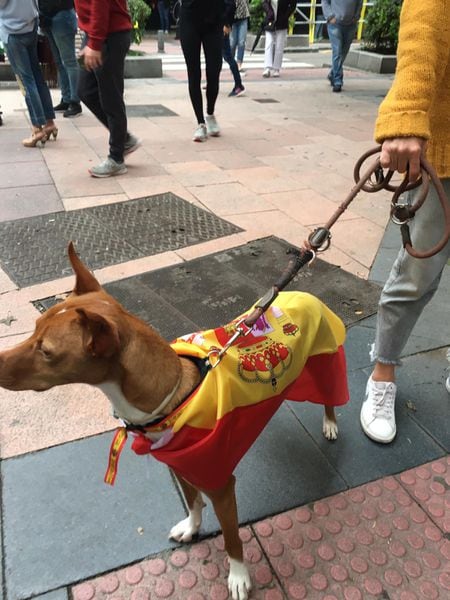
By Thursday, however, the street protests had all but disappeared, with just a few scattered people marching and chatting with reporters. One of them was Laura Domínguez, 39, whose dog Barri wore a Spanish flag as a cape.  “I am here because I am sick and tired,” said Domínguez, wearing a face mask and holding a cigarette.  “They’re creating a country of idlers.  And now they want to take everything away from me.”
Barri the dog wearing a Spanish flag.
Barri the dog wearing a Spanish flag.Manuel Viejo González
On Núñez de Balboa street, nearly 50% of residents voted for the conservative Popular Party (PP) at the last general election, held in November 2019, followed by the far-right Vox with 23%, the center-right Ciudadanos with 6.7%, and the Socialist Party (PSOE) with 5.4%. The leftist Más País and Unidas Podemos attracted less than 1% of the vote.
The regional premier of Madrid, Isabel Díaz Ayuso of the PP, has been encouraging these street demonstrations. “I hope people will go out on the street – the events of Núñez de Balboa are going to seem like a joke then,” she recently said. Meanwhile, Madrid Mayor José Luis Martínez Almeida, also of the PP, said this week that “as long as [safety] conditions are maintained, everyone is free to voice their opinion.”
Vox leader Santiago Abascal has been pushing for anti-government demonstrations and challenging authorities to ban them, arguing that this would prove that fundamental freedoms are being violated. At a recent session of Congress to extend the state of alarm, Abascal said that his party would apply for permission to hold demonstrations against the government on the streets of Spain’s main cities, but that in order to respect social-distancing measures, the protests would be held inside vehicles rather than on foot.

**************************************

Wednesday, 13 May 2020

SPANISH CARE HOMES?

CARE HOMES across Western Europe have been ravaged by coronavirus and in Spain alone there have been more than 16,000 deaths, many around the capital Madrid.  The true number may never be known, but families are asking why so many of their elderly relatives were lost.


Around lunchtime on 8 March, Rosana Castillo met up with some close friends not far from her house in Lucero, a working-class neighbourhood in west Madrid, and, as they did every year, joined a protest to mark International Women's Day.  They gave each other a warm hug, held hands and marched to chants of "Down with the patriarchy" and "Feminism will win".


Spaniards, then, could still venture freely outside and coronavirus, which had already killed several hundred in Italy, felt more like someone else's pain. Castillo, a 60-year-old retired primary school co-ordinator, had seen a few people on the underground wearing surgical masks as a protection, but thought most of them were probably tourists.  "We weren't really talking about it here," she said.

But it was preying on her mind. She had visited Carmela, her 86-year-old mother, hours before at Monte Hermoso, the care home near the square where the women had gathered.  Arriving at the main gate, Castillo was told she could not come in.  A worker said two residents had contracted Covid-19, the disease caused by the virus, and visits had been suspended.

Castillo had seen Carmela, who had advanced Alzheimer's, three days earlier, when her mother was discharged from hospital after a week's treatment for breathing difficulties.  The doctor told her Carmela was going to be fine, that her case was not related to the virus even though she had not been tested.
To Castillo's frustration, the worker said nothing else and went back inside Monte Hermoso.  As she exchanged phone numbers with some relatives, Castillo saw another worker rushing away, covering her mouth with a piece of cloth. They had known each other for a long time but when the woman left, without stopping to talk, Castillo became suspicious.   "At that moment," she told me, "I felt something wasn't right."


It was already widely known, first from China, then Italy, that elderly people with existing health issues were especially vulnerable to the virus.  Yet in Spain, where a fifth of the population is above 65, or some 8.9 million people, the government of Prime Minister Pedro Sánchez had announced little in response.
As Castillo followed news of the outbreak, she wondered if enough was being done to protect her mother or, indeed, anyone else. Unable to visit Carmela, who had lived there for five years, her only source of information came from infrequent, and usually very brief, phone calls from Monte Hermoso.  No matter how much Castillo asked, few things were said.

Consuelo Domínguez, a long-time friend, coincidentally, also had her mother living in Monte Hermoso, a red-brick, private centre with large windows and rooms for up to 130 residents.  She, too, struggled to get details.  Both daughters knew some staff had gone into isolation with coughs and a fever, the most common symptoms of Covid-19, and were pretty sure there was more going on.

Coronavirus was spreading in Spain at an alarming speed and, on 14 March, the prime minister imposed a state of emergency with a nationwide stay-at-home order. No-one was truly safe. On that afternoon, Domínguez received an unexpected call from Monte Hermoso.   The worker was "very tense," she said, "you could feel it."   Surreptitiously, Domínguez was told that 70 people had been infected with the virus and at least 10 patients had already died.  "I was frightened," she said. Domínguez called her friend.  "I couldn't believe it," Castillo recalled. "We weren't being told the truth."


Castillo and Domínguez alerted journalists and, on 17 March, Monte Hermoso became national news.  Only then did the Madrid government reportedly become aware of the devastating outbreak. Nineteen people were already dead.
In the evening, Castillo received a call from Monte Hermoso.  Her mother, who shared her room with another woman in similarly poor health, had a fever. "It shocked me," Castillo said.  She knew Carmela was unlikely to survive.


The relatives created a WhatsApp group, and disturbing messages flowed in. "Staff were very nervous...  Some [residents] were even a little bit delirious," said one of a visit two days before they had been halted.  Aurora Santos, whose mother was also at Monte Hermoso, recalled seeing residents unwell in the cafeteria around the same time.  "We didn't know anything the management had done," she told me, "the protocols they had followed, nothing".


She joined Castillo and Domínguez in gathering information.  They believed patients with symptoms had not been separated from those without, before the virus spread rapidly through the home.  Staff who had been in isolation after falling ill were reportedly not being replaced, while those who continued to work were having to do longer, exhausting shifts.  Lacking adequate protection, workers had to make face masks at home. "We were trying to help, our loved ones were there," Domínguez said.  "Why weren't they being honest with us?"

Monte Hermoso, it turned out, was not alone.  In fact, nobody seemed to know the true scale of what was going on.  For years, Carmen Flores, head of the Patients' Defenders ombudsman group, had warned about precarious conditions in some of Spain's 5,417 care homes.  "The amount of messages we were getting those days was insane," Flores told me. "I was thinking:  You can't let these people rot."


Three in every four homes in Spain are privately run and many patients, like Carmela, have some of their costs publicly funded.  José Manuel Ramírez, president of the federation representing social care managers, said fees received by the residences had not changed in the past decade, a result of years of austerity in Spain.

Many companies had to carry out savings somewhere to make a profit, claimed Flores, who also alleged that some lacked equipment even in normal times, while many operated with minimum staff. (Workers' unions also say staffing was insufficient, which Ramírez rejected.)   A worker at one care home where more than 90 patients died told me:  "For a long time we had been saying something serious would happen.  The conditions were unsustainable. This isn't a surprise at all."

Crowded hospitals were having to turn away patients from care homes and send them back, often to die.  Many residences did not have oxygen bottles, crucial in treating a disease known to cause severe respiratory problems, or even a doctor - Monte Hermoso, Castillo said, had one doctor, who most days worked only in the mornings.

The Spanish government had centralised the purchase and distribution of medical material amid a worldwide run, so the homes asked officials to send tests and protective kits.  However, Ramírez alleged they were not given priority, and pictures emerged of carers wearing gowns made of plastic bags.  "There was nothing that could be done without support," he said.  "It was a catastrophe."

The army was deployed to disinfect 1,300 care homes and Monte Hermoso was one of the first. Margarita Robles, the defence minister, said patients, in some places, were found abandoned without care, sometimes dead in their beds, the bodies left for funeral services to retrieve.  "Un horror," Flores told me.
Almost 6,000 people have now died in nursing homes in Madrid, after showing Covid-19 symptoms.  Spanish public prosecutors are investigating possible crimes including manslaughter for neglect, mistreatment and abandonment.

"I think there was a lot of wrongdoing," said Castillo.  "These people couldn't shout or say they were unwell. They died in silence and alone."  Monte Hermoso has not replied to interview requests by email; when contacted by phone, an employee told me they would not talk to journalists.

*******************************


Saturday, 14 March 2020

Johnson And The Guinea Pigs


by Les May

EARLIER this afternoon I watched the Minister for Care, Helen Whately, trying to give a reassuring message that the government had an effective strategy for dealing with the SARS-02 virus which when it infects humans causes the disease now known as Covid19What she did not explain is why the UK is following a strategy which differs from that being followed in Spain and Ireland, recommended as good practice by the World Health Organisation (WHO) and vigorously pursued by China.  That it works is evidenced by the massive decline in new cases in China in recent days and the fact that the it is now advising Italy about the measures to be taken to defeat the outbreak.

Following WHO guidance other countries affected by the disease are pursuing a policy of ‘contain the disease and eliminate the virus’That’s not easy and it is expensive.  As well as hospitalising and treating those who are suffering from the disease you have to find the people they have been in contact with and isolate them until they either show signs of the disease or you can be sure that the incubation period is over.

Boris Johnson and his government prefer the cheapskate option of letting the virus infect at least 60% of the us so that the survivors will no longer be at risk from infection and so transmission of the virus will come to an end and it will disappear. It has the grandiose title of ‘herd immunity’ which makes it sound a medically respectable strategy.

A more honest appraisal of it is that Johnson and his government are proposing to use the UK population as guinea pigs and are quite prepared to see a lot of people die as ‘collateral damage’. This is a purely political decision. If it really is ‘science based’ as is claimed then that evidence needs to be placed in the public domain so that it can be independently evaluated by people who are less close to government than Chief Scientific Adviser, Sir Patrick Valance and Chief Medical Officer, Professor Chris Whitty. These two seem happy to provide cover for the political decisions being made by Johnson.

As I pointed out in an earlier article if 60% of a UK population of 60 million people become infected with the virus causing the disease Covid19 that is 36 million people. The mortality rate for those infected is 1%, that translates to 360,000 deaths. Not everyone infected with the virus will show symptoms, but as the mortality rate for those who do show symptoms is about 4% we can estimate that the total number of people who will be infected and show symptoms, will be about 9 million people. Of these 80% will recover without hospitalisation, 15% will require oxygen and 5% will require to be artificially ventilated. In other words 1.8 million of those 36 million it is assumed will be infected, will need hospitalisation.

If we assume that the virus is with us for 18 weeks of the summer and the infection curve is fairly flat that means there will be a requirement for space for a 100,000 patients of which 75,000 will need oxygen and 25,000 will need to be artificially ventilated EACH WEEK. If the infection curve is not flat and is sharply peaked these figures will be much higher for a short time.

I have based these figures on the information provided by the WHO and UK government assumptions about the proportion of the population who need to be infected to produce ‘herd immunity’. If you don’t like the message don’t shoot the messenger.

If you are sceptical about whether the NHS will be able to cope with 100,000 high maintenance patients a week for much of the summer you are not alone.

When the weekly death toll starts to move into four figures Tory MPs will get jittery: when granny and grandad die gasping for breath, Johnson’s ‘Red Wall’ will be rubble.
************************

Monday, 11 November 2019

Not a good night for Spanish Socialists

by Guy Hedgecoe, Madrid
Although Pedro Sánchez's [Spanish] Socialists have emerged as winners having suffered only slight losses in this election, the overall result is not a positive one for the acting prime minister.

With Podemos having lost some ground and Más País securing only a handful of seats, there is no clear left-wing majority.  The Socialists' arch-rivals on the right, the PP, have recovered many of the seats they lost in April's ballot.

If the country's longstanding political stalemate is to be broken, Mr Sánchez might have to seek the support of the PP [centre right], or else a third election in the space of one year could beckon.
Meanwhile, the huge surge by the nationalist Vox party makes it the country's third political force and it will now find it easier to set the agenda on the right. That is likely to hinder any attempts by Mr Sánchez to seek a conciliatory solution to the Catalan crisis.


The April election ended in deadlock, with parties failing to form a coalition by a September deadline, thus forcing Sunday's election.


To form a coalition now, they would need to form alliances with smaller, nationalist parties, analysts suggest.

Meanwhile, the PP and Vox could seek to make the most of their gains.

One PP politician said Prime Minister Sánchez should "start to think about going", given the early results.
******************

Tuesday, 5 November 2019

REVIEW: The Spanish Revolution 'Explained'

Review:  'Lessons of the Spanish Revolution 1936-39' 
by Vernon Richards (introduction by David Goodway). 
£15.00 ($21.95) Published by PM Press / Freedom Press.
reviewer Brian Bamford

Spanish Civil War &  

Sinful Post-Hoc Reasoning *


VERNON RICHARDS, a former long-term editor of the anarchist newspaper Freedom, in his introduction to the First English Edition (1953) of his 'Lessons of the Spanish Revolution' made a modest admission of his own limitations as he tried to counter his  critics:  'Some have cricised me for being wise after the event and for writing on events of which I was but a spectator from afar.  I mention these criticisms as a warning to the reader of my limited qualifications for dealing with such a complex subject.  But I feel I should in my defence also point out that that most of the criticisms I have made in this book were expressed by me in 1936-1939 in the columns of the journal Spain and the World.'

When recently I spoke to the historian David Goodway, who wrote the introduction for this current PM PRESS edition, he suggested that his distance from the events in Spain allowed Vernon Richards to be more 'objective' in his analysis. His remark did not entirely surprise me both because it reflected the view of other people in the Freedom group with whom I have discussed this matter, but additionally this approach fits with what Dr. Goodway argued when I attended one of his lectures at a Northern Radical History Network event in Bradford in April 2013, where he passionately argued that historians in the nature of things all develop a narrative, and then go on to relentlessly pursue the advocacy of that perspective.  Thus, history becomes a form of the art of advocacy and polemical presentation. 

'History is what historians do'?

'History is what historians do', declared Isaiah Berlin in his book 'The Proper Study of Mankind'.

Post-hoc reasoning is the fallacy where we believe that because one event follows another, the first must have been a cause of the second.  In some cases this is true, but other factors may be responsible.

Did the decision of the CNT to participate in the governments first in Barcelona and later in Madrid lead to a degeneration of the integrity of the whole of the Spanish anarchist body politic?  Was the leadership to blame for the compromise of principles or was it also a dereliction of duty on the part of the rank and file in the CNT?

In Chapter XX Vernon Richards responds to some of the critics of the original English edition.who claimed he had 'over-emphasised the faults of the leaders of the CNT-FAI' and 'had been "over-charitable" to the rank and file members of the revolutionary organisations.'   Richards admits these criticisms are 'valid, though we (he) also believes that we (he) has erred in the right direction!'

He argues further:  'The rank and file saw - or "instinctively felt" - more clearly than the leaders, and we (he) have no doubt in our mind that the action of the workers in raising the barricades in Barcelona in May 1937 was a last desperate attempt to save the revolution from strangulation by the Jacobins and the reactionary politicians who had insinuation by themselves once more into positions of power.  Barcelona in May 1937 was to the Spanish Revolution what Kronstadt, sixteen years earlier, had been to the Russian Revolution.'

The seeds of the 'Lessons of the Spanish Revolution'?


VERNON Richards admits in his Introduction (1953) that his historical account would never have been written but for the publication of the first two volumes of La CNT en la Revolution Espanola by Jose Peirats.  Other sources he gives are Diego Abad de Santillan's Por que perdimos la guerra and Gerald Brenan's Spanish Labyrinth.  

Recently Stuart Christie told me that Vernon Richards had written this history in response to Felix Morrow's Revolution & Counter-Revolution in Spain (New York: Pathfinder, 1938).  I haven't been able to confirm this but in his Biographical Postscript in 1972 Vernon Richards welcomed 'more material.... from.all quarters on the left' including Felix Morrow's  book.  

Stuart Christie e-mailed me to say:  'My recollection of Vero’s book was that it was an attempt to respond to Felix Morrow’s half-decent 'Revolution and Counter-Revolution in Spain’.

What is notable about Felix Morrow's Trotskyist account here is that he, like so many Marxists, focuses on the correct  political leadership and he argues that the anarcho-syndicalist CNT 'had changed little since its origin in the Cordoba Congess of 1872' and being 'Hopelessly anti-political, it played no role in bringing the Republic', adding  'Spain would not find its ideological leadership here'.  

Mr. Morrow concludes his analysis:  'Thus, the (Spanish) proletariat was without leadership to prepare it for its great tasks, when the republic arrived.  It was to pay dearly for this lack!'

What Morrow is doing here is using apriori or cookbook thinking in which he and Leon Trotsky use to make sense of the Spanish context in the historical background and development of the Spanish Civil War and to create a blueprint for what to do.  He takes the view that what was needed in the Spanish conflict was a 'Bolshevik methodology' (p6 of 'Revolution & Counter-Revolution in Spain' pub. by Pathfinder) arguing:
'The making of the Soviet Union and its achievements - a peasant country like Spain - were extraordinarily popular in Spain.  But the Bolshevik methodology of the Russian Revolution was almost unknown.  The theoretical backwardness of Spanish socialism had produced only a small wing for Bolshevism in 1918.'   

And yet most of the Spanish anarchists rejected the Bolshevik model.  Indeed, one of the main concerns of the adherents of the CNT and the anarchists in the FAI in July 1936, was to avoid what they saw as the errors associated with the development of the Russian Revolution.   Vernon Richards presents it thus in Ch. IV entitled 'ANARCHIST DICTATORSHIP OR COLLABORATION AND DEMOCRACY':
'The dilemma of the "anarchist and confederal dictatorship" or "collaboration and democracy" existed only for those "influential militants" of the CNT-FAI who, wrongly interpreting their functions as delegates, took upon themselves the task of directing the popular movement. '

Mr. Richards begins by saying:  'The first mistake, it should be remembered, was made in the early days of the struggle, when an ill-armed people were halting a carefully prepared military operation carried out by a trained and well-equipped army, which no one, not even some of the "influential members" of the CNT-FAI, imagined could be resisted.'

Richards concludes:  'The slogan of the CNT-FAI leadership - "the war first, the revolution after" - was the greatest blunder that could have been made.'
He supports this with a quote from Diego Abad de Santillan:
'We knew that it was not possible to triumph in the revolution if we were not victorious in the war.  We even sacrificed the revolution without noticing that that sacrifice also implied the sacrifice of the objectives of the war.'

Against this there is the view of Paul Preston, perhaps currently the most widely read historian in the English language on the Spanish Civil War, who argues:
'While exhilarating to participants and observers such as George Orwell, the great collectivist experiments of the autumn of 1936 did little to create a war machine.... The May events witnessed by Orwell in Barcelona were provoked by the need to remove obstacles to the efficient conduct of the war.  Despite incorporating the working class militias into the regular forces and dismantling the collectives, Negrin's government still did not achieve victory - not because its policies were wrong but because of the international forces arrayed against the Republic.'

Shortly before I embarked on this review one of  Preston's former students sent me this e-mail:
'The bottom line is Paul’s (Preston) fundamental and unshakeable belief that the absolute priority on the Republican side of the Spanish Civil War should have been to focus on the conventional war effort and not on the Revolution, which was detrimental to that effort — and his total support for the actions of the Negrin government and the integrity of Negrin himself.'

On the 15th, July 2016, during an interview with the historian Ian Kershaw, entitled 'The Last Days of the Spanish Civil War', Paul Preston had even claimed that Negrin was 'the Churchill of the Spanish republic - the great War Leader.'   


The main danger in philosophy, as Lars Hertzberg identifies it, is the danger of apriorism, the idea that we can tell how things “must be”.  It strikes me that some English historians like Sir Paul Preston and Dr. David Goodway readily embrace apriorism: Preston in 'The Spanish Holocaust'** and Goodway in his claim that all historians pursue and advocate a preconceived narrative.*** 

Yet Isaiah Berlin in his monumental book The Proper Study of Mankind wrote:  'History does not reveal causes; it presents only a blank succession of unexplained events.'   

In Sir Paul Preston's interview above with Ian Kershaw, Preston said that he intended to write a book about the 'guilty men' and specified Largo Caballero as a principle culprit in this respect.  Similarly Mr. Richards reveals his own bias when commenting on Burnett Bolloten's book, which he otherwise admires, he writes:  'The new material I think presents the socialist/trade union leader Largo Caballero in too favourable a light - as a victim of intrigues - whereas he was an old fox, as are all trade union leaders - not least the anarcho-syndicalist variety, such as Lopez, Peiro, and Pestana.'

I remember Jim Pinkerton, the former International Secretary of the old Syndicalist Workers' Federation, once told me that Vernon Richards would never join a trade union because it was not in his nature to do so.  At one point in this book he even describes a trade union as if it were what the sociologists call a 'total institution':  
'And trade unions just like other self-contained concentrations of human beings, such as prisons, armies, and hospitals, are small-scale copies of existing society with its qualities, as well as its faults.' 

Like Vernon Richards I've spent some time in prison in the UK, and in the summer of 1963, I was even held in a dungeon in a small village in the province of Segovia, and I can tell him that there is a vast qualitive difference in these experiences to being a rank and file member of a trade union in either the UK, in the T&G in Gibraltar, or in the La Linea branch of the CNT in Spain.  
 
Mr. Richards demonstrates his apriorism in the section subtitled 'Anarchism and Syndicalism' which begins by declaring:  'In organisations with a mass following, the small anarchist minority can only retain its identity and exert a revolutionary influence by maintaining a position of intransigence.' 

Then Richards concludes by telling us and the Spaniards struggling to tackle the privations of the Civil War, that:  'Thirty years earlier, Malatesta, with that profound understanding of his fellow men which inspired all his writings, had clearly seen the effects of the fusion of the anarchist movement with the syndicalist organisation...'  

In reviewing this book it is clear that it is well worth reading the present work, for as Jose Peirats in 1954 wrote:  'It is important to anarchists to draw the lessons of the facts and actions of their own movement.'    Yet Peirats argues Richards's book which extols Malatesta and anarcho-communist insurrection over the anarcho-syndicalist General Strike has flaws as well as virtues.  Indeed I seem to recall that Peirats book on  The CNT in the Revolution Espanola arguing that the anarchists were in fact 'too insurrectionary' in so far as they seized the towns and then neglected the small pueblos.

And yet, though I would have you read these histories I am mindful of what Peirats said about the Vernon  Richards' Lessons of the Spanish Revolution, he declared:  
'este obrita' (small work) is too 'severo' and 'demasiado lateral' (too bias) and 'selectivo'.  Peirats concludes that 'none of his (Richards's) statements will be contradicted by history' but it is necessary 'to give to facts their relative importance.'

We must be aware that all these historians Richards, Goodway, and Preston are guilty of  apriorism.  Both Richards and Preston, have criticised Orwell for his original naivety about both the situation in Spain when he went to Spain.  That, in my view, makes Orwell's observations more reliable because it helps him to observe the unfolding of events without the clutter of preconceived notions.

Lars Hertzberg takes up this question 'apriorism' by addressing an issue that was absolutely fundamental for a philosopher like Wittgenstein: the question of honesty.  According to Hertzberg, Wittgenstein always regarded honesty as an issue in philosophy, and the question of what it means to “try to keep philosophy honest” is unavoidable for anyone working in the Wittgensteinian tradition.  Hertzberg is not saying that philosophers in that tradition are more honest than others.  His point is rather that for Wittgenstein “a concern with one’s intellectual honesty is internal to the difficulty of philosophy”

In the case of the historians like Richards, Goodway and Preston, their primary concern is the art of advocacy. 

When Peirats writes it is necessary 'to give to facts their relative importance' it is because he is conscious that Richards has undervalued the experience of the heat of the moment in the context of the Spanish Civil War.  When I wrote in Freedom an obituary for Frederica Montseny**** in January 1994, Vernon was critical complaining to Charles Crute that it was too sympathetic to 'someone like her' and that that I hadn't refered to his own book.  Frederica had joined the republican government as a Minister but had later admitted that it was a mistake.

Helenio Capellas, the Catalan anarchist whose father was in the same Los Solidarios group as Durruti and Garcia told me in the 1990s that while Durruti was not so bright, Spanish anarchism had a lucky escape when Garcia Oliver didn't succeed in dominating the anarchist movement, because he would have proven to be a bit too much like an anarchist Lenin.

This is what Peirats means when he claims Richards is too severe on 'individuals' by which Richards means those guilty folk who joined and supported the republican government: I remember in 1964 reading in a  glossy Spanish Civil War history publication on a news-stand, that was produced by people sympathetic to Franco, and it claimed that the effect of anarchists joining the government was shocking in its effect on Spaniards in the 1930s.  


“Propuesta Premio Nobel de la Paz al Generalísimo Franco”

In 1964, General Franco's Spain commemorated 'XXV años de paz franquista : sociedad y cultura en España hacia', and I was with my family in the Andalucian town Ronda in the August of that year when the festival was in full swing; indeed 1964 was also the year that Franco was nominated for the Nobel Prize for Peace.  At that time I was just discovering Ronda a town which Ernest Hemingway and Ava Gardner spent time, but it was also where my one-year old eldest son caught a dose of hay fever and started to vomit and failing to keep his food down.  A visit to the local Chemist - we could't afford a doctor - who gave us suppositories (Spain at that time depended on imported French medicine and it meant using suppositories for more ailments than constipation) which cured him within a couple of days.

But such everyday problems are trivial to the historian who works on a grand scale.  The problem with the historians according to Tolstoy is that 'Everything is forced into a standard mold invented by the historians:  Tsar Ivan the Terrible,... after 1560 suddenly becomes transform from a wise and virtuous man into a mad and cruel tyrant.  How?  Why? - You mustn't even ask...'  

This is what Dr. David Goodway has already admitted above and it is something which truly represents the poverty of the historians.  At least Goodway was honest about that,   But Vernon Richards, unlike his companera Marie Louise Berneri, never went to Spain during the Civil War.  He later, after 1958 helped to set-up a resort on the Costa Brava.  In that way he had contact with the Catalans and found that in the rural areas the people in the villages 'talked openly, because they knew who could not be trusted in the community, whereas in Barcelona, for instance, you did not know your neighbour at the next cafe table and therefore talked openly at home or outside away from the crowds.'  That seemed  consistent with my own experience in Alicante in 1963 and later in Andalucia; I remember what a shock it was in 1967 when I went to live briefly in Portugal, in Elvas, and found the Portuguese talking freely in bars about politics.

The texture of life & 'unreal histories'

or how historians get fat?


When Isaiah Berlin***** addressed what Tolstoy had to say about the historians he quoted from the War and Peace, epilogue, part 1, chapter 1:  'If we we allow that human life can be ruled by reason, the possibility of life [i.e. as a spontaneous activity involving consciousness of free will] is destroyed.' 

According to Berlin: "Tolstoy wanted to write a historical novel whose 'principal aims was to contrast the 'real' texture of life, both of individuals and communities, with the unreal picture presented by historians.  Again and again in the pages of War and Peace we get a sharp juxtaposition of 'realty' what 'really' occurred - with the distorting medium through which it will later be presented in the official accounts offered to the public, and indeed be recollected by the actors themselves - the original memories having now been touched up by their own treacherous (inevitably treacherous because automatically rationalising and formalising) minds.  Tolstoy is perpetually placing the heroes of War and Peace in situations where this becomes particularly evident."

What we have in these histories of the historians is what Tolstoy calls the 'great illusion' which he sets out to expose.  The historian Paul Preston in the interview already referred to with Ian Kershaw,  related about when he went to Spain:  'Of course the Spain of the late 1960s, was much nearer to the Spain of the civil War than the Spain of today, ... original memories.'  He also made a joke to Kershaw:  'I was thin when I went to Spain'.  Since then he's made a good living writing about little else.


It is because of this defect attributed to the historians so clearly perceived by Tolstoy, that explains why George Orwell's 'Homage to Catalonia' with all its limitations is in the end is so much more a populat and influential to the work of the professional historians of the likes of Paul Preston.   As I write this Sir Paul Preston himself is having to admit his debt to Gerald Brenan, formerly a member of the Bloomsbury Group; with  ‎Lytton StracheyVirginia Woolf, John Maynard Keynes, and E. M. Forster, and later author of The Spanish Labyrinth: an Account of the Social & Political Background of the Spanish Civil War.  Brenan was more of an anthropologist than a historian and besides the Spanish Labyrinth wrote about village life in Andalucia, as was  Julian Pitt-Rivers who wrote People of the Sierra a study of the village of Grazellema a short bus ride from Ronda.  Franz Borkenau  produced an eye-witness accounts in the The Spanish Cockpit as a sociologist who visited Spain in the midst of the war in 1936 and 1937.  Even Vernon Richards and Jose Peirats were really autodidacts rather than professional historians, and I believe they were better off for this.

I together with my young wife lived for over a year in the home of a recently widowed seamstress and her two daughters, Conchita and Pepita, in the fishing village of Denia.  It was there that my eldest lad was born in August 1963.  Vernon Richards refers in his biographical postscript to Margarita Balaguer, an eighteen-year-old seamstress in a haute.couture fashion house 'which she had attempted  unsuccessfully to collectivize found the liberation of women the most rewarding of all the revolutionary conquests.  For as long as she could remember she had fought the accepted notion that 'men and women could  never be friends.'  Now she found she had better friends among men than among women.  A new comradeship had arisen."  I don't know what my seamstress landlady, Senora Lola, in Denia, would have had to say about that all those years ago when we went to tidy-up her dead husband's niche in the cemetery on All Souls Day in 1963.  Last month, some 65 years after General Franco was nominated for the Nobel Peace Prize, the socialist goverment of the acting Prime Minister of Spain, Pedro Sanchez has had the remains of its former dictator from the state mausoleum in the Valley of the Fallen, where he was buried in 1975, for reburial in a private grave, and  Sanchez claims it is a step towards national reconciliation, the exhumation was the most significant move in years by Spanish authorities to lay the ghost of the general whose legacy still divides the country he ruled as an autocrat for nearly four decades.  Meanwhile Catalonia is in crisis over the imprisionment of the Catalan nationalist leaders, and a poll by the pollster 40dB for EL PAÍS is suggesting that Spain which will be holding its fourth general election in four years his coming Sunday, and yet the new vote is not likely to break the prolonged political stalemate, according to a survey by the pollster 40dB for the newspaper EL PAÍS.


Logic and Sin in the writings of LUDWIG WITTGENSTEIN by Philip R. Sheilds:  Bertrand Russell was fond of relating the following story about Ludwig Wittgenstein's student days at Cambridge:  "he used to come to my rooms at midnight and, for hours, he would walk backwards anf forwards like a caged tiger.  On one such evening, after an hour or two of dead silence, I said to him, 'Wittenstein, are you thinking about logic or about your sins?'  'Both,' he said, and then reverted to silence." .'

**Danny Evans in the Bibliographical Postscript to 'Lessons of the Spanish Revolution' writes:  'Paul Preston, has moved in the opposite direction to the drift of specialist historiography, providing increasingly caricatured depictions of Spanish anarchists in his later work, most notably 'The Spanish Holocaust' (London: Harper Press, 2013).'

***  Dr. Goodway in his portrayal of the job of the historian at the 4th Northern Radical History Network meeting held on Saturday 20 April 2013, in Bradford

****    In November 1936, Francisco Largo Caballero appointed Montseny as Minister of Health. In doing so, she became the first woman in Spanish history to be a cabinet minister.[2] She was one of the first female ministers in Western Europe (but preceded by Danish Minister of Education, Nina Bang and Miina Sillanpää of Finland). She aimed to transform public health to meet the needs of the poor and the working class. To that end, she supported decentralized, locally l-responsive and preventative health care programs that mobilized the entire working class for the war effort. She was influenced by the anarchist sex reform movement, which since the 1920s had focused on reproductive rights and was minister in 1936 when Dr. Félix Martí Ibáñez, the anarchist director general of Health and Social Assistance of the Generalitat de Catalunya, issued the Eugenic Reform of Abortion, a decree that effectively made abortion on demand legal in Catalonia.  Once in exile took the view that it was an error for the anarchists to have participated in the republican government in 1936.

***** The Proper Study of Mankind: An Anthology of Essays by Isaih Berlin (PIMLICO) 1998.