Showing posts with label art. Show all posts

Friday, 27 November 2020

Greetings on Lancashire Day!

An occasional update from Lancashire Loominary
No. 2 November 27th 2020
Greetings on Lancashire Day!
This is an update about ideas, publications and events at Lancashire Loominary. It’s about publishing fiction and non-fiction on the history and culture of Lancashire (by which I mean all of it) and its people. It’s not about ‘the great and the good’ but so-called ‘ordinary’ working class people who did extraordinary things. I do this roughly every 4-6 weeks. Let me know if you don’t want to receive it.
The original ‘Lankishire Loominary’ was published by James T. Staton in Bolton in the 1850s and 1860s. The name changed on a fairly regular basis; at one point it was ‘The Bowtun Loominary, Tum Fowt Telegraph Un Lankishire Lookin’ Glass. But I like the alliteration of Lancashire Loominary and its textile connections. The reason you’re getting this is because you’ve either bought, helped or promoted previous examples of my work and I thought you might be interested in future titles.
Lancashire Re-united: A Lancashire Day thought-piece
Lancashire and Yorkshire both have strong identities and despite historic rivalries, we have more in common, as Jo Cox would have said, than what divides us. Yet while our Yorkshire neighbours are building up momentum for a ‘One Yorkshire’ region, Lancashire is lagging behind. On Lancashire Day 2020, this paper argues for a re-united Lancashire, with its own democratically-elected assembly, based broadly on its historic boundaries but looking to the future for a dynamic and inclusive county-region that could be at the forefront of a green industrial revolution. It isn’t about creating top-down structures but having an enabling body that can help things happen: in business, arts, education and other fields. As well as a new county-region body to replace the mish-mash of unelected regional bodies and mayors with little accountability, a re-united Lancashire also needs strong local government (that is genuinely local) working co-operatively with the communities it serves and a vibrant economy that is locally based where profits go back into the community.
Back in 1895, Bolton writer and visionary Allen Clarke said:
“I would like to see Lancashire a cluster of towns and villages, each fixed solid on its own agricultural and industrial base, doing its own spinning and weaving; with its theatre, gymnasium, schools, libraries, baths and all things necessary for body and soul. Supposing the energy, time and talent that have been given to manufacture and manufacturing inventions had been given to agriculture and agricultural inventions, would not there have been as wonderful results in food production as there have been in cotton goods production?” (Effects of the Factory System, 1895)
Utopian? Perhaps – we need our utopian visions!. But there’s an element of realism there too. He recognised that capitalism had unleashed enormously powerful productive forces, but not necessarily with the best results. What Clarke was saying over a century ago is being said by many green activists and thinkers today and was what Gandhi preached in his own time and what ‘small is beautiful’ thinkers like Leopold Kohr, Franz Schumacher and John Papworth argued.
Humanity has the resources and skills to create a better world, for everyone; the consequences of not trying are worsening climate change and all that follows from it. The old cliché remains true: think globally, act locally – and regionally.
Clarke looked forward to a Lancashire that was a greener, more self-sufficient place – within a co-operative rather than a capitalist system. Now, as we struggle to emerge from the coronavirus pandemic, is the time to think differently about the world we live in. This paper is about what Lancashire could look like in the next twenty years – by which I mean the ‘historic’ Lancashire, including Greater Manchester and much of Merseyside. But this is not about looking backward – it’s about creating a progressive and inclusive vision for a re-united Lancashire ‘county-region’ within a prosperous North and a Federal Britain. A Lancashire Co-operative Commonwealth.
The state of the county
The Lancashire of Allen Clarke’s day has changed in so many ways. In the towns, gone are the mills and mill chimneys with their attendant pollution and poor working conditions inside the factory walls. But we have also lost some of the civic pride and buoyancy of the great Lancashire boroughs including Clarke’s beloved Bolton.
‘Lancashire’ itself has been split and divided in what was a travesty of democracy. No wonder there is a very worrying degree of despondency and cynicism within these towns that ‘nothing can be done’ and we are powerless. It becomes easy to blame scapegoats, be they immigrants, asylum seekers, politicians or whoever.
Lancashire has yet to find a new role that can build on its past achievements, without just being a dull collection of retail parks, charity shops and sprawling suburbia, nor indeed a heritage theme park. We have many successful businesses and a thriving academic sector with great universities, some world-class, in many towns and cities; there is the potential for that to spin-off into new industries and services that are world-leaders.
Manchester has emerged as a dynamic regional centre, though many of the once-thriving towns surrounding it are in a parlous state. This has got to change and consigning towns like Bolton, Oldham, Rochdale and Bury to the role of commuter suburbs is not acceptable. Instead of the centralised ‘city-region’ we need a more decentralised and collaborative ‘county-region’ with several centres and smaller hubs connected by good rail links.
There is a disconnect between urban and rural, with tourist ‘honeypots’ around Lancashire and areas like the Ribble Valley and Trough of Bowland besieged by traffic from towns and cities and homes for local people made unaffordable by urban dwellers buying up second homes – a process accelerated by Covid-19.
The county that was stolen
Allen Clarke’s Lancashire has been shrunk by an undemocratic diktat in the 1970s. Nobody asked the people of Bolton, Rochdale, Oldham, Wigan and other towns if they wanted to be part of ‘Greater Manchester’. We have an elected mayor but without the democratic oversight of an elected council – which at least the original Greater Manchester Council had, before it was abolished by Mrs Thatcher in 1986. Something else we weren’t asked about. Now, in 2020, some politicians are contemplating further municipal vandalism with the destruction of the remaining ‘Lancashire’ county council and three ‘super’ councils replacing it and the existing districts. Talk about making a bad job even worse. In Cumbria, there is talk of creating one single unitary authority; this would mean the death of ‘local’ government.
Allen Clarke was a strong believer in municipal reform and backed The Municipal Reform League, formed in Lancashire in the early 1900s. There’s a need for something like that but on a bigger scale, addressing the huge democratic deficit in the English regions, particularly the North, as well as the loss of power by local government. We need a ‘Campaign for Northern Democracy’ that can involve Lancashire, Yorkshire, Cheshire, Cumbria and the North-East as friendly allies and partners.
Samuel Compston of Rossendale, a radical Liberal of the old school, spoke of the virtue of ‘county clanship, in no narrow sense’. He was on to something and his words were carefully chosen. Regional or county pride does not pre-suppose antipathy to other regions and nations, and it needs to include everyone within the region. But it requires a democratic voice, not just one person elected every few years as ‘mayor’, nor a committee of local authority leaders whose prime loyalty is to their own council ward.
Yorkshire has been quicker off the mark and the Campaign for a Yorkshire Parliament has won wide cross-party support; the Yorkshire Party has made several local gains. The Yorkshire-based ‘Same Skies Collective’ has developed some fresh new ways of thinking about regionalism. The Yorkshire Society is succeeded in reinvigorating a strong, inclusive Yorkshire identity - a very good model for us to follow in Lancashire.
Here, there’s a ‘Friends of Real Lancashire’ and we have a Lancashire Society which currently has a low profile. Lancashire needs to play its part in the regionalist revival with a much higher profile and cross-party support. A reformed Lancashire that includes Greater Manchester and Merseyside makes sense as an economic unit but also chimes with people’s identities – in a way that artificial ‘city regions’ never will.
‘Greater Manchester’ typifies the problem of ‘city-regions’. It has reduced the once proudly-independent county boroughs to the status of satellites - commuter suburbs of Manchester (or ‘Manctopia’ as it was described in an excellent TV programme recently). Nearly 50 years on from the creation of ‘Greater Manchester’ our ‘city region’ still has precious little legitimacy and if there was a referendum tomorrow on being part of Lancashire or ‘Greater Manchester’ I have little doubt about the result.
A democratic new Lancashire
Regional democracy must be the next big jump for our political system with county assemblies, elected proportionately, taking real powers out of Westminster and Whitehall, backed up by strong well-resourced local government which has the right scale (not too big!). In England, we haven’t grasped the distinction between the national, regional and local, with cack-handed attempts to combine the regional and local (witness current attempts to create a unitary authority for all of Cumbria and three huge ‘local’ authorities covering all Lancashire). The latter are neither sufficiently ‘strategic’ to be effective regional bodies, and anything but ‘local’. Cumbria itself is big enough to be a county-region but still needs effective local government beneath it.
We need to get power out of the centre – Westminster/Whitehall – and give county-regions such as Lancashire real powers (see below) complemented by local government which really is ‘local’ and relates to historic, ‘felt’ identities which make economic and political sense.
Parameters and powers
A re-constituted Lancashire county-region should include much of what once constituted Lancashire with the additions of parts of historic Cheshire to the south (Stockport, Tameside and Trafford in Greater Manchester). In some places, e.g. Warrington, Widnes and Runcorn, local referenda on joining the appropriate county-region could be held. The historic ‘Lancashire north of the Sands’ really makes more sense within a Cumbria county-region that works closely with its Lancashire sister. This provides a county-region of significant size able to wield economic clout without being too large (which a region of ‘The North’ would be, both in population and geographical scale). Crucially, it would reflect people’s identities.
A major failure of the attempts to create regional assemblies during the Blair Government was their obvious lack of powers, prompting the successful attempts by the advocates of the centralised status quo to label them as expensive ‘white elephants’. While on one hand it makes sense for a new county-region to evolve gradually in terms of the powers and responsibilities it has, it must be able to demonstrate a clear reason to exist from the start. That means taking over responsibility for many of the areas which Wales and Scotland already have. It should include tax-raising powers.
The county-region should be empowered to support economic development across its area, investing in emerging industries, research and marketing. The ‘Lancashire Enterprises’ of the 1980s, stimulated and overseen by Lancashire County Council, would be a good model to start with. Part of its role should be to encourage new social enterprises and encourage greater employee and community involvement in large enterprises.
For transport, a ‘Transport for Lancashire’ should be created to take over the powers of existing transport authorities, as well as the ineffective Transport for the North. There should be close collaboration between sister bodies in Yorkshire, Cumbria, the North-east, and the Midlands, with formation of joint bodies to develop inter-regional links.
Another regular canard against regional government is that it creates ‘more politicians - ’jobs for the boys’, another effective line of attack against the idea of a North-East Assembly in 2004. It depends how you look at that. Regional devolution must include reducing the number of MPs at Westminster, as their functions transfer to the county-region. The same goes for the civil servants. Some powers that are currently devolved, but with little democratic scrutiny (transport, health, etc.) could simply come under the democratically-elected county-region, with members elected by a proportional voting system.
Localising local government
One of the most disastrous decisions of local government reform in the 70s was the destruction of small, usually highly efficient, local councils. Medium-sized towns, such as Darwen, Heywood, Farnworth, Radcliffe and others often ran their own services, built good quality housing and underpinned a very strong sense of civic pride. They were ruthlessly destroyed in the spurious cause that ‘big is better’ and the knee-jerk approach of far too many bureaucrats to centralise as much as possible. Can anyone honestly say that these medium-sized towns have benefitted from the changes imposed on them in the 70s?
Within a Lancashire ‘county-region’ local government should ultimately be based on smaller but empowered and well-resourced units that reflect people’s identities – the Darwens, Athertons, Radcliffes as well as larger towns such as Oldham, Burnley, Blackburn and Blackpool. However, in the short term use should be made of existing powers to create local councils (‘town’ or parish councils) for small and medium-sized towns that don’t have their own voice, based on the ‘Flatpack Democracy’ model developed by independent town councillors in Frome, Somerset.
These smaller but more powerful local councils should co-operate with their parent borough council and neighbouring communities on issues of mutual concern within a Lancashire county-region – a ‘co-operative commonwealth’ as argued below.
Having vibrant town as well as city centres must be a major element of the county-region. This means having a vision for town centres which offer something that the mega-stores don’t offer: a sense of conviviality and sociability. The arts have a key role to play – small galleries, larger public facilities including theatres and annual festivals (Bolton’s Film Festival is a good example) can help revive town centres and give them a new role.
Some Lancashire towns have been successful in developing niche manufacturing which offer highly skilled, well-paid jobs – but there’s a need for much more, working in partnership with the higher education sector. The ‘Preston Model’ should be rolled out to other similar-sized towns and cities to encourage much more local procurement and business support. It all needs sensitive encouragement which should come from re-structured and empowered local councils working within a collaborative framework provided by the county-region’s Lancashire Enterprises, as part of ‘The Lancashire Co-operative Commonwealth’.
A new green industrial revolution for Lancashire
Allen Clarke’s prophecy in Effects of the Factory System in (1895) that the cotton industry was doomed has finally come to be. Most of the mills that once dotted the south Lancashire landscape have been demolished. A few have survived but many are in poor condition, with only the prospect of demolition ahead of them unless something is done. The University of Bolton has had the sense to re-use some old mill buildings as part of its campus.
Yet most of the surviving Lancashire mills, perhaps with the exception of Manchester’s Ancoats, don’t have the wonderful mix of creative industries, office space and living accommodation that has been achieved with some of the mills in Yorkshire. At Saltaire, Salt’s Mill is perhaps the finest example, though rivalled by the Dean Clough Mills in Halifax. More should be done to protect our Lancashire mills and find good uses for them. Why should Yorkshire have all the fun?
Allen Clarke would have loved the idea of putting the mill buildings to better use - as places to live, but also as office and art space, recreational centres and performance areas. How about mill roof gardens? There’d be no shortage of space, with room to grow fruit and veg. Time for the ‘Incredible Edible Mill’!
We also need to build new, inspirational buildings that can take their place alongside the fine architecture bequeathed us by past generations. We need a vision, at least as radical as that of the Bolton landscape architect T.H. Mawson, of what our towns and cities should look like in the next 20 years, not what developers think is ‘good enough’ for us and makes the quickest return for them. We need some new Lord Leverhulmes (for all his faults!), women and men of vision, able to work collaboratively and creatively. Lancashire could be at the forefront, once again, of an industrial revolution – but this time a green revolution which benefits everyone, not just a handful of entrepreneurs.
Sharing the same skies: the countryside for everyone
Alongside a vibrant urban society, economy and culture, we need to make the best of our countryside, the ‘green lungs’ that make Lancashire so special. At its best, it can compete with the Lakes and the Peak District in terms of scenic beauty and is relatively well served with vibrant shops and smaller towns. It’s a huge asset in attracting talent into the region as a place to live and work.
Yet public transport access to the countryside is nothing like as good as it ought to be. Some of the most attractive areas have little or no bus services, or they don’t operate on Sundays – just when people need them. Places like Rivington, Pendle and Holcombe – let alone the Ribble Valley and Pendle - can be clogged with cars and motor bikes at weekends. At the same time, many stations that gave walkers access to the countryside, have closed.
Never mind HS2, let’s rebuild a world-class local transport network. For a fraction of the cost of that high-speed white elephant, we could have a network of modern, zero-emission trams and buses serving town and country, feeding in to a core rail network. If we look at the examples of Germany, Switzerland and Austria their popular rural areas typically have either frequent train services or rural trams connecting from the larger urban centres.
One of the few bright spots during the coronavirus outbreak has been the remarkable growth in cycling. Clarke and his friends Johnston and Wild would be delighted. Quiet roads, good weather and time on your hands was the ideal combination. Cycle shops have enjoyed a boon. I hope this renewed interest in cycling will survive, particularly if the Government puts its money where its mouth is and provides funding to expand cycle facilities in both town and country. That will need a strong regional body to implement cycle infrastructure working with local authorities and communities – a clear role for Transport for Lancashire.
People will still use their car to get out into the countryside and that needs to be managed and provided for. Car parks can be ugly, but so can cars parked alongside verges. The more alternatives there are available, the less likely we are to assume that the only way to enjoy the countryside is by that form of transport which does most to disfigure it.
Why not copy the example of some of the national parks in the United States, which prohibit car access to the most sensitive areas? If you get there by car, leave it in a ‘parking lot’ and either walk, get on a local bus or hire a bike. It could work in some of our national parks including the Lakes and popular visitor locations such as Rivington and the Pendle Forest. The exciting plans for a ‘South Pennines’ regional park could include sensitive measures to restrict visitors’ car access and promote use of public transport, cycling and walking.
Allen Clarke wanted to see a new ‘agricultural revolution’ in Lancashire, and that’s still relevant. Much of Lancashire, particularly in the north of the county, has a highly productive agricultural sector and we need to guard against precious agricultural land being lost to development. We need to do much more to feed our own people and not be dependent on imported foods. The ‘incredible edible’ model, of small-scale food production within towns was invented here in Lancashire and needs to be rolled out in every town and village.
Beyond a boundary: a Red Rose Co-operative Commonwealth?
The future of England should be about county-regions co-operating with empowered, but geographically smaller, local councils. There should be strong encouragement to co-operate on issues when it makes sense, and to share resources and specialist staff. That co-operation should extend further, across the North. Why not a ‘Northern Federation’ of county-regions – Lancashire, Yorkshire, Cheshire, the North-East and Cumbria, collaborating on issues of joint concern, such as strategic transport links and academic co-operation?
Good, democratic governance must be about addressing inequality, jobs, the environment, health, education and having a thriving and diverse cultural sector. Allen Clarke’s vision in 1895, of locally-based and socially-owned units of production make sense in a modern digital age, co-operating as equals with partners across the globe.
His idea of a ‘co-operative commonwealth’ could certainly work at a Lancashire level; after all, it’s where co-operation began. Allen Clarke, with and his radical friends Solomon Partington, the co-operator and feminist Sarah Reddish and Samuel Compston looking over his shoulder, would have said “what are you waiting for?”
And we can’t wait. The coronavirus pandemic has focused people’s minds on the dysfunctional way we have lived our lives. An even bigger threat is climate change which requires re-thinking every aspect of how we live, travel, work and play. A democratic revolution is needed to create appropriate governance that can address those issues.
That revolution needs to go beyond Lancashire and the North. We need to build a Federal Britain which is no longer dominated by London: a federation of equals. Now is the time to create that Allen Clarke’s vision of a ‘Lancashire Co-operative Commonwealth’ that can, in the words of Clarke’s heroine, Rose Hilton – get agate with the job of “washing the smoky dust off the petals of the red rose” and create a county-region that is fit for the 21st century. A Lancashire re-united.
Lancashire United: What we stand for
· The promotion of a strong, inclusive Lancashire identity that is welcoming to everyone regardless of race, ethnicity, gender or age
· The creation of a new Lancashire county-region which includes Greater Manchester and Merseyside
· The formation of a democratically-elected Lancashire Assembly, using a fair voting system
· The devolution of powers over transport, health, education, economic development, culture and tourism to the county-region, with democratic oversight
· The encouragement of informal Lancashire-wide networks in the areas of higher education and research, culture and the arts, sport and other areas
· The encouragement of democratic forms of social ownership - ‘a co-operative commonwealth’
· The empowerment of local government and town/parish councils
· Close and collaborative working with our neighbours in Cumbria, Yorkshire, Cheshire and Derbyshire and the formation of a Northern Confederation
Lancashire Day, November 27th 2020
See facebook group #Lancashire United twitter @lancsunited and www.lancashireloominary.co.uk

Wednesday, 13 November 2019

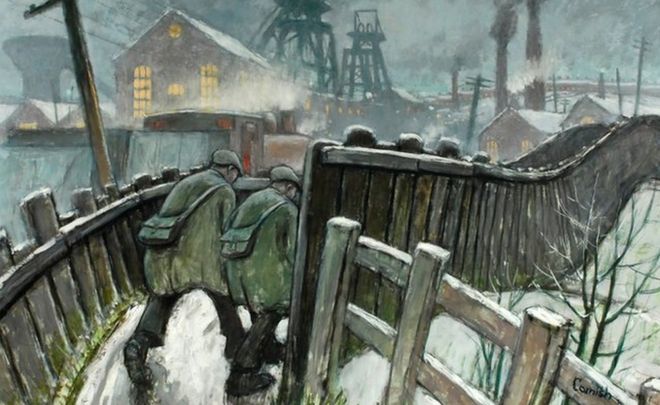
Commemorating Norman Cornish: Pitman Painter

 Pit Road, Winter by Norman Cornish
Pit Road by Norman Cornish depicts miners striding to work on a cold grey morning

A SERIES of exhibitions about a miner turned artist have been announced to mark a century since his birth. 

Norman Cornish, a former miner of Spennymoor, County Durham, was known for his paintings of life in the industrial North East.

He was a student of the Pitman's Academy at The Spennymoor Settlement set up in the 1930s to give mining families access to the arts.

Durham Council said six venues would host shows throughout the year.
One of the first shows, Norman Cornish, A Slice of Life opens at the Mining Art Gallery, Bishop Auckland Market Place on 6 April and will run until 13 October 2019.

Norman's son John Cornish said: "We are very proud of the esteem in which my father's work is held by the public and we hope the planned exhibitions and events will serve to reinforce the region's pride in its cultural heritage."
Cornish was awarded an Honorary Doctorate of Arts by the university in 2012. He died in 2014.
Later this year, four further exhibitions will be announced at Gala Gallery in Durham and the Greenfield Gallery in Newton Aycliffe.
Cornish's former home from the 1950s and 60s is set to be recreated as part of the Remaking Beamish Project 1950s town, which is expected to conclude the centenary events.

Sunday, 6 October 2019

Forger Shaun Greenhalgh gives interview at Bolton Museum

 By Saiqa Chaudhari Education Reporter
HE fooled the world's art experts with his incredible talent and gained international notoriety after it was revealed an "Egyptian Relic" he sold to Bolton Museum was a fake ­— created in a garden shed.
Now master forger Sean Greenhalgh is returning to Bolton Museum for a rare public interview to coincide with the airing of a new BBC series.

Mr Greenhalgh said: "Bolton Museum is the place that inspired my love and interest in art.
“I am sorry for what I did and so grateful for this opportunity to give something back.
“I hope the pieces I have made will bring in even more people to my hometown museum, which is a fantastic place that everyone should come and visit." 

He will be talking exclusively to Museum Collections Manager Sam Elliott about his past ­— which led to him being locked up ­— and forthcoming BBC Four series "Handmade in Bolton".

He created four historical objects for the programme using traditional methods and materials.
All four items ­— a jewelled eagle brooch, an alabaster carving, a ceramic plate, and a rock crystal bottle ­— will be on display in Bolton Museum’s foyer from October 7.

It is only the third time Mr Greenhalgh has set foot inside the museum, following his release from prison in 2010.

He created several hundred forgeries, which were sold to many museums as well as royalty and even an American president.

Among his forgeries was the infamous ‘Amarna Princess’, which was acquired by Bolton Council for £440,000. A British Museum report authenticated the figure as 3,300 years old.

In July this year, Mr Greenhalgh visited the museum with a film crew and director Waldemar Janusczak to get inspiration for the ceramic plate he was making for the BBC show.

The BBC Four series will air October 7, 9, 10, and 13 at 7.30pm.

Mr Greenhalgh’s question and answer session will take place on Friday, October 11 from 7pm to 8.30pm, in Bolton Library.

Tickets for the interview are £5 and all proceeds will go to the Mayor’s charities.

To reserve a seat visit https://shaungreenhalgh.eventbrite.co.uk or book in at Bolton Central Library. Places are limited.

Mr Greenhalgh will also be signing copies of his book, A Forger’s Tale: Confessions of the Bolton Forger, which will be available to purchase after the interview.

******************

Sunday, 26 May 2019

John Ruskin Matters Exhibition

  'Joy For Ever' 
by Brian Bamford
YESTERDAY, I visited an exhibition at the Whitworth Art Gallery in Manchester:   'This exhibition responds to the 200th birthday of artist, art critic and social reformer John Ruskin with a joyful look at how to use art for social change.'
Part of this exhibition draws on the work of Goya and Hogarth to illustrate a point about their work as 'outsiders to critique and reflect on dysfunctional European society of their time:  'the nationalism, warfare, poverty, homelessness, abuse, corruption,,, all subjects that come under their forensic scrutiny.'
This work is labelled according to the descriptive note 'as conceived as Britain propels towards exit from the European Union' and, it says, that 'this  timely exhibition activates the work of Goya and Hogarth to raise questions of a tortured mind-set of Britain on the eve of Brexit'.
One of the engravings by Hogarth shows his satirical critique of the South Sea Bubble.  This is relevant because the subtitle to the exhibition is 'How to use art to change the World and its Price in the Market'.  
*************

Wednesday, 23 January 2019

Ruskin’s and Turner’s influence on later artists


Refuge:  The Art of Belonging (15 February-29 June 2019, at Abbot Hall Gallery) 

 
IN showing Ruskins and Turners influence today among contemporary artists, the
exhibition will also display a series of large monochrome drawings by Emma Stibbon.
In June 2018, Royal Academician Stibbon retraced the steps of Turner and Ruskin
visiting the Alps.  She took the route made by Ruskin in June 1854 when he produced
a series of daguerreotypes (early photographs) of Alpine scenery, to see what remains
of the glaciers today.  Her work shows how geography has been impacted by climate
change over the last two centuries. Ruskin, Turner & the Storm Cloud will also be
shown at York Art Gallery from March 29 to June 23 2019.

The exhibition book, bringing together a collection of new essays by artists, climate
change scientists, art historians and curators, will be published in March 2019.  More
Lakeland Artsexhibitions during 2019: 
 
Refuge, The Art of Belonging (15 February-29 June 2019, Abbot Hall) tells the story
of artists who entered Britain as a result of Nazi occupation alongside a community
project exploring the lives of refugees living in Cumbria. The exhibition examines
displacement within artistswork and the adoption of new landscapes.

The show features works from Lakeland ArtsCollection including Hilde Goldschmidt,
Hans Coper, Lucie Rie, Lucian Freud, Frank Auerbach and Kurt Schwitters. Schwitters
(1887-1948) the first multi-media artist, settled in Ambleside, Cumbria, after coming
to Britain as a refugee. Anne, Countess of Pembroke (Lady Anne Clifford) (22 March-
22 June 2019, Abbot Hall) sees an unsung campaigner return home.

Abbot Hall takes part in the National Portrait Gallerys Coming Home project which is
loaning portraits of iconic individuals to places across the country that they are most
closely associated with. This means Abbot Hall is able to show off the finest portrait
of Lady Anne Clifford, which is in the National Portrait Gallerys collection. Lady Anne
Clifford (1590-1676) spent much of her life in a long and complex legal battle to obtain
the rights of her inheritance.

This portrait of her, by William Larkin, (c1618), is an excellent example of those commissioned by members of the Court of Charles I. Her fascinating fight is known
through her diaries and the magnificent

The Great Picture, painted in 1646 and on permanent show at Abbot Hall. The Lady
Anne Clifford portrait, on loan from the National Portrait Gallery, will be hung alongside
the portrait of her mother, Lady Margaret Russell, Countess of Cumberland, which was
also painted by William Larkin. Annes mother was the only person who supported her
campaign.

The arrival of this important portrait sees mother and daughter reunited in Cumbria.

*************

JOHN RUSKIN in CUMBRIA & Beyond?

Lakeland Arts’ exhibitions for 2019:

Turner, Ruskin, Scottish Colourists, The Art of Belonging and more 

 
'In 1884 Ruskin wrote about an encroaching Storm Cloud
a darkening of the skies
that he attributed to the belching chimneys of the modern world.'

Lakeland Arts has revealed key highlights from its exciting 2019 programme of exhibitions.
Helen Watson, Lakeland ArtsDirector of Programming, said:  

'Lakeland Arts has a fabulous and fascinating year ahead. We will be showing off great works from our own collections as well as major loans from across the UK.

'We will be exhibiting more than 450 years of art history as well as contemporary work from artists of today.'


Main summer exhibition:
The main summer show at Abbot Hall Art Gallery, Kendal, is Ruskin, Turner & the Storm Cloud (12 July – 5 October 2019).
The exhibition will include more than 100 works and stretch across five rooms.  It is one
of the biggest exhibitions in the UK during the 200th anniversary of John Ruskins birth.
Ruskin, Turner & the Storm Cloud will be the first in – depth examination of the relationship between both men, their work, and the impact Ruskin had in highlighting climate
change. In addition to Ruskins paintings and writings, the exhibition will feature an
introductory film along with a new publication incorporating fresh research on Ruskin
and Turners work.

Abbot Hall is partnering with York Art Gallery and University of York on Ruskin, Turner & the Storm Cloud. Works from both partners go on show alongside substantial loans
from national and regional collections. Ruskin (1819- 1900) was the leading English
art critic of the Victorian era, as well as an art patron, draughtsman, water colourist,
prominent social thinker and philanthropist.

JMW Turner (1775-1881) was a landscape painter, traveller, poet and teacher. Many
people consider him the first modern painter. Ruskin said of Turner he was the
greatest of the ageand was a lifelong supporter.  The exhibition will feature watercolours,
drawings and a haunting portrait of Ruskin from the National Portrait Gallery, made in
the aftermath of his first serious mental illness.

In 1884 Ruskin wrote about an encroaching Storm Cloud - a darkening of the skies
that he attributed to the belching chimneys of the modern world.  The imagery also
allowed him to articulate his ongoing mental struggles.   Bringing together Victorian
and contemporary works of art, the exhibition will demonstrate the unsettling messages
underpinning Ruskins eye for beauty in the natural world.

Ruskins anxiety about darkening skies and polluted storm clouds is contrasted with
his early interest in Turners luminous pictures. 

The exhibition contains a substantial display of Turners watercolours, demonstrating
his evolving style, and his creation of highly-finished sample studies of British and
alpine landscapes. Lakeland Arts’  The Passage of Mount St Gothard (1804) by
Turner will be a key painting on show.   Cultural organisations in Cumbria including
Ruskin Museum and Brantwood in Coniston will also be marking the anniversary of
Ruskins birth with a series of exhibitions and events in 2019, making the county the
place to visit for everything Ruskin related.
The Ruskin Museum holds the most comprehensive display in the Lake District about
the life and work of John Ruskin. Brantwood is Ruskins former home where he spent
the last 28 years of his life. Helen Watson said:
Ruskin, Turner & the Storm Cloud will be one of our biggest shows ever. If you havean interest in Ruskin and Turner this is a must-see exhibition.
Next year is hugely significant in celebrating Ruskin and we are delighted to have this landmark exhibition at Abbot Hall during the 200th anniversary of his birth. Its particularly apt that the exhibition takes place in Cumbria – the home of Ruskin and the place he found most inspiration.


**************

Tuesday, 27 November 2018

Bread & Roses Song & Spoken Word Award

THE Communication Workers’ Union (CWU) and Culture Matters are pleased to announce the second edition of their successful Songwriting and Spoken Word Award.   The Musicians’ Union is also sponsoring and supporting the Award this time.

The Award is now open for submissions. The new Award is a practical example of cultural democracy, with the aim of encouraging musicians and performers to write material meaningful to working class people and communities, and to encourage those communities to develop and practice their creativity.

There is a £100 cash prize for each of the top five entries.  The judges will be drawn from practising performers, the CWU, the Musician's Union, and members of Culture Matters.

Dave Ward, General Secretary of the CWU, said:
I welcome this continuing partnership with Culture Matters. The arts and culture generally are vital to the labour movement, and working class communities across the country. We want to build on the grassroots DIY ethic started by punk music, celebrate the new opportunities for working class people to write songs, make music and perform spoken word, and encourage contributions from people who might otherwise not consider entering competitions.

We are sponsoring this Award because we want to encourage our members in the CWU, and working people everywhere, to express themselves creatively on themes that matter to them as workers and which help develop understanding of the cultural struggle for a better world.

So get writing and get performing, and send your entries in!

Attila the Stockbroker, one of the judges, said:
This new Award is a great idea. There’s a real need to encourage younger and emerging performers to write and perform songs and poetry that mean something to ordinary working- class people rather than the mind-numbingly bland rubbish force-fed us by the mainstream music business and media.

Get involved – and encourage people you know to get involved!

Submission Guidelines and Award Rules:

Entry is open to all, regardless of trade union membership. The submission guidelines are as follows:
Entries should broadly deal with any aspect of working-class life, communities, culture and concerns.

Entries can be from solo or duo artists/performers, and are actively encouraged from grassroots, younger and emerging performers.

Entries should consist of one song or performance of original material, in English, whether previously published or not.

Entries should be submitted as audio or live/pre-recorded video files (MP3/4 format or video) via email. All entries will be judged equally, but some video entries may be also selected to feature on the Culture Matters YouTube channel, which is currently in development.

Entry is free and is open to all residents of Great Britain, regardless of trade union membership.
Culture Matters will fund five prizes of £100 each.

All entries will remain the copyright of the entrant, but CWU and Culture Matters will have the right to publish them online and in other media.

The organisers accept no responsibility for entries that are incorrectly submitted or not delivered due to technical faults.

By entering the Award, entrants agree to accept and be bound by the rules of the Award and the decisions of the judges.

Due to the likely volume of entries, the organisers regret that they cannot enter into correspondence with individual entrants.

Entries should be sent via email to: entriesculturematters@gmail.com

The deadline for receipt of submissions is midnight on March 2nd 2019. When emailing submissions, please provide your full name, postal address and phone number.

************

Wednesday, 4 April 2018

Decide For Yourself

by Les May

YOU can find an image of the mural which has been denounced as ‘anti-Semitic’ by people attacking Corbyn at:


If you click on it you will get an enlarged image. Right click on that and you will get a menu which includes ‘Save Image As’.  Find that file and click on it to load it into an image viewer. You will then be able to decide for yourself whether it really is ‘anti-Semitic’ or just a well executed piece of art which you are free to interpret as you wish.

As the ‘white on black’ font of the website is hard to read I have converted it to ‘black on white’ and appended it below. I hope the author does not mind.

How does a piece of public art lead to the possible downfall of one of 's most senior statesmen?  It sounds like a riddle and I'm sure it would baffle anybody just twenty years ago, but not in this current Orwellian age.  Literally just days after being accused of being a Russian agent, Jeremy Corbyn, leader of the Labour Party and Her Majesty's Opposition, has been denounced as an anti-Semite. 

Being labelled an anti-Semite is incredibly easy these days if you're a UFO and ghost-believing tin foil hat-wearing conspiracy theorist like me, but it is still quite rare inside the pen of Corbyn's ideological community.  The mural was put up in 2012 by the artist Kalen Ockerman, better known as 'Mear One', see: http://mearone.com/

It was called Freedom for Humanity and was painted on a wall in the heart of 's .  It depicts a row of six elderly suited men sitting round a table which is covered by a board game that resembles Monopoly.  The table has no legs and its top is supported on the backs of four naked and faceless seated human figures who are bent over completely.  Behind them are a pile of loose cogs from a machine.  In the background is a pair of smoking factory chimneys next to two objects that are either volcanoes or cooling towers from a power station.  There is a network of lines behind them that look like chemtrails in the sky.  On the left is a man carrying a placard in his right hand that says: 
'The New World Order is the enemy of humanity.'  His left hand is held aloft in a fist.   On the right is a tired and sad-looking mother holding her baby. Above the scene is a rising sun framing a pyramid with a detached capstone containing the Eye of Providence.   I think it is a magnificent artwork and deserves to be ranked among the great examples of political graffiti across the world, like those ingenious pieces from and .  It must have been a striking experience to walk down the street and see it. I was planning to take a trip to the location and film it for HPANWO TV while it was still there.   Then I looked into the matter and I found out that it had already been obliterated in 2012, just three weeks after it had been finished.  The borough council ordered the destruction of the painting on the grounds that it was 'anti-Semitic!'   Source: http://www.bbc.co.uk/news/av/uk-england-london-19844681/kalen-ockerman-mural-to-be-removed-from-brick-lane.

The problem that has arisen today comes from all those years ago. Jeremy Corbyn originally spoke out against the removal of Freedom for Humanity.  He told the artist he was "in good company" and compared the removal of the painting to the famous Man at the Crossroads fresco in that was whitewashed by the Rockefellers for its Marxist iconography (It was happily recreated in at a later date).  There is absolutely no suggestion at all that the six antagonistic figures in the painting were Jews.  The artist himself denied it and the man on whose wall the mural was painted, a restaurant manager of Bangladeshi origin, said that two of the figures looked Indian, see source link above.  The allegation is that the faces of the six evil men included generic Jewish features of the kind seen in propaganda from Nazi Germany.  I don't see that myself; the faces are all very different.  Two of them, the one of the far right and the one third from the left, look like old photographs of British colonial officials from the days of the Empire.  The one on the far left has a full beard that is more typically Russian.  The problem with the painting is most likely its conspiracy theoretical element.  As I say in the background links below, there is a paranoid hypersensitivity when it comes to linking conspiracy theory of any kind to hatred of Jews.  This serves a purpose for the people behind the conspiracy because it means their enemies are hampered by social degradation and marginalization.  Therefore the conspirators eagerly encourage this public hysteria.  However, in the background links I explain why it is, in the vast majority of cases, a false premise.  The New World Order is caused by the Illuminati, not the Jews.  I can't put it any simpler than that; there are no qualifiers to that statement. Corbyn was first pulled up by a Jewish MP, Luciana Berger, on Twitter (where else?). 

Corbyn backed down and about-turned. He said that Freedom for Humanity was 'deeply disturbing' and he now 'wholeheartedly supported its removal'.   He went on:  
'I sincerely regret that I did not look more closely at the image I was commenting on, the contents of which are deeply disturbing and anti-Semitic.'

As I've explained, the content of the mural is not anti-Semitic and there is information available to explain why that is in detail which I have produced myself. Corbyn should have known better than to believe that a grovelling public apology would save him from the standard and predictable hashtag barrage.  It would have been better to stand his ground and fight the anti-Semitism premise altogether.  If Mr Corbyn had approached me I would have coached him in this matter. The media lynch mob is currently in full swing;  the torches and pitchforks are being passed round. Jewish welfare groups under the influence of the Israeli lobby have taken the bait hook, line and sinker.  Corbyn is desperately trying to placate them, in vain.  As I said, it's an exercise in futility.  

This is just the latest in a series of attempts to discredit the leadership of Jeremy Corbyn by his Blairite opponents within the Labour Party.  See here for details of the previous flare-up: https://hpanwo-voice.blogspot.co.uk/2016/05/is-ken-livingstone-nazi.html.  The only real anti-Semitism in the Labour Party comes from the radicalized Muslims that the government have been breeding for the last few decades through their sponsorship of Saudi-run mega-mosques and their agents posing at popular media hate-preachers, see: http://hpanwo-voice.blogspot.co.uk/2016/08/anjem-choudary-arrest-blocked-by-mi5.html

Corbyn is actually very similar to Donald Trump.  He would be deeply offended at my comparison, but I think it's accurate.  He is a man in a political office whom the does not want in that role.  They worked hard to keep him out of it.  They have since wavered between trying to remove him and trying to manage the situation with him remaining as leader.  Whenever the latter fails they try the former.  Corbyn's career prospects are not looking rosy.   A part of me thinks this is probably for the best; not because of Corbyn himself but because of the second echelon of Labour officials behind him, a posse of total blackguards who are currently trying to ride in his slipstream to their own positions of power.  If Corbyn becomes Prime Minister then it will only be for a few months before there is an et tu Brutus situation and then he'll be lying in the back benches with Andy Burnham, Yvette Cooper and Diane Abbott's knives his back.  At the same time, anything that the real 'Evil Six!' from the painting do not want gives me a warm fuzzy feeling.  Thankfully the Jewish voice of reason has not gone silent in its hour of need. Jenny Manson of the Jewish Voice for Labour defended Corbyn and marvelled at the ingenuity of the media for smearing 'the most passionate anti-racist campaigner of the last forty years' as 'pro-racist and anti-Semitic.'  

 Source: https://evolvepolitics.com/the-jewish-voice-twitter-account-is-absolutely-destroying-the-medias-latest-corbyn-anti-semitism-smear-tweets/. I take my hat off to these people; they face abuse from other Jews for their stances. They were there for David Icke when he was in this position and I'm glad they are here again.

Wednesday, 21 February 2018

THE DANGER TREE IN MANCHESTER

 Review of The Danger Tree at Manchester Library by Steve Watson
(Eastern Correspondent)


BILL Drummond is a former art student, musician with the KLF, one of two blokes who burned a £million quid on the Isle of Jura in 1994, and has steadfastly refused to explain why ever since.  

Bill has an affinity with the North, and has a long relationship with Liverpool having worked at the Everyman Theatre in the 1980s!   In one of his recent books on the nature of art he states that 'all galleries should charge at the point of entry.  And they should be proud to do so.  Because they should be putting on works that people are willing to pay to see.'

Drummond was back in Liverpool last year and several hundred people had paid £100 to attend a few of his events, one involved ripping pages out of a book, the other dressing up in yellow capes, wandering round Toxteth and finishing up by the docks watching a stack of pallets being burnt. Art at its best?

For those that 
a) didn’t have £100 to spend 
and b) if they had would have spent it elsewhere in Liverpool then a random stroll may have taken them into one of them deplorable free exhibitions or installations as they call them these days down near the Pierhead!  

The Danger Tree, with its promotional leaflet saying 'Free to Enter' was making its second visit to the City!   And the exhibition following a stint in Birmingham is now in Manchester. 
 

The Danger Tree is described as an augmented reality art exhibition by impressionist landscape painter Scarlett Raven, and digital artist story teller Marc Marot and within seconds of entering through the front door visitors find themselves somewhere between a shelled out French farm building and the No Mans Land of The Somme.   Just over a hundred years ago in the real life fields of carnage thousands of French, English and Commonwealth troops faced a barrage of shells to the point where on 1st July 2016 some 57,000 were killed, seriously wounded or missing to the point where their remains would never be found.  

The one place of shelter if you can call it that was a large gnarled tree capable of providing both a point of refuge and an easy target for enemy fire.  Earning itself its 'Danger Tree' name it became the spot where many soldiers from Canada fighting for the Commonwealth would depart this world and at this conjuncture stories diverge.  Some sources say the dead tree still remains others that its spot sports a replacement and there may well have been many different Danger Trees across the jagged landscape but regardless it remains a point of thought and respect. 
 
A good hour session in the exhibit (which I will remind you is free Mr. Drummond) and you may or may not be aware that art can sometimes be powerfully challenging and dragging you out of your comfort zone.  Such exhibitions can be very subjective but rather than a line of static paintings or objects the trick with the Danger Tree is the use of electric wizardry to transform the illusion of the bombed out farmhouse in a war zone into a place where the sheer horror of the Somme literally surrounds you.  Using something called Blipper technology which is best appreciated than understood visitors are given an Ipod which when scanned across Raven’s stunning landscapes bursts into sound and movement with the war poems of Sassoon, Owen and Brooke as well as contemporary poets and voiced by Christopher Ecclestone, Sean Bean and Sophie Okonedo.  Individual soundtracks and moving images make the words augmented reality into one hell (in every sense) of an experience. 
 
This isn’t art to visit and feel warm.  This is art where you come out into the day light and feel slightly humbled shaken and subdued, this is the reality of the Accrington Pals and other local battalions marching off to France and returning as just names on cenotaphs.  This isn’t highbrow art, no its shock tactics of a part of history in the anniversary of its final end.  Our fathers, grandfathers and more brought back to life for a short period by a skeletal tree amongst a field of poppies.

Take shelter beneath The Danger Tree if you will at Manchester Central Library’s Exhibition Hall (First floor) daily except Sunday until March 31st. Mon -Thurs 10.00am 6.00pm, Fri & Sat 9.00am to 4.00pm. 
 
And its free Mr Drummond! 
****** 

Friday, 19 January 2018

Why a Minister for Loneliness?

By Les May


MOST of us have felt lonely at some time in our lives but last year a commission found that nearly nine million people in this country either often, or always, feel loneliness.  So when Theresa May said a few days ago  'I want to confront this challenge for our society and for all of us to take action to address the loneliness endured by the elderly, by carers, by those who have lost loved ones — people who have no one to talk to or share their thoughts and experiences with',  I think she should be applauded.

For once it's right to say 'throwing money at the problem isn't the answer'. Giving money is the easy bit.   Giving time is the thing that is hard.  Ultimately the success of this initiative is going to depend on the willingness of volunteers to do just that.

Recently I met an enthusiastic young woman working in a building society who has decided not to let her university education in Art and Drama go to waste and who is giving up some of her free time to use these skills to help others gain the confidence to interact with others.

You can see something of what she is trying to do at the Rochdale Apna Ghar KYP centre on Wednesday 31 January 2018 at 6pm. (01706) 630 140 and info@kyp.org.uk

Sunday, 1 October 2017

Art of Revolution


WE approached the Art of Revolution exhibition staged at the Undercroft in Norwich by the artist Gennadiy Ivanov, who orginates from Belarus and has lived in England for 15 years, in September with some trepidation. We had already been warned by a student that some of the exhibits were confusing so far as the images of so many sailors and clowns didn’t seem to immediately correspond with is commonly expected at an event commemorating 100-years of the Russian revolution.


It was an eclectic mix and I felt it was a powerful exhibition, which was in the end extended until the 14th, October.
I thought at first that the many portraits of sailors may have had something to do with the Kronstadt rebellion* in 1921, but was then reminded of the film Battleship Potemkin by Eisenstein which was about a rebellion in 1905. But the clown image I was told by Ivanov that the word 'Guevara' in Che Guevara means ‘clown’ in the country of Guevara’s birth.
For me perhaps the most powerful oil painting and image in the show was Gennadiy Ivanov’s ‘Sailor’s Hands’. The hands grasping desperately onto what may be a red flag are almost transparent.

In the blurb in the booklet that accompanies the exhibition the nature of the colour red is describe thus:
''In many cultures Red means passion and love. In Tibetan philosophy it signifies connection with the Universe. In the Russian language ‘red’ often means 'beautiful’. ‘Beauty Will Save the World' (Dostoevsky). Artists are responsible for bringing creativity to the world, not only to bring Beauty to it – but to Save it''
Mr Ivanov told the Eastern Daily Press:
The inspiration for the show for the show came from the 100the anniversary of the Russian Revolution but that the exhibition also explored revolution in the broadest possible terms…. It is an exhibition about different types of revolutions which have happened in 100 years like digital revolution, like art revolution, movie, fashion, design, industrial revolution, sexual revolution, so we have a very wide theme.’

 
* The Kronstadt rebellion was a major unsuccessful uprising against the Bolsheviks in March 1921, during the later years of the Russian Civil War. Led by Stepan Petrichenko[1] and consisting of Russian sailors, soldiers, and civilians, the rebellion was one of the reasons for Vladimir Lenin's and the Communist Party's decision to loosen its control of the Russian economy by implementing the New Economic Policy (NEP).[2][3]