
Showing posts with label york. Show all posts

Monday, 4 March 2019

'Is this York Free Press?'


York Free Press: IS THIS YFP? – I’ve Come to Register a Complaint! by Christopher Draper
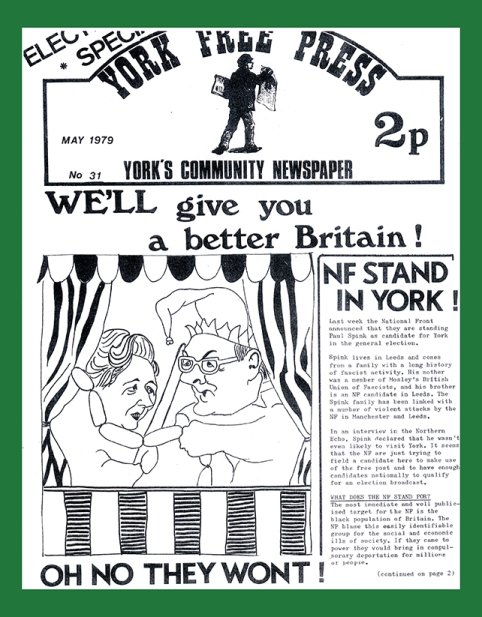


Cover of York Free Press, Issue 31, May 1979. Cartoon of Thatcher and Callaghan as Punch and Judy. Article about National Front standing for election in York.
York Free Press No.31, 1979 (C.Draper)

THAT was my introduction to “York Free Press”, one of the best and most enduring of the “alternative newspapers” that for a decade or two enlivened Britain’s culture and politics.
It was 1976 and I was an idealistic young teacher living and working in York and aggrieved at an article I’d read in a recent issue.  York’s selective school system was about to be “comprehensively” reorganised but the YFP article argued for incorporating six-form colleges which I considered a device for keeping an A-Level elite away from less academic plebs. YFP claimed to be open to everyone and advertised weekly meetings upstairs in the Lowther on King’s Staith so I turned up one evening expecting a row and instead was welcomed in and invited to write a rejoinder.  I was utterly disarmed, it wouldn’t happen at Socialist Worker!  I was already a libertarian socialist but this bunch of scruffy student hippies turned me 100% anarchist and so I’ve remained.

Actually they weren’t all scruffy hippies,  Vaughn Harvey was but Tony Zurbrugg (who now runs Merlin Press) was already a serious-minded libertarian-communist permanently clad in an RAF greatcoat, Danae and Howard Clarke (later of “War Resisters International”) were smart-casual and always smiling, Danny Golding “The Ayatollah” (nowadays Labour loyalist) was too humourless to qualify as a real hippy but there was always a supporting cast of “occasionals” who couldn’t be asked to turn up every week.   That was an attractive feature of YFP, you helped at whatever level you felt comfortable with.  Most political groups demand so much that they retain only fanatics.  YFP enjoyed regular “bring food and drink to share” socials so less active supporters kept in touch and made friends with regular “collectivists”.

Around 1978 we organised a national 'PAPERS EVERYWHERE!' conference-jamboree weekend at York University.  We invited every community paper we could think of and people from about eighty titles turned up.  It was wonderful exchanging papers, experiences, ideas and what little technical expertise we’d acquired. I was especially impressed by a rather posh Sheffield guy who single-handed ran The Totley Independent, which he gave away free and financed by taking ads from small shops and tradesmen.  He stuck out like a sore thumb amongst an array of vaguely alternative-socialists but was content to paddle his own canoe.  It showed the potential of the format.  Some titles such as Islington Gutter Press and Rochdale Alternative Paper (RAP), which I believe sold 8,000 copies per issue, were real big hitters whilst others, like the Totley,were happy to nurture community spirit and less intent on exposing scandal and corruption.  RAP revealed Cyril Smith’s dirty deeds forty years before the commercial press dared touch the story.

I think two things sparked the birth of the alternative press, the “swinging sixties” do-it-yourself politics and certain technical developments in printing.  Lead-typesetting was no longer involved and the new process required less skill and cost.  Like other papers, at YFP we used ordinary typewriters to produce the text and trimmed, then glued the result to a large sheet of cartridge paper.  Other articles were stuck alongside the first to build up a newspaper page with spaces left for photographs which had to be “screened” and treated separately. Headlines were the real pain – LETRASET!

Headlines were produced by a sort of transfer process.  You bought these rather expensive “Letraset” transparent plastic sheets with individual black letters affixed to the undersides.  By scribbling on top of the required letter it detached from the sheet and adhered to the paper placed underneath  You had to build the headline a letter at a time, any misspelling meant you must discard your first effort and start all over again and keeping it all level and evenly spaced was a tedious task.  Sometimes we had lots of tables and space to lay out the paper but often we managed in someone’s cramped bedroom with people coming and going and ideas, jokes and arguments flying back and forth.

YFP was a monthly with a price of 2p and 1,000 print run, sold door to door with a network of local shops selling on the basis of sale or return. It was a struggle to keep it going but the paper survived long after I left York.  I was always a bit of a populist, keen to present the politics in an attractive wrapping and my favourite all-time article was, “The Great York Fish and Chip Survey!”   Every Thursday for three months we’d sample 3 or 4 different local chip shops, weigh the portion of chips and the fish and then assess the price, quality etc.  Finally we tabulated the results and published a league table to great reader acclaim! Is that petit bourgeois politics or anarchy in action? Every article was subject to the deepest of political analysis – “Is it ideologically sound?” – was the inevitable dilemma.

The balance of collective responsibility and initial initiative at YFP remained problematic.  When a character calling himself “Euston Arch” joined us he immediately began arranging music events in the name of YFP and only afterwards seeking collective approval.  When he signed us up to a potentially disastrous gig featuring “Wayne County and the Electric Chairs” at the Mecca Ballroom we accepted responsibility and survived but immediately expelled him from the collective.  After we printed a story by a guy who told us he was literally kicked out of his York bedsit by the landlord as a uniformed policeman stood idly by (illustrated by a cartoon of a cop shielding his eyes) I received a threat to sue from The Police Federation (my address, 1 Newton Terrace, was the published editorial address).  We agonised whether to apologise and “correct” the story or stand firm and take the consequences.  Fortunately, within days the local straight press published an account of the same landlord doing the same thing to someone else so we lived to fight another day.

Anarchism rather than socialism characterised the alternative papers movement.  Although lots of Marxists were individually supportive they tended to regard papers like YFP as trivial compared to their party newspapers whilst Tories and Labour Party types regarded us as scurrilous troublemakers. Although I wanted the paper to become a sort of local Private Eye, both funny and muck-raking, whilst at YFP I established an abiding interest in researching radical history. I interviewed a founder member of York Communist Party who claimed workers were more interested in politics in the old days and all he had to do in the twenties was ride his bike along a road, ring a hand-bell and people would come out of their houses and he’d start an impromptu discussion on socialism. He described how difficult it was to keep up with the ever-changing political line emanating from Moscow and how he’d finally been expelled from the CP when “I zigged when I should have zagged”!

In 1979 I researched and YFP published a series of articles on “Fascism in York in the 1930’s” which revealed a continuity of not only Blackshirtideas with current National Front candidates but the same local families were still organising attacks on socialist opponents. There were so many good stories and so many great times and in 1980 I was sorry to leave but keen to start another scurrilous rag elsewhere, but that’s a story for another day…
********

Wednesday, 23 January 2019

Ruskin’s and Turner’s influence on later artists


Refuge:  The Art of Belonging (15 February-29 June 2019, at Abbot Hall Gallery) 

 
IN showing Ruskins and Turners influence today among contemporary artists, the
exhibition will also display a series of large monochrome drawings by Emma Stibbon.
In June 2018, Royal Academician Stibbon retraced the steps of Turner and Ruskin
visiting the Alps.  She took the route made by Ruskin in June 1854 when he produced
a series of daguerreotypes (early photographs) of Alpine scenery, to see what remains
of the glaciers today.  Her work shows how geography has been impacted by climate
change over the last two centuries. Ruskin, Turner & the Storm Cloud will also be
shown at York Art Gallery from March 29 to June 23 2019.

The exhibition book, bringing together a collection of new essays by artists, climate
change scientists, art historians and curators, will be published in March 2019.  More
Lakeland Artsexhibitions during 2019: 
 
Refuge, The Art of Belonging (15 February-29 June 2019, Abbot Hall) tells the story
of artists who entered Britain as a result of Nazi occupation alongside a community
project exploring the lives of refugees living in Cumbria. The exhibition examines
displacement within artistswork and the adoption of new landscapes.

The show features works from Lakeland ArtsCollection including Hilde Goldschmidt,
Hans Coper, Lucie Rie, Lucian Freud, Frank Auerbach and Kurt Schwitters. Schwitters
(1887-1948) the first multi-media artist, settled in Ambleside, Cumbria, after coming
to Britain as a refugee. Anne, Countess of Pembroke (Lady Anne Clifford) (22 March-
22 June 2019, Abbot Hall) sees an unsung campaigner return home.

Abbot Hall takes part in the National Portrait Gallerys Coming Home project which is
loaning portraits of iconic individuals to places across the country that they are most
closely associated with. This means Abbot Hall is able to show off the finest portrait
of Lady Anne Clifford, which is in the National Portrait Gallerys collection. Lady Anne
Clifford (1590-1676) spent much of her life in a long and complex legal battle to obtain
the rights of her inheritance.

This portrait of her, by William Larkin, (c1618), is an excellent example of those commissioned by members of the Court of Charles I. Her fascinating fight is known
through her diaries and the magnificent

The Great Picture, painted in 1646 and on permanent show at Abbot Hall. The Lady
Anne Clifford portrait, on loan from the National Portrait Gallery, will be hung alongside
the portrait of her mother, Lady Margaret Russell, Countess of Cumberland, which was
also painted by William Larkin. Annes mother was the only person who supported her
campaign.

The arrival of this important portrait sees mother and daughter reunited in Cumbria.

*************

Friday, 25 January 2013

Political Prisoners & Luddites in York


ALMOST 100 turned up last Saturday at the York Guildhall to a commemorate the 200-year anniversary, in January 1813, of the execution of several men accused of being Luddites. In York, at that time, before a densely packed Court room all the men were found guilty of crimes like criminal riot, unlawful oaths, robberies etc. They were men of the West Riding of Yorkshire: of the Calder Valley, of the Spen Valley and the Colne Valley. A contemporary writer wrote:

'As the day broke slanting rain faded away to reveal flakes of snow' as the men were taken shackled to York Castle to be punished, the streets were heavily policed because of the 'fear that people will try to rescue the people before they were executed'.

 Dr Katrina Navickas at the University of Hertfordshire, spoke eloquently and pointed out that to the men from the West Riding in those days the city of York was 'a foreign land'. It was, she said, a case of 'execution for political of social crimes'. It was the time of the last years of the Napoleonic Wars, and Ms. Navickas told us that in the West Riding there were 'communities of silence' with a fear of spies, but Joseph Woods from Halifax visited the parents of one executed man Tom Smith to uncover some of the facts. She claimed the Luddites were not 'a faceless mob' but were confronted, as we are today, by a free market economics in which the invisible hand of capital would 'increase profits' and 'cheapen labour'. Government had already 'banned' trade unions in the early 1800s.

In their letters the Luddites had shown themselves to be knowledgeable looking to protection from the Elizabethan laws. They knew that the new technologies of their time would threaten to reduce their skills as workers. In a book by George Walker 'The Costumes of Yorkshire' there is an illustration of a Luddite as a man in a woman's dress; rather like the one in the painting by Ford Madox Brown entitled 'Work' (this picture is at present in storage at the Manchester Art Gallery).

Professor Malcolm Chase addressed the issue of York as a historic place for political prisoners because it was the epicentre of Yorkshire. From the imprisonment of Welshmen in 1295; through the jailing of Parisian nobles in the 15th Century; to the men of the West Riding being hung, drawn and quartered in 1664; and on to the Jacobite executions 'York was a political place,' he said. Indeed, it seems that York was the major political prisoners after London. York was a centre of reform and Pro. Chase said 'Campaigns for centre for political reform often began in York'; these political vibrations continued right up to the First World War.

The last speaker, Alan Brooke, was indeed an anarchist from Huddersfield and he claimed that in 1912 George Greensmith, a local anarchist, claimed that 'the syndicalists were inspired by the Luddites'. He made many quotations with references to Gustav Landau's criticism of Marx, the Munich Soviet, Max Weber, Tomas Mann, Bellock, Chesterton, Louis Mumford, and Friz Lange's film 'Metropolis'. He said: 'The Luddites tried to engage the people for a law to stick to and uphold the Elizabethan Statutes'. But it was a time when the regime didn't want the market or the workplace to be constrained by statutes.

Curiously the problems of the weavers, colliers, and other workers of Nottinghamshire, Leicester, Yorkshire and south Lancashire over the introduction of new technology and their attempts to retain their skills and artisan crafts, has some similarities to the the late 19th century struggles of the Spanish rural workers of Andalucia to fight 'piecework' through violent action: in 1882, these workers who labelled themselves the 'Desheredados' or 'Disinherited', consisting of the vineyard labour of Jerez and Arcos de la Frontera, broke away from the Regional Workers' Federation after the Congress in Seville in that year. Gerald Brenan writes in 'The Spanish Labyrinth':

'The real struggle on the large estates was over destajo (piece-work)... The landlords could not pay decent wages so long as their labourers did so little work. The labourers would not work harder because by doing so they would increase the already cruel unemployment. The serfs, landlords got serf labour – that is, bad and unwilling labour – but the labourers did not get the one privilege of which is maintenance.'

The issue of piece-work was serious for the people of this South West corner of Spain in the late 19th Century, just as the issue of the introduction of new technology was for the people of the West Riding of Yorkshire in the early 19th Century.  In both cases they thought the practices were inhuman and degraded people.  Gerald Brenan explains:

'Feeling in the country districts at that time (1880s) was especially tense because the last two years had been years of severe drought and famine. The starving labourers had had to stand by and watch the crops on the large estates carried off to be sold at high prices in Seville or Cadiz. Ever since 1876 discontent had been acute and had shown itself in burnings of vineyards and in assassinations. Secret groups and societies pullulated. Then came a year of exceptional abundant rainfall. The harvest was excellent and a strike of reapers against piece-work led to a state of excitement and expectation in the whole district.'

In both cases the people responded in the best way they could and perhaps the only way they could; through riot and direct action.  In the absence of proper trade unions the Luddites were attacking machinery while trying to invoke the Elizabethan statutes to protect themselves, and the labourers of the Cadiz province of Southern Spain were seeking 'justicia' by sabotage and direct action.  There seems to be some similarity in these struggles.  As he faced the prospect of execution in York George Mellor spoke up:

'The human soul is worth more than work or gold'

One could image a Spanish anarchist in Andalucia in the 19th Century saying something similar.


Friday, 16 November 2012

Authoritarian Fascists expose anti-libertarian politics

by Christopher Draper (York)
I'VE been an anarchist for forty years and always considered English anarchism a broad church but it now seems more like a asylum with lunatics on the rampage.  After a pack of Anarchist Federation (AF) bullies attacked a lone representative of the Northern Anarchist Network (NAN) at the recent London Anarchist Bookfair (27.10.2012) it is surely time for everyone who professes alliance to Anarchism to stand up liberty and denounce these party-building authoritarians.

An objective account of the attack on Brian Bamford of the NAN and theft of publications from his bookstall appears elsewhere on the web posted by 'Five Leaves Publications' who had no prior connection to Bamford or the NAN but were simply shocked to witness 'anarchists' acting like this.

If one stall-holding organisation attacked another stallholder at an ordinary commercial event one might expect the organisers to do everything in their power to support the victim in seeking recompense.  In this case it appears neither the organisers nor the AF intend to do anything to repair the damage.  Apparently the Anarchist  Federation claim the violence is justified as the perpetrators object to an article published in 'Northern Voices', a magazine edited by Bamford.  The bookfair organisers do not feel impelled to disabuse AF of such perverse, authoritarian notions and prefer, instead, to treat the matter as a little local difficulty that could be resolved over a quiet pint.  I profoundly disagree.

I also profoundly disagree with Martin Gilbert's posted aversion to anarchists 'washing their dirty linen in public'.  I have written previously of Freedoms' refusal to practice free speech and whilst I have no hestitation in identifying the Authoritarian Fascists (AF) as a real enemy of anarchism, I am troubled by many libertarians' tolerance of intolerance.  Anarchism is more than laisez-faire, to actively promote freedom we must first stand up to bullies and have no hesitation in identifying them even where they've already infiltrated our ranks.

We don't need the 'Sex Pistols' or the 'Sun' to convince the public that Anarchy means chaos if we tolerate such violence.  Furthermore, this was no sudden impulse for my own researches reveal not only premeditation and planning but also a sustained campaign by AF members to disrupt publication of 'Northern Voices'.  Over the past two years AF members have repeatably intimidated both sales outlets and the magazine's printers in an unsuccessful attempt to close it down.

Anarchist tolerance should never extend to such intolerant behaviour.  If we don't speak out we are complicit in their evil, authoritarian ways.  Personally I would go further and ask anarchists who quietly cling to peaceful, constructive, thoughtful engagement with their fellow-men and women to speak up a little more and come out of the closet as anarchists.  When I worked as a teacher and whenever I published an article or take part in any community action or event I always identify myself as an anarchist to help promote a sane, positive image of our philosophy.  I feel the conspiratorial, play-acting that starts with anarchists' using pseudonyms on the web encourages make-believe revolutionary fantasy more suited to devotees of 'dungeons and dragons'.  Perhaps even now deluded members of AF are celebrating their attack as a victory over the dark forces of Satan.

Tuesday, 9 October 2012

Manchester's Liberal Myth & Liverpool's Hidden History

3rd Northern Radical History Meeting

York, Nottingham, Bradford, Liverpool and Greater Manchester were represented at the 3rd meeting of NRHN:  participant interests and research included syndicalism; Chaplin and clog dancing in Liverpool; the Luddites and next year's anniversary of their executions in York; the election riots of the 1830s; the endgame of the Indian Empire; Jews and other foreigners in Manchester and the Wigan Diggers.

Bill Williams in his talk, asked the question as to what extent is Manchester justified in calling itself a 'liberal city' or indeed, how strong is England's claim to be a tolerant society?  He began by examining the history of immigration in the 1930s and the impact of British immigration laws between 1933 and 1938:  capital and skills useful to Britain were permitted to be imported, and jobs were available to immigrants so long as they could not be taken by British workers, Jews who could find a guarantor who was willing to put up £50 were enabled to enter and there were a few industrial trainee-ships available to foreigners.  Following Kristalnacht, or Night of Broken Glass in November 1938, when the Nazi SA attacked Jewish shops in Germany and Austria, the immigration policy in Britain was relaxed somewhat, but it was still not easy for the  less educated  Ostjuden from eastern Europe who were resident in Germany and Austria to access or grasp the intricacies of these laws.

Bill Williams has been able to trace the development of this phenomena of the Ostjuden in microcosm through his access to a hundred or so letters from the parents of a Ostjuden girl, who had herself been allowed to come to Manchester as a refugee through the program of 'Kinder transport' that prevailed while her parents were left to fend for themselves in Austria.  Her parents later moved illegally from Austria to what they regarded as the relative safety of Zagreb in what is now Croatia, but as the political situation developed they were later shot in the street by Croatian Fascists.  Yet, in the same way that the Ostjuden failed to appreciate the international situation in Europe, so the island people of England demonstrated both institutional blindness and anti-Semitism as Roman Catholics, Quakers, and even some leading Jews resisted the immigration of Jews into this country, in some cases owing to the fear that it would lead to more local anti-Semitism.  Bill concluded his lecture by saying that the claim to a liberal tradition in Manchester was really largely 'empty rhetoric'.

Steve Higginson, a former Liverpool postal worker and union official, described what was meant by 'Writing on the Wall' in Liverpool as being hidden history from below.  He explained how it had developed out of the Liverpool Docker's Dispute in the 1990s, and through the involvement of the playwright Jimmy McGovern.  He said that he had been influenced by E.P. Thompson's essay 'Time, Work-Discipline, and Industrial Capitalism', published in 1967, about the imposition of the time discipline on the English working class through the changes brought in by the industrial revolution.  Steve argued that Liverpool as a port city, had escaped to some degree this time neurosis owing to it being dominated more by nature rather than the factor of time, and as a consequence he felt that the culture there was distinct and different from that of the industrial inland towns and cities in the UK.  The appreciation of this distinction was leading the 'Writing on the Wall' group to reassess and reinterpret the 1911 Great Transport Strike; to reconsider the origins of the shop steward's movement and to examine ideas about anarchist influences in Liverpool on the 1911 dispute in the light of this.  He seemed to be saying that a kind of unconscious 'anarchism' was at work here which 'chimed' with the local workforce and was particularly best represented among the dockers.  He referred to a sympathetic strike that had taken place in Liverpool at the time of the execution of the anarchist educationalist, Francisco Ferrer, in Barcelona following the riots there that became known as the 'Semana Tragica' (Tragic Week).  A play is now understood to be a work in progress dealing with these events. 

Steve Higginson said that he had been influenced by Tom Nairn's book 'The Break-up of Britain' (1977), and saw in it a reflection of the 19th Century 'Council of the North', he felt that this should lead to a 'Northern Parliament'.   He argued that the North/ South Divide was now a significant reality and would have to be tackled.  This would seem to chime with the comments of Paul Salvison, a speaker at the previous Northern Radical History Network meeting in June.  It was reported that this coming Thursday, at the Adephi Hotel in Liverpool, there will be a meeting entitled 'Austerity!  My arse!' which will be addressed by Len McClusky and Ricky Tomlinson.

The next meeting of the NRHN is expected to be in January 2013, the venue is likely to be Bradford.

Tuesday, 3 July 2012

From Family History & Socialism with a Northern Accent to the Conspiracy Against the Person's Act

NORTHERN RADICAL HISTORY NETWORK

THE seats almost ran out at the Town Hall Tavern in Manchester last Saturday for the Northern Radical History Conference.  The attendance had a good geographical spread across the North from Cumbria in the North West to Derby and Sheffield in the South East, with Leeds, York, Huddersfield, Liverpool and Shropshire in between, not to mention Greater Manchester and Salford:  no-one came from Northumbria alas, unless we count Martin who is in exile from Durham.  There was a good mix of political tendencies including the SWP, the Labour Party as well as anarchists and libertarians , and a quarter of those present were women.  People sent in over a dozen apologies for none attendance.

As Steve Higginson from Liverpool, who was down to speak on 'Writing on the Wall', had been called to London on union business his spot was filled by Martin Bashford doing an item entitled 'Can Family History be Radical?'  Martin claimed that this kind of history could represent 'history from below'.  He said that from the 1950s there had been an evolution of family history alongside that of radical history and he referred to Raphael Samuel as hitting on the idea of studying family history and oral history.  Martin gave an example of Louise Rawe's study of the 'Match Girl's Strike' as an example of family history and likened it to investigative journalism.

Paul Salveson, as a well known northern historian living in Golcar near Huddersfield, argued that there was a distinctive Northern Socialism which, unlike the London socialists, was less influenced by Marx and more  by John Ruskin.  Paul said that Northern Socialism owed more to Carlyle, Robert Blatchford, Walt Whitman, Thoreau, Edward Carpenter, the Bolton lad Alan Clarke as well as Ruskin, and he insisted that socialism up here had a more environmental content.

The star turn of the day was Karen Springer (Derby People's History Group) speaking on 'The Alice Wheeldon Case'.  This strange First World War case, which seems to have slipped off the political and historical radar, involves a woman of working class origins, Alice Wheeldon, who became a radical and whose family living at 12, Pear Tree Road, Derby, sheltered conscientious objectors in 1916.  This ultimately led to her and her kids becoming of interest to both MI5 and the Russian KVD.  Alice was ultimately charged under the Conspiracy Against the Person's Act in 1916 and sentenced to a term of imprisonment.  This followed a trial involving witnesses like the 'amateur spy', Alex Gordon, who couldn't 'For Reasons of State' be cross-examined by the defence.  The prosecution had alleged Alice Wheeldon had acquired a quantity of poison with the intention of assassinating David Lloyd George, the then Prime Minister.  She was released from prison in late 1918 and died in early 1919.

Friday, 27 April 2012

Miss Julie

IN THE current Northern Voices 13, now on sale at most of our outlets, Chris Draper judges his Six O' the Best Theatres of the North of England. The Royal Exchange, Manchester must figure in his thinking here as he ponders the architectural gems among his 'six superlative venues' of the North: up for consideration here must be such wonderful towns and cities as Leeds, Newcastle, Scarborough, Blackpool, York, Liverpool, Hull, and Keswick's Theatre on the Lake; which will come out top? Currently the Exchange must be a runner with northerner, Maxine Peake,now performing as 'Miss Julie' in August Strindberg's play of the same name. Of this play The Guardian reviewer of 'Miss Julie' at Manchester's Royal Exchange writes:
'Maxine Peake stated in a 2011 Guardian interview that the two things that make her most unhappy are 'misogyny and capitalism'. It's a fine sentiment, though it makes you wonder if she's finding much joy in the role of an aristocratic woman whose transgression below stairs earns her the contempt of her father's valet.'

While The Telegraph reviewer writes:
'This is a production that penetrates the heart of Strindberg’s disconcerting masterpiece, and one of the best productions I have ever seen at the Royal Exchange.'

Miss Julie by August Strindberg
Royal Exchange, Manchester: Until 12 May
Box office:
0161 833 9833 Venue website David Eldridge's new version sticks closely to Strindberg's original recipe of seduction and remorse. Though the language has been roughened up a bit (the Italian lake district is dismissed as 'a pisshole'), the location, a late-19th-century Swedish estate on midsummer eve, remains unaltered.
Northern Voices' leading cultural critic, Chris Draper, admits 'I'm biased against Manchester' arguing 'it's too big and boastful and we don't need another London in the North...', but what does he have to say about the Manchester Royal Exchange Theatre? To find out send £2.50 (or £5 for the next two issues)cheques payable to 'Northern Voices' for a copy of the printed version of 'Northern Voices' to Northern Voices: c/o 52, Todmorden Road, Burnley, Lancashire BB10 4AH. Tel. 0161 793 5122. E-mail: northernvoices@hotmail.com