
THERE has been an astonishing attack launched against the regional newspaper - the Salford Star - by the Assistant Mayor for Housing, and Swinton South Councillor Gena Merrett. She accuses the Salford Star an independent community media group of being a 'key supporter of an extreme left wing political party' that aims 'to smash the Labour Council and the Labour Party'. It appears that the Labour Council in Salford have begun a MaCarthyite witch hunt against those critics of its programme of draconian cuts. These 'red scare' tactics will cut no ice with the thousands of Salfordians who will see their welfare benefits slashed in April 2013.
Monday, 11 March 2013


Security Services Links to Blacklisting
BLACKLISTED workers have lodged a formal complaint to the Investigatory Powers Tribunal (the security services watchdog) and are calling for an investigation about potential involvement of MI5, GCHQ and other sections of the security services in the Consulting Association blacklisting scandal.
The complaint was lodged on 21 February by Sarah McSherry of Christian Khan solicitors on behalf of the Blacklist Support Group and comes only a few days after the IPCC revealed that they had asked the Met Police 'Operation Herne' to investigate the role of undercover police officers in blacklisting of trade union members in the construction industry (this also followed a complaint by the Blacklist Support Group).
The Crown Office and Procurator Fiscal Service – Criminal Allegations against Police Division has only now acknowledged receipt of the complaint to the IPT.
Ref: MS/GU/CA13000028
The involvement of security services in blacklisting first came to light in January 2012 when David Clancy (head of investigations at the Information Commissioners Office and ex-police officer) told the Central London Employment Tribunal that 'information on some of the blacklist files could only have been supplied by the police or the security services'. Mr Clancy repeated the statement during a Select Committee investigation into blacklisting in the autumn of 2012.
Blacklisted workers have repeatedly complained that entries on some of their files include personal sensitive information that has never been in the public domain and appear to come from under cover state surveillance or phone tapping. These assertions by blacklisted workers appear to have been confirmed when The Times revealed that a 'key officer' from the NATIONAL EXTREMISM TACTICAL COORDINATION UNIT (NECTU) attended Consulting Association meetings during 2008. There was a mutual exchange of information between the two organisations according to information supplied to The Times by Ian Kerr, recently deceased chief executive of the Consulting Association.
The recent discovery that over 200 environmental activists were also on the illegal blacklist has added to the story, especially as environmental activists were a well publicised target of NECTU. Steve Hedley (RMT union Assistant General Secretary) and a named blacklisted worker in the complaint said:
'If the security services are secretly colluding with big business to blacklist trade union members, then this is a major human rights violation. I have seen information on blacklist files that almost certainly emanated from undercover surveillance and the documentary evidence would suggest that state collusion in this conspiracy has been going on for decades. The RMT demand a full investigation into any links between MI5, MI6 and GCHQ and those shady blacklisting organisations such as the Consulting Association and the Economic League.'
Blacklist Support Group
video: www.youtube.com/watch?v=eRB9DjmhBHg
blog: www.hazards.org/blacklistblog
facebook: http://www.facebook.com/groups/blacklistSG/
The complaint was lodged on 21 February by Sarah McSherry of Christian Khan solicitors on behalf of the Blacklist Support Group and comes only a few days after the IPCC revealed that they had asked the Met Police 'Operation Herne' to investigate the role of undercover police officers in blacklisting of trade union members in the construction industry (this also followed a complaint by the Blacklist Support Group).
The Crown Office and Procurator Fiscal Service – Criminal Allegations against Police Division has only now acknowledged receipt of the complaint to the IPT.
Ref: MS/GU/CA13000028
The involvement of security services in blacklisting first came to light in January 2012 when David Clancy (head of investigations at the Information Commissioners Office and ex-police officer) told the Central London Employment Tribunal that 'information on some of the blacklist files could only have been supplied by the police or the security services'. Mr Clancy repeated the statement during a Select Committee investigation into blacklisting in the autumn of 2012.
Blacklisted workers have repeatedly complained that entries on some of their files include personal sensitive information that has never been in the public domain and appear to come from under cover state surveillance or phone tapping. These assertions by blacklisted workers appear to have been confirmed when The Times revealed that a 'key officer' from the NATIONAL EXTREMISM TACTICAL COORDINATION UNIT (NECTU) attended Consulting Association meetings during 2008. There was a mutual exchange of information between the two organisations according to information supplied to The Times by Ian Kerr, recently deceased chief executive of the Consulting Association.
The recent discovery that over 200 environmental activists were also on the illegal blacklist has added to the story, especially as environmental activists were a well publicised target of NECTU. Steve Hedley (RMT union Assistant General Secretary) and a named blacklisted worker in the complaint said:
'If the security services are secretly colluding with big business to blacklist trade union members, then this is a major human rights violation. I have seen information on blacklist files that almost certainly emanated from undercover surveillance and the documentary evidence would suggest that state collusion in this conspiracy has been going on for decades. The RMT demand a full investigation into any links between MI5, MI6 and GCHQ and those shady blacklisting organisations such as the Consulting Association and the Economic League.'
Blacklist Support Group
video: www.youtube.com/watch?v=eRB9DjmhBHg
blog: www.hazards.org/blacklistblog
facebook: http://www.facebook.com/groups/blacklistSG/
Friday, 8 March 2013
Blacklist Support Group News:
Dundee March against Blacklisting
Saturday 9th March 10:30am
Assemble: Meadowside (Opp. High School of Dundee), Dundee.
March to the Sir Robert McAlpine Limited Waterfront development.
Jim McGovern MP, Pamela Nash MP, Francie Graham, Steuart Merchant.
UNITE Rank & File & Blacklist Support Group.
http://www.facebook.com/events/282952575167240/
A tribute evening for Steve Acheson
Friday 22nd March 7pm
The Saffron Eastern cuisine,
The Old Town Hall,
107 Cheetham Hill Road,
Manchester.
M8 8PY
Tickets £20.00 or £12 concessionaires
Food included
Entertainment and speeches
Bring own beer.
http://www.facebook.com/events/136777489831454/
Blacklist Support Group AGM
Saturday 23rd March 10.30am - 4pm
Faraday House,
48-51 Old Gloucester Street,
WC1N 3AE London,
John McDonnell MP
LEN McCLUSKEY (Unite)
PAUL KENNY (GMB)
John Hendy QC - Professor Keith Ewing - Gail Cartmail (AGS Unite)
Blacklisted workers including:
Frank Morris - Crossrail
Steve Acheson - Fiddlers Ferry
ALL WELCOME.
http://www.facebook.com/events/410613229027373/
Press coverage & blogs:
http://www.theepochtimes.com/n2/united-kingdom/police-should-not-investigate-their-own-blacklist-construction-workers-demand-356759.html
http://www.thecourier.co.uk/news/local/dundee/dundee-city-council-urged-to-veto-blacklist-companies-1.68372
http://alanwainwright.blogspot.co.uk/
http://union-news.co.uk/2013/03/time-to-choose-for-blacklisters-be-part-of-the-clean-up-or-part-of-cover-up/
http://www.bexhillobserver.net/news/bexhill-news/rother-agrees-to-have-no-truck-with-construction-companies-that-blacklist-1-4843939
http://www.hazards.org/blacklistblog/2013/03/07/crossrail-and-bfk-must-answer-blacklisting-charges/
Blacklist Support Group
video: www.youtube.com/watch?v=eRB9DjmhBHg
blog: www.hazards.org/blacklistblog
Police Now Focus on Credit Card Kids
CREDIT card use by the bosses of the charity Link4Life that runs the Touchstones Museum on the Town Centre Esplanade, and Rochdale Leisure Centre, are set to be investigated by the police. Three bosses of the charity have been shown to have used their company credit cards for personal purchases and thus transgressing the rules of the Link4Life charity which receives the support of council taxpayers.
Chief Superintendent Annette Anderson who has begun inquires into Link4Life told the journalist Chris Jones in a story in tomorrow's Rochdale Observer that 'we are aware of concerns raised by Simon Danczuk MP into the use of company credit cards at Link4Life.' She added: 'We will be carrying out further enquiries with Link4Life to establish whether or not any criminal offences have been committed.'
This probe was triggered following an independent audit found Link4Life's managing director, Craig McAteer, his deputy, Peter Kilkenny, and the business manager, David Weldon, had all broken the company rules on use of the group's credit cards. They had been issued with company credit cards to pay for lawful business costs. It was shown this week that Mr. McAteer had used his card to pay for £10,455 for personal items, including a £2,071 holiday trip. Of the other two, Peter Kilkenny paid £1,480 for 'non-business' items, and David Weldon had used his card to pay for flights costing £991. All three defended their use of the cards: Mr. McAteer asked the auditors to consider that any financial benefit was countered by other business expenses; Mr. Kilkenny said the difference between business and personal was not always clear and that he always paid the money back promptly; Mr. Weldon said that he did not have a personal credit card at the time of his purchase, and that he paid it back promptly. Though all three paid the money back the auditors found that they had already broken the company rules by using the cards for personal items in the first place.
The independent investigation and audit had come about as a result of a request by the Rochdale Council, which itself was provoked by a whistle-blower coming forward with information about the use of company credit cards earlier last Summer. Members of the Touchstones Challenge protest group who were present to make their views felt before last Wednesday's Cabinet meeting at Rochdale Town Hall began, had asked for the issue of the credit card use by the Link4Life bosses be referred to the police and the Charity Commission. Judging from some of the questions from the Touchstones Challenge group, they would welcome a broader inquiry into the management of Link4Life over the last few years, including 'the treatment of staff' and the overall management, particularly of heritage and the arts in Rochdale.
Chief Superintendent Annette Anderson who has begun inquires into Link4Life told the journalist Chris Jones in a story in tomorrow's Rochdale Observer that 'we are aware of concerns raised by Simon Danczuk MP into the use of company credit cards at Link4Life.' She added: 'We will be carrying out further enquiries with Link4Life to establish whether or not any criminal offences have been committed.'
This probe was triggered following an independent audit found Link4Life's managing director, Craig McAteer, his deputy, Peter Kilkenny, and the business manager, David Weldon, had all broken the company rules on use of the group's credit cards. They had been issued with company credit cards to pay for lawful business costs. It was shown this week that Mr. McAteer had used his card to pay for £10,455 for personal items, including a £2,071 holiday trip. Of the other two, Peter Kilkenny paid £1,480 for 'non-business' items, and David Weldon had used his card to pay for flights costing £991. All three defended their use of the cards: Mr. McAteer asked the auditors to consider that any financial benefit was countered by other business expenses; Mr. Kilkenny said the difference between business and personal was not always clear and that he always paid the money back promptly; Mr. Weldon said that he did not have a personal credit card at the time of his purchase, and that he paid it back promptly. Though all three paid the money back the auditors found that they had already broken the company rules by using the cards for personal items in the first place.
The independent investigation and audit had come about as a result of a request by the Rochdale Council, which itself was provoked by a whistle-blower coming forward with information about the use of company credit cards earlier last Summer. Members of the Touchstones Challenge protest group who were present to make their views felt before last Wednesday's Cabinet meeting at Rochdale Town Hall began, had asked for the issue of the credit card use by the Link4Life bosses be referred to the police and the Charity Commission. Judging from some of the questions from the Touchstones Challenge group, they would welcome a broader inquiry into the management of Link4Life over the last few years, including 'the treatment of staff' and the overall management, particularly of heritage and the arts in Rochdale.
Thursday, 7 March 2013
Rochdale Cabinet & claims of dodgy credit
LAST night in Rochdale Town Hall, Trevor Hoyle, a supporter of the protest group Touchstones Challenge, asked 'What were the Board of Trustees (Governors) doing ... were they fulfilling their roles as a charity?' He was speaking of the business oversight of the charity Link4Life, in an exchange of views and questions with the public shortly before an emergency Cabinet meeting of Rochdale Council set to discuss the developments following the revelations that the bosses of Link4Life, Craig McAteer, the managing director and his deputy, Peter Kilkenny, had used the company credit card for 'personal' items.
The Rochdale Council leader, Colin Lambert, had pointed out that Link4Life is an independent body separate from the Council and with its own Board of Governors; though there are Councillors on the Board of Governors they don't represent the Council. Link4Life provides Leisure, Sport centres and museum services in the Rochdale area on behalf of the council. The Chief Executive told the meeting that with regard to the nature of the contract between Link4Life and the Council, there had been no 'systemic service delivery' failure but that 'conduct is an issue'.
Mr. Hoyle argued that though 'Link4Life is separate from Rochdale MBC, the council-tax payers are largely financing Link4Life!' Councillor Lambert assured him that 'the Council is trying to get the best deal for the tax-payer' and that the Council have sought an independent investigation. It seems the Council will be requesting that it be able to review the audited accounts of Link4Life; that it will be revisiting the partnership agreement with Link4Life and that it will be trying to get an agreement by this coming weekend.
Wednesday, 6 March 2013
Tory welfare minister given a hard time in Bolton by benefit protestors!
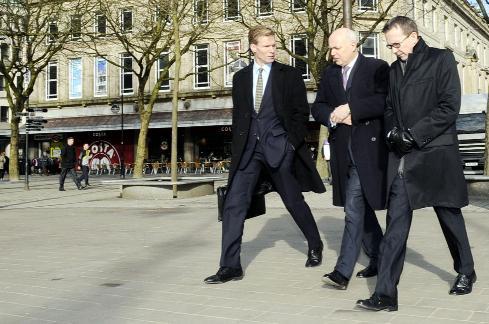
The following article which we print in full appeared in the 'Bolton Evening News' on Friday 1st March 2013.
"WORK and pensions secretary Iain Duncan Smith (pictured centre) was greeted by angry protesters and members of the public on a visit to Bolton.
The man in charge of the Government’s welfare reforms was in town yesterday on a fact fiindng secret visit to the Department of Works and Pensions building at Elizabeth House in Back Spring Gardens.
Not even the local Conservative party had been made aware of his trip, but a tip-off led to Bolton’s unions quickly organising a small group of about a dozen protesters.
They followed the former Tory Party leader from Caffe Nero in Deansgate — where he had been enjoying a coffee with two aides until 9.45am yesterday — for the 300 yards to Elizabeth House, opposite the Octagon theatre.
On his walk, a clearly uncomfortable Mr Duncan Smith was constantly heckled by the protesters, who blew whistles and shouted “he wants your bedroom” and “how many bedrooms have you got in your subsidised mansion?”
Once they became aware who he was, several members of the public joined in, including a group of teenagers.
During his walk — flanked by his two aides but no security — Mr Duncan Smith was heard to say several times “how much further?”
When The Bolton News approached Mr Duncan Smith for an interview he replied: “I’m sorry I’ve got a meeting at 10am”, and one of his aides added: “He’s very busy”.
Demonstrator Florence Hill, a retired former chairman of Bolton Unison, said: “He said ‘hello’ to me.
“I said “don’t say hello to me, you’re not welcome here”, and one of the two men with him said ‘we’re always welcome in Bolton’.”
Bill Hardman, aged 59, of Little Lever, joined the protest outside the building and had been following Mr Duncan Smith in his wheelchair. Mr Hardman, who was born with spina bifida, lost his job at Remploy in Bolton last September after working there for 33 years said: “I’m here because I know what effect this is having, not just on myself but on every disabled person, it’s absolutely frightening.”
Matt Kilsby Bolton Unison branch chairman, said “We heard it was happening and decided to contact people. Whether four people or 40 turned up didn’t matter, the message was that he was not welcome here.”
The DWP refused to comment."
Paul Preston, Tolstoy & the Fool!
Scholarly Snobbery in Professor's Attack on Orwell
WHEN last Saturday, in Manchester at the International Brigade Memorial Trust's series of lectures dedicated to the 75th anniversary of the publication of George Orwell's 'Homage to Catalonia'
I heard, yet again, Professor Paul Preston's criticisms of the book, I was reminded of George Orwell's own essay 'Lear, Tolstoy and the Fool', written towards the end of his life in March 1947, and dealing with an attack by Tolstoy, perhaps the greatest Russian writer on William Shakespeare, regarded as possibly the greatest dramatist ever. Tolstoy wrote his pamphlet 'Shakespeare and the Drama' as an introduction to another pamphlet, 'Shakespeare and the Working Classes', published around 1905 by Ernest Crosby. Orwell, in another essay 'Tolstoy & Shakespeare' (1941), wrote: 'I want to examine one of the greatest pieces of moral, non-aesthetic criticism – anti-aesthetic criticism, one might say – that have ever been written': Tolstoy's essay on Shakespeare, according to Orwell, is 'terrific attack on Shakespeare, purporting to show not only that Shakespeare was not the great man he was claimed to be, but that he was a writer entirely without merit, one of the worst and most contemptible writers the world has ever seen.'
For years, Professor Preston has similarly sought to diminish the influence of George Orwell and undermine his eye-witness accounts of the Spanish Civil War as described in the book 'Homage to Catalonia' and elsewhere by saying: 'George Orwell's Homage to Catalonia is a book which I would rank alongside Spike Milligan's “Adolf Hitler: My part in His Downfall”, another interesting book by a footsoldier who played a small part in a much wider conflict'. Preston, has previously used this silly aside, more times than I care to remember: in a lecture years ago at the Imperial War Museum; on Radio Four's 'Start the Week' with Andrew Marr; on Radio 3's 'Night Waves'; again last year in an International Brigade Memorial Trust (IBMT) talk at the People's History Museum, to mention a few of the many times over the last few years.
At last Saturday's IBMT's event at the Manchester Conference Centre Jim Jump, the IBMT Secretary, read from Professor Preston's written draft to an auditorium filled with about 300 (Prof. Preston was suffering from kidney stones and could not present his own paper), and again the old 'joke' about Orwell and Milligan was repeated together with the slight praise that the good Professor would place 'Homage to Catalonia' among his top one hundred books on the Spanish Civil War. Well the good Professor, like Tolstoy, can do a good put down, but Paul Preston is a far less skilled writer than the likes of Tolstoy or even Orwell, and despite his erudition with regard to the Spanish Civil War Preston often, it seems to me, displays a lack of grasp of the cultural anthropology of Spain and its peoples. Space won't allow me to elaborate what I mean here, but let me say that I am concerned about the contents of Chapter Two entitled 'Theorists of Extermination' in Professor Preston's recent book 'The Spanish Holocaust' that demonstrates to me that either Preston doesn't grasp the anthropology of Spanish culture and civilisation, or that he is deliberately dealing with it in a superficial way to justify his own hypothesis and his ideological standpoint.
Professor Preston challenges Orwell's 'Homage to Catalonia' on the grounds that his eye-witness account as a footsoldier in the POUM Brigade represents a view with a limited and narrow perspective. Such a participant observer, it is argued, lacks a broad understanding of the overall nature of the war and its international consequences. Thus, we are told, Orwell's first-hand reports were those of a politically naïve footsoldier who couldn't speak Catalan: Orwell, we later learn, was fairly fluent in French and was promoted precisely because this knowledge gave him an advantage in understanding the Catalans. Orwell may initially have had a limited understanding of the origins of the Spanish Civil War, but by coming fresh to the conflict he was able to get under the skin of the participants thus coming to terms with the real world events on the ground, and to then see the war in microcosm. Academic critics, like Preston, like to say this is a fundamentally distorted and perverse view because it is so narrowly defined, and some argued that it is only because of Orwell's well crafted writing that he has had so much influence with his book being far and away the best seller on the Spanish war. Timothy Garton Ash, the distinguished war journalist, has recently written that 'Homage to Catalonia' represents a 'gold standard' in war reporting which ought to be seen as a model for journalists, and Noam Chomsky while saying that it was Orwell's best book, has warned us against the snobbery of scholars and historians who affect an air of superiority when dealing with the accounts of participants in conflicts like the Spanish Civil War.
Clearly Paul Preston is not a writer of the quality of either Tolstoy or Orwell, but like Tolstoy in his treatment of Shakespeare, he has now in later life dedicated himself to debunking George Orwell's book on the Spanish Civil War. In doing so he is clearly flogging a dead horse, just as Tolstoy was with Shakespeare, for the one thing he cannot explain away is George Orwell's popularity. When he is questioned about this, we are left with the conclusion that the influence and success of Orwell's work, including 'Homage to Catalonia' is to do with the way his ideas were embraced by the Cold War Warriors in America in the 1950s. Tolstoy faced with the same problem of what he called 'the false glorification of Shakespeare', had to blame it on a conspiracy or delusion began in the 19th century owing to the machinations of certain German intellectuals like Goethe. Only Tolstoy on Shakespeare is able to see through the con-trick and grasp that he is not a simply not a genius but is 'a bad writer', and, in the same way, only Professor Preston, the 'definitive' historian on the Spanish Civil War, and a few of his cronies in academia, aren't taken in with the collective delusion that considers 'Homage to Catalonia' to be something other than a 'perverse' piece of war reportage.
I heard, yet again, Professor Paul Preston's criticisms of the book, I was reminded of George Orwell's own essay 'Lear, Tolstoy and the Fool', written towards the end of his life in March 1947, and dealing with an attack by Tolstoy, perhaps the greatest Russian writer on William Shakespeare, regarded as possibly the greatest dramatist ever. Tolstoy wrote his pamphlet 'Shakespeare and the Drama' as an introduction to another pamphlet, 'Shakespeare and the Working Classes', published around 1905 by Ernest Crosby. Orwell, in another essay 'Tolstoy & Shakespeare' (1941), wrote: 'I want to examine one of the greatest pieces of moral, non-aesthetic criticism – anti-aesthetic criticism, one might say – that have ever been written': Tolstoy's essay on Shakespeare, according to Orwell, is 'terrific attack on Shakespeare, purporting to show not only that Shakespeare was not the great man he was claimed to be, but that he was a writer entirely without merit, one of the worst and most contemptible writers the world has ever seen.'
For years, Professor Preston has similarly sought to diminish the influence of George Orwell and undermine his eye-witness accounts of the Spanish Civil War as described in the book 'Homage to Catalonia' and elsewhere by saying: 'George Orwell's Homage to Catalonia is a book which I would rank alongside Spike Milligan's “Adolf Hitler: My part in His Downfall”, another interesting book by a footsoldier who played a small part in a much wider conflict'. Preston, has previously used this silly aside, more times than I care to remember: in a lecture years ago at the Imperial War Museum; on Radio Four's 'Start the Week' with Andrew Marr; on Radio 3's 'Night Waves'; again last year in an International Brigade Memorial Trust (IBMT) talk at the People's History Museum, to mention a few of the many times over the last few years.
At last Saturday's IBMT's event at the Manchester Conference Centre Jim Jump, the IBMT Secretary, read from Professor Preston's written draft to an auditorium filled with about 300 (Prof. Preston was suffering from kidney stones and could not present his own paper), and again the old 'joke' about Orwell and Milligan was repeated together with the slight praise that the good Professor would place 'Homage to Catalonia' among his top one hundred books on the Spanish Civil War. Well the good Professor, like Tolstoy, can do a good put down, but Paul Preston is a far less skilled writer than the likes of Tolstoy or even Orwell, and despite his erudition with regard to the Spanish Civil War Preston often, it seems to me, displays a lack of grasp of the cultural anthropology of Spain and its peoples. Space won't allow me to elaborate what I mean here, but let me say that I am concerned about the contents of Chapter Two entitled 'Theorists of Extermination' in Professor Preston's recent book 'The Spanish Holocaust' that demonstrates to me that either Preston doesn't grasp the anthropology of Spanish culture and civilisation, or that he is deliberately dealing with it in a superficial way to justify his own hypothesis and his ideological standpoint.
Professor Preston challenges Orwell's 'Homage to Catalonia' on the grounds that his eye-witness account as a footsoldier in the POUM Brigade represents a view with a limited and narrow perspective. Such a participant observer, it is argued, lacks a broad understanding of the overall nature of the war and its international consequences. Thus, we are told, Orwell's first-hand reports were those of a politically naïve footsoldier who couldn't speak Catalan: Orwell, we later learn, was fairly fluent in French and was promoted precisely because this knowledge gave him an advantage in understanding the Catalans. Orwell may initially have had a limited understanding of the origins of the Spanish Civil War, but by coming fresh to the conflict he was able to get under the skin of the participants thus coming to terms with the real world events on the ground, and to then see the war in microcosm. Academic critics, like Preston, like to say this is a fundamentally distorted and perverse view because it is so narrowly defined, and some argued that it is only because of Orwell's well crafted writing that he has had so much influence with his book being far and away the best seller on the Spanish war. Timothy Garton Ash, the distinguished war journalist, has recently written that 'Homage to Catalonia' represents a 'gold standard' in war reporting which ought to be seen as a model for journalists, and Noam Chomsky while saying that it was Orwell's best book, has warned us against the snobbery of scholars and historians who affect an air of superiority when dealing with the accounts of participants in conflicts like the Spanish Civil War.
Clearly Paul Preston is not a writer of the quality of either Tolstoy or Orwell, but like Tolstoy in his treatment of Shakespeare, he has now in later life dedicated himself to debunking George Orwell's book on the Spanish Civil War. In doing so he is clearly flogging a dead horse, just as Tolstoy was with Shakespeare, for the one thing he cannot explain away is George Orwell's popularity. When he is questioned about this, we are left with the conclusion that the influence and success of Orwell's work, including 'Homage to Catalonia' is to do with the way his ideas were embraced by the Cold War Warriors in America in the 1950s. Tolstoy faced with the same problem of what he called 'the false glorification of Shakespeare', had to blame it on a conspiracy or delusion began in the 19th century owing to the machinations of certain German intellectuals like Goethe. Only Tolstoy on Shakespeare is able to see through the con-trick and grasp that he is not a simply not a genius but is 'a bad writer', and, in the same way, only Professor Preston, the 'definitive' historian on the Spanish Civil War, and a few of his cronies in academia, aren't taken in with the collective delusion that considers 'Homage to Catalonia' to be something other than a 'perverse' piece of war reportage.
Tuesday, 5 March 2013
Link4Life: The Credit Card Kids!
TOMORROW there will be an emergency Council cabinet meeting at Rochdale Town Hall to discuss a probe into the use of credit cards by the Link4Life bosses that run leisure centres, museums and art galleries in the Rochdale area for the council. Last year there were suggestions that some of the top administrators in the charity Link4Life may have been using the company credit cards for 'personal' items. It has now been found that Craig McAteer, the Link4Life managing director, had spent £2,071 on a holiday in May 2011, and it is claimed, he charged £11,598 of 'personal' items to the charity trust over a 30-month period. Mr. McAteer has since paid all this money back, but in some cases it took up to 14 months for the Link4Life charity, partly funded by tax-payers, to get the money back.
Other Link4Life bosses such as deputy manager Peter Kilkenny obtained £1,480 of 'personal' spending, including £1,030 on a bond for a flat, and finance officer David Weldon spent £991 on flights. Both are believed to have quickly paid these sums back. Mr McAteer has responded to say that he has other business costs, such as mileage costs and the use of his personal phone for work that he pays out of his own pocket. Delays in repaying 'personal' items was a consequence of his 'very busy' schedule. Mr. Kilkenny claimed that his flat bond was an agreed expense for relocation, and the difference between 'personal' and business use wasn't always clear at the moment of purchase. Mr. Weldon claimed he didn't have a personal credit card when he purchased the flights, and that he paid the money back rapidly.
The auditors have found that 'Craig McAteer, Peter Kilkenny and David Weldon all failed to observe rules about the use of credit cards which is a disciplinary matter according to Link4Life's procedures and may be subject to a range of sanctions set out in the company's disciplinary policy.'
Members of Touchstones Challenge protest group that has in the past voiced concerns about Link4Life's management of the local Rochdale museums and heritage are expected to seek to attend tomorrow's urgent meeting of the Rochdale Council cabinet looking into this matter. Debbie Firth, the Secretary of Touchstones Challenge, has said: 'In the agenda which you can find on the (Rochdale MBC) link it mentions consideration of excluding public and the press but I have been told that the public can attend so I will be turning up to see if I can get in.'
Other Link4Life bosses such as deputy manager Peter Kilkenny obtained £1,480 of 'personal' spending, including £1,030 on a bond for a flat, and finance officer David Weldon spent £991 on flights. Both are believed to have quickly paid these sums back. Mr McAteer has responded to say that he has other business costs, such as mileage costs and the use of his personal phone for work that he pays out of his own pocket. Delays in repaying 'personal' items was a consequence of his 'very busy' schedule. Mr. Kilkenny claimed that his flat bond was an agreed expense for relocation, and the difference between 'personal' and business use wasn't always clear at the moment of purchase. Mr. Weldon claimed he didn't have a personal credit card when he purchased the flights, and that he paid the money back rapidly.
The auditors have found that 'Craig McAteer, Peter Kilkenny and David Weldon all failed to observe rules about the use of credit cards which is a disciplinary matter according to Link4Life's procedures and may be subject to a range of sanctions set out in the company's disciplinary policy.'
Members of Touchstones Challenge protest group that has in the past voiced concerns about Link4Life's management of the local Rochdale museums and heritage are expected to seek to attend tomorrow's urgent meeting of the Rochdale Council cabinet looking into this matter. Debbie Firth, the Secretary of Touchstones Challenge, has said: 'In the agenda which you can find on the (Rochdale MBC) link it mentions consideration of excluding public and the press but I have been told that the public can attend so I will be turning up to see if I can get in.'
Monday, 4 March 2013
London Evening Standard Editorial
THE blacklist of individuals regarded as troublemakers that was compiled by a body called the Consulting Association and revealed by the Information Commissioners after a raid in 2009 was disturbing in itself, and calamitous for the job prospects of more than 3,000 people whose names were on it and who were sometimes given short shrift by potential employers.
But until now it has been taken as read that the blacklist chiefly affected people working in the construction industry, including trade union activists and those who raised health and safety concerns at work. Now, the GMB union says that it included the names of 200 environmental activists.
One of them is John Stewart, who has led a good deal of the opposition to the expansion of Heathrow Airport. He is respectable, retired, with no criminal convictions and a reputation as a formidable campaigner. Two years ago, he was refused entry to the US, and escorted off a plane by armed guards with no reason given. He feels now that this may be because his name appeared on the list.
If this is true, the problem becomes very disquieting indeed. It’s hard to think of anything more inimical to the modern spirit of openness and transparency than the existence of a secret blacklist circulating between employers and institutions. And if it includes people whose only offence is to hold views or conduct campaigns that some companies or institutions find troublesome, it becomes downright frightening, particularly if it affects people’s basic rights, including freedom of movement. Totalitarian regimes have secret lists of troublemakers; Britain has the Freedom of Information Act.
It is not clear whether Mr Stewart was barred from America because he was classed as a potential agitator or for some other reason; the US does not give explanations. But he should know what use was made of his data. Plainly, the Government has some way to go to reinforce a culture of openness in private industry as well as public institutions. Good citizens must be free to engage in public-spirited campaigns without fearing for their rights.
Press links:
http://www.morningstaronline.co.uk/news/content/view/full/129983
Friday, 1 March 2013
Crossrail: New Blacklist Links Emerge!
Renewed Call For Investigation
PRESSURE on Crossrail to investigate alleged blacklisting on the £15bn project has intensified after it emerged that a second figure closely associated with blacklisting organisation The Consulting Association (TCA) has a key labour role on the scheme.This week it emerged that Pat Swift, previously the human resources contact for TCA boss Ian Kerr at Bam Nuttall, is now human resources manager for Crossrail’s western tunnels contractor BFK - a joint venture comprising Bam Nuttall, Ferrovial and Kier.
The revelation emerged as former Crossrail electrician and Unite union shop steward Frank Morris began employment tribunal proceedings backed by Unite against BFK, claiming he was victimised and sacked from the project alongside other workers after raising safety concerns.
Last November, Building revealed that Crossrail’s industrial relations manager Ron Barron was an established blacklister and point of contact with TCA in his former human resources role at the contractor CB&I. Barron, who was employed by Bechtel to work on Crossrail, left his post shortly after Building’s story was published.
Labour London Assembly member, John Biggs, who tabled a motion calling on mayor Boris Johnson to provide evidence that Crossrail is free of blacklisting in January, said the “stain” of TCA demanded the mayor do more to uphold public confidence with an independent investigation. 'These allegations do not prove misdeeds but we need, on the largest publicly funded construction contract in Europe, to show that we leave no stone unturned in ensuring exemplary and proper practice,' he said.
Labour’s shadow business secretary Chuka Umunna said the latest revelation suggested that inquiries previously carried out by Crossrail had 'failed to uncover details of those engaged on the project with a history of involvement in blacklisting.'
Pat Swift declined to comment, referring inquiries to Crossrail.
A Crossrail spokesperson said it had “seen no evidence of, blacklisting of any kind” in connection with the project and wished to see any substantive evidence available. They added: 'Mr Morris is wrong to claim that he was laid off or removed from a Crossrail site for raising safety concerns. Mr Morris was employed by EIS Electrical not Crossrail Limited. A contract between our western tunnels contractor BFK and EIS Electrical ended in September 2012 as the work EIS were carrying out to commission the first two tunnel boring machines at Westbourne Park had been completed with tunnelling now under way. EIS Electrical subsequently made 28 workers redundant.'
Thursday, 28 February 2013
Police Commissioner at Rochdale Council
COMMUNITY! - COMMUNITY! -COMMUNITY!
IF we didn't already know that New Labour had made the word 'Community' fashionable, last night, after listening to Tony Lloyd the Manchester Police Commissioner addressing Rochdale Council, we would now; for he flogged the word to death along with 'building bridges' between the police and the citizens, co-operation between the criminal justice system and the public. Policing, we learned, required expertise in the areas of terrorism, organised crime and child sexual exploitation. And we mustn't forget domestic violence, for 'a woman is at the greatest risk in her own home'. He didn't say where a man is at the greatest risk, perhaps at work on a building site, but that is not a fashionable thing to say. When it comes to general current catchwords, Mr Lloyd is a master at the art.
The Rochdale Council Budget:
PERHAPS the most controversial item in the amendments to the Labour Council's Budget proposals was that in the Liberal Democrat proposal of cutting the number of Councillors from 60 to 40 and a consequent reduction in the number of local elections. This was met with derision from the Labour benches. To Labour Councillor, Liam O'Rourke, this was undemocratic in so far as less councillors would mean 'less democracy'. Yet the Mayor had earlier in this full council meeting complained about 'the decrease in public interest in local democracy' despite the number of councillors lolling on the benches in the Town Hall. There were less than half a dozen observers in the public gallery at last night's full council meeting. Councillor Alan Brett made sneering references to the Lib-Dem Party saying that with their numbers they could easily meet in a telephone box.
The issue of payment the removal of 'Council funding for Trade Union posts' (Lib-Dem) and 'withdrawal of funding provided to Trade Unions' (Tory), was raised in both the Lib-Dem and Tory Party amendments. Councillor Farnell spoke of the help from the trade unions in putting through the current cuts, and Coun. Liam O'Rourke said: 'The implementation of decisions to make redundancies were helped by our relationship to the trade unions'
Now there's a thought!
The trouble is that both the Tories and Lib-Dems point to the absurdity of the Council paying money to the trade unions to attack the council and defend their members. The reality, it seems, if we are to believe the Labour councilors, Coun. O'Rourke and Coun. Farnell, is the opposite, is that the Council-paid union bosses, presumably Unison in this case, actually seduces their own membership to accept the bitter pill of redundancies without a murmur. The issue is not perhaps that the council is foolish for paying the union bosses, so as that the council is wise in that the trade unions by taking the bosses' money are undermined in objectively pursuing the interests of their own members.
In the end the Budget proposed by the governing Labour Council was accepted, and both the Tory and Lib-Dem amendments were decisively rejected.
Wednesday, 27 February 2013
New Royal Exchange Northern Award
NEW AWARD ANNOUNCED FOR EMERGING THEATRE DIRECTORS
Details have today been announced of The Royal Exchange Theatre Hodgkiss Award - a new award for emerging theatre directors providing those with a passion for new work a significant platform to develop it.
The award is the only scheme of its kind in the north that celebrates the unique collaboration between a writer and director. It offers a theatre maker of outstanding promise the chance to direct a new piece of work – by a writer of their choice – in a production fully supported by the Royal Exchange Theatre, Manchester in 2014.
Actor Christopher Eccleston and award-winning playwright, Rona Munro will be joined by Bush Theatre Artistic Director, Madani Younis and Artistic Director of the Royal Exchange Theatre, Sarah Frankcom on the judging panel. Also on the panel will be Sue Hodgkiss, local business woman and philanthropist, whose support has made this inaugural award possible.
Applications can be submitted online from Monday 8 April until Saturday 18 May. Five candidates will be shortlisted and will be asked to attend an interview and work-sharing day on Saturday 29th June at the Royal Exchange Theatre. The successful Director will be announced at 7pm that evening.
Royal Exchange Theatre Artistic Director Sarah Frankcom said: 'The creation of new work and the collaboration between the director and writer is at the heart of the theatre-making process. The Royal Exchange Theatre is excited by the potential of this award to introduce new voices, explore new ways of making work collaboratively and engage with the modern world.'
Judging panel member Madani Younis said: “I’m delighted to have been asked to be one of the judges for the inaugural Royal Exchange Hodgkiss Emerging Directors Award. The Award offers a unique opportunity for theatre-makers to be bold and imaginative and potentially to work with the Royal Exchange Theatre and I am looking forward to joining my fellow judges in discovering and supporting new theatre-makers.'
Details have today been announced of The Royal Exchange Theatre Hodgkiss Award - a new award for emerging theatre directors providing those with a passion for new work a significant platform to develop it.
The award is the only scheme of its kind in the north that celebrates the unique collaboration between a writer and director. It offers a theatre maker of outstanding promise the chance to direct a new piece of work – by a writer of their choice – in a production fully supported by the Royal Exchange Theatre, Manchester in 2014.
Actor Christopher Eccleston and award-winning playwright, Rona Munro will be joined by Bush Theatre Artistic Director, Madani Younis and Artistic Director of the Royal Exchange Theatre, Sarah Frankcom on the judging panel. Also on the panel will be Sue Hodgkiss, local business woman and philanthropist, whose support has made this inaugural award possible.
Applications can be submitted online from Monday 8 April until Saturday 18 May. Five candidates will be shortlisted and will be asked to attend an interview and work-sharing day on Saturday 29th June at the Royal Exchange Theatre. The successful Director will be announced at 7pm that evening.
Royal Exchange Theatre Artistic Director Sarah Frankcom said: 'The creation of new work and the collaboration between the director and writer is at the heart of the theatre-making process. The Royal Exchange Theatre is excited by the potential of this award to introduce new voices, explore new ways of making work collaboratively and engage with the modern world.'
Judging panel member Madani Younis said: “I’m delighted to have been asked to be one of the judges for the inaugural Royal Exchange Hodgkiss Emerging Directors Award. The Award offers a unique opportunity for theatre-makers to be bold and imaginative and potentially to work with the Royal Exchange Theatre and I am looking forward to joining my fellow judges in discovering and supporting new theatre-makers.'
Trade Union Activist Condemns libcom website
BECAUSE the readership of the NV Blog is a broad Church, with viewers from many different political persuasions, it may be necessary to explain who Dave Douglass is, and outline his standing with regard to the trade union and anarchist-left. His activist record in politics goes back to the 1960s and he played a major part in the Miners' Strikes both in the 1970s and 1980s. He has written extensively on these strikes and industrial matters in the last half of the 20th Century. He held positions in both the National Union of Miners (NUM) and later in the Transport & General Workers' Union (now Unite the Union). I have known him since the strikes of engineering apprentices in the 1960s. He has always described himself as an anarchist.
Dave Douglass has historical knowledge of the attempts to blackball Northern Voices and the NAN, and he refused to accept an invite to attend the Manchester Anarchist Bookfair in 2011, when he found out that the organisers 'David' and Sally were banning both the NAN and Northern Voices. He also has had a first-hand account of what happened at the London Anarchist Bookfair in 2012, because one of closest mates was working on the next stall to the NAN/ Northern Voices stall when the members of the Anarchist Federation (AF) first threatened the stall-holder if he didn't clear off, and then half-an-hour later launched their attack to enforce departure.
Dave's comments below are a response to a thread/ post and series of comments published on the anarchist website, libcom, on the 21st, February. He forwarded this to Northern Voices because he fears that the editors at libcom may delete it. Last night, a member of the NV Editorial Panel examined the libcom site and could not find Dave's account. An AF groupie, Spiky Mike, had asked for the NAN thread to be taken down.
"How a so called 'libetarian' website can host such vulgar proto-racialist anti working class spew is frankly beyond me. It reminds me of the young Conservative conference social during the miners strike of 84/5 when all those chinless upper class twits sat round singing about miners families having only 'half half a hamster' for our xmas dinners. The deeply felt hatred of the traditional working class in general and northern working class in particular engendered in these comments is palpable. Needless to say it is also factually totally incorrect. Members of the AF did not 'disassociate themselves' from comments made by Comrade Bamford in the Northern Voices mag, they physically attacked him, overturned the bookstall, and stole books . Prior to this they had brought about a ban on display and sale of NAN literature and bookstall at Manchester Anarchist Book fare and subsequently censored an individual member, abusing him and forcing him firstly not to be allowed to speak and secondly to leave the building. They campaigned against all radical bookshops selling NAN literature and attempted to stop the printers printing it. That is not' simply disassociating 'yourself a long anarchist tradition, that is sectarian violence, and silencing opposition, a long fascist tradition. AF must in fact disassociate itself from these sectarian attacks and allow freedom of thought and speech and publication for any section of the movement. What sort of vision for a future society does it present if we all have to conform to one particular view of the world and the people in it ?"
Emergency Motion for North West TUC Conference in March 2013
Emergency Motion for North West TUC Conference 2013:
Title: Blacklisting in the Construction industry
IN March 2009, the offices of the Consulting Association were raided by staff acting on behalf of the Information Commissioner's Office (ICO). Documentation discovered on the premises included a blacklist containing the names of over 3,000 construction workers. This illegal data base contained personal information about (inter alia) the trade union and political activities of building workers.
Conference notes that this data-base also included personal details of environmental activists, MPs, journalists and academics, as well as details about their families and other interests. Conference also notes, that information provided on these files was, according to David Clancy, Special Investigator for the ICO, provided by the police and security services.
The Consulting Association was set up and run on behalf of at least 44 major construction companies; including Sir Robert McAlpine; Carillion; Balfour Beatty. Many of these companies paid both an affiliation fee, a fee for each name they requested to be monitored, and provided supplementary information on trade union activists and other workers in their employ.
Though many of these companies have been exposed for their links to the Consulting Association, they continue to receive tax-payer funded public sector contracts: for example Tameside MBC has handed over lucrative contracts to Carillion to maintain and manage their properties.
Conversely in January 2013, Hull City Council took the decision to refuse to award public contracts to the 44 construction firms who were implicated with the secretive blacklisting organisation: The Consulting Association. More recently Knowsley MBC and Tower Hamlets MBC have done the same, and Harlow MBC are reported to be considering their position with this regard.
Recent reports in the national press and other media have disclosed that blacklisting had been taking place on Crossrail and Olympic projects. Conference consequently calls upon the TUC:
i. To support demands for a full investigation/ public inquiry into blacklisting, both past and present, and into the intimate involvement of both the police and security services in these iniquitous practices.
ii. To draw up a list of local authorities who are awarding contracts to blacklisters like Carillion, and to try to get them to award publicly funded contracts to companies that are not among the 44 companies that were affiliated to the Consulting Association.
Produced by Tameside TUC & Greater Manchester Contracting Branch for Greater Manchester County Association TUCs' 'Emergency Motion'.
Title: Blacklisting in the Construction industry
IN March 2009, the offices of the Consulting Association were raided by staff acting on behalf of the Information Commissioner's Office (ICO). Documentation discovered on the premises included a blacklist containing the names of over 3,000 construction workers. This illegal data base contained personal information about (inter alia) the trade union and political activities of building workers.
Conference notes that this data-base also included personal details of environmental activists, MPs, journalists and academics, as well as details about their families and other interests. Conference also notes, that information provided on these files was, according to David Clancy, Special Investigator for the ICO, provided by the police and security services.
The Consulting Association was set up and run on behalf of at least 44 major construction companies; including Sir Robert McAlpine; Carillion; Balfour Beatty. Many of these companies paid both an affiliation fee, a fee for each name they requested to be monitored, and provided supplementary information on trade union activists and other workers in their employ.
Though many of these companies have been exposed for their links to the Consulting Association, they continue to receive tax-payer funded public sector contracts: for example Tameside MBC has handed over lucrative contracts to Carillion to maintain and manage their properties.
Conversely in January 2013, Hull City Council took the decision to refuse to award public contracts to the 44 construction firms who were implicated with the secretive blacklisting organisation: The Consulting Association. More recently Knowsley MBC and Tower Hamlets MBC have done the same, and Harlow MBC are reported to be considering their position with this regard.
Recent reports in the national press and other media have disclosed that blacklisting had been taking place on Crossrail and Olympic projects. Conference consequently calls upon the TUC:
i. To support demands for a full investigation/ public inquiry into blacklisting, both past and present, and into the intimate involvement of both the police and security services in these iniquitous practices.
ii. To draw up a list of local authorities who are awarding contracts to blacklisters like Carillion, and to try to get them to award publicly funded contracts to companies that are not among the 44 companies that were affiliated to the Consulting Association.
Produced by Tameside TUC & Greater Manchester Contracting Branch for Greater Manchester County Association TUCs' 'Emergency Motion'.
Homage to Catalonia & George Orwell Lecture
International Brigade Memorial Trust.
Reg. Charity No: 1094928
www.international-brigades.org.uk
LEN CROME MEMORIAL LECTURE
Saturday 2nd March, 2013
George Orwell: Homage to Catalonia: 75 Years On
Venue: Manchester Conference Centre and Hotel
Sackville Street, Manchester M1 3BB
www.manchesterconferencecentre.co.uk
Registration: 10 am – 10.30 am
Lectures: 11 am – 5 pm
Speakers: Dr Richard Baxell, Dr Tom Buchanan, Christopher Hall,
Professor Paul Preston, Chair: Professor Mary Vincent
BOOKING FORM
Name:
FULL CONFERENCE FEES
1. (Please circle one of the four options and include appropriate fee)
Conference fee: £10
2. Conference fee/refreshments/lunch: £25
STUDENT CONCESSION
3. Conference fee: £5 or £10 on the day
4. Conference fee/refreshments/lunch: £20
Pre-booking for lunch is essential. Deadline: 31st January, 2013
Payment: Cheques payable to: IBMT
Please send payment, together with this booking form to:
Charles Jepson, Treasurer, Aysgaard, Beardwood Brow, Blackburn, BB2 7AT
For further information contact:
Hilary Jones: hilary.m.jones@btinternet.comhilary.m.jones@btinternet.com (0161 224 1747)
Dolores Long: doloreslong@fastmail.fmdoloreslong@fastmail.fm (0161 226 2013)
Reg. Charity No: 1094928
www.international-brigades.org.uk
LEN CROME MEMORIAL LECTURE
Saturday 2nd March, 2013
George Orwell: Homage to Catalonia: 75 Years On
Venue: Manchester Conference Centre and Hotel
Sackville Street, Manchester M1 3BB
www.manchesterconferencecentre.co.uk
Registration: 10 am – 10.30 am
Lectures: 11 am – 5 pm
Speakers: Dr Richard Baxell, Dr Tom Buchanan, Christopher Hall,
Professor Paul Preston, Chair: Professor Mary Vincent
BOOKING FORM
Name:
FULL CONFERENCE FEES
1. (Please circle one of the four options and include appropriate fee)
Conference fee: £10
2. Conference fee/refreshments/lunch: £25
STUDENT CONCESSION
3. Conference fee: £5 or £10 on the day
4. Conference fee/refreshments/lunch: £20
Pre-booking for lunch is essential. Deadline: 31st January, 2013
Payment: Cheques payable to: IBMT
Please send payment, together with this booking form to:
Charles Jepson, Treasurer, Aysgaard, Beardwood Brow, Blackburn, BB2 7AT
For further information contact:
Hilary Jones: hilary.m.jones@btinternet.comhilary.m.jones@btinternet.com (0161 224 1747)
Dolores Long: doloreslong@fastmail.fmdoloreslong@fastmail.fm (0161 226 2013)
Tuesday, 26 February 2013
What's on? Looking at the local music scene: Number 71 Bar, Stalybridge!
On Friday night, I called into the Number 71 Bar on Mottram Road, Stalybridge, to watch the Alex Mckown band. The venue was formerly the Mottram Road, No1 Conservative club. About two years ago, it was transformed into a snooker and sports lounge and there are live concerts every Friday, when admission is free. Concerts and functions also take place on Saturday's, but these are ticket events only.
Alex McKown's first gig was at "The Moon and Sixpence" in Glossop in 2008. The 17 year old, who comes from Glossop, first started to play the guitar when he was six years old but started guitar lessons at Tameside Music Academy, when he was eleven years of age.
Since his first gig in 2008, McKown has acquired something of a reputation for being a guitar prodigy and has performed with his own band at the 'Great British Rythm and Blues Festival' in Colne in 2009, the 'Newark Blues Festival' and the 'Ramsbottom Blues Festival'. In 2011, he was nominated for the British Blues Award.
Whether or not Mckown is a guitar prodigy, is questionable, but he's certainly a good blues guitarist. When watching him and his band perform on Friday night, I was not disappointed. Playing second lead guitar with McKown, was Tony Auton, of the Cheyenne social club.
The band played a set list which comprised their own songs from their CD's as well as covers including a song by Billy Preston and 'Texas Flood', by Stevie Ray Vaughan (SRV). Many guitarist would have given this song a wide birth, simply because it is notoriously difficult to play well, because SRV was a guitar prodigy, and possibly one of the best blues guitarists of all time. Nevertheless, I enjoyed Mckown's version of it and enjoyed listening to the band. For a lad aged 17 years old, he's got a lot of talent as a blues guitarist, and he's certainly worth watching.
In April, Steve Whalley, - who played with Slade II replacing Noddy Holder - will be performing at the same venue. Whalley originates from Stalybridge but moved down south many years ago. He was lead singer and guitarist with the Stalybridge band the Puritans and also played with Greasy Bear who were regular performers at the legendary 'Magic Village' in Manchester. For further details contact the Number 71 Bar.
Carillion Accused on Human Rights Violations
TROUBLED construction giant Carillion face more allegations of human rights violations as part of the construction industry blacklisting scandal in a court case to be heard at the Employment Appeal Tribunal in Blackfriars on 12:00 Tuesday 26th Feb. If successful, the case would significantly extend the of the influence of the Human Rights Act remit into the area of employment law.
Case Reference: D.R. Smith v (1) Carillion, (2) Carillion (JM) Ltd. (3) Schal International Managemen Ltd.
The human rights claims are made by engineer Dave Smith who was repeatedly dismissed and refused work once his name appeared on the illegal Consulting Association blacklist after he had raised concerns about asbestos, poor toilet facilities and contaminated waste on London and Essex building sites controlled by companies in the Carilion Group. Mr Smith is one of thousands of blacklisted construction workers who discovered he was on the construction blacklist for being a member of a trade union. Mr. Smith's blacklist file runs to 36 pages and includes his name, address, date of birth, NI number, car registration full works history, photographs and copies of his safety reps accreditation with the Schal office stamp on it.
Carillion are to be grilled by MPs when they are called to give evidence to the Scottish Affairs Select Committee investigation into blacklisting in employment. The Select Committee has already heard evidence that Frank Duggan (ex-Group Personell Director for CarillionPLC), Liz Keates (current Head of HR at Carillion Health) and John Ball (ex-Head of HR at Carillion PLC) were all at various times the “main contact” between Carillion and the Consulting Association.
Mr Smith's file is only one of hundreds of files with entries referring to firms in the Carillion group including John Mowlem now trading as Carillion (JM) Ltd and Carillion's in house employment agency Sky Blue. The GMB union estimate that from October 1999 to April 2004 that Carillion checked at least 14,724 names, making the firm one of the bigger users of the blacklist at the time. Invoices and salesbook records show that Carillion paid £37,814.72 to the Consulting Association between 1999 and 2006 and its managers were still attending at meetings as late as 2008.
Mr. Smith's test-case Employment Tribunal in January 2012 gained notoriety when the companies admitted in court to blacklisting him because he was a trade union safety representative on their building sites but he still lost the case on the legal technicality that he was not directly employed by the companies but via an employment agency.
John Hendy QC will argue that case should be allowed to continue to the next stage of the legal process because the original ET decision is in violation of the Human Rights Act and the European Convention on Human Rights - Article 8 (the right to privacy) and Article 11 (the right to freedom of association). Human rights are supposed to apply to "everyone" but in UK employment law, apparently they only apply to direct employees. Mr Smith's legal team is arguing that existing UK law should be interpreted in such a way as to uphold human rights and therefore the tribunal should extend the legal protection to all "workers" and not just direct employees.
Dave Smith said:
'I am taking this claim to highlight a major human rights scandal. Honest trade union members were blacklisted for nothing more than raising concerns about safety issues or unpaid wages. It is not illegal to be a member of a trade union - but it is illegal for big business to systematically breach an individuals human rights. Carillion are a multi-national corporation and seem to think they are above the law. For many years they played an active role in this secret conspiracy that MPs have described as a "National Scandal". Blacklisted workers will continue to expose Carillion and the other blacklisting firms until we get the justice we deserve.'
Carillion is already facing legal claims for corruption, bullying and racism by nearly 100 Swindon Hospital workers represented by the GMB union. It is believed that Carillion has lost publicly funded contracts with local authorities because of the fall-out from the blacklisting scandal.
Case Reference: D.R. Smith v (1) Carillion, (2) Carillion (JM) Ltd. (3) Schal International Managemen Ltd.
The human rights claims are made by engineer Dave Smith who was repeatedly dismissed and refused work once his name appeared on the illegal Consulting Association blacklist after he had raised concerns about asbestos, poor toilet facilities and contaminated waste on London and Essex building sites controlled by companies in the Carilion Group. Mr Smith is one of thousands of blacklisted construction workers who discovered he was on the construction blacklist for being a member of a trade union. Mr. Smith's blacklist file runs to 36 pages and includes his name, address, date of birth, NI number, car registration full works history, photographs and copies of his safety reps accreditation with the Schal office stamp on it.
Carillion are to be grilled by MPs when they are called to give evidence to the Scottish Affairs Select Committee investigation into blacklisting in employment. The Select Committee has already heard evidence that Frank Duggan (ex-Group Personell Director for CarillionPLC), Liz Keates (current Head of HR at Carillion Health) and John Ball (ex-Head of HR at Carillion PLC) were all at various times the “main contact” between Carillion and the Consulting Association.
Mr Smith's file is only one of hundreds of files with entries referring to firms in the Carillion group including John Mowlem now trading as Carillion (JM) Ltd and Carillion's in house employment agency Sky Blue. The GMB union estimate that from October 1999 to April 2004 that Carillion checked at least 14,724 names, making the firm one of the bigger users of the blacklist at the time. Invoices and salesbook records show that Carillion paid £37,814.72 to the Consulting Association between 1999 and 2006 and its managers were still attending at meetings as late as 2008.
Mr. Smith's test-case Employment Tribunal in January 2012 gained notoriety when the companies admitted in court to blacklisting him because he was a trade union safety representative on their building sites but he still lost the case on the legal technicality that he was not directly employed by the companies but via an employment agency.
John Hendy QC will argue that case should be allowed to continue to the next stage of the legal process because the original ET decision is in violation of the Human Rights Act and the European Convention on Human Rights - Article 8 (the right to privacy) and Article 11 (the right to freedom of association). Human rights are supposed to apply to "everyone" but in UK employment law, apparently they only apply to direct employees. Mr Smith's legal team is arguing that existing UK law should be interpreted in such a way as to uphold human rights and therefore the tribunal should extend the legal protection to all "workers" and not just direct employees.
Dave Smith said:
'I am taking this claim to highlight a major human rights scandal. Honest trade union members were blacklisted for nothing more than raising concerns about safety issues or unpaid wages. It is not illegal to be a member of a trade union - but it is illegal for big business to systematically breach an individuals human rights. Carillion are a multi-national corporation and seem to think they are above the law. For many years they played an active role in this secret conspiracy that MPs have described as a "National Scandal". Blacklisted workers will continue to expose Carillion and the other blacklisting firms until we get the justice we deserve.'
Carillion is already facing legal claims for corruption, bullying and racism by nearly 100 Swindon Hospital workers represented by the GMB union. It is believed that Carillion has lost publicly funded contracts with local authorities because of the fall-out from the blacklisting scandal.
Friday, 22 February 2013
Rochdale's Spodden Valley & Asbestos Threat
LAST Friday, the abandoned asbestos factory, formerly Turner Brothers, was set on fire in the early hours. In tomorrows Rochdale Observer the head of planning on Rochdale Council said: 'The fire has now potentially made the site subject to action under thew Building Acts.' It seems,according to Mr Rowlingson that because of the risk of asbestos polluting the surrounding area, the council 'could protect the building and could then seek to recover its costs from the owner.'
The site is now owned by Renshaw Properties Ltd., a British Virgin Isles registered company, owned by two family trusts, for which the Jersey-based Hawksford acts as trustees. The cost to clean up the site has been put at £17m.
We are certainly missing Jason Addy now, and his campaign organisation, the Spodden Valley group. Mr. Addy who got married last year and moved to Clitheroe, had for over ten years led a campaign to clean up Spodden Valley where the Turners Brothers site is.
The site is now owned by Renshaw Properties Ltd., a British Virgin Isles registered company, owned by two family trusts, for which the Jersey-based Hawksford acts as trustees. The cost to clean up the site has been put at £17m.
We are certainly missing Jason Addy now, and his campaign organisation, the Spodden Valley group. Mr. Addy who got married last year and moved to Clitheroe, had for over ten years led a campaign to clean up Spodden Valley where the Turners Brothers site is.
Met. Police Inquiry into building site Blacklist

Shadow business secretary Chuka Umunna, who led a Commons debate on blacklisting last month, welcomed the Met's decision. Photograph: BBC/PA
_________________________________________________________
Move reverses earlier decision not investigate claims of Met police involvement in compiling 3,200-name blacklist
THE Metropolitan police have launched an investigation into allegations of collusion in the blacklisting of construction workers. Officers are alleged to have handed information on individual workers to the blacklist, keeping thousands of builders and electricians out of work and driving some into long-term destitution. This month it emerged that the Met had dismissed a complaint from the Blacklisting Support Group which claimed police involvement in compiling the 3,200-name list that came to light in 2009. After growing concern among politicians and union leaders, however, the decision has been overturned and the force confirmed on Thursday that an inquiry was under way. 'An investigation is now being carried out under the supervision of the Independent Police Complaints Commission,' the Met said, and 'it would not be appropriate for us to comment further at this time.'
The information commissioner's office said last year that some of the content on the blacklist could only have come from the police or security services. The files were collected by the Consulting Association, a clandestine organisation funded by major names in the construction industry.
Dave Smith, the leader of the Blacklist Support Group, welcomed the announcement, telling Building magazine: 'There are entries on some blacklist files that are surveillance reports about anti-racism demonstrations that took place nowhere near a building site. We have other evidence to suggest that this information was compiled by undercover police officers. There are entries on other blacklist files that contain private, sensitive information that has never been in the public domain and that no manager or director of a building firm would ever have access to.'
The shadow business secretary, Chuka Umunna, who last month led a debate in the Commons on blacklisting, welcomed the police investigation as a positive step in getting to the 'full truth'.
He said: 'Serious allegations that some information on blacklist files came from members of the police and security services … need to be looked into fully as part of getting to the bottom of the blacklisting scandal.'
Sarah McSherry, a partner at Christian Khan solicitors, the firm representing the Blacklist Support Group, called for the investigation to be handled entirely by the IPCC given the Met's decision to "non-record" the original complaint last November. She said: 'We will be making further representations to the IPCC that, given their deplorable lack of knowledge of the Police Reform Act and the seriousness of the allegations of widespread corruption and criminal behaviour on the part of Metropolitan police officers, the [Met's Directorate of Professional Standards] DPS should have no involvement in the investigation of this complaint, which should be the subject of an independent investigation by the IPCC.'
Unite welcomed the news of the IPCC investigation into blacklisting. Unite's assistant general secretary Gail Cartmail said: 'What more evidence does Vince Cable and this government need that there needs to be a full "Leveson"style inquiry into blacklisting. There needs to be a full and transparent investigation, backed by statutory powers, into all the allegations associated with the sordid spying enterprise called the Consulting Association (CA). The Business Secretary must immediately make plans to put in law genuine protections against blacklisting conspiracies. This should include making blacklisting a criminal offence up to and including imprisonment for the culprits.'
From The Guardian, Thursday 21 February 2013 17.28 GMT
Blacklist Support Group:
video: www.youtube.com/watch?v=eRB9DjmhBHg
blog: www.hazards.org/blacklistblog
facebook: http://www.facebook.com/groups/blacklistSG/
Blacklisting & Special Branch
Claims by blacklisted workers that information on some of the Consulting Association blacklist files emanate from undercover police officers are to be investigated as part of Operation Herne, an ongoing investigation into the activities of the Special Demonstration Squad, a deep undercover section of Special Branch. The investigation into police collusion with blacklisting has been set up after a complaint was submitted by the Blacklist Support Group (BSG). The Metropolitan Police originally refused to investigate the BSG complaint but was forced into a U-turn after a successful appeal to the Independent Police Complaints Commission (IPCC) by Christian Khan solicitors.
Sarah McSherry - partner at Christian Khan said:
'The IPCC’s decision to uphold our clients’ appeal and require the Metropolitan Police Service Directorate of Professional Standards (DPS) to record their complaint is in stark contrast to the DPS’ original view that “the complaints process is not the correct vehicle to forward their concerns or allegations. We will be making further representations to the IPCC that, given the seriousness of the allegations of widespread corruption and criminal behaviour on the part of Metropolitan Police officers, the DPS should have no involvement in the investigation of this complaint which should be the subject of an independent investigation.'
The issue first came to light in January 2012 when David Clancy (head of investigations at the ICO and himself an ex-police officer) gave evidence to an Employment Tribunal that 'information on some of the blacklist files could only have come from the police or the security services.' Mr. Clancy repeated the assertion when giving evidence to the Scottish Affairs Select Committee investigation into blacklisting.
The involvement of police or security services in the blacklisting of trade unionists has been raised in parliament by shadow Employment Minister Ian Murray MP and Labour's John McDonnell MP and Michael Meacher MP have both demanded a full Leverson style Public Inquiry, a call which is supported by the TUC and all the major trade unions.
In addition, Ian Kerr (the now deceased Chief Executive of the Consulting Association) told The Times about a meeting in 2008 where 8 construction industry directors were addressed by a "key officer" of a police organization - the National Extremism Tactical Co-Ordination Unit (NETCU) and agreed a two way sharing of information.
Only this week it was disclosed that the names of over 200 environmental activists also appear on the Consulting Association blacklist - which make claims about the involvement of undercover police officers even more credible.
Dave Smith - Blacklist Support Group:
'There are entries on some blacklist files that are detailed surveillance reports about anti-racism demonstrations that took place nowhere near a building site. We already have other evidence to suggest that this information was compiled by undercover police officers. There are entries on other blacklist files that contain private sensitive information that has never been in the public domain and that no manager or Director of a building firm would ever have access to. It is difficult to conceive of any possible way this information could appear on the construction blacklist without the police, security services or some other arm of the state being the original source. Undercover police and big business spying on trade unionists and anti-racism campaigners - where are we living: Nazi Germany? Apartheid South Africa? We want to know why information collected by the police has ended up on a secret blacklist of trade unionists operated by multi-national companies. If police collusion is proven, at best it is individual corruption. At worst it is systematic state involvement in a major human rights conspiracy.'
Plus Sarah McSherry and Roy Bentham just did a great interview on Radio 5 Live with Sarah Derbyshire
http://www.guardian.co.uk/uk/2013/feb/21/met-police-inquiry-construction-worker-blacklist
Sarah McSherry - partner at Christian Khan said:
'The IPCC’s decision to uphold our clients’ appeal and require the Metropolitan Police Service Directorate of Professional Standards (DPS) to record their complaint is in stark contrast to the DPS’ original view that “the complaints process is not the correct vehicle to forward their concerns or allegations. We will be making further representations to the IPCC that, given the seriousness of the allegations of widespread corruption and criminal behaviour on the part of Metropolitan Police officers, the DPS should have no involvement in the investigation of this complaint which should be the subject of an independent investigation.'
The issue first came to light in January 2012 when David Clancy (head of investigations at the ICO and himself an ex-police officer) gave evidence to an Employment Tribunal that 'information on some of the blacklist files could only have come from the police or the security services.' Mr. Clancy repeated the assertion when giving evidence to the Scottish Affairs Select Committee investigation into blacklisting.
The involvement of police or security services in the blacklisting of trade unionists has been raised in parliament by shadow Employment Minister Ian Murray MP and Labour's John McDonnell MP and Michael Meacher MP have both demanded a full Leverson style Public Inquiry, a call which is supported by the TUC and all the major trade unions.
In addition, Ian Kerr (the now deceased Chief Executive of the Consulting Association) told The Times about a meeting in 2008 where 8 construction industry directors were addressed by a "key officer" of a police organization - the National Extremism Tactical Co-Ordination Unit (NETCU) and agreed a two way sharing of information.
Only this week it was disclosed that the names of over 200 environmental activists also appear on the Consulting Association blacklist - which make claims about the involvement of undercover police officers even more credible.
Dave Smith - Blacklist Support Group:
'There are entries on some blacklist files that are detailed surveillance reports about anti-racism demonstrations that took place nowhere near a building site. We already have other evidence to suggest that this information was compiled by undercover police officers. There are entries on other blacklist files that contain private sensitive information that has never been in the public domain and that no manager or Director of a building firm would ever have access to. It is difficult to conceive of any possible way this information could appear on the construction blacklist without the police, security services or some other arm of the state being the original source. Undercover police and big business spying on trade unionists and anti-racism campaigners - where are we living: Nazi Germany? Apartheid South Africa? We want to know why information collected by the police has ended up on a secret blacklist of trade unionists operated by multi-national companies. If police collusion is proven, at best it is individual corruption. At worst it is systematic state involvement in a major human rights conspiracy.'
Plus Sarah McSherry and Roy Bentham just did a great interview on Radio 5 Live with Sarah Derbyshire
http://www.guardian.co.uk/uk/2013/feb/21/met-police-inquiry-construction-worker-blacklist
Subscribe to:
Posts (Atom)

 Posts
Posts


